SEO Content Strategy for SaaS (2025): A Practitioner’s Playbook

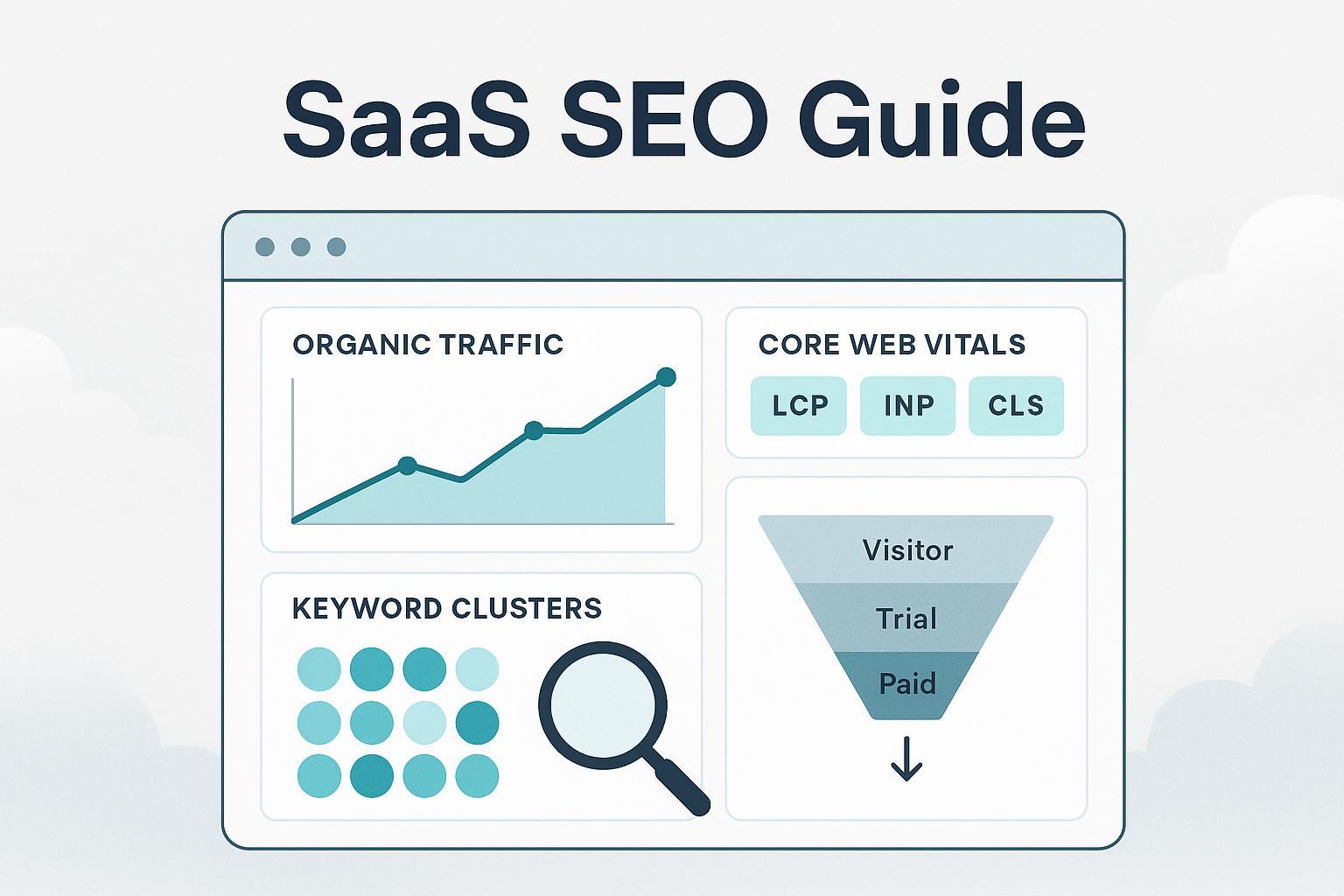
If your SaaS growth plan still treats “traffic” as the goal, you’re leaving pipeline on the table. The bar moved: Google elevated helpfulness, tightened spam enforcement, and replaced FID with INP in Core Web Vitals. Here’s the deal—what wins in 2025 is a tight loop between buyer-intent content, technical excellence (especially for JS-heavy sites), and measurement that your CFO actually trusts.
1) Strategy first: map buyer intent to revenue
A durable SaaS SEO strategy starts with intent, not keywords. Define your journey and attach content to how buyers evaluate software—not how marketers wish they did.
- Awareness: problems, frameworks, and definitions.
- Consideration: comparisons, alternatives, use cases, integrations.
- Decision: pricing, demos, security, implementation, proof.
Create a simple scoring model for topics: revenue proximity (high/med/low), competitive gap (easy/moderate/hard), and proof assets available (case studies, screenshots, benchmarks). Prioritize anything with clear commercial intent and frictionless handoffs to conversion surfaces (trial, demo, sales chat). For readers new to SaaS SEO fundamentals, this overview explains core concepts and 2025 context well in the “What Is SaaS SEO? Guide & Strategies for 2025” by TripleDart.
Sample pillar-to-intent map
| Pillar (Topical hub) | Buyer Stage | Cluster Pages | Primary CTA |
|---|---|---|---|
| “CRM for SMBs” | Consideration | “Best CRM for agencies,” “CRM alternatives to X,” “CRM for real estate,” “CRM integrations (Gmail, Slack)” | Compare plans + Book demo |
| “Data security in SaaS” | Awareness → Decision | “SOC 2 vs ISO 27001,” “What is SSO,” “SaaS data residency,” “Security checklist for SaaS buyers” | Security one-pager + Talk to security |
| “Onboarding & adoption” | Consideration | “How to improve time-to-value,” “User rollout plan,” “Admin training templates” | Start trial + Implementation guide |
Think of it this way: every cluster page should either qualify the reader forward or disqualify quickly and politely.
2) Topic clusters that win: architecture and internal links
Pillars establish authority; clusters capture intent variety. Build one comprehensive pillar per core job-to-be-done, then connect 6–12 focused cluster pages. Use descriptive anchors in-body, not just breadcrumbs. Link “sideways” across clusters to mirror real evaluation: from “CRM for agencies” to “Security checklist” to “Pricing”—that’s how buyers actually think.
On-page, answer the primary query in the first 150–200 words. Add a concise FAQ that targets related questions you see in Search Console and sales calls. Use comparison tables, annotated screenshots, and short how-to steps. These patterns help both human evaluators and answer engines select your page for clear, quotable snippets.
3) Technical SEO that actually sticks for SaaS sites
SaaS sites are often SPAs or hybrid-rendered apps with complex docs and pricing logic. You need search-friendly rendering, fast interactions, and clean indexation.
-
Rendering and routing. Prefer SSR/SSG for index-critical routes (home, features, pricing, docs landing) and use semantic, clean URLs with the History API. Validate final rendered HTML with URL Inspection in Search Console. Google’s JavaScript guidance remains your north star; start with the JavaScript SEO basics for crawl/render considerations.
-
Core Web Vitals. 2025 thresholds remain LCP < 2.5s, INP < 200 ms, CLS < 0.1. Focus on code-splitting, deferring non-critical JS, image optimization, and reserving space to prevent layout shifts. See the thresholds and remediation concepts summarized under Web Vitals.
-
Structured data and docs hygiene. Use JSON-LD for Organization, Product, FAQ, and Article where appropriate. For docs/KB: ensure unique titles/H1s, stable versioning, canonicalization between versions, and sensible nav to avoid orphaned content. Run the Rich Results Test before deploys.
-
Index controls. Keep robots.txt tight, eliminate parameter bloat, and set canonical URLs to consolidate variants. For multi-language or regions, implement reciprocal hreflang and an x-default.
4) AI/LLM era optimization—without the hype
What does Google actually recommend for AI Overviews? There’s no special markup; eligibility follows standard practices. The official guidance in Google’s “AI features and your website” reiterates that helpful, reliable content and clear structure win. So: craft precise question-and-answer sections, add succinct definitions near the top, include compact tables where helpful, and keep your clusters tight.
Will AI Overviews tank your CTR? Evidence is mixed across niches. What you can control is being the clearest source on specific, evaluative queries—and pairing that content with compelling, friction-light CTAs.
5) Programmatic SEO, the safe way
Programmatic can accelerate SaaS growth when each page serves a distinct, human-valuable intent—think integrations, industry templates, or solution blueprints. The line to avoid is scaled, near-duplicate pages whose sole purpose is manipulation. Google’s March 2024 update folded “helpful content” into core signals and sharpened spam enforcement; doorway-like patterns are risk-prone according to Google’s March 2024 core update and spam policies.
Programmatic governance checklist
- Define uniqueness criteria (data, examples, screenshots) per page type.
- Enrich at scale with FAQs, user quotes, and real setup steps.
- Enforce hub-and-spoke linking; prevent orphan pages.
- Set de-duplication rules; merge thin variants into comprehensive hubs.
- Review sample pages weekly for quality drift.
- Track assist metrics (time-to-value, activation) not just clicks.
6) International, accessibility, and privacy-first analytics
International SEO. Choose a consistent architecture (subfolders recommended for most SaaS), implement reciprocal hreflang (include x-default), localize examples and pricing, and earn local references. Keep language-country pairs stable across releases.
Accessibility (WCAG 2.2). Aim for AA: semantic HTML, ARIA where needed, keyboard-friendly nav, visible focus states, and alt text for all non-decorative images. Audit with Lighthouse and axe, then publish an accessibility statement and backlog.
Privacy-first analytics. If you operate in the EEA or run Google Ads, implement Consent Mode v2 with conservative defaults and clear UX. This preserves modeling and Ads measurement when users deny consent, per Google’s Consent Mode developer guide. Consider server-side GTM to reduce client exposure and stabilize data collection.
7) Measurement and ROI your CFO will accept
Tie SEO to trials, pipeline, and payback—then work backward. Build a dashboard that blends GA4, Search Console, and CRM data: organic sessions → product-qualified signups → opportunities → revenue. Segment by intent cluster and landing page type. Track activation (e.g., setup steps completed) to capture SEO’s assist beyond last-click.
Benchmarks are directional, not destiny. For context, opt-in free trial programs have seen median trial-to-paid near 18% in 2025 analyses, according to First Page Sage’s SaaS free trial conversion benchmarks (2025). Treat this as a reference point; your mix, ACV, and onboarding will move the needle more than averages.
Model ROI with payback: if an organic trial costs $150 to acquire and your net MRR per converted account is $200 with 80% gross margin, you can roughly model payback and CLV:CAC by segment. Share this math with finance early so they co-own targets.
8) A focused 90‑day execution plan
Week 1–2: Audit and align. Confirm ICPs, collect win/loss and sales notes, mine GSC and CRM for queries that create revenue, and benchmark Core Web Vitals and index health.
Week 3–4: Architecture. Finalize 3–4 pillars and 8–12 clusters each. Write briefs with SERP outlines, FAQs, CTAs, and internal link maps.
Week 5–8: Build. Publish the first pillar set, implement schema, and ship rendering fixes (SSR/SSG for critical routes). Add comparison tables and security one-pagers.
Week 9–10: Programmatic pilot. Launch 20–40 integration/industry pages with strict enrichment criteria and governance reviews.
Week 11–12: Measure and iterate. Connect dashboards, QA attribution, prune or merge thin pages, and expand clusters that show activation and pipeline.
Example zone: applying the playbook at “AcmeCRM” (fictional)
AcmeCRM sells a PLG CRM for agencies. The team maps three pillars: “CRM for agencies,” “SaaS security,” and “Onboarding & adoption.” They build 10–12 cluster pages per pillar, including “CRM alternatives to X,” “Agency-specific CRM templates,” and “SOC 2 vs ISO 27001.” Each page answers the core query in the opening, adds a compact FAQ, and links sideways to pricing and a security one-pager.
On the technical side, they migrate pricing and docs to SSR, implement JSON-LD for Organization, Product, and FAQ, and fix CLS by reserving image space. They hit LCP 2.1s, INP 160 ms, CLS 0.05 across top routes. They also tighten robots.txt and add hreflang for en-us and en-gb.
For measurement, they track organic → trial → product-qualified signups by cluster. Within 60 days, “CRM for agencies” contributes 28% of organic trials with a 19% trial-to-paid rate, while the security cluster shortens sales cycles for higher-ACV deals. Programmatic “integration” pages drive modest but high-intent visits; weekly governance merges weak variants and doubles down on the top five.
Where to go deeper from here
- For a ground-up SaaS strategy blueprint, this stepwise resource complements the playbook above: 10-Step B2B SaaS SEO Strategy to Outrank Competitors in 2025 (RevvGrowth).
- For AI/LLM-specific tactics aligned to SaaS, including answer engine optimization patterns, see “10 SEO + AI SEO Strategies for SaaS” (GrowthKitchen, 2025).
Final thought: you don’t need 1,000 pages—you need 50 that match intent, render cleanly, load fast, and move buyers forward. Ready to tune your first three pillars this week?