Predictive AI Marketing in 2025: How it’s Rewiring ROI Forecasting and Customer Retention

Updated on 2025-10-05
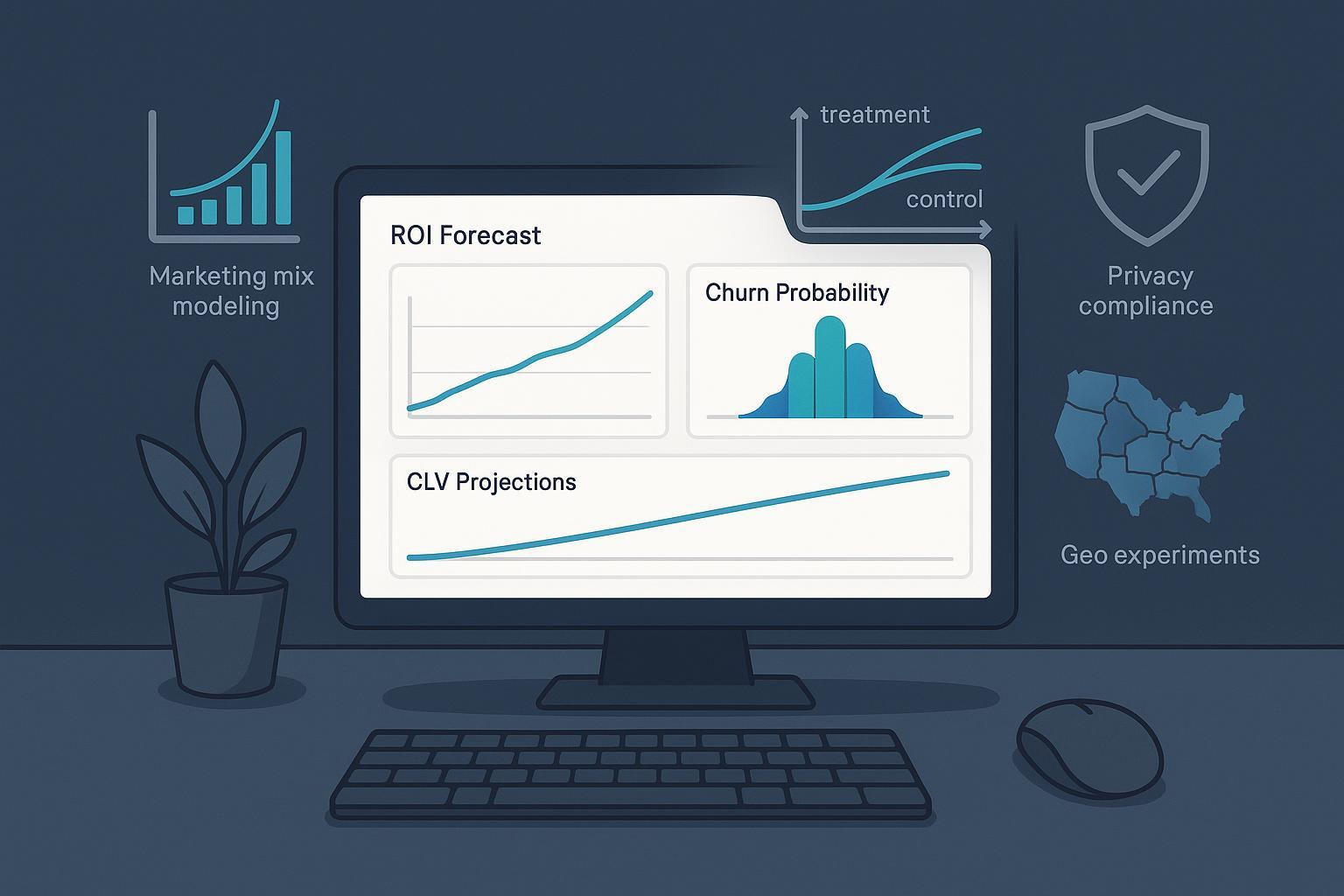
Predictive AI has shifted from pilot projects to everyday decision-making in marketing. In 2024–2025, the combination of privacy changes and accelerated AI adoption pushed teams to rebuild forecasting and retention playbooks around models that are explainable, experiment-backed, and finance-ready. Marketing leaders now ask a sharper question: How do we produce ROI forecasts that withstand signal loss and how do we use propensity-based interventions to actually keep customers?
Why it matters now
Enterprise use of AI continued to broaden in 2025, with marketing among the leading functions capturing value, according to McKinsey’s 2025 State of AI. Investment and adoption momentum are equally clear: the Stanford HAI 2025 AI Index documents record private AI investment in 2024 and sharp increases in organizational AI use. Practically, this means senior teams are budgeting for 2026 with AI-enabled forecasting and retention programs as standard—no longer experimental.
On the operating side, maturity models from BCG’s 2024 Blueprint for AI-Powered Marketing show how leaders integrate data, modeling, content, and governance to move from isolated wins to scaled impact. The throughline: predictive analytics becomes the backbone for allocation, timing, and next-best-action decisions.
Forecasting under signal loss: the modern measurement stack
Cookie deprecation, mobile platform tracking limits, and AI-first search experiences have eroded legacy journey-based attribution. Forecasts grounded in multi-touch attribution alone are more volatile. A resilient approach triangulates:
- Marketing Mix Modeling (MMM) for strategic budget elasticity at aggregate levels
- Causal lift experiments (geo or public service announcement-style tests) to quantify incrementality
- Per-user propensity and uplift models for tactical decisioning and retention offers
Modern measurement guidance from Google recommends triangulating and calibrating methods—combining aggregate MMM, privacy-safe experiments, and selective user-level optimization. See Think with Google’s 2024 Modern Measurement Playbook for geo experiment design patterns and calibration principles. For teams new to incrementality testing, this primer on causal lift (Geo/PSA) experiments walks through treatment vs. control setup and analysis.
Search-side dynamics also matter: AI summaries change how demand flows into your site and how signals are captured. This affects forecasting inputs and conversion expectations; see AI summaries and SEO shifts in 2025 for a deeper look at visibility and measurement implications.
Retention-first economics: from propensity to uplift
Retention is where predictive AI delivers immediate, defensible value. Two model types matter most:
- Propensity models estimate the likelihood of a behavior (e.g., churn or purchase) given features such as recency, frequency, behavior, sentiment, and product usage.
- Uplift models estimate the individual treatment effect—the incremental change if an intervention is applied—separating “persuadables” from “sure things” and “sleeping dogs.”
For uplift modeling, authoritative tutorial material covers data needs, treatment indicators, and evaluation metrics like AUUC and Qini curves. See TensorFlow Decision Forests uplift tutorial (2025) and Microsoft Fabric’s uplift modeling guide (2025). In practice, use randomized assignment or robust causal techniques to avoid confounding; validate targeting with holdouts or geo tests before scaling.
Feature design for retention is as much art as science. Behavioral signals (e.g., session streaks, time since last value event), economic markers (discount sensitivity), and content affinity can all help. If you leverage textual feedback or social chatter, sentiment-based features can be informative—see AI sentiment analysis in content marketing (2025) for considerations and pitfalls.
Operating model: weekly forecasts, scenario planning, and governance
Predictive AI changes not only what you model, but how you work. A pragmatic cadence that aligns marketing and finance:
- Weekly forecasting cycle
- Generate best/base/worst scenarios for revenue, CAC, and retention outcomes.
- Feed MMM outputs (quarterly), causal lift findings (ongoing), and propensity/uplift signals (weekly) into a unified forecast.
- Decision reviews
- Marketing, Analytics, and Finance meet for allocation decisions; document assumptions and risk ranges.
- Experiment pipeline
- Maintain continuous A/B or geo tests to validate interventions and recalibrate models.
- Explainability and audit trail
- Use model cards, feature importance (e.g., SHAP/LIME), and decision logs for transparency.
- Content and campaign operations
- Translate model insights into creative variants, timing, and channel mix; standardize reporting. For workflow acceleration, see humans+AI content workflows best practices (2025).
Practical workflow note (tooling)
Teams often need a simple way to turn insights into content experiments and monitor engagement signals alongside retention KPIs. Platforms like QuickCreator can help operationalize content tests and centralize SEO/engagement analytics that complement your predictive insights. Disclosure: QuickCreator is our product.
Regulatory guardrails that enable trust (2025)
Responsible AI isn’t just a compliance box—it’s how you unlock budget confidence.
- California Privacy Protection Agency (CPPA) updates in 2025 finalized rules for cybersecurity audits, risk assessments, and Automated Decision-Making Technology (ADMT) disclosures and opt-outs, with staggered effective dates into 2026–2027. See the agency’s CCPA/CPRA updates page (2025) for timelines and official materials. Document where automated scoring or retention targeting meaningfully affects offers; honor opt-outs; maintain audit-ready logs.
- The Canadian Marketing Association’s Guide on AI for Marketers (2025) provides practical checklists aligned to transparency, fairness, reliability, and security. Use these to structure model risk tests, bias checks for protected attributes and proxies, and incident response.
These guardrails shape feature selection, consent flows, and monitoring. They also make AI programs more defensible during budget reviews and external audits.
A 90-day implementation roadmap
Days 0–30
- Data audit: consolidate first-party data with consent metadata; institute data quality SLAs.
- Bias checks: screen features for protected attributes and proxies; set up feature store and versioning.
- Baseline models: build a churn propensity model with holdouts; design a geo experiment for one paid channel.
- Measurement schema: define MMM data inputs (spend, sales, controls) and reporting cadence.
- Governance prep: draft ADMT notices and opt-outs for retention flows (California readiness for 2027), and start model cards and DPIAs.
Days 31–60
- Launch geo experiment; begin uplift pilot for a single retention offer.
- First MMM run; institute weekly forecasting cycle with scenario ranges.
- Explainability tooling: add SHAP/LIME for stakeholder reviews; establish experiment dashboards.
Days 61–90
- Calibrate MMM with geo results; expand uplift to two segments.
- Refresh MMM quarterly; systematize continuous experiment cadence.
- Finalize ADMT notices and opt-outs; complete DPIAs; align a marketing–finance joint governance checkpoint.
Metrics that matter (for finance and marketing)
- Forecast accuracy: Mean Absolute Percentage Error (MAPE) at weekly and monthly horizons
- Incremental lift: from geo or conversion-lift experiments with confidence intervals
- Retention impact: churn reduction at fixed spend, CLV uplift vs. baseline
- Efficiency: CAC payback, CLV/CAC ratio
- Operating speed: time-to-decision and experiment cycle time
Evidence and method references
- Adoption and value capture: McKinsey — The State of AI (2025)
- Investment and adoption trends: Stanford HAI — 2025 AI Index Report
- Operating model maturity: BCG — Blueprint for AI-Powered Marketing (2024)
- Measurement and experiments: Think with Google — Modern Measurement Playbook (2024)
- Responsible AI and compliance: CPPA — CCPA/CPRA updates (2025) and CMA — Guide on AI for Marketers (2025)
What to watch next
- Platform policy changes impacting attribution and conversion lift features
- New benchmarks from consultancies and academic indices on ROI and retention impacts
- Regulatory updates in the U.S. (state-level AI/ADMT rules) and internationally
If you’re ready to pilot a governed workflow that connects predictive insights to content experiments and reporting cadence, you can explore options and accelerate execution with QuickCreator—keep it vendor-neutral, document decisions, and integrate with your measurement stack.