How to Optimize Your Content for ChatGPT (2025 Best Practices)
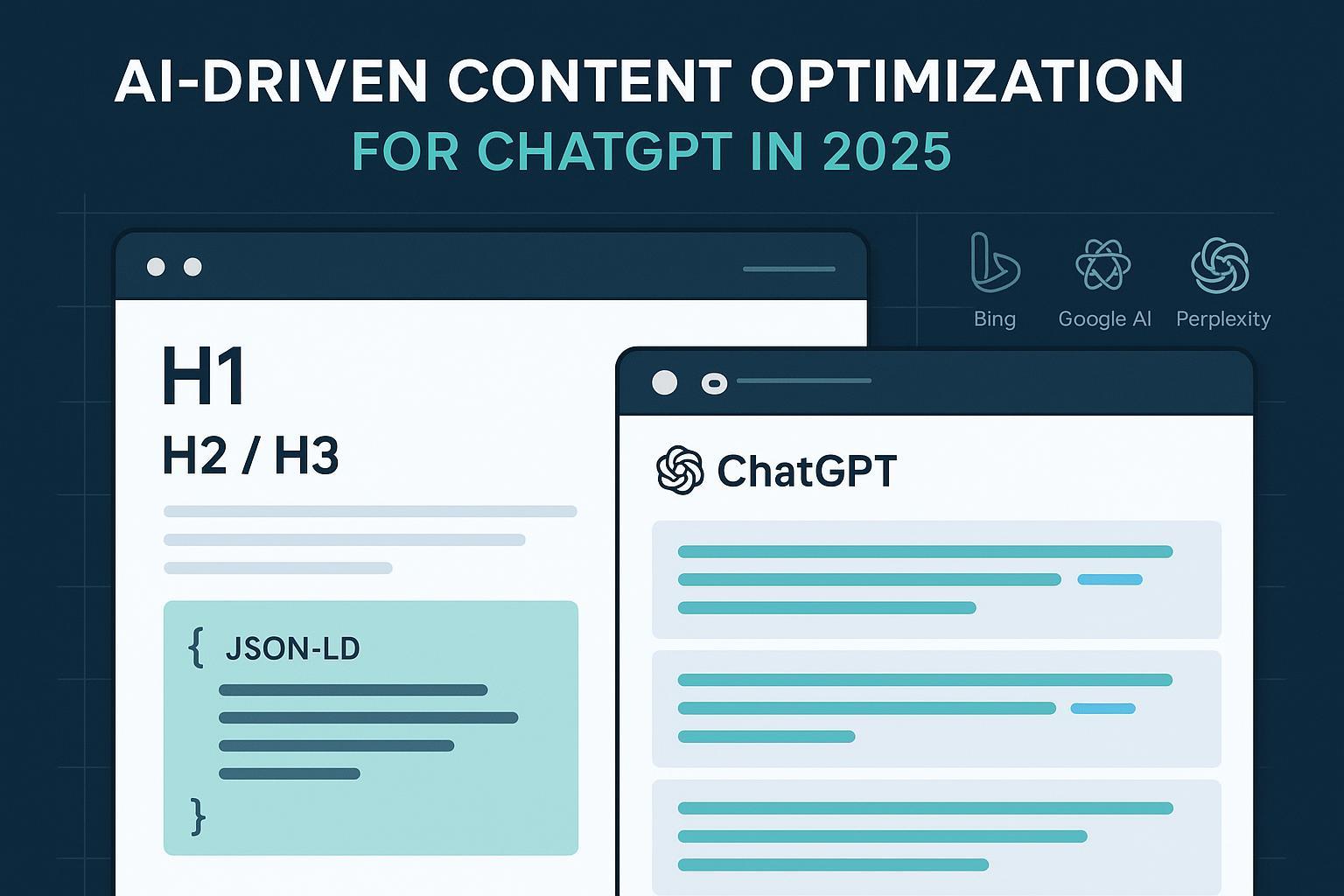
If you want ChatGPT to cite your pages—and to show up across AI answer engines—you need clear, answer-first structure, valid schema, fresh and authoritative content, and a way to measure AI-era visibility. Think of it like turning your long-form article into a set of well-labeled “passages” that LLMs can quickly understand and reference.
Why ChatGPT cites certain pages
ChatGPT Search provides answers “with links to relevant web sources,” and the fine-tuned GPT-4o model leans on an external search stack—meaning pages that are crawlable, authoritative, and recent win more often. OpenAI states this in the “Introducing ChatGPT search” (July 2024) and continues to highlight source links in release notes through 2025.
Google’s AI Overviews rely on indexed, snippet-eligible pages; there’s no special markup just for AIO. The system issues multiple related “fan-out” queries to find diverse supporting links. Google’s official guidance—“AI Features and Your Website” (May 2025) and the Search Central blog (May 2025)—underscores helpful, reliable content and technical eligibility.
Bing/Copilot tends to surface links alongside answers and considers relevance, authority, freshness, and interaction signals. Microsoft summarizes these factors in its EU Digital Services Act filing, the Bing Systemic Risk Assessment (Aug 2024).
Bottom line: Optimize for core search quality first, then make your content modular and extractable so LLMs can reference it confidently.
Structure for extractability: answer-first and passage-level chunking
Start every major section with a 40–60 word direct answer. Follow with evidence, examples, and nuance. Use question-based H2/H3 headings to map intent, and keep each subsection focused on a single idea.
Why this works: Google has treated passages as ranking units since 2020, enabling specific sections to rank even if the page is broad. See “Passage indexing: Helping more pages shine in Search” (Oct 2020) and rollout coverage in 2021. In parallel, retrieval-augmented generation (RAG) performs better when documents are segmented into coherent chunks; 2025 findings in EMNLP and sector reviews show improved retrieval accuracy with well-structured passages, for example the EMNLP Findings federated RAG mapping (2025) and a June 2025 NIH review of RAG in healthcare.
Practical cues:
- Phrase subsections as questions users actually ask.
- Put the core answer first, then support it.
- Avoid tangents inside a single subsection; start a new H3 if you need a different angle.
- Summarize key facts near the top of each block.
Schema and technical signals
Structured data won’t guarantee an AI Overview citation, but it helps machines understand your page. Implement JSON-LD for types that match visible content: Article, FAQPage, HowTo, Product, Review, VideoObject, Organization, Person. Google’s guidance—Intro to Structured Data (2025)—emphasizes accurate, complete recommended properties. Industry snapshots like the Web Almanac 2024 Structured Data chapter echo its value for contextual understanding.
Technical baselines matter:
- Ensure crawlability and indexing (robots.txt, canonicals, sitemaps; submit to Bing Webmaster Tools).
- Maintain freshness: keep visible updated dates and accurate
dateModifiedin Article schema. Google reiterates standard SEO best practices in AI features guidance (May 2025). - Optimize performance and mobile friendliness; thin, slow pages tend not to be preferred.
Multimodal readiness (images, video)
LLMs and AI features increasingly interpret visuals. Pair every critical visual with text equivalents: descriptive alt text, captions, and transcripts for video. Mark up videos with VideoObject schema and provide helpful metadata.
Google’s docs for image SEO and video SEO detail how alt text, captions, transcripts, and schema improve understanding and discoverability. ChatGPT’s multimodal capability is native to GPT-4o; optimizing the text context around visuals makes it easier for the model to extract and cite facts, consistent with OpenAI’s ChatGPT Search announcement (2024).
Measurement: KPIs and iteration
You can’t manage what you don’t measure. Track AI-era visibility and outcomes, not just clicks.
Core KPIs to monitor:
- AI Overview inclusion rate: share of tracked queries where your domain appears as a supporting link.
- Citation frequency across engines (ChatGPT, Perplexity, Bing Copilot) and attribution rate.
- Share of voice in AI answers for priority topics.
- Assisted conversions influenced by AI experiences (modeled attribution).
Expect volatility: AI answers change frequently, and CTR patterns shift when summaries appear. Industry monitors and analyses show reduced clicks when an AI summary is present; benchmarks through late 2025 report meaningful CTR impacts. See Seer Interactive’s September 2025 update on AIO and CTR and a July 2025 Pew Research short read on click behavior with AI summaries. Microsoft’s filing also emphasizes freshness and behavioral relevance in ranking, per the Bing Systemic Risk Assessment (Aug 2024).
Tooling note: Use a mix of trackers to triangulate visibility—one AIO trigger/source tracker, one cross-engine citation monitor, and optionally a front-end capture of answers mentioning your brand. Maintain snapshots over time.
Practice → What to do → Why it helps
| Practice | What to do | Why it helps |
|---|---|---|
| Answer-first paragraphs; question-based H2/H3 | Put the direct answer in the first 40–60 words; phrase headers as questions; expand with evidence below. | Improves extractability for AI Overviews and LLMs; aligns with passage relevance and intent (Google AIO docs 2025; Google Passage Ranking 2020; RAG findings 2025). |
| Passage-level chunking | Segment content into tight, semantically coherent blocks; avoid tangents; summarize near the top. | Enables precise retrieval and ranking of specific sections (Passage ranking 2020; EMNLP/NIH RAG 2025). |
| Schema (Article, FAQPage, HowTo, VideoObject) | Implement JSON-LD matching visible content; validate and keep accurate properties. | Improves machine understanding; supports rich results; aids evidence structuring (Google structured data docs 2025; Web Almanac 2024). |
| Freshness signals | Keep visible updated dates; maintain dateModified; update evergreen assets; submit sitemaps/RSS. | Favored for time-sensitive topics; supports eligibility and quality (Google AIO docs 2025; Bing ranking preferences 2024). |
| Multimodal optimization | Pair visuals with alt text, captions, transcripts; use VideoObject schema and descriptive filenames. | Helps AI interpret visuals; improves accessibility and extraction (Google images/video docs; OpenAI multimodal). |
| Technical health | Ensure crawlability, performance, mobile friendliness; manage canonicals and indexing (incl. Bing). | Ensures inclusion in core indices that power AI features (Google/Bing webmaster guidance). |
| Measurement & iteration | Track inclusion rate, citations, share of voice, assisted conversions; run prompt suites monthly; refresh missing pages. | Aligns optimization with outcomes; adapts to volatility (industry analyses 2025; Bing/Seer/Pew). |
A 7-step workflow you can run this month
-
Audit priority topics and URLs Identify the questions your audience asks and the pages that should answer them. Map each page to a single primary intent plus 3–5 adjacent sub-questions.
-
Restructure sections for answer-first For each H2/H3, write the 40–60 word direct answer first. Add supporting examples, data, and citations immediately after.
-
Chunk passages and add Q-based headers Split long sections into semantically tight blocks. Phrase headings as questions. Summarize key facts near the top of each block.
-
Implement and validate schema Add Article, FAQPage, HowTo, and VideoObject JSON-LD matching visible content. Validate with Google’s Rich Results Test; fix errors and warnings.
-
Refresh and submit Update evergreen assets with new data or examples; keep visible updated dates and
dateModified. Resubmit sitemaps; ensure Bing indexing. -
Optimize visuals for multimodal Write alt text that conveys the key fact; add captions; publish transcripts for video. Mark up videos with VideoObject and descriptive metadata.
-
Measure, test, and iterate Track AIO inclusion rate, citations, and share of voice by topic. Run a monthly prompt suite in ChatGPT, Perplexity, and Bing Copilot; log citations and adjust pages missing from answers.
Closing
You don’t need secret markup to show up in ChatGPT or AI Overviews—you need pages that answer clearly, read like modular passages, and surface evidence machines can trust. Start with answer-first sections, validate your schema, refresh your best assets, and measure AI-era visibility. Then keep iterating. Ready to see which of your pages LLMs quote tomorrow?