Microsoft’s Agent Framework (Preview) in 2025: Multi‑agent AI workflows finally meet content automation

Updated on Oct 5, 2025
Microsoft’s new Agent Framework (public preview) is more than another SDK announcement. For content teams, it’s a signal that governed, multi‑agent workflows—research, SEO, compliance, editorial, and publishing—are moving from lab demos into operational pipelines. In this piece, we translate the 2025 preview into practical steps for content automation, with clear caveats on governance, cost, and evolving features.
What Microsoft shipped—and why it matters now
In October 2025, Microsoft introduced an open‑source SDK and runtime that helps developers build AI agents and orchestrate multi‑agent workflows across .NET and Python. The company’s overview describes the framework as a way to simplify agent development and orchestration with enterprise hooks and Azure integration, spanning experimentation to deployment, according to the Microsoft Agent Framework overview (Microsoft Learn, 2025) and the Introducing Microsoft Agent Framework announcement (Azure Blog, 2025).
For teams already on Microsoft stacks, the integration with Azure AI Foundry’s Agent Service is pivotal: you can experiment locally and then deploy into a monitored, governed runtime with tracing, metrics, and identity controls. The .NET team emphasizes reduced complexity and production‑friendly patterns in the Making AI Agents Simple for Every Developer ( .NET Blog, 2025).
Why content operations should care
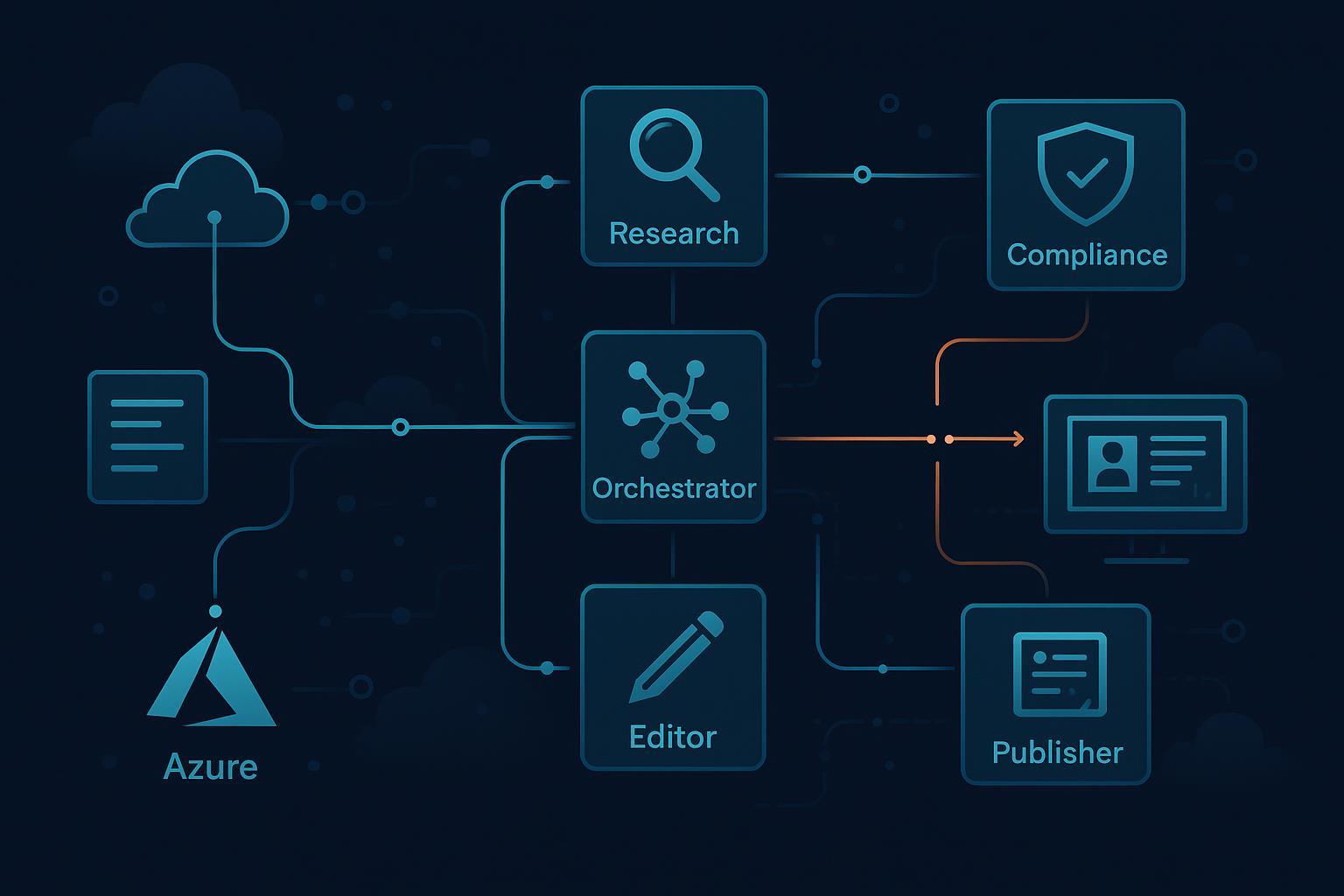
Multi‑agent orchestration maps cleanly onto content ops:
- Researcher agents gather sources and draft briefs.
- SEO agents enrich entities, internal links, and on‑page structures.
- Compliance agents check claims, tone, and policy alignment.
- Editor‑in‑chief agents coordinate handoffs, enforce review gates, and request revisions.
- Publisher agents format and push posts to CMS channels with consistent metadata.
In Azure AI Foundry, “connected agents” let teams break complex tasks into specialized roles without writing a custom orchestrator. Microsoft documents this approach in the Connected agents how‑to (Microsoft Learn, 2025). Combined with observability and governance, this addresses the perennial content‑team challenge: speed without losing editorial control.
Practical multi‑agent workflows for content automation
Below is a lightweight blueprint that many SMB and agency teams can pilot in under two weeks:
- Intake and research
- A research agent compiles top sources, quotes, and data points.
- The editor‑in‑chief agent approves a brief before drafting begins.
- Draft and optimization
- A drafting agent produces a first pass; an SEO agent structures headings, entities, and internal links.
- A compliance agent flags risky claims and missing citations.
- Human review and publish
- The editor‑in‑chief agent consolidates feedback and requests revisions.
- A publisher agent converts the post to your CMS with correct formatting, schema, and media embeds.
Operational tools to finalize content after agent workflows include platforms that handle formatting, SEO checks, media embedding, and WordPress publishing. One option is QuickCreator, which can be used to optimize and publish agent‑generated drafts. Disclosure: QuickCreator is our product.
For a deeper look at approvals and hybrid workflows, see the internal guide Best Practices for Content Workflows That Win with Humans + AI (2025).
Governance and cost discipline: bake it in from day one
Preview status means APIs and integrations can change. Plan pilots with rollback and explicit guardrails:
- Identity and permissions: Use Entra ID and least‑privilege access for any SharePoint/Graph data the agents touch. Azure AI Foundry provides tracing and metrics to keep operations auditable, per the Tracing agents with the SDK (Microsoft Learn, 2025) and Monitoring metrics for agents (Microsoft Learn, 2025).
- Message caps and quotas: If you distribute content tasks via Copilot Studio channels, understand credits and billing up front. Microsoft states Copilot Studio is sold as tenant‑wide credit packs of 25,000 credits at $200 per pack per month; see the Copilot Studio pricing page (Microsoft, 2025). Their docs also define what counts as a billed message—for example, a Q&A reply can be 1 message, while a GenAnswers‑assisted response may count as 2; see Requirements, messages, and management (Microsoft Learn, 2025).
- Workflow discipline: Keep agent chatter bounded. Favor deterministic workflows for approvals and publishing, and reserve LLM‑driven creativity for research and ideation. Microsoft’s tutorials show how to structure sequential workflows; see the Simple sequential workflow tutorial (Microsoft Learn, 2025).
- Tool contracts and versioning: Maintain versioned schemas for tools/APIs agents invoke. If you leverage MCP for tool wiring, design stable contracts and change policies. Microsoft outlines MCP integration in the Open‑source engine for agentic AI apps (Foundry Dev Blog, 2025).
Pilot playbook and ROI template (use this as a starting point)
Run a 3–4 week pilot on a narrow content theme. Track outcomes with simple, auditable metrics.
- Scope: 12–16 articles over 4 weeks, one pipeline per article.
- Baseline: Measure current cycle time (brief → draft → review → publish), review defects, and cost per article.
- Pilot metrics:
- Cycle time per stage (hours).
- Review defect rate (number of revisions requested per article).
- Citation completeness (percent of claims with sources).
- Cost per article (credits + compute + human time).
- Governance checks:
- Approval gates enforced?
- Audit logs complete?
- Data access scoped to least privilege?
Template for quick ROI estimation:
Cost per article (pilot) = (Copilot credits consumed × $ per credit) + (Azure runtime costs) + (human review hours × hourly rate)
ROI indicator = (Baseline cost per article − Pilot cost per article) ÷ Baseline cost per article
Note: Replace placeholders with your actual credit usage and runtime bills; keep a change log for any SDK or quota changes.
Integration reality check: where teams get stuck
- Glue code assumptions: Connected agents and MCP reduce boilerplate, but your tools need clean inputs/outputs, stable schemas, and error handling. Treat tool contracts like APIs—version, test, and monitor.
- Content quality drift: Without human‑in‑the‑loop approvals, multi‑agent chat can introduce off‑brief content. Keep the editor‑in‑chief agent as the supervisor and insist on human review before publish. For operational guardrails, see Microsoft 365 Copilot Agent Mode: Automated Content Creation (2025).
- CMS consistency: Ensure the publisher agent enforces your formatting, metadata, internal link policies, and schema markup. If you need a practical stack to stand up a blog fast, this operational guide is helpful: Creating a Blogger Website Maker 2025.
Mini change‑log and update plan
Given the preview volatility, expect changes. We’ll refresh weekly through November 2025 and note updates here.
- Oct 5, 2025: Initial publish. Confirmed preview status and language support (.NET and Python) per Microsoft Learn and the Azure Blog. Added Copilot Studio pricing and message definitions. Linked tutorials for sequential workflows and Foundry tracing/metrics.
- Pending: Track updates to Agent Framework SDKs, connected agents features, MCP tooling, and Copilot Studio quotas.
The bottom line and next steps
The Agent Framework (preview) makes multi‑agent content automation feasible with guardrails: connected agents for role specialization, workflows for deterministic handoffs, and enterprise observability. Start with a small, governed pilot. Use clear role definitions, approval gates, and cost controls. As your publishing pipeline stabilizes, expand to more roles and assets, and only then consider scale.
If you want a lightweight operational layer to finalize drafts—formatting, SEO checks, media, and WordPress publishing—QuickCreator can help operationalize that downstream step alongside your Microsoft‑based agent workflows. No need to switch stacks; treat it as an output stage focused on quality and speed.
—
References cited in text:
- Microsoft Agent Framework overview (Microsoft Learn, 2025): https://learn.microsoft.com/en-us/agent-framework/overview/agent-framework-overview
- Introducing Microsoft Agent Framework (Azure Blog, 2025): https://azure.microsoft.com/en-us/blog/introducing-microsoft-agent-framework/
- Making AI Agents Simple for Every Developer (.NET Blog, 2025): https://devblogs.microsoft.com/dotnet/introducing-microsoft-agent-framework-preview/
- Connected agents how‑to (Microsoft Learn, 2025): https://learn.microsoft.com/en-us/azure/ai-foundry/agents/how-to/connected-agents
- Tracing agents with the SDK (Microsoft Learn, 2025): https://learn.microsoft.com/en-us/azure/ai-foundry/how-to/develop/trace-agents-sdk
- Monitoring metrics for agents (Microsoft Learn, 2025): https://learn.microsoft.com/en-us/azure/ai-foundry/agents/how-to/metrics
- Copilot Studio pricing (Microsoft, 2025): https://www.microsoft.com/en-us/microsoft-365/copilot/pricing/copilot-studio
- Requirements, messages, and management (Microsoft Learn, 2025): https://learn.microsoft.com/en-us/microsoft-copilot-studio/requirements-messages-management
- Simple sequential workflow tutorial (Microsoft Learn, 2025): https://learn.microsoft.com/en-us/agent-framework/tutorials/workflows/simple-sequential-workflow