Metaverse Lite (3D Social): What It Is, What It Isn’t, and Why It Matters

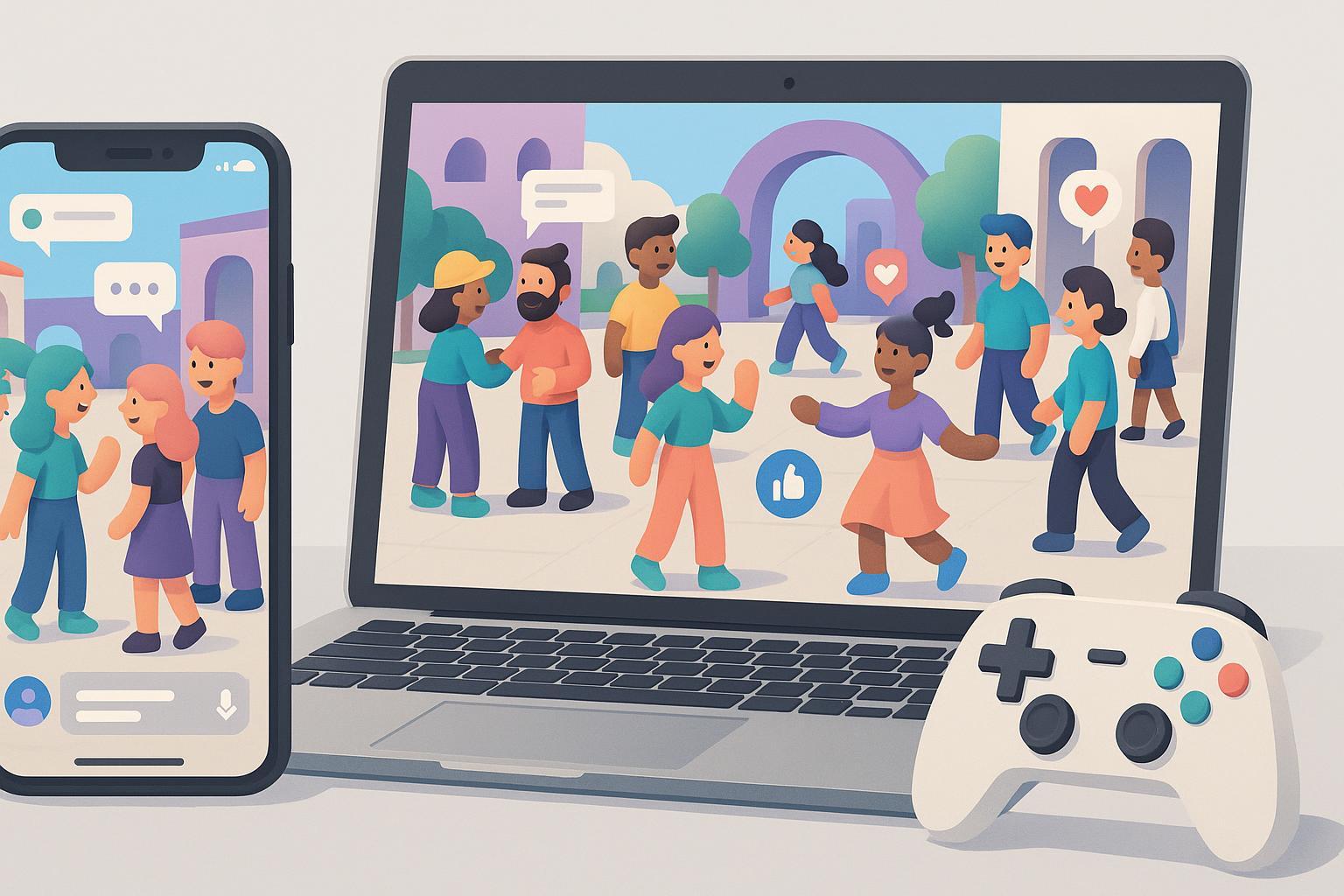
Metaverse Lite (3D Social) describes approachable, cross‑device virtual worlds where people meet as avatars, hang out in shared spaces, and create content—without needing a VR headset. Think of it as the “accessible layer” of the metaverse: it runs on phones, laptops, and consoles, with VR as an optional bonus rather than a requirement.
Key takeaways
- Metaverse Lite focuses on 3D social presence—avatars, shared spaces, user‑generated content (UGC)—that works on everyday devices.
- It differs from VR‑first visions by prioritizing accessibility and reach over fully immersive hardware.
- Platforms like Roblox, VRChat, Rec Room, Spatial, Fortnite Creative/UEFN, and ZEPETO illustrate the model in different ways.
- For brands and creators, it unlocks community events, lightweight branded items, and creator partnerships without heavy hardware or budgets.
- Safety, moderation, and audience fit are critical planning factors as of 2025.
A plain‑English definition
Metaverse Lite (3D Social) is a set of shared, real‑time 3D spaces where people socialize as avatars, co‑create content, and carry persistent profiles across sessions—accessible via smartphone, desktop/web, and console, with VR optional. In other words, it’s like a virtual coffee shop anyone can enter with the device they already have; a fully VR metaverse is more like a high‑end nightclub that only some guests can enter because of hardware and setup.
This framing aligns with broad metaverse definitions that emphasize multi‑device, synchronous social spaces and the goal of an inclusive, safe, and interoperable ecosystem, as summarized by the World Economic Forum’s 2023 governance materials in its overview of an immersive, interoperable collection of shared digital spaces for real‑time interaction.
What it is—and what it isn’t
- What it is: 3D social experiences built around avatars, shared spaces, UGC, and persistent identity. Access on mobile/desktop/console, with VR optional.
- What it isn’t: Not VR‑only. Not necessarily blockchain/NFT‑based. Not just gaming (though many experiences are game‑like). Not guaranteed to be fully interoperable or persistent across platforms.
Government and industry studies show that many popular virtual worlds support mobile/desktop access in addition to VR—reinforcing the “Lite” model’s inclusivity. For example, a survey by Japan’s Ministry of Internal Affairs and Communications documents social virtual worlds and associated safety concerns while noting access across devices in services like VRChat and ZEPETO; see the English report on virtual worlds, platforms, and safety considerations.
How access works (with examples)
- Desktop and optional VR: VRChat explicitly supports “desktop mode”—you don’t need a headset to participate—alongside major VR devices. See the platform’s guidance on getting started with desktop and VR access.
- Cross‑device scale (mobile/PC/console): Roblox runs on phones, PCs, and consoles, with optional VR modes on supported devices; “certain features may only be available to eligible users based on device type,” per its terms. For current adoption signals, Roblox’s 2025 investor updates report sizable DAUs and hours, underscoring cross‑device engagement; see the Q2 2025 financial results reporting 111.8 million DAUs and 27.4 billion hours engaged.
- Cross‑play including VR: Rec Room emphasizes that it “cross plays on everything from phones to VR headsets”—see the concise claim on its homepage highlighting cross‑platform access.
- Web/mobile/VR publishing and play: Spatial positions itself as a publish‑once, play‑anywhere platform spanning Web, iOS, Android, and VR; see its blog overview of building in Unity and publishing to Web, Mobile, and VR.
- Non‑VR creative sandbox: Fortnite Creative/UEFN delivers user‑built 3D experiences across PC and consoles (with authoring on PC), illustrating a non‑VR approach within massive game infrastructure. Consult Fortnite’s Help Center for current supported platforms and requirements.
- Mobile‑first 3D social: ZEPETO centers on avatar identity and digital fashion with primarily mobile access, while offering PC tooling for creators; see the docs for testing worlds and creator workflows.
As of 2025‑09‑10, the common thread is inclusivity: major platforms offer multiple entry points, with VR as an enhancement rather than a gate.
Metaverse Lite vs. VR‑centric visions
| Dimension | Metaverse Lite (3D Social) | VR‑centric Metaverse |
|---|---|---|
| Primary access | Mobile, desktop/web, console; VR optional | VR headsets required or strongly preferred |
| Reach & friction | Broad reach, low friction (no special hardware) | Narrower reach, higher friction (device cost, setup) |
| Typical experiences | Social hubs, mini‑games, co‑creation, events | Highly immersive simulations, VR‑only events |
| Build/entry cost | Lower: web/mobile toolchains, UGC systems | Higher: VR assets, QA for multiple HMDs |
| Persistence/interoperability | Varies by platform; walled gardens common | Similar constraints today; long‑term goal is open standards |
| Safety & moderation | Standard UGC policies + youth protections | Similar needs; additional VR safety/comfort factors |
For an overview of industry goals around safety, privacy, and interoperability, see WEF’s work on privacy and safety frameworks for immersive environments.
Why it matters for brands and creators
- Community building without VR: Host hangouts, workshops, and lightweight events that users can join from phones or laptops.
- Branded assets and spaces: Commission avatar wearables or small worlds as engagement anchors in platforms that support UGC.
- Creator partnerships: Collaborate with native creators who understand platform norms and build authentic experiences.
- Evolving ad formats: Some platforms now support native advertising to older teen/adult segments. Roblox, for instance, expanded video ads in 2025, noting that as of Q4 2024, a majority of its DAUs were 13+ and eligible for ads; see its newsroom update on scaling video ads and partnership with Google.
Critically, time‑based engagement shows why 3D social can be impactful. Roblox’s Q2 2025 report cites tens of billions of hours engaged, illustrating how “dwell time” is a core metric for 3D social participation; see the shareholder communication on hours engaged at platform scale.
Risks, constraints, and safeguards
- Audience fit: Some platforms skew younger; match the platform’s demographics and culture to your brand.
- Moderation and safety: Evaluate platform tools and policies, especially for youth. VRChat, for instance, provides parental and safety resources describing controls and modes; review the safety resources for families and guardians.
- Regulation: Jurisdictions are adding duties for user‑to‑user services. The UK’s Online Safety Act outlines phased obligations around illegal/harmful content and age assurance that apply to virtual communities; see the official government explainer of the Online Safety Act and the broader policy collection with implementation updates.
- Fragmentation and lock‑in: Experiences are platform‑specific; true interoperability is limited today (an issue also recognized in WEF’s governance framing of defining and building the metaverse).
- Performance and UX: Device capabilities vary widely—design for lowest‑common‑denominator access where possible, and test on mobile networks.
Platform snapshots (access in brief)
- Roblox: Mobile, PC, console; optional VR modes on supported devices; strong UGC ecosystem and scale signals in 2025 IR updates—see Q1/Q2 2025 results highlights.
- VRChat: Desktop mode plus VR across major headsets; creator‑driven social worlds; see getting started and device support details.
- Rec Room: Cross‑play across phones, consoles, PC, and VR; see the homepage note on cross‑platform play.
- Spatial: Publish/play on Web, iOS, Android, and VR; see the creator toolkit overview for cross‑platform publishing.
- ZEPETO: Mobile‑first social with strong avatar/digital fashion focus; PC creation/testing supported; see docs on testing worlds.
- Fortnite Creative/UEFN: Non‑VR 3D creative sandbox with broad platform reach via the Fortnite game ecosystem; check supported platforms.
For a policy‑and‑safety‑focused cross‑platform snapshot including VRChat and ZEPETO, see Japan’s MIC English survey of virtual worlds and metaverse services.
How to measure success in 3D social
- Participation: Unique participants, concurrent users at events, item claims.
- Dwell time and repeat visits: Minutes/hours spent, session frequency, and return rates.
- UGC and co‑creation: Number of user builds, remixes, or contributions to challenges.
- Completion and progression: Quests finished, mini‑games completed, or paths through your space.
- Community health: Sentiment, safety incidents, moderation escalations, and creator feedback.
Time‑based metrics matter here because these are places people spend time, not just pages they click—illustrated by platforms that report large totals for “hours engaged,” like Roblox in 2025; see the shareholder letter on engagement hours as a core signal.
Getting started (a practical checklist)
- Define your audience and goals: community hangout, product education, or creator‑led challenge?
- Pick a platform that matches your audience and access needs (mobile‑first vs. cross‑device; UGC depth; moderation tools).
- Start with an MVP: a simple, branded social hub or micro‑game, plus one or two avatar items.
- Partner with native creators who know the platform’s culture and tooling.
- Build safety into the plan: age gates where available, clear codes of conduct, and staffed moderation windows; align with evolving frameworks like the UK’s Online Safety Act policy guidance and industry discussions on privacy and safety in immersive environments.
- Test accessibility: verify performance on mid‑range phones, laptops, and typical network conditions.
- Instrument measurement: track participation, dwell time, repeat visits, UGC outputs, and qualitative sentiment.
- Iterate: treat it like a live service; improve content and systems based on telemetry and community feedback.
The bottom line
Metaverse Lite (3D Social) lowers the barrier to 3D virtual community. By emphasizing cross‑device access, avatar identity, and UGC—with VR as a nice‑to‑have—you can reach larger audiences today while staying aligned with safety and governance best practices. Keep expectations pragmatic, measure what matters (time and participation), and partner with creators to make your presence feel native. As interoperability and standards evolve, the “Lite” pathway gives you traction now and options for tomorrow.