Meta’s 2025 AI Chatbot and Generative AI Content Policies: What Creators Need to Do Now

Updated on 2025-10-07
- June 24, 2025: Meta’s Oversight Board directs Meta to identify and label manipulated audio/video at scale and in local languages.
- 2025: Meta expands “AI info” labeling across more formats and surfaces per its transparency tracker.
- Oct 1, 2025: Meta announces AI-powered recommendations update with a Dec 16, 2025 effective date; user notices start Oct 7.
What changed—and why it matters
In late June 2025, Meta’s independent Oversight Board instructed the company to “identify and label manipulated audio and video at scale,” criticizing past inconsistencies and urging multilingual clarity across Facebook, Instagram, and Threads. See the Board’s directive in the Oversight Board (2025) ruling on at-scale labeling.
Meta has been iterating on how AI-generated and AI-edited content is presented to users since 2024. The April 2024 Newsroom post introduced label terms such as “Made with AI,” the tap-through “AI info” context, and “Imagined with AI” for photorealistic assets created with Meta AI. Meta also shifted from removing certain manipulated media to labeling and adding context unless other policies are violated. See Meta’s April 2024 approach to labeling manipulated media.
By 2025, Meta’s transparency tracker shows continued expansion of AI labeling, with more content types and placements surfacing explanatory context for users. Reference Meta’s 2025 Transparency tracker on labeling AI content for the latest iterations and examples.
The near-term timeline: through Dec 16, 2025
On October 1, 2025, Meta announced AI-powered updates to its recommendation systems, with in-product notices beginning October 7 and an effective date of December 16, 2025. Creators should expect distribution dynamics to evolve as AI signals and labeling context interact with ranking. See Meta Newsroom’s Oct 1, 2025 update on AI recommendations.
What this implies:
- Labeled synthetic audio/video and photorealistic imagery may be treated differently in sensitive contexts (elections, health, civic integrity) relative to neutral entertainment or education.
- Ads created or significantly edited with generative AI features may carry explicit disclosures. Meta outlined labeling expectations for ads in early 2025; see Meta’s Feb 2025 note on GenAI transparency in ads.
- Monitor audience retention and reach from mid-October through January 2026 to detect shifts related to labeling and recommendation changes.
Build a cross-format disclosure workflow (image, audio, video, text)
If you use AI in any part of your production, implement a simple, repeatable workflow that travels with the asset from ideation to publishing:
-
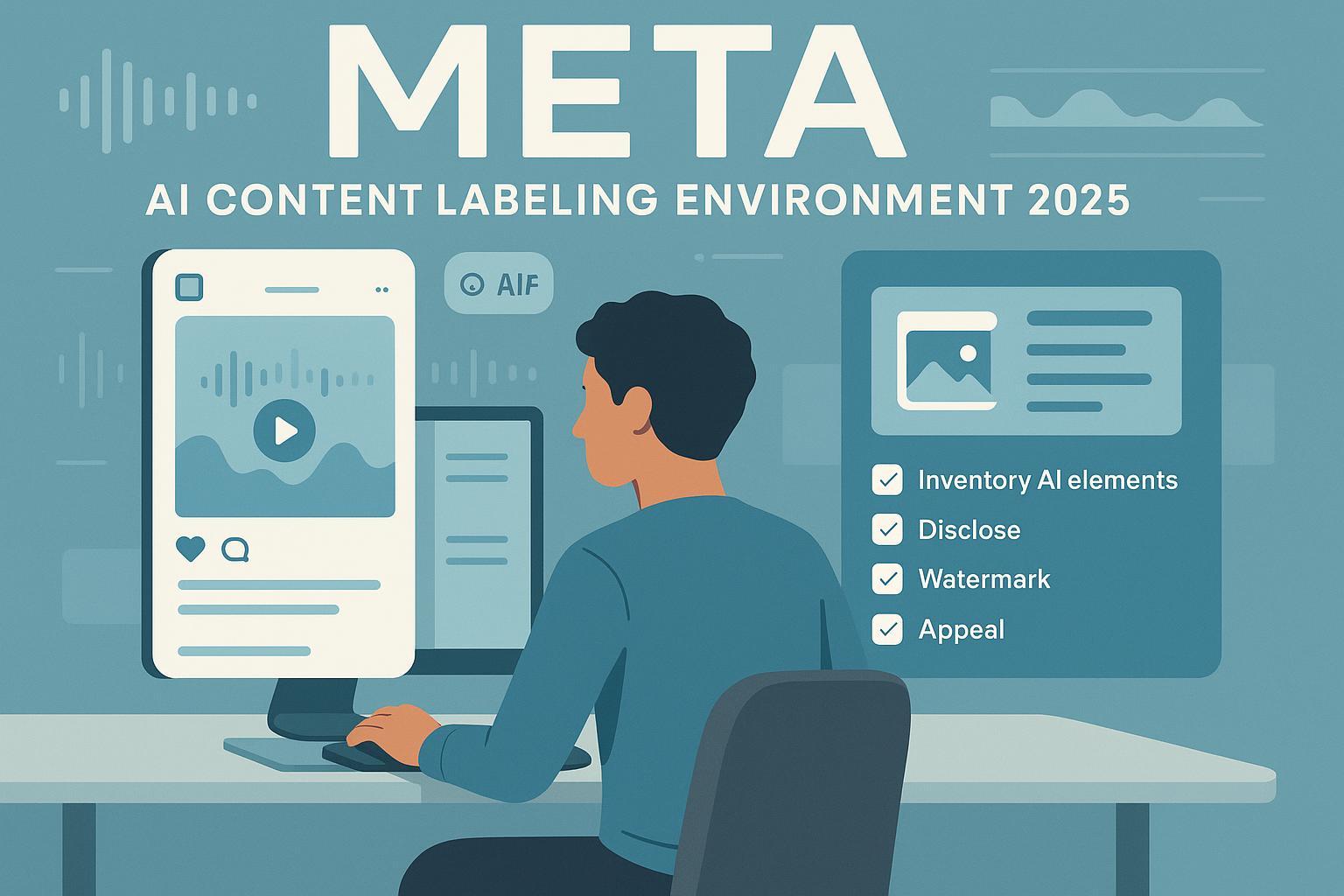
Inventory AI elements
- Record model/tool, version, prompt, seed, and any fine-tuning or voice cloning.
- Note edit history and whether watermarking is enabled.
-
Decide when to disclose (decision checklist)
- Photorealistic or convincing voice clones? Add an AI disclosure.
- Edited real-person footage or audio? Add an AI disclosure and consider a non-photorealistic style.
- Sensitive topics (elections, health, crises)? Use prominent disclaimers and context.
- Ads created/edited with generative features? Follow ad-specific disclosures.
-
Apply in-product labels and manual captions
- Use available “AI info” or disclosure toggles in upload flows where provided.
- Place a clear disclosure in the first screen of the caption or overlay.
- For multilingual audiences, include local-language labels where feasible.
-
Post-publication monitoring
- Track whether Meta applies or modifies labels automatically.
- Compare engagement and reach on labeled vs. unlabeled variants (where policy permits).
For a detailed process foundation, see our internal guide Step-by-Step Guide to Using QuickCreator for AI Content, which maps production steps you can adapt to platform-specific disclosures.
Measurement and optimization: prepare for the Dec 16 shift
Set up A/B or sequential testing for assets where labeling might affect reach. Keep experiments compliant—do not hide disclosures to “game” distribution.
Baseline and track:
- Pre/post label reach, clicks, saves, and watch-time.
- Retention curves on Reels with disclosure overlays.
- Audience sentiment: comments and DMs reacting to transparency.
Optimize for clarity without friction:
- Use concise disclosure phrasing (first screen of caption or overlay).
- Favor non-photorealistic styles when realism could be misleading.
- Maintain consistent provenance notes so editorial teams can respond to reviews quickly.
To sustain quality signals, creators can reference the Content Quality Score | QuickCreator Help Center for principles aligned to E-E-A-T that help keep posts discoverable even when labeled.
Safeguards around minors and sensitive contexts
Policy and public scrutiny are intense around minors and chatbots. In August 2025, U.S. Senators pressed Meta with concerns about how chatbots engage children and the risks of manipulative interactions; see the U.S. Senate letter to Meta (Aug 19, 2025). Meta has also expanded teen account protections, such as stricter defaults in sensitive content controls; see Meta’s July 2025 update on teen protections.
Practical steps for creators:
- Avoid parasocial AI personas that target teens; set clear boundaries and avoid romanticized interactions.
- Provide resource links (e.g., platform safety centers) when discussing mental health topics; do not offer medical advice.
- Keep disclosures age-appropriate and unmistakable.
For privacy context and regional nuances, review Meta’s Privacy Policy portal (2025), particularly sections addressing children’s data for certain devices and services.
Appeals and provenance: prepare your packet before you need it
Enforcement can be uneven across regions and formats. When posts are labeled unexpectedly or distribution changes, you’ll want evidence ready:
- Provenance logs: model/tool, version, prompts, seeds, edit history, watermarking state, and date/time of publication.
- Disclosure artifacts: screenshots of captions/overlays and any self-report toggles used.
- Intent notes: a one-liner explaining the content’s purpose (educational, satire, demo, etc.).
- Policy mapping: how the content avoids violating Community Standards (e.g., impersonation, voter interference, harassment). Meta’s general guidance on false/altered content and demotion is outlined in Meta’s approach to misinformation.
For governance techniques you can adapt to your production environment, see Best Practices for Content Workflows That Win with Humans + AI (2025).
Practical workflow example (neutral tool mention)
If your team struggles with documentation and consistency across formats, a lightweight content platform can help standardize prompts, disclosure copy blocks, and provenance fields. QuickCreator can be used to organize AI-assisted workflows and centralize caption templates and quality checks alongside your production calendar.
Disclosure: QuickCreator is our product.
Example checklist you could maintain in any platform:
- Asset card with model/tool, version, prompt, seed
- Disclosure text blocks for image/audio/video
- Watermarking and overlay settings
- Labels applied (manual vs. auto)
- Post-publication metrics grouped by labeled/unlabeled variants
Next steps and update cadence
- This month: Audit your last 90 days of posts for AI elements; add disclosures and provenance notes retroactively where missing.
- Early November: Run small A/Bs to learn how disclosures affect retention and CTR in your niche.
- December 16: Monitor distribution closely as Meta’s recommendation updates take effect; adjust creative approaches in sensitive contexts.
- Ongoing: Keep a mini change-log; refresh workflows monthly through Q1 2026.
If you need a structured place to keep provenance and disclosure templates together with your content calendar, consider using a neutral content workspace. QuickCreator can help you centralize workflows and quality checks without implying any native Meta auto-labeling features.
Bottom line
Meta’s 2025 policies and system updates move AI transparency from “nice-to-have” to “non-negotiable.” Creators who build disclosure into the workflow, retain clean provenance, and measure label-related performance will be best positioned to protect reach and trust—especially through the December recommendation changes and continuing scrutiny around minors and civic integrity.
References used in this analysis:
- Oversight Board ruling (2025): “Identify and label AI-manipulated audio and video at scale.”
- Meta Newsroom (2024): approach to labeling AI-generated content and manipulated media.
- Meta Transparency (2025): labeling AI content tracker.
- Meta Newsroom (Oct 1, 2025): AI-powered recommendations update (Dec 16 effective).
- Meta Newsroom (Feb 2025): transparency for ads created/edited with generative AI.
- Meta Transparency: approach to misinformation and demotion of altered/false content.
- U.S. Senate letter (Aug 19, 2025): concerns about minors and chatbots.
- Meta Newsroom (July 2025): expanding teen account protections.