Meta’s AI Chat Data Will Power Personalized Ads: Privacy, Regions, and Marketer Playbooks (2025)

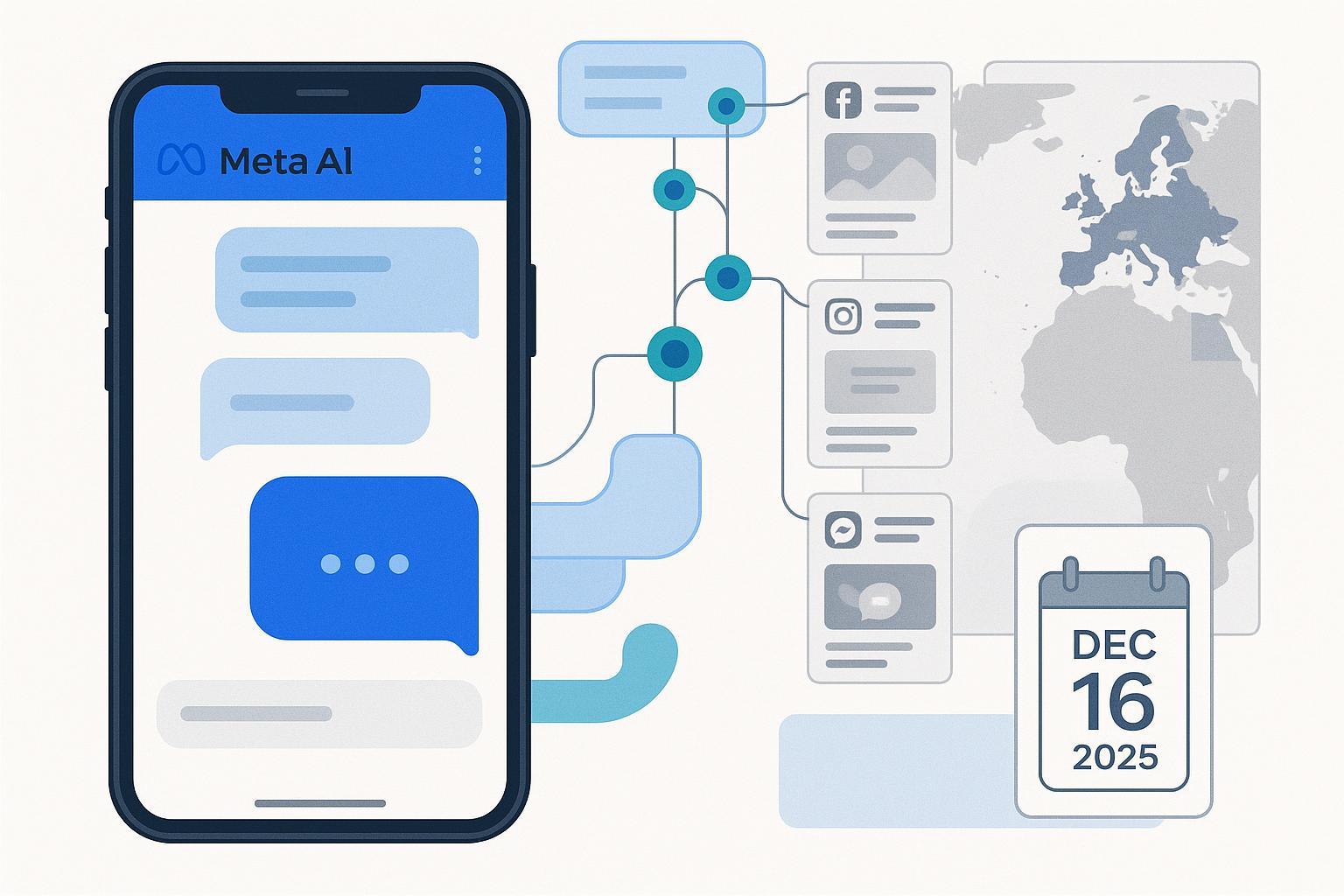
Updated on 2025-10-02. This is a fast-moving policy. Expect weekly updates through December 16, 2025, then monthly.
What’s changing and when
Meta announced in early October 2025 that it will start using interactions with Meta AI (the chatbot and AI features across Facebook, Instagram, Messenger, WhatsApp, and compatible devices) to personalize content and ads beginning December 16, 2025. Notifications to users will begin rolling out the week of October 7. Multiple outlets corroborate that ads will not appear inside AI chats at launch, but chat-derived signals will inform ranking elsewhere in the apps. See the timeline and placement details summarized in The Register’s October 1, 2025 report and the user messaging dates in 9to5Mac’s October 1 coverage.
Regional exceptions apply: the EU, UK, and South Korea are currently excluded due to stricter data laws, and there is no traditional opt-out beyond not using Meta AI features in included regions. This exclusion and the “no full opt-out” stance are reinforced by Fortune’s October 2, 2025 analysis.
Evolving items to monitor:
- Any change to regional exceptions (EU/UK/South Korea)
- The precise handling of chat logs for model training vs. personalization
- Retention and consent UI changes
Why this matters to marketers
Think of AI chat signals as probabilistic intent cues. If someone spends time discussing hiking gear with Meta AI, the system may weight hiking-related content and ads more heavily in their feeds and reels. Ads are not injected into the chat interface, but the signals influence ranking across placements.
There are guardrails. Repeated reporting indicates Meta will exclude sensitive categories (such as religion, sexual orientation, political views, health, race/ethnicity, philosophical beliefs, and trade union membership) from ad personalization based on AI chat content, as summarized in 9to5Mac’s 2025 explainer. For marketers, that means you should avoid creative or segmentation that implies knowledge of any sensitive trait or conversation.
Practically, expect volatility. New signals can shift audience sizes, frequency, and performance. Build campaigns ready to test, learn, and adjust—especially around the December 16 go-live.
Privacy and regulatory context (non-legal overview)
The regional exceptions align with stricter rules on profiling and automated decision-making. The EU’s GDPR limits decisions “based solely on automated processing” that have legal or similarly significant effects without explicit consent or certain safeguards; see GDPR Article 22 (canonical text). UK guidance similarly emphasizes lawful basis, transparency, minimization, and safeguards for profiling.
Separately, confusion around WhatsApp has circulated. End‑to‑end encryption still protects personal messages between individuals; Meta AI interactions are different because they involve the AI itself. As the Electronic Frontier Foundation’s September 2025 WhatsApp privacy explainer notes, messages with Meta AI are processed by Meta’s servers, while chats with other people remain end‑to‑end encrypted.
Marketers should also respect platform ad policies. Meta prohibits discriminatory advertising and the use of personal attributes for ad targeting; review the Meta Ad Standards overview and ensure your creative and targeting choices align.
Disclaimer: This section provides non-legal guidance. Consult qualified counsel for region-specific compliance.
Actionable playbook: Privacy-by-design personalization
- Consent-safe segmentation
- Favor broad, non-sensitive interest themes (e.g., outdoor gear, productivity tools, DIY) rather than health, politics, religion, or other sensitive areas.
- Use lookalike audiences with creative variations rather than micro‑targeting that could imply private chat knowledge.
- Region-stratified planning
- Split campaigns into “Included regions” vs. “Exempt regions (EU/UK/South Korea).” Maintain a contingency for exemptions changing.
- Create separate reporting views and budget controls for included vs. exempt geographies to track differential performance.
- Creative guardrails
- Avoid copy that hints you’ve “read” a user’s AI chat. Keep relevance thematic: showcase the hiking trail guide, not “we saw you chat about boots.”
- Test tones (informational vs. aspirational), formats (video/reels vs. static), and contextual cues (seasonal, local imagery) to improve relevance without over‑personalizing.
- Measurement and analytics
- Run holdout tests (by geo or audience) to assess incrementality. Combine platform experiments with your BI annotations around December 16.
- Monitor weekly through go‑live; then monthly. Attribute changes carefully—do not credit gains solely to AI signal shifts without evidence.
Operational checklist and workflows
- Map current audiences to non‑sensitive proxies and re‑brief creative teams.
- Build regional toggles into campaign structures (budgets, placements, reporting).
- Prepare a public-facing Q&A and a living changelog to explain personalization and reassure users.
- Document approved language for social/community managers to respond to user questions.
- Accelerate content updates and FAQs with a structured workflow. Platforms like QuickCreator can help teams generate region-specific FAQs, changelogs, and transparent messaging at speed. Disclosure: QuickCreator is our product.
- For stepwise execution tips, see this internal workflow resource: Step-by-step QuickCreator AI content guide.
Measurement and monitoring
- Establish baselines now. Capture pre‑change KPIs (reach, CTR, conversion, ROAS) in included regions.
- Design incrementality tests (A/B or geo holdouts) and annotate dashboards around October notices and the December 16 shift.
- Keep a weekly review cadence until mid‑December, then monthly; label updates in your internal docs with “Updated on {date}.”
Messaging, trust, and distribution
- Update your privacy statement to clarify that your brand relies on platform personalization features and does not process user chat content.
- Publish a clear FAQ explaining what’s changing, which regions are affected, and how you respect sensitive topics.
- Train social/community teams with approved, plain‑language responses to avoid “creepy” personalization.
- When distributing explanatory posts, prioritize helpful headlines and relevance. For additional guidance on avoiding clickbait while improving discovery, see Google Discover optimization tips.
Future watch: What to expect
- Policy clarifications: Meta may further define how AI-derived interest signals are weighted in ad ranking and which categories are excluded.
- Regional changes: Exemptions could evolve; prepare a contingency for EU/UK/South Korea if pilots or new consent mechanisms emerge.
- Performance volatility: Expect shifts in audience composition and frequency as new signals enter the system. Brands that communicate transparently and avoid sensitive inference should see steadier performance.
FAQ (short)
- Will ads appear inside Meta AI chats? No. Multiple 2025 reports indicate ads won’t be inside the chat UI at launch; signals inform feeds and other placements (see The Register and 9to5Mac cited above).
- Is there an opt-out? Traditional opt‑out isn’t offered in included regions; users can avoid Meta AI features. EU/UK/South Korea are currently excluded (see Fortune).
- What sensitive topics are excluded? Reports consistently cite religion, sexual orientation, political views, health, race/ethnicity, philosophical beliefs, and trade union membership (see 9to5Mac). Avoid implying knowledge of these attributes.
- Does this affect WhatsApp E2EE? No. End‑to‑end encryption protects personal messages; interactions with Meta AI are different (see EFF’s 2025 explainer referenced above).
Next steps (for teams)
- Build your regional split plan and measurement framework now.
- Draft FAQs and update your privacy statement; set weekly monitoring meetings.
- Create a living changelog and assign owners for updates through December 16.
- If you need a streamlined way to publish region‑specific FAQs, changelogs, and transparent update posts, QuickCreator supports fast, SEO‑friendly content workflows and collaboration without complex setup.
Opinion vs. fact note: Timeline, regional exclusions, and placement details are based on 2025 reporting from The Register, 9to5Mac, and Fortune. Guidance herein reflects practitioner experience and should be adapted to your legal and brand context.
References (selected)
- Timeline and placements: The Register (Oct 1, 2025); 9to5Mac (Oct 1, 2025)
- Regional exceptions and opt‑out: Fortune (Oct 2, 2025)
- WhatsApp AI privacy context: EFF explainer (Sep 2025)
- Policy constraints: GDPR Article 22 (canonical text); Meta Ad Standards overview