How to Maintain Quality in AI-Generated Content (2025)

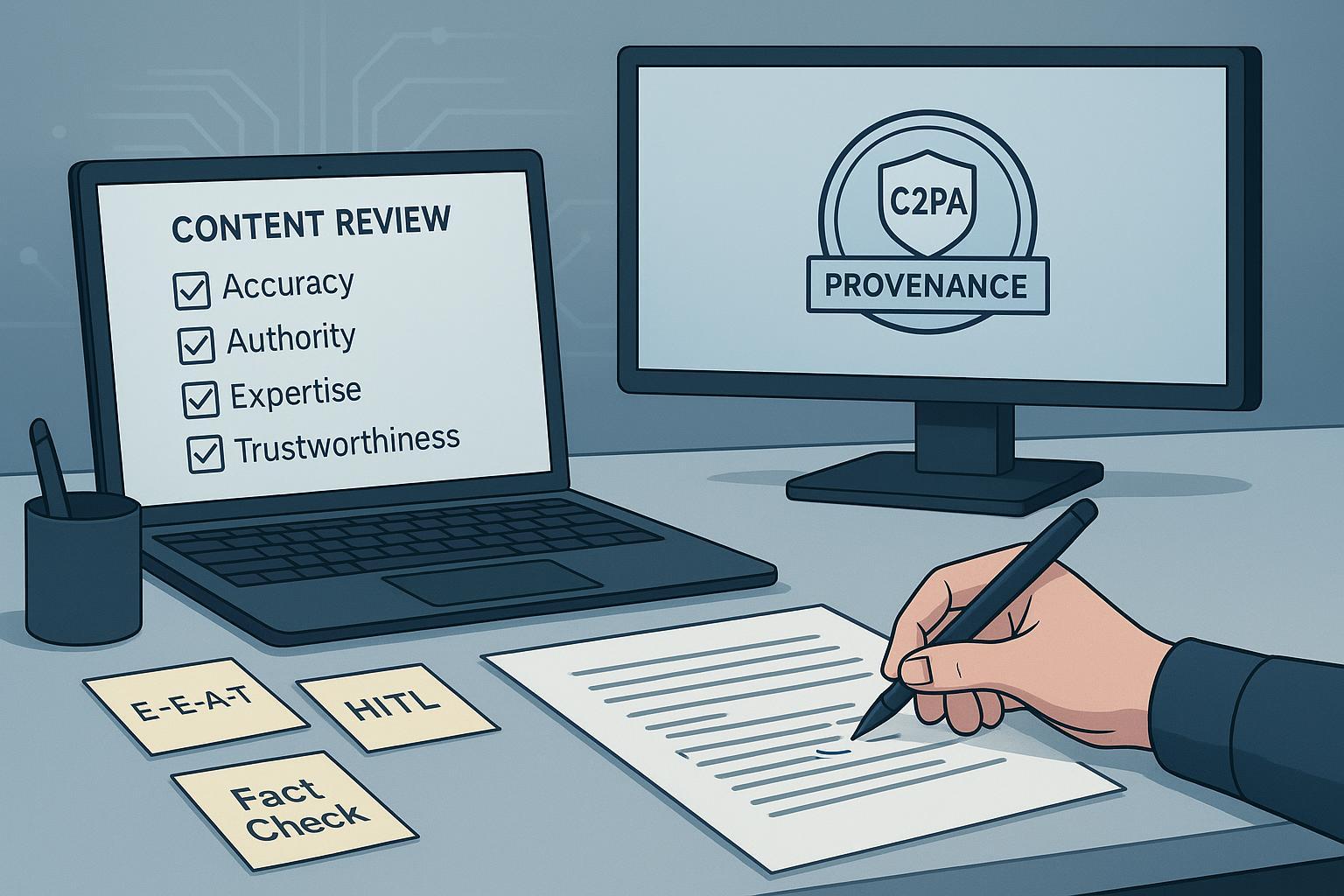
Quality isn’t a nice-to-have for AI-generated content—it’s the difference between trust and trouble. Teams that scale generation without strong editorial and compliance guardrails risk publishing hallucinations, plagiarism, biased language, or deceptive claims. The good news: by combining human-in-the-loop review, transparent provenance, and measurable standards, you can publish responsibly at scale.
The 2025 quality bar: what “good” looks like
“Good” AI content demonstrates experience, expertise, authoritativeness, and trustworthiness (E-E-A-T), and it’s created for people—not for search engines. Google reinforced this stance while cracking down on scaled, low-value output in its March 2024 update, emphasizing that automation is fine when it produces helpful content, and spam is not. See Google’s core update and spam policies (March 2024) and the product team’s overview of the update.
Quality also requires transparent provenance. In the EU, the AI Act phases in obligations through 2026, including labeling synthetic content “as far as technically feasible” using reliable methods such as watermarks and metadata. For timelines and obligations, review the European Commission’s AI Act entry into force (2024) and a law-firm summary of staged obligations (DLA Piper 2025 update).
Finally, avoid deception and disclose material connections. The U.S. FTC’s 2024 rule bans fake reviews and deceptive endorsements, including AI-generated ones. Details are in the FTC’s press release announcing the fake reviews rule (Aug 2024) and the Federal Register publication.
A practical five-stage workflow for AI content quality
Think of quality like a relay race: each stage hands off a stronger draft to the next.
-
Prompt design and source planning. Define the purpose, audience, and scope. Specify source requirements (primary docs, official standards). Prefer retrieval-augmented generation (RAG) for factual tasks. Add guardrails—forbidden claims, compliance flags, tone/voice constraints—directly in your prompts and SOPs.
-
Draft generation and human editorial review. Require a trained editor to check structure, clarity, voice, and reader usefulness. Add accurate bylines and role credits. Remove fluff. Replace generic claims with sourced statements or delete them.
-
Fact-checking and citation verification. Verify every substantive claim against primary sources; add descriptive anchors in-text. Reject untraceable assertions. Keep a change log and reviewer notes.
-
Bias/toxicity and compliance screening. Run automated checks for slurs, stereotypes, or unsafe advice; then do a human pass. Apply disclosure rules (endorsements, sponsorships), copyright/licensing checks, and—if operating in EU markets—label synthetic content accordingly.
-
Provenance and publishing QA. Embed verifiable content credentials (C2PA) or watermarks where supported. Complete SEO quality checks. Set up monitoring for post-publication corrections.
Editorial SOPs that actually stick
Assign clear roles and write down the handoffs. A lead editor should own tone, structure, and usefulness and sign off before compliance review. A fact-checker validates data, quotes, and legal references, adding links and notes along the way. A compliance reviewer screens for disclosures, copyright, and jurisdictional rules. Finally, the publisher embeds content credentials, runs final QA, and schedules monitoring. Comment fields should prompt for specifics—not “looks good”—for example: “Source confirmed; link added to the original publication,” “Disclosure added for affiliate relationship; label placed above the fold,” and “Bias screen flagged a stereotype in paragraph three; revised with neutral phrasing.”
If you work in regulated or high-stakes contexts, align SOPs with NIST’s AI Risk Management Framework and Generative AI Profile. NIST recommends explicit human oversight, escalation criteria, and deactivation triggers when outputs deviate from intended use. See NIST’s AI RMF hub and the Generative AI Profile publication entry (2024).
Compliance map: label, disclose, and avoid spam
- EU AI Act labeling: Mark synthetic content (text, images, audio, video) using robust, interoperable techniques “as far as technically feasible.” Keep logs and metadata. For timelines, check the Commission’s entry-into-force communication and the staged obligations via DLA Piper.
- FTC endorsements and reviews: Don’t generate or buy fake reviews; disclose material connections clearly and conspicuously. Read the FTC’s fake reviews rule announcement and the Federal Register rule.
- Google Search spam policies: Avoid scaled content abuse and low-value pages designed to manipulate rankings. Automation is acceptable when outputs are helpful and original. Reference Google’s March 2024 spam policy update.
Measurement and monitoring: your quality dashboard
Quality isn’t set-and-forget. Build a dashboard that tracks factual accuracy corrections per 1,000 words, editor intervention time and throughput, engagement for human-reviewed versus unreviewed drafts, compliance incidents such as missed disclosures or copyright flags, and your provenance adoption rate (how often C2PA watermarking or metadata are applied). Vendor and research benchmarks suggest human-in-the-loop and retrieval improve accuracy and throughput. For directional evidence, see Optimizely’s 2025 Opal AI Benchmark Report and EvidentlyAI’s benchmark overview of RAG and evaluation. Treat vendor metrics as inputs to your own targets, not gospel.
When to escalate or halt publication
A simple decision tree saves time and reputation. High-risk claims in legal, medical, or financial domains should escalate to domain experts with primary-source citations and formal sign-off. If provenance is ambiguous—content credentials can’t be embedded or the source trail is missing—pause and remediate. Repeated bias/toxicity flags warrant routing to a senior editor and DEI reviewer, with sections rewritten or removed. When sources conflict, cite both, explain the variance, or remove the claim. And if a statistic cannot be verified, replace it with qualitative insight or run a controlled test to generate internal data.
Common failure modes—and early catches
Hallucinated specifics often appear as overly precise numbers or quotes without traceable sources; mandate primary citations inline to counter that. Thin “listicles” pack pages with generic advice—replace them with concrete SOPs, examples, and links to original documents. Over-automation publishes drafts without a human pass; enforce editorial sign-off on every draft. Disclosure drift hides or omits affiliate relationships; use publishing checklists with explicit placement. Provenance gaps leave synthetic media unlabeled; standardize Content Credentials via C2PA or similar methods across systems. For context on provenance standards, see the C2PA 2.2 specification.
Tooling snapshot: where automation helps—and where it doesn’t
| Purpose | What automation does well | Where human review is essential |
|---|---|---|
| Prompting & RAG | Structures queries, fetches sources, reduces hallucinations | Decides scope, relevance, and ethical boundaries |
| Editorial polish | Flags grammar and style issues | Judges clarity, usefulness, and brand voice |
| Fact-checking | Surfaces links and known facts | Verifies claims against primary sources, resolves conflicts |
| Bias/toxicity | Detects slurs and unsafe patterns quickly | Evaluates subtle framing, context, and fairness |
| Compliance | Reminds disclosures and checks patterns | Interprets jurisdictional rules, edge cases |
| Provenance | Embeds content credentials and watermarks | Sets policy for labeling and user expectations |
Build a quality culture, not a one-off checklist
Checklists are necessary—but culture keeps them alive. Train editors and product teams on the “why,” publish your AI-use and disclosure policy, and commit to regular audits. Consider aligning with ISO/IEC 42001 to formalize governance across leadership, operations, and continuous improvement; major explainers from standards bodies and cloud providers outline how organizations implement it.
One last question: if a reader skimmed only the headline and one paragraph, would they still get value they can act on today? If not, tighten the draft before it ships. That’s the standard.