Best AI Writing Tools Like Jasper (2025): 10 Smart Alternatives for Marketing Teams

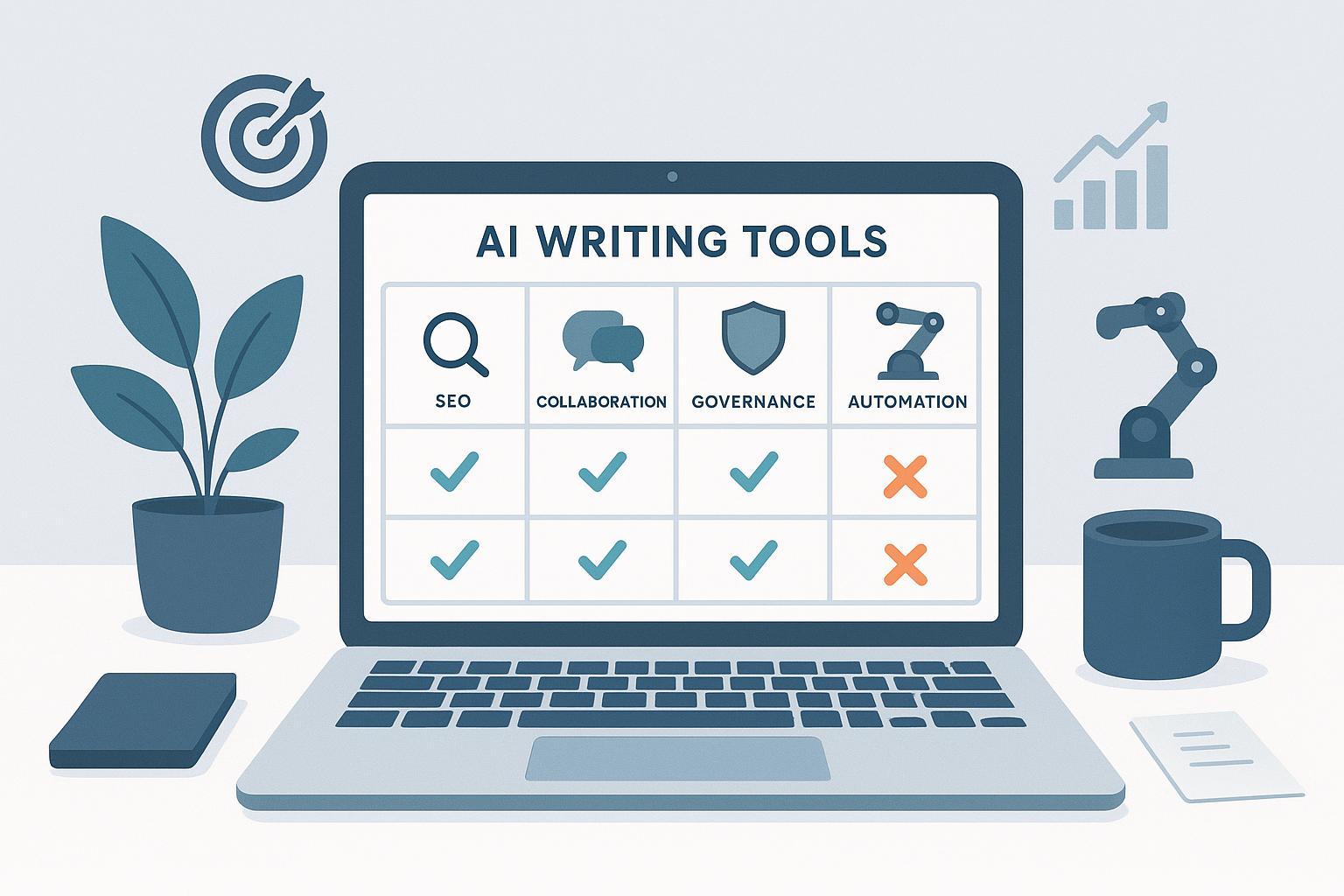
If you’re leading content and growth in 2025, you’re likely weighing the trade‑offs between speed, on‑brand quality, SEO performance, and governance. This guide spotlights credible tools like Jasper—without the hype—so you can shape a shortlist that fits budgets, team workflows, and compliance needs. All comparisons reflect publicly available information as of Dec 2025, with links to vendor pages for verification.
How to read this guide
We focus on what actually drives outcomes for marketing teams: price model and scalability; SEO depth without mandatory add‑ons; brand voice and governance; collaboration; automation/API; and privacy/compliance clarity. When pricing or plan limits vary across sources, we point you to the official pricing pages rather than quoting numbers that may change month to month.
Quick decision lens
Here’s the core trade‑off: tools that emphasize governance and collaboration often cost more per seat, while budget‑friendly platforms may trade off compliance depth or advanced SEO. If your work is ad/landing‑page heavy, prioritize predictive scoring and channel integrations. If long‑form SEO drives ROI, prioritize native SERP analysis, content scoring, and CMS publishing paths. If you operate in a regulated or enterprise environment, governance, auditability, and data controls should come first—then layer in automation and agents.
Snapshot comparison (directional)
| Tool | Price level | SEO depth (native) | Brand voice/governance | Collaboration | Automation/API | Compliance clarity |
|---|---|---|---|---|---|---|
| Copy.ai | Medium–High | Medium | Medium | High | High | Medium |
| Anyword | Medium | Medium | Medium | Medium–High | Medium–High | Medium |
| Writesonic | Medium | Medium–High | Medium | Medium–High | Medium–High | Low–Medium |
| Surfer SEO | Medium | High | Low | Medium | Medium | Medium |
| Scalenut | Medium | High | Low–Medium | Medium | Medium | Low |
| Pepper Content | High | Medium–High | High | High | Medium–High | Medium |
| Article Forge | Low–Medium | Medium | Low | Low–Medium | Low | Low |
| Addlly AI | Medium–High | Medium–High | Medium–High | Medium | Medium–High | Medium–High |
| Writer.com | High | Medium | High | Medium–High | High | Medium–High |
| Hypotenuse AI | Medium | Medium | Medium | Medium | Medium | Medium |
Note: This matrix is meant to guide shortlisting, not to replace a hands‑on pilot.
Copy.ai — Automation‑forward GTM content
Copy.ai positions itself as a workflow and agent platform geared toward GTM teams. Teams like the shared projects model, role/permission controls, and the way Agents can stitch tasks together for multi‑step content workflows. Pricing and entitlements change over time, so validate the latest on the vendor page; you can review current tiers on the Copy.ai prices page as of Dec 2025 via the vendor’s own listing in the aptly named Copy.ai prices resource. According to the vendor’s public pricing page, plans range from collaborative chat up to agent‑based tiers with higher automation limits, and API access typically sits in upper plans. Best for teams that want to orchestrate repeatable campaign content with light SEO needs, then publish via connectors. Watch out for credit‑based or workflow‑run consumption if your usage can spike unpredictably.
Reference: see the vendor’s current tiers on the Copy.ai prices page as of Dec 2025: Copy.ai prices.
Anyword — Predictive scoring for ads and landing pages
Anyword stands out for its predictive performance scoring that estimates how variations might perform across channels. That feedback loop is handy when you’re iterating headlines and CTAs under pressure. Collaboration improves at mid‑to‑upper tiers, and API access is available for programmatic testing. This is a fit if paid acquisition and landing pages drive the majority of your content ROI and you value data‑backed copy testing. It’s less of a fit if your workload is long‑form editorial at scale. Pricing and seat models evolve; verify the latest details on the official pricing page as of late 2025.
Reference: confirm current plans on the vendor’s official page: Anyword pricing.
Writesonic — Cost‑effective generalist with SEO agents
Writesonic blends broad templates with brand voice controls and an expanding set of SEO helpers, including agents for audits and on‑page suggestions. Teams appreciate the balance of cost and capability, plus publishing integrations and an accessible learning curve. It’s a strong pick for small to mid‑size marketing teams that need to produce a lot of baseline content quickly and then refine in‑house. That said, governance documentation and compliance certifications aren’t as prominent publicly as enterprise‑first platforms, so larger or regulated organizations should evaluate policies closely and ask for security documentation. Always validate plan names and limits on the official site because they shift as products evolve.
Reference: check the current tiers and inclusions on the vendor site: Writesonic.
Surfer SEO — Deep on‑page optimization
Surfer is a specialist for SEO planning and optimization rather than an all‑in‑one writer. Its Content Editor gives real‑time guidance based on SERP analysis and competitor signals, while features like Audit and Auto‑Optimize help maintain and improve existing pages. If your team already writes in Docs or a CMS, Surfer’s extensions and integrations fit into that flow nicely. This tool shines when you need structured briefs, topical coverage guidance, and iterative optimization at scale. It’s not a fit if you expect a full content ops platform with governance, brand training, and publishing controls out of the box.
Reference: see the official product overview for Content Editor: Surfer Content Editor overview (Dec 2025).
Scalenut — Topic clusters and content scoring
Scalenut aims to simplify SEO strategy for teams by generating keyword clusters, content outlines, and scoring guidance inside a cohesive workflow. It’s compelling for teams building an SEO engine from the ground up because it reduces the friction between research and writing. Collaboration features and seat counts are better at higher tiers, and more mature teams may run into scale limits. If you’re early in SEO maturity or need an affordable planning‑to‑draft path, Scalenut belongs on the shortlist. If you require advanced governance, audit logs, or enterprise security posture, you’ll likely need to supplement with other tools.
Reference: review the platform capabilities on the vendor site: Scalenut platform overview.
Pepper Content — CMP + marketplace for enterprises
Pepper combines an AI‑enabled content marketing platform with access to a curated marketplace of creators. For enterprises and fast‑growing teams, that pairing can remove bottlenecks from briefs to delivery, while calendars, approvals, and dashboards give operations teams the oversight they need. It’s best for organizations that want a single vendor for strategy, production, and performance, and that can invest in onboarding. Smaller teams may find the breadth—and associated cost—more than they need. Implementation takes planning, especially if you’re integrating across multiple CMS and analytics tools.
Article Forge — Bulk long‑form and WordPress scheduling
Article Forge focuses on speed and scale for long‑form drafts. When you need to spin up many pages programmatically—think supporting content for a large topical cluster—its scheduler and WordPress integrations help teams move quickly. Quality varies by topic, so human editing and brand adaptation are essential before publishing. It’s a pragmatic pick for bulk first drafts and content refreshes where strict editorial voice is secondary. It’s the wrong tool if every page must meet a high bar for narrative quality without substantial editing.
Addlly AI — Brand‑trained agents and GEO
Addlly emphasizes zero‑prompt, brand‑trained agents designed to execute multi‑channel campaigns (blogs, social, email, PR) while incorporating GEO (generative engine optimization) ideas. It appeals to organizations that want to codify brand rules and campaign steps into reusable agents. Pricing and enterprise features are often quote‑based, and third‑party reviews are thinner than longer‑established vendors, so plan a careful pilot. It’s a match for teams that want agentic campaign execution, but it’s not ideal if you require transparent, standardized pricing and a large ecosystem of public benchmarks.
Writer.com — Governance‑first, enterprise‑grade
Writer is built for enterprises that need tight governance, brand standards, and administrative oversight. It offers agentic workflows, strong admin controls, and an API with usage‑based pricing for teams that plan to embed AI into existing systems. If auditability, role‑based permissions, and extensibility are table stakes for your program, put Writer near the top of your evaluation. For small teams that mainly need fast creative drafting at a low per‑seat cost, it may be more platform than you need.
Reference: examine API and usage‑based options on the official developer pricing page: Writer developer pricing (Dec 2025).
Hypotenuse AI — Ecommerce product/catalog at scale
Hypotenuse is tailored for ecommerce operations—bulk product descriptions, category pages, and meta at scale—plus SKU‑level brand voice consistency. Shopify integration and CSV/PIM workflows streamline publishing for large catalogs. It’s a strong fit for merchants and marketplaces, especially when product content velocity is a bottleneck. It’s not the best pick if your needs center on broad editorial, social campaigns, or complex cross‑functional collaboration.
When to stay vs when to switch
A quick note on Jasper, the benchmark many teams start from. If your organization already has mature workflows built around its brand voice and collaborative long‑form tools, and you rely on third‑party SEO partnerships and enterprise governance, staying put can make sense. According to the vendor’s trust materials, the platform emphasizes enterprise security and compliance; you can review the current stance as of Dec 2025 on the official trust page. Switching becomes attractive when per‑seat costs constrain usage, when you want deeper native SEO without add‑ons, or when your use case skews heavily toward bulk publishing or predictive conversion scoring.
Reference: review the vendor’s current security posture: Jasper Trust.
Migration mini‑guide (fast but safe)
Start with your voice assets. Export brand guidelines, tone examples, and high‑performing copy, then train/import them into your new tool’s brand voice system; validate outputs on a small set of gold‑standard pages before scaling. Align SEO workflows by choosing a tool with native SERP analysis and content scoring or pairing a writing platform with a specialist; rebuild your brief templates and define thresholds for “publish‑ready.” For publishing, connect your CMS early in the pilot, map roles and approvals, and run a parallel publish on a non‑critical page to confirm formatting and metadata carry through. Close the loop on data and compliance by reviewing the vendor’s data retention, training data usage, and certifications, then updating your internal governance checklist (roles, audit logs, PII handling) to match the new platform.
How to pick your shortlist in a week
- Define your top two outcomes: for example, “improve SEO content velocity by 30%” and “cut ad copy iteration time in half.”
- Map required capabilities to those outcomes: native SEO scoring vs predictive copy scoring, agent workflows vs simple templates, API needs, and governance.
- Run two parallel pilots with identical briefs and metrics; score time‑to‑first‑draft, editing effort, and performance signals.
Bottom line
Pick the platform that aligns with your dominant workflow, not just the flashiest demo. If you’re a paid media team, gravitate to predictive scoring. If you’re SEO‑driven, choose native SERP depth and content scoring. If you’re enterprise or regulated, anchor on governance, auditability, and clear data policies first. Then, let pilots decide—same brief, same deadline, same reviewers. That’s the fairest test you can run in 2025.