How to Increase Your Brand Mentions in AI Models (2025)

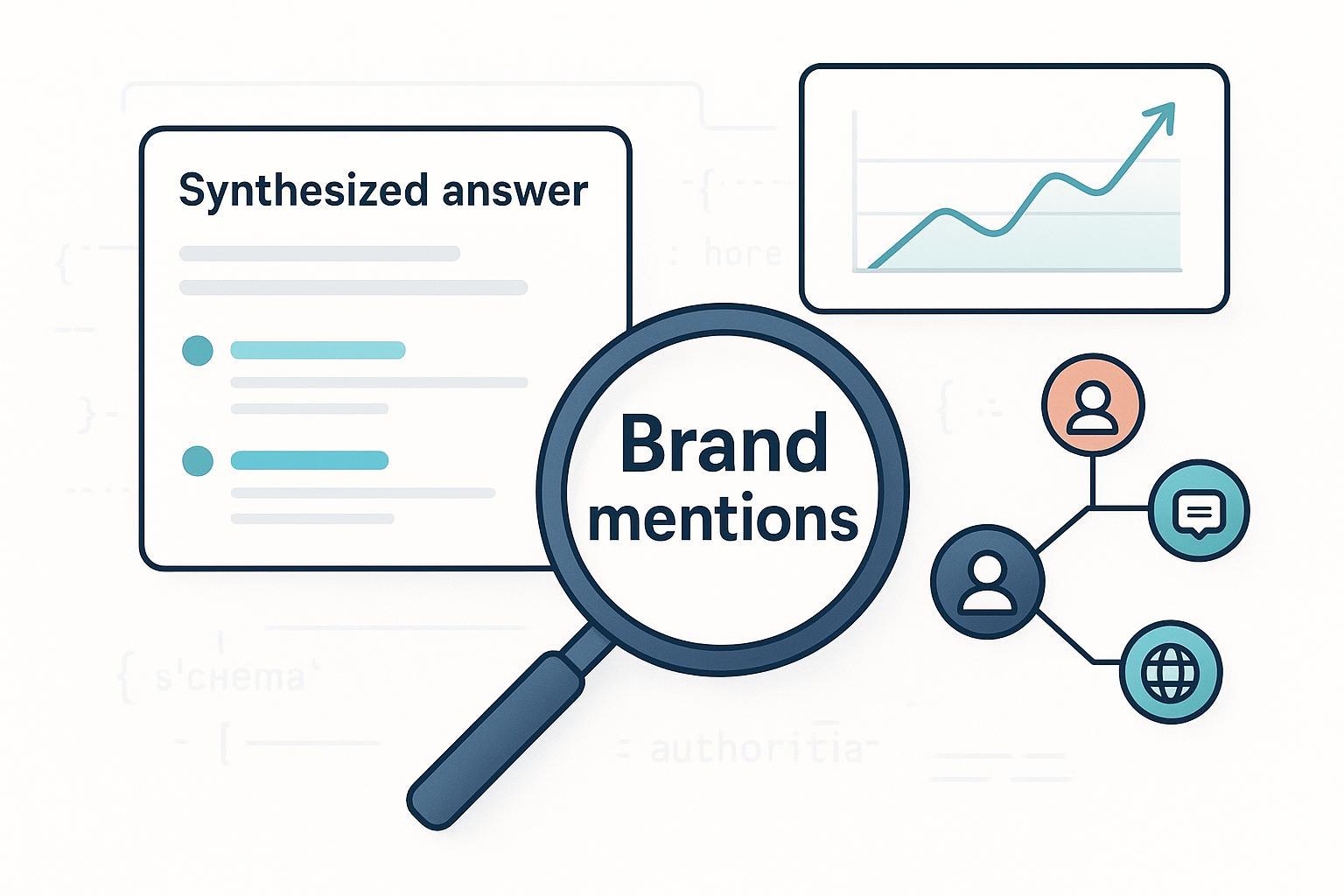
When AI answers the question instead of listing ten blue links, your brand either appears in the citations—or it doesn’t. Mentions and links inside AI answers now influence awareness, trust, and referral traffic across Google AI Overviews, Bing Copilot (search), Perplexity, ChatGPT search, Claude with retrieval, and Arc Search. If you’ve noticed competitors being named while you’re invisible, you’re not alone. The good news: increasing brand mentions in AI models is a repeatable program, not a guessing game.
How AI engines choose sources (and what that means for you)
AI layers rely on high-quality web sources, but their behaviors differ. Google notes that its AI features are grounded in web information and provide citations so users can “explore further,” emphasizing reliability and diversity of sources, as described in Google’s own guidance on AI features and your website. Independent audits show patterns, too: for example, SE Ranking’s 2024 recap reported an average of 6.82 links in AI Overviews and strong overlap with top organic results—so treat it as a range rather than a rule, per the SE Ranking 2024 AI Overviews research recap.
| Engine | How it cites | Sources often seen | Practical implication |
|---|---|---|---|
| Google AI Overviews | Inline card with 3–6+ linked sources | Established media, Wikipedia, YouTube, Reddit/Quora, authoritative blogs | Earn editorial citations and community credibility; rank well organically to increase odds |
| Bing Copilot (search) | Enumerated source list with titles/URLs | Professional outlets; English-heavy bias in many audits | Provide clearly attributable, expert-backed pages to be cited |
| Perplexity | Prominent Sources panel (especially in Pro), many links | Wide mix; transparent source list | Package research and definitions; clear summaries help inclusion |
| ChatGPT search | Answer with Sources section and numbered links | Business sites, Wikipedia; variable behavior | Make content scannable with evidence and canonical explanations |
| Claude (with retrieval) | Citations for provided docs; no universal web browsing | Your uploaded content or connected knowledge | Publish robust, well-structured docs; retrieval-ready assets |
| Arc Search | Summary page with listed sources | Fresh, useful pages surfaced quickly | Keep content updated and clearly scoped for summaries |
The takeaway is simple: engines reward clarity, authority, and corroboration. So, think like a citation editor. Would a cautious system feel confident naming and linking to your page?
Audit your current AI presence
Start by establishing a baseline. Run a structured audit across your most valuable prompts and questions (e.g., “best X for Y,” “how to choose X,” “[your topic] benchmark,” “[your topic] pricing,” “[your brand] vs [competitor]”). For each engine, capture screenshots, cited URLs, sentiment, and whether your brand is named, linked, or absent. Sample at least 100 prompts to see patterns across informational and commercial intents.
Next, trace the trail of sources that do appear. Which publishers, forums, videos, and directories keep showing up? If AI engines repeatedly cite third-party explainers or roundups instead of you, you’re missing authority nodes. Ask yourself: are those outlets citing your research, quoting your experts, or referencing your definitions? If not, that’s your gap.
Finally, instrument analytics to attribute AI referrals when possible. ChatGPT search often appends utm_source parameters; Copilot and Perplexity can pass referrers in certain flows. Create an “AI” channel grouping so you can tie content and PR moves to visibility and clicks.
Strengthen entity clarity and E-E-A-T
AI engines favor sources they can unambiguously map to known entities and trusted experts. Treat your About/Entity page as the canonical source of truth: consistent name, logo, and descriptors; leadership bios; editorial standards; physical location and contact details; and a media kit. Use Organization and Article schema (with author and publisher details) and add sameAs links to authoritative profiles (Wikidata QID and Wikipedia if eligible, LinkedIn company page, professional directories). Keep these attributes mirrored across locales.
Google repeatedly encourages structured data to help systems understand page meaning and eligibility for rich results. Follow the official overview for implementation best practices in Google’s structured data documentation, validate markup, and align it with visible content. You’re not “gaming” AI—you're removing ambiguity so engines can confidently cite you.
E-E-A-T isn’t a single ranking factor, but it’s a north star for quality. Demonstrate real experience in your writing, show author credentials, cite primary sources, and keep bylines, dates, and update notes transparent. For sensitive topics, raise the bar: peer review, expert medical/legal review, and rigorous sourcing.
Content and digital PR plays that earn mentions
Build assets that other publishers and engines want to reference. Original research and benchmarks are the linchpins: pricing studies, feature comparisons, market size snapshots, and survey-backed insights with clear methods. Package takeaways at the top, add downloadable tables/charts, and include quotable stats with context.
Pair research with definitional and how-to content. Aim for scannable sections, explicit Q&A blocks, and, where appropriate, HowTo/FAQPage schema. For high-intent comparisons, include decision frameworks and short tables. Add well-captioned videos and diagrams; YouTube assets are frequently cited in AI Overviews.
Distribution is just as important. Pitch credible media and trades with exclusive angles, contribute expert commentary to roundups, and participate thoughtfully on Reddit and Quora. These communities appear in AI answers more often than many marketers expect. If you consistently provide non-promotional answers backed by data, your handle—and your work—get referenced.
Prompt and question mapping (GEO) that AI can quote
Let’s dig in. Create a prompt library that mirrors what real users ask across AI engines. Group by intent: discovery (“what is…,” “how does… work”), evaluation (“best…,” “top… for…”), and selection (“vs,” “alternatives to,” “is … worth it”). Map each prompt to a page or section in your content. Your goal is coverage and package fit.
Then, format answers the way AI likes to extract: lead with a crisp summary, include evidence (quotes, data, references), and use semantic headings. Add compact comparison tables and step lists where they genuinely help. Think of it this way: if a model has to assemble a clean answer in seconds, your page should look like an answer kit.
Measurement and tracking that prove progress
You can’t manage what you don’t measure. Establish a weekly capture run for your top prompts across engines and a monthly synthesis for trends and share of voice. Tie changes to releases—new research, PR hits, video launches—and annotate your dashboards accordingly.
- Core KPIs to track: share of voice (mentions and citations) by engine and query set; prompt coverage; net new third-party citations; sentiment; and AI-driven referral clicks/conversions.
Methodologically, cite your sources the way you want to be cited. When you reference platform behavior or benchmarks, rely on primary documents and mature audits, such as Google’s overview of AI features and your website and the mixed link-count findings in the SE Ranking 2024 AI Overviews research recap. For engines beyond Google, note that ChatGPT search now highlights web sources in its results, per OpenAI’s ‘Introducing ChatGPT search’, and that some newsroom audits have flagged citation issues across AI engines, as covered by the CJR Tow Center comparative study (2025).
Handling negative or incorrect mentions
Speed matters. Set alerting for your brand across engines and social listening so you can catch problematic statements early. Log each incident with the prompt, engine, screenshot, date, severity, and owner.
When you find inaccuracies, first fix your own content. Clarify the fact on a visible page with a succinct Q&A segment and credible citations. Then, use in-product feedback mechanisms (e.g., “Feedback” on AI Overviews) with evidence. For longer-term prevention, publish a clear explainer that future answers can quote and ensure your entity and schema are airtight.
Not all negative mentions are wrong. If feedback is fair, address the underlying issue—product clarity, support, pricing, documentation—and publish updates that third parties can validate. Over time, the best antidote is consistent, authoritative transparency.
A 30/60/90-day plan you can run now
- 30 days: Establish your baseline across 100+ prompts for each engine; tag AI referrals in analytics; publish or upgrade a canonical About/Entity page with Organization and Article schema; add sameAs to authoritative profiles; validate structured data; identify ten definitional/how-to opportunities and add clear TL;DR + Q&A blocks.
- 60 days: Ship one or two original research pieces with media pitches; secure 5–10 editorial mentions; contribute useful, non-promotional answers in two priority communities; localize 3–5 core pages for target markets and mirror entity attributes; run weekly QA of answers and file feedback on inaccuracies with evidence.
- 90 days: Expand the prompt library to 300+ mapped questions; produce two or three expert video explainers and mark up with VideoObject; publish comparison tables and buyer’s guides for high-intent queries; formalize a negative-mention runbook (owners, SLAs); evaluate API-based tracking for internal BI integration.
Where this program lands you
You’ll know which prompts matter, where you appear, and why. Your entity will be unmissable, your content will look like an answer kit, and third parties will have reasons to cite you. Will every query show your brand overnight? No. But with steady research publishing, expert distribution, rigorous schema, and disciplined tracking, you’ll earn durable mentions—and the citations that drive real clicks.
Here’s the deal: AI engines are conservative with trust but generous with sources that make verification easy. If you build with that mindset, your brand becomes the easiest answer to cite.