How to Use AI to Train Junior Content Writers

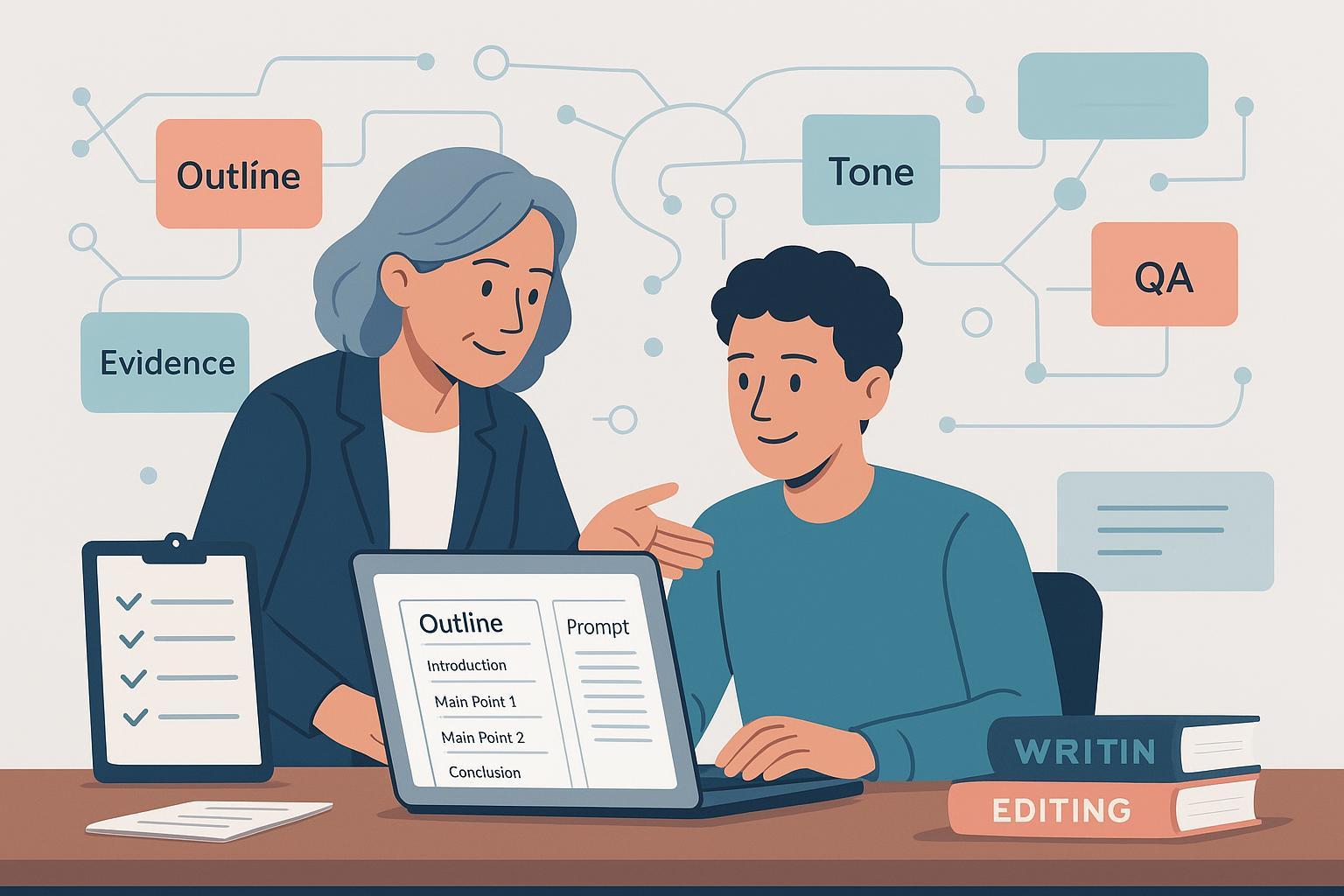
If you manage junior writers, AI can feel like a moving target: helpful in bursts, risky when overused. Here’s the deal—AI becomes a training multiplier when you use it to build fundamentals on purpose: clarity, evidence, structure, and voice. Treat it like a coach and scaffold, not a shortcut to publish faster, and you’ll see quality rise while feedback loops tighten.
Where AI Actually Helps (and Where It Doesn’t)
AI shines when it supports micro-skills and editorial thinking:
- Research scaffolding and outline critique so juniors start with a strong structure.
- Variant ideation for ledes, angles, and headlines to widen the option set.
- Tone and style coaching against your style guide (concise, jargon-light, audience-aware).
- Revision suggestions to cut filler, strengthen claims, and improve transitions.
- QA prompts that remind writers to check citations, dates, and names.
Avoid turning it into a content factory. Google’s policy updates in 2024 targeted scaled, low-value pages and spam tactics; the message was clear: quality and originality win. See Google’s own explanation in New ways we’re tackling spammy, low‑quality content (March 2024), which describes enforcement against scaled content abuse and other patterns of unhelpful pages: Google Search update (March 2024). And to perform in AI experiences, Google emphasizes unique, people-first content and intent alignment; their 2025 guidance lays that out in Succeeding in AI Search (Google Developers, 2025).
Keep the human in the loop, prohibit mass generation, and require sources and lived or tested experience within each piece. That’s your guardrail set.
A Repeatable Six-Week Training Plan
Start with a cohort or 1:1, then recycle the cadence for new hires. Each week includes a practice focus, an AI role, and a checkpoint.
Week 1: Baseline and policy onboarding
Give juniors a short reading pack (Google’s March 2024 update summary and 2025 AI Search guidance) plus your style guide. Run a baseline assignment (600–800 words) to score against a rubric: thesis clarity, evidence use, structure, tone, and link hygiene. Use AI for outline critique and lede variants, but require writers to explain what they kept, changed, or rejected—and why.
Week 2: Evidence-first writing and link hygiene
Teach “evidence precedes claim.” Have juniors revise paragraphs so the data or quote comes first, then the takeaway. Require a claims log with sources. Use AI to propose revision options, but all facts must trace to credible, original sources. For a quick primer on upstream verification and source checks, point them to the SMU Libraries fact-checking checklist.
Week 3: Tone control across personas
Assign three short rewrites of the same section for different audiences (e.g., technical buyer, executive sponsor, practitioner). Use AI as a tone coach: ask for suggestions to tighten sentences, remove fluff, and match voice constraints. Writers choose, edit, and explain their choices in a reflection note.
Week 4: Drafting with AI—under guardrails
Writers produce a full draft with AI as an assistant for outline, examples, and edits—but not as an authority on facts. Require hallucination guardrails in prompts (e.g., “list facts with URLs before drafting; if insufficient evidence, say so”). Keep a human-led fact pass and a link hygiene sweep before editor review. Northwestern’s stepwise use of AI across brainstorming, outlining, drafting, and revising is a helpful model in Breaking down the writing process with AI (Northwestern IT, 2024).
Week 5: Disclosures and transparency
Walk through when and how to disclose sponsorships, gifts, or affiliations. Disclosures must be clear and conspicuous, placed early, and easy to understand. The FTC’s official hub collects examples and rules; have writers practice placing and wording based on the FTC Endorsements and Influencers guidance. If you note AI assistance where readers would reasonably expect it, include a simple statement (see examples below).
Week 6: Capstone and retrospective
Each junior delivers one publish-ready piece under supervision. Score it with the rubric and compare to Week 1. Review KPI deltas and agree on a personal development plan, with one or two focus skills for the next month.
Reusable Prompt Templates
Use these as starting points. Always include audience, goal, constraints, and examples; adapt the voice to your style guide.
| Purpose | Example prompt (adapt and add your context) |
|---|---|
| Outline critique | “You are a senior editor for [audience]. Given this brief [paste], propose an outline with H2/H3s. Identify missing subtopics and flag jargon. Conform to this style: [constraints].” |
| Lede sharpening | “Act as a managing editor. Rewrite this lede to state the thesis in one sentence, add a concrete benefit for [audience], and cut filler. Provide 3 variants with different narrative angles.” |
| Tone alignment | “Rewrite the following paragraph for a [B2B SaaS] audience in a [confident, plainspoken] voice. Keep technical accuracy. Aim for 10–14 words per sentence. Remove buzzwords.” |
| Evidence integration | “Revise this section to foreground evidence. Place the statistic before the claim, cite the source inline with the URL in brackets, and remove hedging verbs.” |
| Hallucination guardrails | “Before drafting, list the specific facts you will use and their source URLs. If you can’t find credible sources, respond ‘insufficient evidence’ and ask clarifying questions.” |
| Headline variants | “Generate 10 headline options (≤60 characters). Include 2 outcome-focused, 2 ‘how to,’ and 2 contrarian options. Avoid clickbait.” |
| QA nudge | “Scan this draft for: missing citations, outdated dates/titles, unclear transitions, and passive voice. Return a checklist of fixes.” |
Think of these like gym machines: they don’t do the workout for your writers, but they target the right muscle groups.
Fact-Checking and Link Hygiene (mini-SOP)
- Build a claims log for every draft. For each non-obvious fact: source, date, author/publisher, and a one-line method note if relevant (sample, scope).
- Prefer primary or canonical sources (official docs, original research, authoritative institutions). Replace secondary roundups if you can find the original.
- Verify names, titles, versions, and dates. Follow the link to the exact page; avoid homepages when a specific document exists.
- Quote or paraphrase faithfully and attribute. If a statistic can’t be verified, cut it or label it clearly as an estimate with context.
- Do a link hygiene pass: remove tracking where possible, fix dead links, and avoid spammy domains.
Editor QA Checklist (people-first, accuracy-first)
- Claims and citations: every factual claim that isn’t common knowledge has a credible source; URLs are present and current.
- Voice and tone: matches brand style; sentences are concise; jargon is justified for the audience.
- Originality: unique insights or examples; no templated filler; paraphrases are transformed and attributed when needed.
- Factual integrity: numbers, names, and product/policy details confirmed; no contradictory statements.
- Hallucination checks: any AI-suggested facts verified against sources; “insufficient evidence” prompts addressed.
- Readability and structure: clear thesis; logical section flow; strong lede and resolved close; smooth transitions.
- Compliance: disclosures present where required; image and data rights respected; no sensitive client data pasted into third‑party tools.
Measurement Starter Pack (track weekly during the program)
- Acceptance rate: percent of drafts accepted without major rewrite.
- Revision cycles per draft: average rounds to editor sign-off.
- Factual correction rate: number of corrections after editorial pass; target a steady decline.
- Time-to-publish: median time from first draft to publish-ready.
- Guideline adherence: rubric score for style, structure, and compliance items.
- Source quality index: share of citations from primary/official or peer‑reviewed sources.
- Disclosure compliance rate: percent of pieces with correct, early placement of required disclosures.
Compliance Basics and Disclosure Examples
When there’s a material connection (payments, free products, affiliate ties, employment), disclosures must be clear and conspicuous—hard to miss, plain language, and placed where the reader will see them right away. The FTC explains expectations and examples in its official resource: Endorsements, Influencers, and Reviews (FTC).
Sample disclosure snippets (adapt to your policies and counsel):
- “Sponsored by [Brand]. The views are my own.”
- “We received a free [product/service] from [Brand] for this review.”
- “This article includes affiliate links. If you buy through them, we may earn a commission.”
- “AI assistance was used for outlining and copy edits; all facts were verified by the editor.”
Avoid legalese; make it obvious and early. Place the disclosure near the headline or within the opening section, not buried at the end.
Risk Management: Hallucinations, Detection Tools, and Privacy
Hallucinations and factual drift happen when writers let AI invent sources or fill gaps with guesses. Guard against this by prompting for sources before drafting, running a human fact pass, and allowing “insufficient evidence” as a legitimate outcome. Keep the stance that AI is a suggestion engine, not an authority.
What about AI-detection tools? They’re unreliable for high‑stakes decisions. OpenAI sunset its own text classifier for low accuracy and warns about overconfidence in detectors; see their note in AI text classifier discontinued (OpenAI). Sector guidance in 2025 echoes this: detectors can flag false positives and are easy to evade, so don’t use them as sole evidence; instead, rely on process controls and human judgment as outlined by Jisc’s AI detection assessment (2025).
Privacy and inputs matter too. Don’t paste client-confidential or regulated data into third‑party tools unless you have approved controls and a data-processing agreement. Train writers to anonymize or synthesize examples during drafting and to check vendor data retention settings.
Put It Into Motion
Pilot this program with two or three juniors for six weeks. Use the prompts, run the mini‑SOP and QA checklist, and track the starter KPIs. You’ll build stronger habits, reduce revision cycles, and ship better work—without handing the pen to a machine. Ready to try it with your next onboarding cohort?