How to Use AI to Rewrite Old Articles Without Hurting SEO

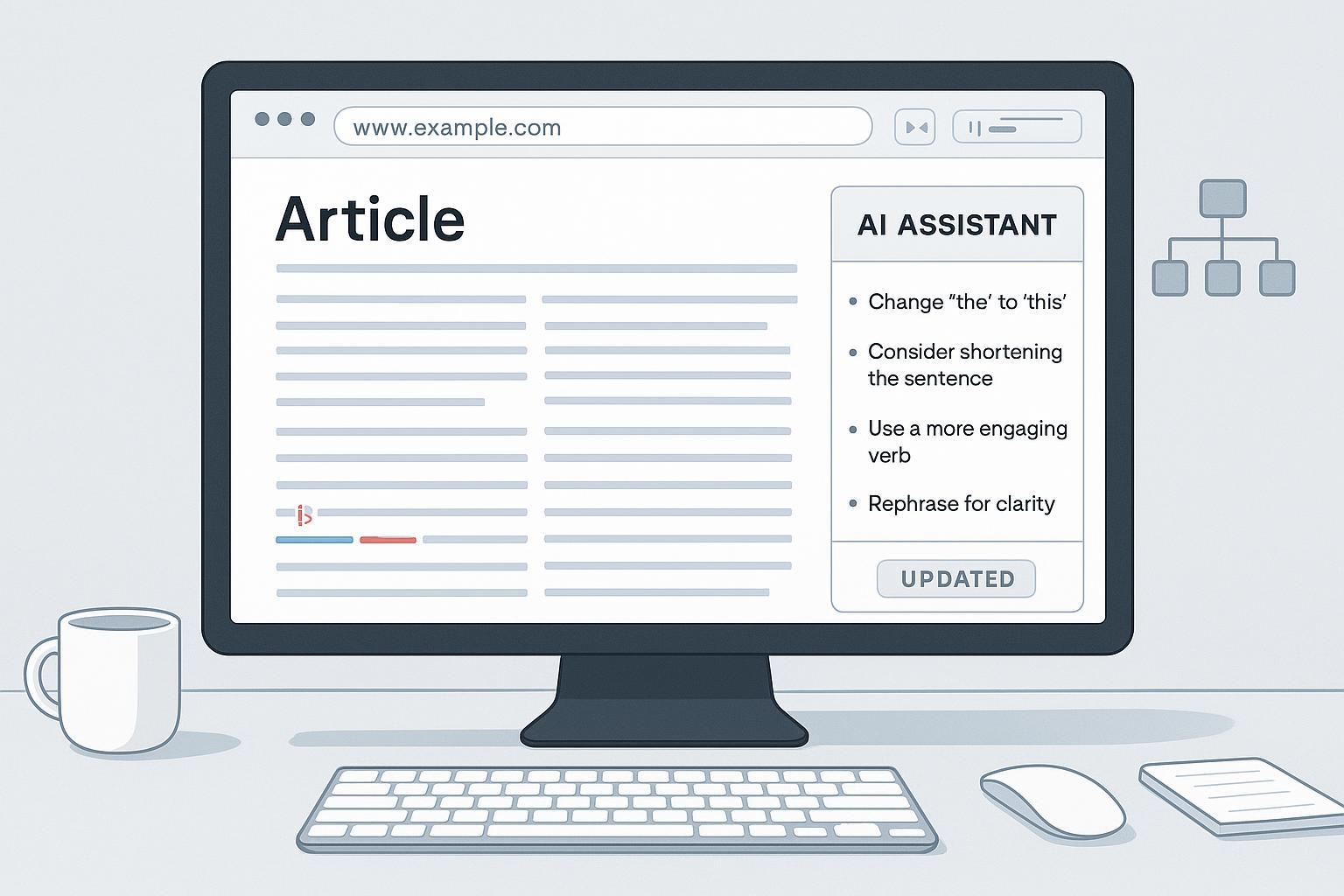
If your older posts are slipping in rankings or feel dated, AI can help you refresh them fast. But here’s the deal: thin paraphrasing can trigger spam signals and even copyright issues. The goal is transformation—adding new value, reorganizing for clarity, and demonstrating experience—so the page becomes more helpful than the original.
Google’s policies focus on content quality, not how it’s made. In 2024, Google expanded spam policies to address scaled, low-value pages regardless of human or automated origin, and the guidance in 2025 emphasizes creating “unique, non-commodity content” that satisfies readers. See Google’s details in the March 2024 update and spam policies, and the 2025 guidance on succeeding in AI Search: core update and spam policies (March 2024) and Succeeding in AI Search (May 2025).
1. Decide the right refresh path
Not every post needs a full rewrite. Classify each URL and choose the least risky path.
| Refresh level | When to choose it | What you’ll do | Key SEO signals |
|---|---|---|---|
| Light refresh | Minor facts or broken links; small clarity edits; ranking stable | Update stats, fix links, tighten phrasing, add alt text | Keep URL; keep original publish date; set dateModified; no redirect |
| Heavy rewrite | Intent drift; outdated sections; new data and structure needed | Reorganize, add sections, replace obsolete info, add citations and examples | Keep URL; update title/meta; show “Updated on …”; set dateModified |
| New page & redirect | Old post can’t meet new intent or targets a distinct query | Publish new page; migrate best content; retire old | 301 from old to new; update internal links; consolidate signals |
2. Preserve SEO continuity
Your URL carries accumulated signals. Prefer to keep it. If you must change the slug, implement a permanent (301) redirect from the old URL to the new one and update internal links to point to the canonical destination. Google’s documentation on consolidating duplicate URLs and canonicalization explains how redirects, rel=canonical, sitemaps, and consistent internal linking guide selection: consolidate duplicate URLs.
- Keep the original URL whenever feasible.
- If the slug changes, add a 301 redirect and update all internal links to the new canonical.
- Avoid splitting similar pages without clear differentiation; consolidate to one best page.
3. Build a gap-driven brief
Before you touch the prose, study the current SERP and your analytics. What do top pages cover that yours doesn’t? Which examples, definitions, or data are outdated? Which intent does the query now reflect?
Create a short brief that guides AI and human editors:
- Target intent and audience outcome.
- Sections to add, remove, and reorganize.
- Facts to update and authoritative sources to cite.
- Unique angles: first-hand steps, screenshots, case notes, comparisons.
4. AI-assisted transformation (not paraphrasing)
Use AI to help synthesize, reorganize, and clarify—then add human experience. Prompts should steer toward value-adding changes.
You are an editor helping me transform an outdated article.
Goals: clarify steps, add missing sections, update facts with citations, and preserve brand voice.
Inputs: original article text + my notes (intent shift, sections to add/remove).
Constraints:
- No 1:1 paraphrasing. Propose a new structure and explain why.
- Flag outdated data and suggest current authoritative sources to cite.
- Insert 1–2 unique examples or mini-case notes I provide.
- Keep reading level ~Grade 9–10; reduce redundancy; improve headings and alt text.
Outputs: outline + revised draft with inline notes for human review.
Style preservation matters. Ask the AI to match tone and reading level, and to surface accessibility upgrades (clear headings, descriptive alt text, readable contrast suggestions). Then you step in to add first-hand insights, pick sources, and approve the structure.
5. Strengthen E-E-A-T
How do you show readers—and algorithms—that your update is trustworthy?
- Add experience: detail the steps you actually followed, include screenshots, or short anecdotes.
- Show expertise: include a byline and credentials; if needed, have an expert review the piece.
- Build authoritativeness and trust: attribute data points with links to original sources; avoid orphan claims. Google’s guidance stresses helpful, people-first pages with clear experience and expertise; see Succeeding in AI Search (2025).
6. Legal and ethical guardrails
This section provides practical guidance and a brief disclaimer; it isn’t legal advice.
- Human authorship: The U.S. Copyright Office registers human-created works, not machine-generated output alone. For AI-assisted content, ensure meaningful human selection, arrangement, and original additions. See the Office’s AI policy and 2025 report: AI policy guidance (Mar 2023) and Copyrightability Report, Part 2 (Jan 2025).
- Derivative works: Close paraphrasing of someone else’s article can still infringe if substantially similar. Create original expression and add unique value.
- Fair use basics: Transformative uses (commentary, criticism, reporting) can weigh in favor, but commercial, market-substituting rewrites often weigh against. Review the factors in Circular FL 102 and consult counsel for edge cases.
Short disclaimer: This guide shares operational practices, not legal advice. For specific scenarios, consult an attorney.
7. Republishing mechanics that don’t trip Search
Dates and discoverability should be accurate and honest.
- datePublished vs dateModified: Keep the original datePublished; update dateModified when you make substantive changes. Show a user-visible “Updated on …” label near the top. Google’s publication date guidance explains how to present and mark dates: publication dates guidance. Use Article/BlogPosting structured data with ISO 8601 timestamps: Article structured data.
- Sitemaps and reindexing: Let normal crawling handle most updates. Use sitemaps to help discovery and request indexing only for priority pages. See sitemaps overview.
8. QA checklist
Before you hit update, run a tight review. Think of it as your safety net.
- Originality and plagiarism: Scan for similarity; manually spot-check against sources; avoid thin paraphrasing that risks spam signals.
- Facts and citations: Verify claims with primary sources; use descriptive anchor text; limit external links to authoritative domains.
- Structure and schema: Validate Article markup and dates with Google’s Rich Results Test and Schema Markup Validator: Rich Results Test and Schema Markup Validator.
- Accessibility: Check headings hierarchy, alt text, and contrast. Validate against WCAG 2.2 using recognized tools.
- Tech SEO: If a slug changed, confirm 301 redirect is live; update internal links; check canonical selection in Search Console.
9. Measure, learn, and iterate
After publishing, monitor performance and make adjustments. In Google Search Console, review coverage/indexing, enhancements, and the Performance report for queries, CTR, and positions. Confirm the canonical and last crawl date via URL Inspection.
Watch for:
- Ranking and CTR shifts for main queries.
- Engagement changes: time on page, scroll depth, conversions.
- If metrics dip, analyze intent alignment, on-page clarity, and internal linking. Iterate the brief and update again—or roll back to the previous version while you reassess.
A final thought: AI is your assistant, not your author. When you use it to amplify human judgment, add original insights, and keep your technical signals clean, old articles can earn a second life—without hurting SEO or crossing legal lines. Ready to refresh, not rehash?