How to Turn Research Notes Into Long-Form Content

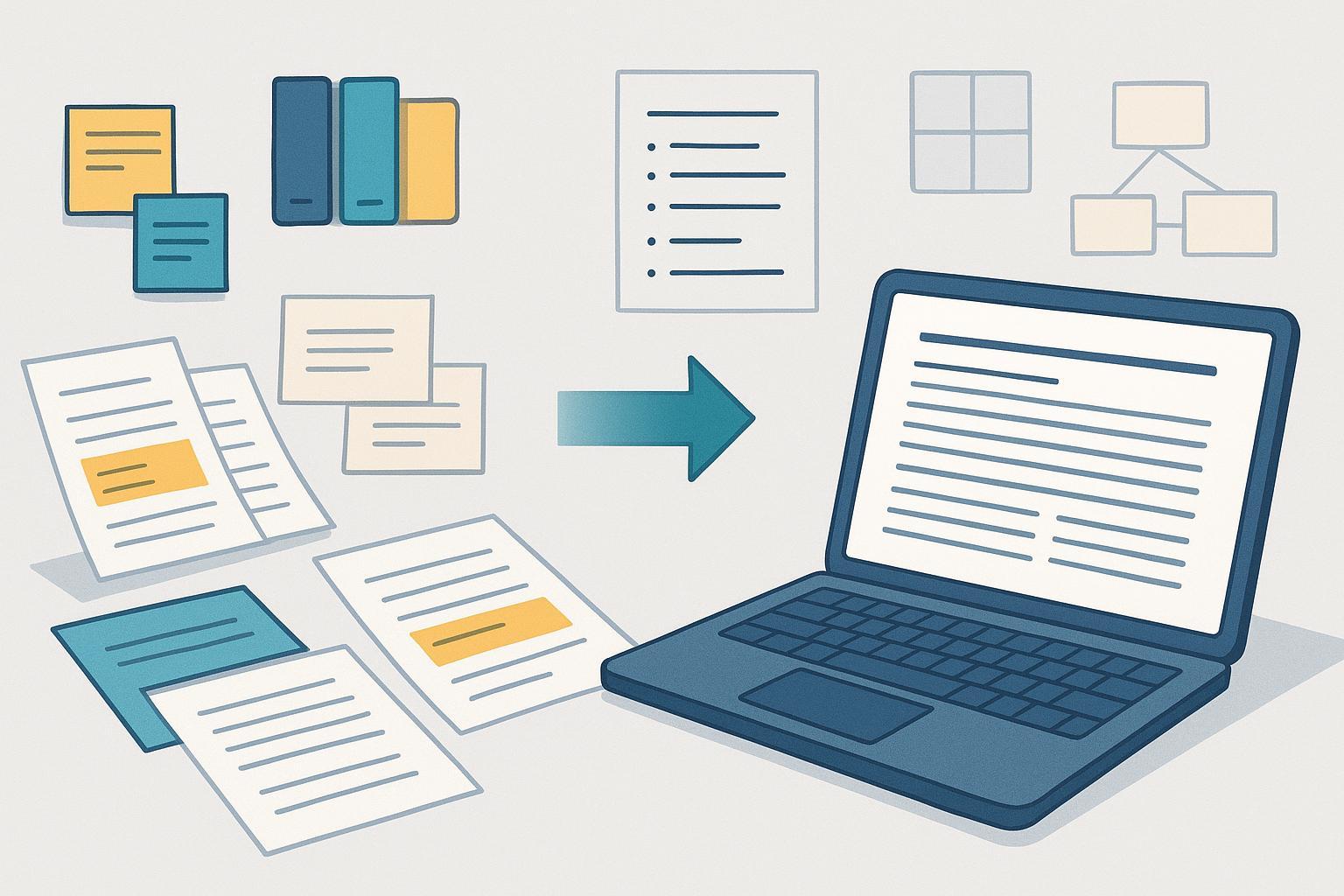
You’ve got highlights, clippings, transcripts, and a dozen “great points” parked in different apps—but the page stays blank. Here’s the deal: you don’t need more notes; you need a repeatable way to turn what you already collected into a clear argument with credible evidence. This guide walks you through a practical pipeline—from triage to outline to smooth prose—grounded in proven methods you can reuse on any project.
Step 1: Triage and normalize your notes
Start by pulling everything into a single intake space. Add lightweight metadata so nothing gets lost in translation: author, year, link/DOI, page or timecode, plus a simple status label (raw, processed). As you skim, consolidate duplicates and mark obvious dead-ends. This early tidying pays off later when you’re moving quickly between claims and citations.
Acceptance check: Could a teammate trace any claim back to an original source in two clicks or less? If not, improve your metadata and filing.
Step 2: Stage your material with PARA
Give your project a dedicated home. In the PARA approach—Projects, Areas, Resources, Archive—you’ll keep only the pieces that serve this single deliverable in the Project space and shove nice-to-have background into Resources. Archive aggressively to reduce clutter. Done right, retrieval feels instant because you’re not digging through unrelated material. For background and implementation, see Tiago Forte’s original explanation of the PARA framework.
Why it works: project-centric staging minimizes context switching. You’ll spend less time hunting and more time synthesizing.
Step 3: Distill ideas with atomic and structure notes
Big, messy highlights don’t draft themselves. Break them down into “atomic” notes—single ideas rewritten in your own words—and link related ideas together. Over time, promote durable insights into evergreen notes and map clusters using structure notes that read like proto-outlines. The community hub at zettelkasten.de’s introduction explains these building blocks and how linking turns fragments into a network you can write from.
Think of it this way: instead of writing from scratch, you’re rearranging already-clarified ideas.
Step 4: Build a synthesis matrix to compare sources by theme
A synthesis matrix helps you move beyond “source-by-source summaries” to see patterns. Define your question, list key themes, line up your sources, and fill intersections with paraphrased findings, context/methods, and select quotes you might use. For an academic-style overview of how this works, Johns Hopkins outlines synthesis with examples in its library guide on literature reviews.
Mini example (themes as rows, sources as columns):
| Theme / Claim | Source A (Author, Year) | Source B (Author, Year) | Methods/Context | Synthesis Notes |
|---|---|---|---|---|
| Onboarding emails increase activation | A: +18% activation; randomized test | B: No effect in enterprise cohort | A: B2C SaaS; B: B2B enterprise | Works in self-serve products; effect vanishes with sales-led onboarding |
Use the Synthesis Notes column to mark consensus, contention, and gaps you’ll address in your draft.
Step 5: From themes to thesis and a MECE outline
Read down your matrix: where do sources converge, and where do they diverge? Draft a guiding question and 2–4 core claims that answer it. Then shape your outline using the MECE principle—Mutually Exclusive, Collectively Exhaustive—so sections don’t overlap and together cover the whole story. For a writer-friendly primer, see Animalz’s explainer on the MECE principle for content.
Practical cues:
- Give each H2 a clear, parallel form (e.g., “Claim: …,” “Evidence shows …,” “Implications for …”).
- Run two tests: Can any paragraph fit under two different sections? Is any major angle missing? If yes, revise.
Step 6: Draft from scaffolds using progressive summarization
You don’t have to leap from bullets to polished prose. Start with a scaffold for each section: the claim, the key reasoning, and a few evidence notes linked to your sources. Then expand in layers—bold the best lines, write a one-sentence summary at the top of each note, and gradually transform bullets into paragraphs. Tiago Forte’s technique of Progressive Summarization is a reliable way to make notes glanceable and draft-ready.
Before/after example:
- Before (bullets): “A shows +18% activation; B no effect; likely context-specific; quote from A p.14.”
- After (prose): “Across self-serve SaaS products, randomized tests report an 18% activation lift from onboarding emails, while enterprise cohorts show no measurable effect. The difference appears to hinge on the presence of a sales-assisted onboarding path, which reduces the email’s marginal value.”
Write transitions early. Bridge sentences that compare clusters (“While A finds a lift in self-serve contexts, B shows no effect in sales-led environments…”) force you to articulate relationships, which tightens the argument.
Acceptance check: Each section states a claim, supports it with at least two credible sources, and ends with a sentence that sets up the next section.
Step 7: Integrate evidence ethically and transparently
Paraphrase after you’ve genuinely understood the source: read, close it, write from memory, then compare and fix. Attribute paraphrases and reserve quotations for phrasing you truly need. Purdue OWL’s guidance on quoting, paraphrasing, and summarizing explains how to avoid patchwriting while giving credit. In your notes, label what’s a direct quote (with page/timecode), what’s your paraphrase, and what’s your commentary.
Traceability tip: Keep a simple claim–evidence map that lists each claim and the citation keys that support it. It doubles as a fact-checking checklist.
Step 8: Check readability, cohesion, and traceability
Style targets aren’t laws, but they help you spot trouble. For general-audience long-form, aiming around Flesch Reading Ease 60–70 or a Grade Level near 8–9 is often easier to scan; adjust if you’re writing for specialists. See Nielsen Norman Group’s discussion of readability, legibility, and comprehension for why sentence length and word choice matter.
Cohesion check: Does each paragraph explicitly connect evidence to the claim it supports? Are you signaling conditions and limits (“in B2C only,” “small sample,” “observational data”)?
Traceability check: Can you jump from any sentence with a fact to the source in seconds? If not, add citation keys or links in comments.
Optional: Use AI to accelerate clustering—carefully
AI can help group notes by theme and draft preliminary summaries, but you need a human in the loop to verify claims, spot bias, and connect outputs back to sources. Keep outputs extractive before you go abstractive, verify every factual assertion, and never accept autogenerated citations without checking the original.
Quick, safe workflow: clean inputs → cluster notes by theme → request extractive summaries → verify against originals → add your synthesis.
Troubleshooting: quick answers when you get stuck
- Conflicting sources: Separate findings by context or method in your matrix; report where claims hold versus where they don’t. If the conflict persists, include both and explain the conditions.
- Uneven note quality: Rewrite raw highlights as atomic paraphrases. Flag unknowns and do targeted follow-up reading instead of aimless searching.
- Outline gaps or overlaps: Re-run the MECE tests. If a theme can sit under two headings, restructure; if a key angle is missing, add a section or explicitly de-scope.
- Weak transitions: Draft bridge sentences that contrast clusters (“Although X shows…, Y undercuts it when…”). These reveal logical jumps you need to fix.
Put the workflow on rails
You now have a simple, repeatable system: normalize notes → stage with PARA → distill into atomic and structure notes → build a synthesis matrix → shape a MECE outline → draft with progressive summarization → check ethics, readability, and traceability. Will every project follow it perfectly? Of course not—but even adopting half of it will reduce overwhelm and speed up drafting.
If you want to go deeper, keep these references close:
- PARA organization: Tiago Forte’s PARA framework guide
- Zettelkasten building blocks: Introduction at zettelkasten.de
- Synthesis techniques: Johns Hopkins literature review guide
- Structuring: Animalz on MECE for content
- Drafting from notes: Progressive Summarization
- Ethics: Purdue OWL on paraphrasing and quoting
- Readability: NNGroup on readability and comprehension