How to Refresh Outdated Articles Using AI

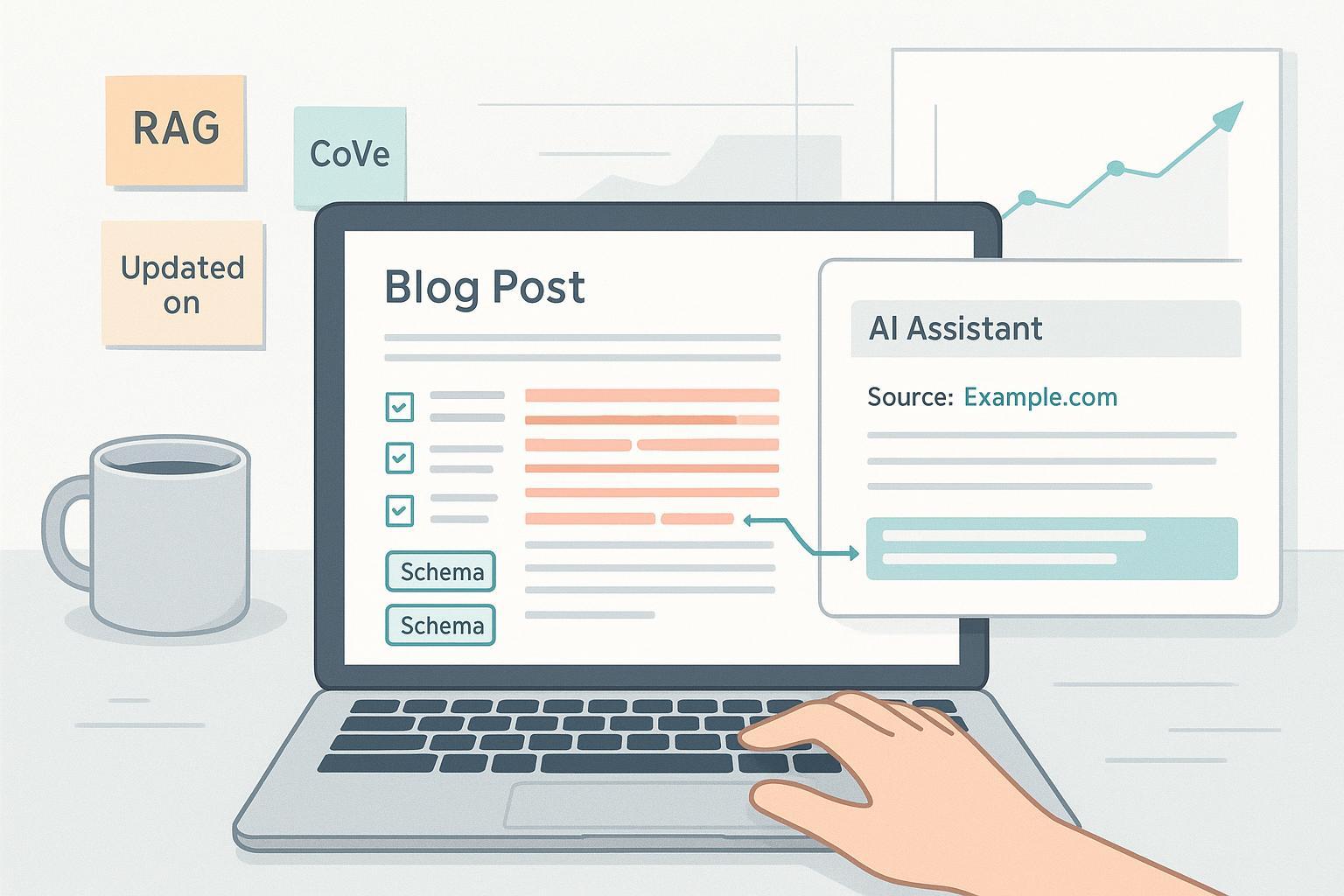
Content decay sneaks up on even the best blogs. Rankings slide, CTR dips, and once-stellar posts stop pulling their weight. AI can help you turn those posts around—if you pair it with editorial rigor, trustworthy sources, and a clean technical update. Here’s a safe, repeatable workflow that teams are using right now to revive performance without risking quality or trust.
1) Find and prioritize what to refresh
Start with evidence. In Search Console and analytics, compare the last 3–6 months to the prior period for each post. Look for decays in clicks, impressions, CTR, and average position, and shortlist URLs that still sit on pages 1–2 (highest ROI to recover). Google’s quality systems now demote low-value content more aggressively—after the March 2024 changes, Google reported showing “45% less low-quality, unoriginal content” in results—so refreshes must add real value, not surface edits. See Google’s statement in the March 2024 update coverage: the reduction of low-quality results was documented there in 2024–2025 context in the Search blog: Google Search update (March 2024): low-quality content reduction.
Use a simple decision tree: keep as-is, update, overhaul, merge, or remove. Posts with intent drift or outdated facts usually need an update; posts that miss the mark structurally or target the wrong queries need an overhaul; overlapping posts may merit a merge. Removing thin, unfixable pages can lift overall quality signals.
Signals that a post deserves a refresh rather than a rewrite:
- It still earns impressions for target queries but CTR and position slipped.
- Search intent evolved (e.g., new tool landscape or steps) and your outline no longer matches.
- Data, screenshots, or examples are older than 12–18 months.
- Competing results now lead with formats you lack (FAQ, step-by-step visuals, up-to-date stats).
2) Plan the update: match intent and define scope
Before you write a word, reconfirm the user’s job-to-be-done. What query families should this post serve, and what does success look like for the reader? Compare the top results’ patterns against your outline. Trim bloat, decide what must be rewritten, and set acceptance criteria for the refresh.
Make a one-page change brief that includes:
- Target queries/themes and the primary job-to-be-done.
- Sections to prune, sections to expand, and any new visuals.
- Inputs: trusted sources, your product or experience notes, style guardrails.
- Success metrics (e.g., recover top-5 ranking for the head term; raise CTR by 15% in 30–45 days).
- Publication/date policy (update visible date only if changes are substantial).
Google’s current stance is simple: helpfulness over method. AI assistance is fine when the output is original, reliable, and people-first. For that north star, see the 2025 guidance in Google’s “Succeeding in AI Search”.
3) A safe-by-design AI workflow (RAG + CoVe + human QA)
Think of AI as your research and drafting copilot—not the final authority. Your system should be designed to ground claims in evidence, verify them, and require human sign-off.
Grounding with retrieval-augmented generation (RAG)
- Curate recent, citable sources (official docs, standards bodies, high-credibility publishers). Retrieve summaries and relevant passages as context for the model.
- Constrain prompts to cite sources inline and to flag statements it can’t support.
- Keep a source list in your changelog so reviewers can cross-check.
Verification with Chain-of-Verification (CoVe) and self-consistency
- After a draft, run a verification pass that asks the model discrete questions about each factual claim and cross-checks against your sources.
- Use self-consistency (multiple sampled answers) to detect conflicts and route them to human review.
The academic and engineering literature supports these patterns. A 2024 survey details techniques to reduce hallucinations, including citation grounding and verification loops: Hallucination mitigation survey (arXiv, 2024). In practice, keep it simple: require citations, verify key facts, and log uncertainties for a human editor.
Human-in-the-loop quality gates
- Reviewer must approve every changed claim, new stat, and definition.
- Add expert review for YMYL-adjacent topics (health, finance, legal). Note the reviewer byline or an “expert-reviewed” line where appropriate.
- Maintain a visible revision note (“Updated on {date}: added new sources, refreshed steps, replaced screenshots”).
Practical prompt pattern (adapt to your stack): Use constraints inline instead of long, fragile instructions. For example: “Using only the sources in context, rewrite the section to match the outline. Cite source name and year in parentheses once per paragraph. If a claim isn’t supported, write ‘[uncertain]’ and propose a question for the editor.”
4) Refresh the page: editorial and technical moves
Rewrite the intro and H2s to meet current intent Open with the problem the reader feels and the outcome your guide delivers. Adjust H2s to mirror how searchers scan today—fewer generic headers, more how-to phrasing and decision points. Replace dated examples and add 2024–2025 realities (e.g., how Google treats low-value content, the shift in rich results eligibility).
Update facts, tools, and examples with citations Swap old stats and tool references for current ones sourced via your RAG step. If you can’t verify a claim, either remove it or add a brief note explaining uncertainty and what changed.
Tune titles, meta, and CTR Craft a title that sets a clear promise, then write a meta description that previews the benefit and differentiator (e.g., “RAG + verification + date policy”). Don’t stuff keywords; use natural phrasing that improves CTR.
Media refresh Replace or add screenshots and simple diagrams that explain the workflow. Compress images and add descriptive alt text so they’re accessible and indexable.
Internal links Repair and add contextual links to relevant hubs and related guides. Use descriptive, natural anchors and standard links so Googlebot can crawl them. Google’s documentation emphasizes that anchor text should be descriptive and links should be crawlable; see Google’s links best practices for details on anchors, elements, and image alt text as anchors.
Structured data and rich result expectations Use Article/BlogPosting markup with accurate author, headline, image, datePublished, and dateModified. Validate in the Rich Results Test and fix warnings. Be realistic about rich results: Google announced in 2023 that FAQ rich results are generally limited to authoritative government and health sites, and HowTo is shown primarily on desktop now; see Google’s HowTo and FAQ changes (Aug 2023).
Date policy: visible and structured Display a prominent “Updated on {Month Day, Year}” only when changes are substantial (new sections, significant rewrites, or major fact updates). Keep datePublished as the original publish date unless the article is effectively republished. Ensure your visible date matches Article structured data and the sitemap lastmod. Google documents date handling and consistency rules here: Publication dates in Search results (2025).
Quick planning table: effort and difficulty
| Step | Typical inputs | Effort (per URL) | Difficulty |
|---|---|---|---|
| Audit & prioritization | GSC/GA4 trends, SERP scan | 45–90 min | Medium |
| Change brief | Outline, sources, acceptance criteria | 30–60 min | Medium |
| AI-assisted drafting | RAG context, prompts, citations | 60–120 min | Medium–High |
| Human review & SME check | Claim-by-claim verification | 45–90 min | High |
| On-page & technical | Titles/meta, schema, media, links | 45–90 min | Medium |
| Publish & monitor | Dates, internal links, dashboards | 15–30 min | Low |
5) Publish, promote, and monitor
Only update the visible date and dateModified when you’ve made meaningful changes; otherwise, keep the original publish date and add a small changelog line. This avoids “freshness theater” and aligns you with Google’s date guidance.
Give the refreshed post new paths for discovery. Add 2–3 contextual internal links from relevant pages and repromote via social and your newsletter. Monitor results weekly for 2–4 weeks, then assess fully at 30–45 days.
Use this lean checklist to judge whether the refresh is landing:
- Recovery or growth in average position and impressions on target queries within 2–4 weeks.
- CTR improvement of 10–25% after your title/meta update.
- Traffic uplift of 20–50% within 30–45 days for the refreshed URL (directional, varies by niche).
- Better engagement signals (higher time-on-page, lower pogo-sticking), plus new internal link clicks.
The directional ranges above reflect common outcomes from practitioner reports; see one practical overview with case examples in Surfer’s content refresh guide.
Troubleshooting: common snags and quick fixes
Dates display incorrectly in SERPs
Ensure your visible “Updated on” matches dateModified in Article structured data and the sitemap lastmod. Avoid multiple, competing dates on the page. Google’s date documentation covers the pitfalls and fixes in detail: Publication dates in Search results (2025).
Schema marked up but no rich results Eligibility isn’t guaranteed. Validate with the Rich Results Test, ensure required properties are present, and remember that FAQ is limited and HowTo is desktop-oriented now per the 2023 announcement: HowTo/FAQ changes.
Internal links aren’t being crawled or helping Use standard links, avoid JavaScript-only navigation for key links, and write human-readable anchors. Cross-link from relevant, higher-authority pages. Reference Google’s guidance on anchors and crawlable links: links best practices.
AI draft contains shaky claims Rerun the section with tighter constraints: require citations in every paragraph, block unsupported facts with “[uncertain],” and trigger a human review step. The 2024 survey of mitigation techniques underscores grounding and verification loops as practical guardrails: Hallucination mitigation survey (arXiv, 2024).
Putting it all together
Here’s the deal: refreshing with AI isn’t about cranking out more words. It’s about making the page more accurate, more useful, and easier to trust. If you make data your compass (GSC trends), ground new claims with citations (RAG), verify what you add (CoVe and human review), and clean up the technicals (schema, dates, internal links), your refreshed posts can rebound fast.
A quick next step you can do today: pick three posts with recent drops but ongoing impressions, draft a one-page change brief for each, and run the RAG + verification workflow for a single section. Ship one updated URL this week, then watch the 30–45 day window for movement. What would that lift mean for your pipeline next quarter?