How to Pass Google Quality Rater Guidelines

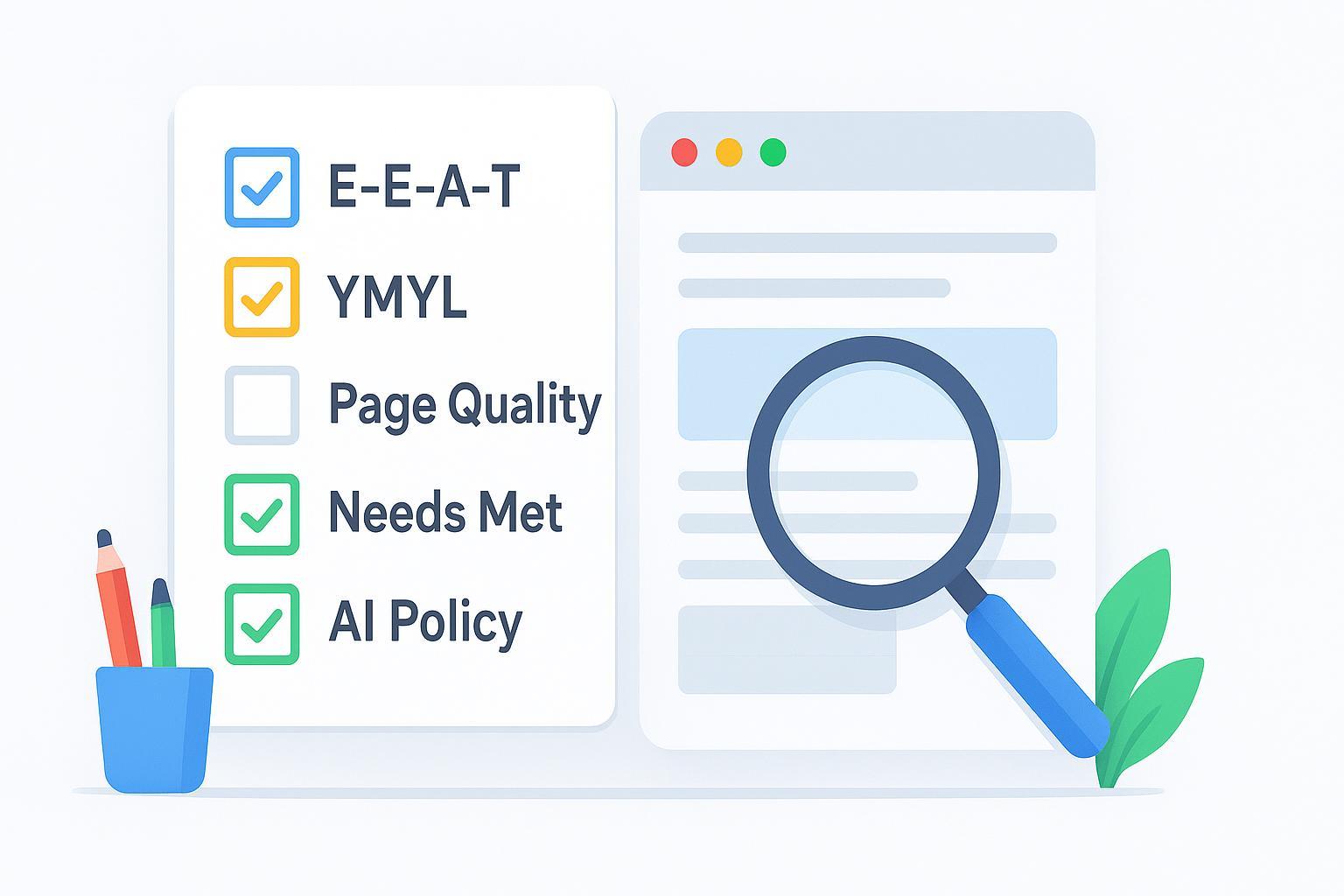
If you lead SEO, edit content in regulated niches, or simply want your site to earn trust, the Search Quality Rater Guidelines (SQRG) are your north star. Raters don’t change rankings directly, but their judgments help Google validate whether search systems reward helpful, safe results. Google has stated that these guidelines help evaluate ranking systems and don’t directly influence ranking; see Google’s E‑E‑A‑T overview and the 2023 SQRG update post.
This guide turns SQRG concepts—Page Quality (PQ) and Needs Met (NM)—into a practical playbook you can implement now.
What Raters Actually Evaluate
-
Page Quality (PQ): Raters look at the page’s purpose, any risk of harm or deception, the quality of the Main Content (MC), the creator/site reputation, and E‑E‑A‑T with trust at the center. Reference the canonical Search Quality Evaluator Guidelines PDF.
-
Needs Met (NM): Separately, raters judge how well a result satisfies the user’s intent for the query, device, and locale—considering dominant, common, and minor interpretations. Google clarified NM in late 2023; see the update notes.
Why does this matter to you? Because aligning with PQ and NM increases the odds that both users and systems recognize your pages as helpful, safe, and deserving of visibility.
The Pass‑or‑Fail Mindset: Start with Harm, Then Quality
Think of PQ as a gate. First, does the page have a beneficial purpose and avoid harm or deception? Only then do raters (and users) judge quality signals like E‑E‑A‑T and MC depth. A page can be detailed yet still fail if it presents risky medical advice without credentials, or if design patterns mislead users.
Quick scenario: A supplement page cites some studies and has long content. It still fails PQ because it implies disease treatment without medical review, uses ambiguous disclaimers, and buries affiliate disclosures. Before polishing headlines, you must remove harm and deception risks.
The Step‑by‑Step Playbook
1) Inventory and Risk Triage
Build a full list of indexable URLs with topic, traffic, last updated date, author, and YMYL exposure (health, finance, legal, safety). Prioritize risky pages (YMYL x high traffic x stale).
Acceptance criteria: Complete URL inventory; YMYL classification applied; last updated date and content ownership populated.
2) Purpose and Harm Screening
Write a one‑line “page purpose” at the top of each draft. Run a harm/deception checklist: Are disclaimers clear? Are CTAs honest? Are claims prescriptive without credible sources? Is anything outdated that could mislead?
Acceptance criteria: Purpose line present; critical harm/deception checks pass; YMYL flags raised where relevant.
3) E‑E‑A‑T Uplift
Add clear bylines with bios showing relevant experience/credentials. For YMYL, include an expert reviewer with credentials and a “last reviewed” date. Publish About, Editorial, Corrections, and Contact pages; enforce HTTPS; and, where applicable, use schema (author, reviewedBy, organization). Google’s framing of Experience, Expertise, Authoritativeness, and Trust is covered in the E‑E‑A‑T explainer.
Acceptance criteria: All articles show an author; YMYL pages show reviewer + review date; trust pages exist and are accessible; HTTPS active; structured data validates without critical errors.
4) Evidence and Sourcing Discipline
Back factual claims with authoritative citations. If you publish original data, include a methods block (sample, dates, collection methods) and link to datasets where possible. Prefer primary sources over summaries.
Acceptance criteria: Claim‑dense sections cite authoritative sources; original data includes transparent methodology; low‑credibility sites avoided.
5) AI Policy and Human‑in‑the‑Loop Review
Use AI to assist, not to mass‑produce thin pages. Document where AI is allowed (outlining, first drafts), how humans must add original insights and examples, and who fact‑checks. For YMYL, require subject‑matter expert (SME) review pre‑publish. Google’s stance focuses on people‑first quality, not the tool you used; see Google’s AI content guidance and avoid scaled content abuse prohibited in Search Spam Policies.
Acceptance criteria: Written AI policy; pre‑publish checklist completed; SME approval on YMYL; no mass publication of low‑value pages.
6) Needs Met Alignment
For target queries, capture dominant/common/minor interpretations by locale/device. Lead the page with the dominant task or answer; support other interpretations with concise modules and navigation.
Acceptance criteria: Each target query has an intent note; the opening section fulfills the dominant intent; secondary modules address common/minor intents without clutter.
7) UX, Ads, and Safety Controls
Keep the Main Content accessible. Label ads; avoid misleading buttons or interstitials. For calculators and tools, provide instructions, assumptions, and disclosures. Ensure safe browsing and honest CTAs. Baseline requirements sit under Google Search Essentials.
Acceptance criteria: No deceptive design patterns; ads clearly labeled; tools documented with assumptions; security flags resolved.
8) Maintenance and Updates
Set review cadences: YMYL every 3–6 months; evergreen non‑YMYL every 12–18 months. Add visible “Updated on” notes for material changes with a short change log. Deprecate obsolete content, fix broken links, and keep redirects tidy.
Acceptance criteria: Each page has a next review date; material updates labeled; quarterly link/redirect hygiene completed.
| Step | What to do | Acceptance criteria |
|---|---|---|
| 1. Inventory | Audit all indexable URLs; tag YMYL; map owners and freshness | 100% coverage; YMYL and ownership fields complete |
| 2. Purpose & harm | Write purpose line; run harm/deception checklist | No critical risks; YMYL flags visible |
| 3. E‑E‑A‑T | Add author bios; add reviewer + review date for YMYL; trust pages; HTTPS; schema | Bios live; reviewer visible on YMYL; schema validates |
| 4. Evidence | Cite authoritative sources; add methodology for original data | Strong citations per claim‑dense section; methods block present |
| 5. AI policy | Define AI usage; ensure human enrichment and SME review | Written policy; pre‑publish checks; SME sign‑off for YMYL |
| 6. Needs Met | Document intents; structure page to serve dominant intent first | Dominant intent satisfied above the fold |
| 7. UX & safety | Label ads; avoid deceptive patterns; document tools | Ads labeled; disclosures clear; safe browsing |
| 8. Maintenance | Set cadences; log updates; fix links/redirects | Next review dates set; quarterly hygiene done |
Examples You Can Emulate
-
Medical article (YMYL). Author is an RN or MD with an SME reviewer (credentials listed). Claims cite government‑backed or medical‑society primary documents. The intro gives the immediate answer users seek (e.g., “When to see a doctor”), followed by detail, risks, and sources. A visible “last reviewed” date sits near the byline. Result: Stronger PQ signals and better NM for symptom‑related queries. See criteria in the SQRG PDF.
-
Finance calculator. The page discloses assumptions (rates, compounding, fees), states data freshness, and includes risk language. HTTPS is enforced, and affiliate relationships are clear. Buttons are honest (“Calculate,” “Apply at lender”)—no dark patterns. Result: Trust increases and deceptive‑design pitfalls are avoided, aligning with Search Essentials.
-
AI‑assisted summary page. An editor uses AI for a first pass, then adds first‑hand experience, original comparisons, and authoritative sources. The team bans thin AI rewrites at scale and documents human review. Result: People‑first quality that complies with AI content guidance and avoids scaled content abuse.
Troubleshooting: Common Failure Patterns and Fixes
-
Low Page Quality (PQ). Symptoms: anonymous authors, thin or paraphrased text, missing or outdated sources, confusing or misleading layouts. Fix: add author bios and reviewer details, rewrite with original value and current primary sources, clean up layout and disclosures, and remove risky claims or link them to credible evidence. See the SQRG PDF.
-
Fails or Slightly Meets on Needs Met (NM). Symptoms: the page doesn’t answer the dominant intent or misses locale/device context. Fix: restructure to lead with the primary task/answer, add a concise module for the second most common intent, and ensure mobile usability matches how the query is used. Clarifications are reflected in Google’s 2023 update post.
-
Scaled content abuse. Symptoms: many low‑value pages, stitched or synonymized content, mass‑produced AI summaries with no original insight. Fix: remove or noindex low‑value sets, consolidate into comprehensive resources, add unique analysis or data, and pace publication. See Search Spam Policies.
For a concise industry recap of recent clarifications (e.g., YMYL definitions and AI Overviews examples added to the guidelines), see Search Engine Land’s summary—and always confirm specifics against the live PDF.
Measuring and Governing Quality
You can’t pass what you don’t measure. Establish targets and track them in your CMS or QA tool.
- Coverage: 100% of YMYL pages show author, SME reviewer, credentials, and review date; the majority of claim‑dense pages include authoritative citations.
- Hygiene: Zero critical HTTPS/malware issues; quarterly redirect and 404 audits; broken links reduced materially each quarter.
- Intent alignment: For your top queries, document dominant intent and ensure the opening section fulfills it; monitor SERP bounce‑backs and on‑page helpfulness signals if you collect them.
- Governance: AI policy published; pre‑publish checklist attached to each new article; SME review logs retained for YMYL.
What happens if you’re short on resources? Start with risk: audit your highest‑traffic YMYL pages first, implement reviewer workflows there, and then roll out E‑E‑A‑T upgrades across the rest of the site. Think of it like fireproofing the rooms closest to the kitchen before you repaint the upstairs.
Final Thoughts
Here’s the deal: if your pages have a clear purpose, avoid harm, and demonstrate real experience and expertise—then support claims with authoritative sources and maintain them—you’re already aligned with the spirit of the SQRG. Use the playbook above, hit the acceptance criteria, and review your most sensitive content on a set cadence. Ready to put it into practice today?