How to Fix Low GEO Visibility

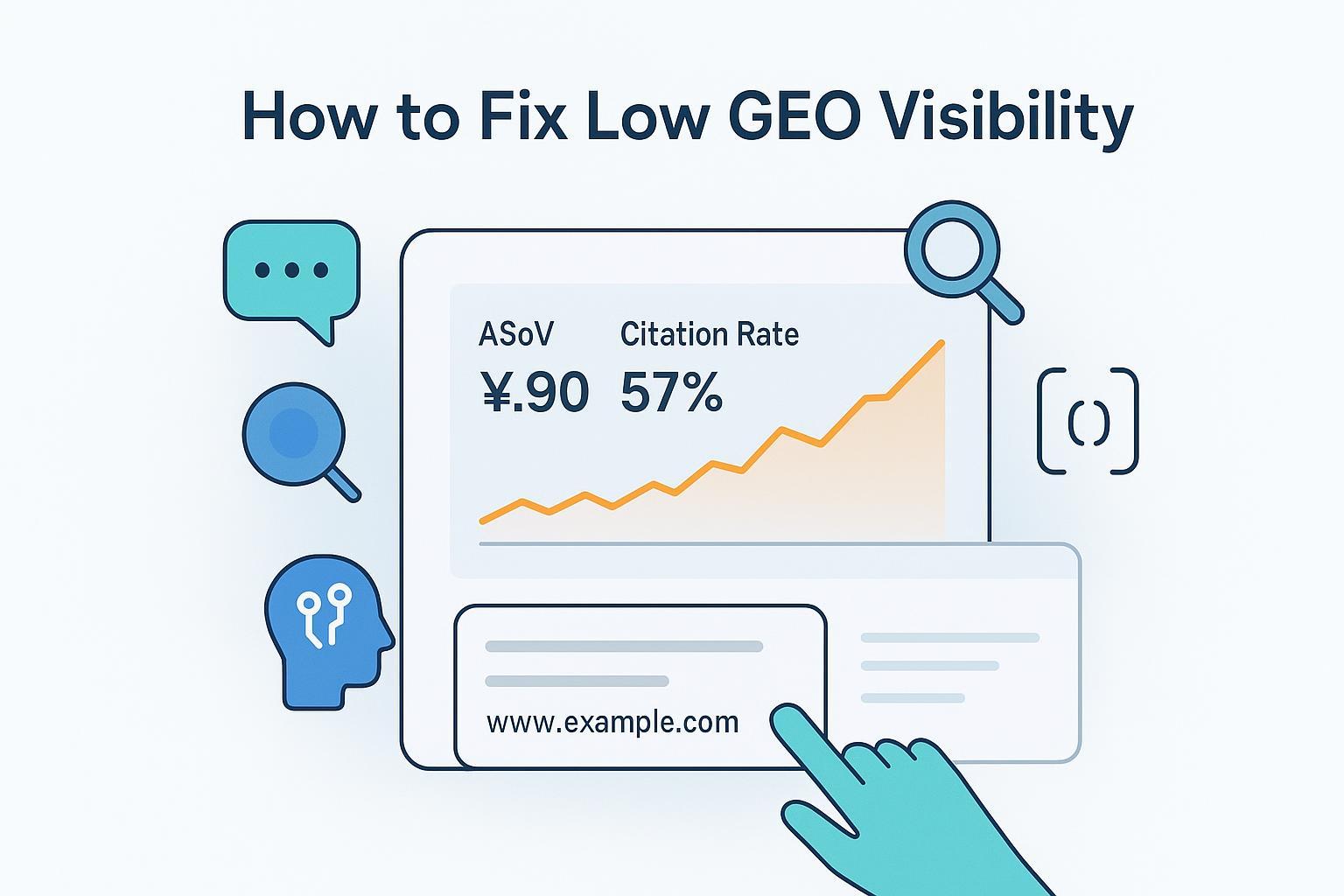
Low Generative Engine Optimization (GEO) visibility hurts where it matters now: you’re absent or rarely cited in AI-generated answers across Google AI Overviews/Gemini, ChatGPT Search, Perplexity, and Claude. This guide is your practical playbook to diagnose why and ship fixes that improve your odds of being selected, synthesized, and cited. Context matters: platforms and policies shifted through 2024–2025, so treat GEO as an ongoing operating system, not a one-time project.
Diagnose the Problem Before You Fix It
Start with evidence. Don’t rewrite a site blind.
What are you trying to improve? Three core metrics capture GEO outcomes. Define them, document how you’ll sample, then baseline across engines.
| Metric | What it means | How to calculate | Why it matters |
|---|---|---|---|
| Answer Share of Voice (ASoV) | Share of AI answers mentioning your brand in a defined question set | answers featuring your brand ÷ (answers featuring your brand + competitors) | Benchmarks your competitive presence in AI answers |
| Citation Rate | Percent of AI answers that explicitly cite/link to your pages | AI answers citing your site ÷ total answers analyzed | Tracks attribution frequency and authority |
| Question→Quote (Q→Q) | Portion of prompts that yield a direct quote or attributed snippet from your content | prompts that produce a quote from your page ÷ total prompts | Diagnoses how “quotable” your content is |
Build a prompt set that mirrors real user questions, including follow-ups. Sample results in each engine and record whether you’re: a) present in the answer, b) explicitly cited, and c) directly quoted. Search Engine Land outlines why GEO shifts measurement from rankings to citations and presence in AI answers; see their overviews of GEO and measurement from 2024–2025 for framing and current constraints: What is generative engine optimization (GEO)? and How to measure brand visibility in AI search (2025). For practical instrumentation patterns and definitions like ASoV and Q→Q, vendor playbooks from BrandRadar (2025) and Gauge (2025) are informative; validate with your own sampling.
Note the limits: sampling is noisy, selection logic is opaque, and behaviors evolve. Document your methodology and keep it consistent quarter to quarter.
The Fix Plan (From Quick Wins to Durable Gains)
1) Define your question–entity map
List the exact questions you want to be cited for and the entities you want tied to them (brand, products, authors). Group by intent (definitions, how-tos, comparisons, risks, pricing). Sample AI outputs to capture common phrasing. Assign every priority question to a “home” page. If you can’t point to one page that fully resolves a question and its natural follow-ups, you’ve found a gap.
2) Make your pages quotable
Engines select clear, compact, source-backed text. Add these blocks where they naturally fit:
- Definition box: “GEO is optimizing content so AI answer engines select, synthesize, and cite your pages in their responses.”
- Step summary: “To diagnose low GEO visibility: 1) baseline ASoV, citation rate, Q→Q; 2) add quotable blocks and schema; 3) reinforce E-E-A-T; 4) fix crawl/index issues; 5) refresh; 6) build authority; 7) re-measure.”
- Short stat with a source: “Google reduced the display of FAQ and removed HowTo rich results in 2023; the schema still aids machine understanding, but you shouldn’t expect those UIs.” Reference: Google’s FAQ/HowTo changes (2023).
Use scannable, question-led subheads that mirror how people ask (“How does X work?” “Is X safe?” “Pros and cons of X?”). Keep sentences declarative and precise. Include fresh statistics (ideally <18 months old) with links to primary sources.
3) Add structured data and entity hygiene
Help engines parse who you are and what the page covers. Prioritize Article, Organization, and Person schema. Use FAQPage and HowTo as descriptive aids, but don’t expect rich result UIs in Google since the August 2023 change. Validate with Google’s Rich Results Test and Schema Markup Validator.
Here’s a compact JSON-LD starter you can adapt:
{
  "@context": "https://schema.org",
  "@type": "Article",
  "headline": "How to Fix Low GEO Visibility",
  "datePublished": "2025-01-15",
  "dateModified": "2025-12-08",
  "author": {
    "@type": "Person",
    "name": "Your Author Name",
    "url": "https://yourdomain.com/authors/your-author",
    "sameAs": [
      "https://www.linkedin.com/in/your-profile"
    ]
  },
  "mainEntityOfPage": {
    "@type": "WebPage",
    "@id": "https://yourdomain.com/blog/fix-low-geo-visibility"
  },
  "publisher": {
    "@type": "Organization",
    "name": "Your Brand",
    "url": "https://yourdomain.com",
    "logo": {
      "@type": "ImageObject",
      "url": "https://yourdomain.com/logo.png"
    },
    "sameAs": [
      "https://www.wikidata.org/wiki/Q123456",
      "https://www.linkedin.com/company/your-brand"
    ]
  }
}
See Google’s documentation for current support and examples: Intro to structured data (Google, 2025) and the Search Gallery.
Entity hygiene basics: maintain authoritative “entity home” pages for your organization, products, and authors; standardize names; add sameAs links to trusted profiles; keep NAP and bios consistent. These steps help AI systems disambiguate you in their knowledge graphs.
4) Reinforce E-E-A-T you can prove
Show real experience, credentials, and transparency.
- Add detailed bylines and bios with credentials and contact. Mark up with Person schema.
- Cite independent, authoritative sources when making claims. Prefer primary data.
- Publish first-party research or methodologies with dates and clear methods.
Google’s guidance on quality, spam, and succeeding in AI search underscores these expectations. See Google’s core/spam policy updates (2024) and Succeeding in AI search (Google, 2025). Search Engine Land also highlights how creator and publisher entities factor into perceived trust: Recognition of content creators (2024).
5) Fix technical eligibility blockers
You can’t be cited if you’re hard to crawl or ambiguous.
- Ensure fast load, clean HTML, and correct canonical tags.
- Keep an up-to-date XML sitemap and robots directives; avoid accidental noindex.
- Resolve duplicates and near-duplicates that dilute signals.
Validate structured data with the Rich Results Test and syntax with the Schema Markup Validator.
6) Operationalize freshness and versioning
Models prefer current, stable sources. Put freshness on rails.
- Review high-value pages quarterly; refresh statistics and examples.
- Maintain visible “Updated” dates, per-section notes, and a changelog.
- Keep URLs stable to preserve accumulated context and citations.
7) Build authority that engines want to cite
Authority still compounds. Invest in signals that earn citations beyond your site.
- Run digital PR to secure mentions from reputable publications.
- Contribute expert quotes and guest insights; make authors reachable.
- Publish original research that others will cite, with transparent methodology and dates.
Engine-Specific Notes (Handle With Care)
- Perplexity: Tends to show clickable citations with titles/URLs and exposes metadata in some views. Their docs outline web search behavior and an API for developers; see Perplexity search guides and changelog. Structure your definitions and summaries to be easily lifted and attributed.
- Google AI Overviews/Gemini: Displays sources and links in summaries, but selection logic is not fully documented. Keep entity signals and freshness tight; avoid relying on deprecated rich result expectations.
- ChatGPT Search: Provides answers with links to sources; browsing reliability and citation style continue to evolve per release notes. Write clean, self-contained snippets that can be quoted without heavy context.
- Claude: Public detail on citation mechanics is limited. Treat improvements as emerging; validate with your own sampling.
Troubleshooting: If Results Don’t Move
Not cited despite “great content”? Add explicit quotable blocks, refresh stats, and clean up entity references. Weak or missing bylines are a common miss—strengthen Person schema and bios.
Competitors win most citations? Expand your coverage depth and pursue authoritative third-party references through PR and expert contributions.
Misrepresentation in AI answers? Standardize naming, create authoritative entity pages, and update third-party profiles (e.g., Wikidata/LinkedIn). Where feasible, contact publishers to correct inaccuracies.
Structured data errors? Validate JSON-LD, align markup with visible content, and remove unsupported expectations (e.g., HowTo rich results in Google).
No movement after 4–8 weeks? Increase your prompt sample size, resubmit sitemaps, and add authority signals. Remember that engines need time to recrawl and retrain components.
Measure, Report, Iterate
Build a simple cross-engine dashboard for your top questions. Track ASoV, citation rate, Q→Q, and presence by engine. Document prompt lists and sampling methodology so you can reproduce results and spot real change.
Run controlled tests: for example, add definition boxes and Article/Person schema to 20% of pages and compare ASoV and citation rate over 4–8 weeks. Keep link density disciplined and cite primary sources inside the content you want quoted.
Think of GEO as a recurring sprint. Start with one high-value page this week, ship the quotable blocks and schema, then review the data in a month. Ready to raise your answer share? Let’s get to work.