How to Create a Thought Leadership Strategy

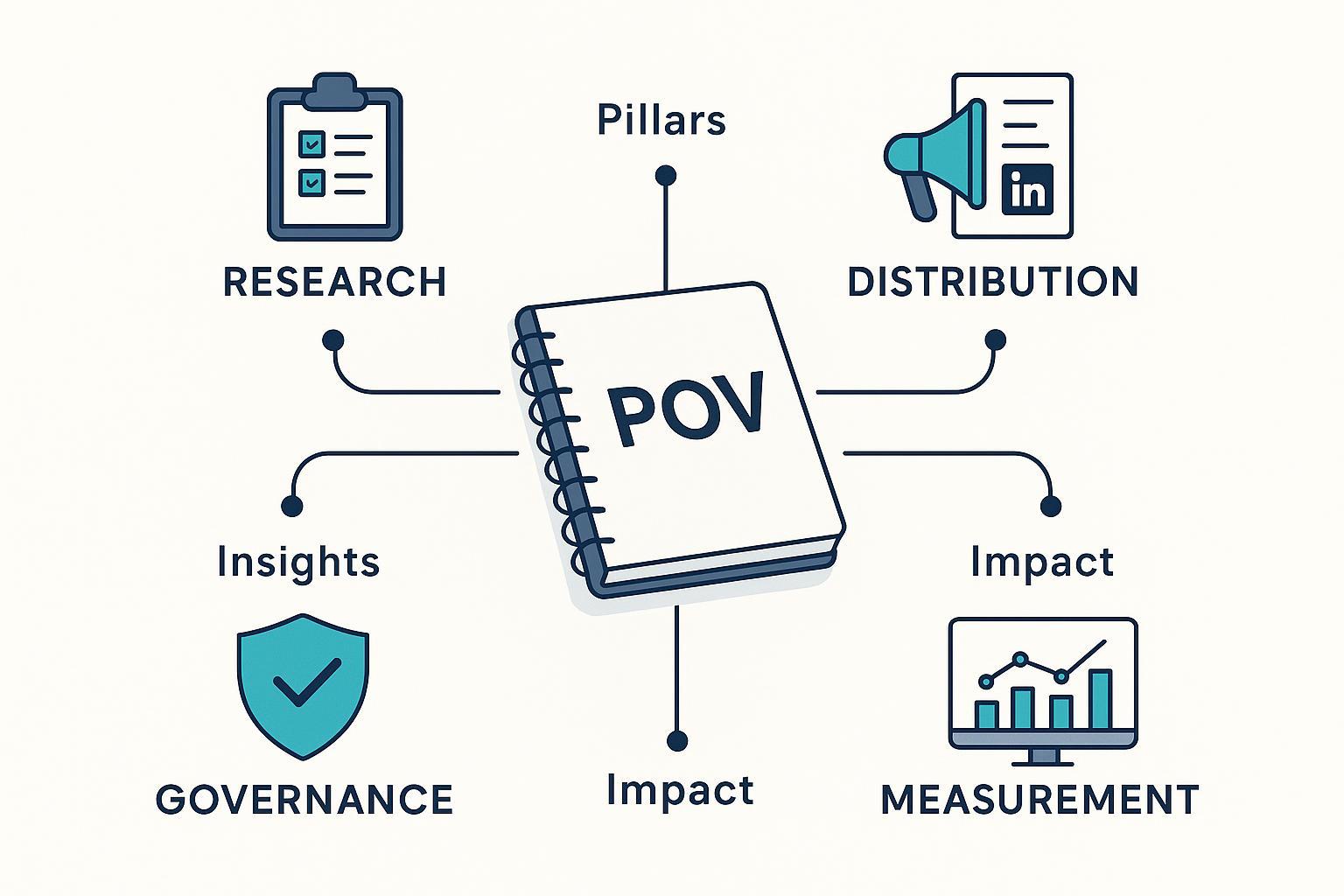
If your market can’t tell what you stand for, your content is just noise. Thought leadership fixes that—when it’s original, consistent, and useful. According to the "2024 Edelman–LinkedIn B2B Thought Leadership Impact Report" (Edelman, PDF), buyers use strong thought leadership to evaluate vendors and are more willing to pay a premium to work with organizations that publish it; see the publisher’s data in the 2024 Edelman–LinkedIn B2B Thought Leadership Impact Report (PDF).
This operator’s guide walks you, step by step, from blank page to a program you can run. We’ll set goals and guardrails, shape a point of view (POV), build pillars, enable your executives, run small-scale research, ship consistently, and measure impact beyond vanity metrics.
1) Set goals, scope, and guardrails
Start with outcomes, not channels. Decide what thought leadership must do for the business: open doors with target accounts, reduce discounting, accelerate deals, or shape a category narrative. Define two commercial goals (for example, influence a meaningful share of enterprise pipeline and reduce average discount), set guardrails for sensitive topics and competitor mentions, and identify your spokespeople and SME contributors with their time constraints and preferred formats; finally, write a short “not-list” so future content doesn’t drift off strategy.
2) Choose your niche and sharpen your POV
A POV is not a slogan. It’s what you believe, why now, what you challenge, and what you predict—anchored to your expertise and customer outcomes.
Try these prompts
- We believe: “In [market], [belief] matters more than [common practice] because [evidence/outcome].”
- Why now: “A change in [tech/regulation/buyer behavior] makes the old playbook risky.”
- We challenge: “Everyone optimizes for [X], but the real lever is [Y].”
- We predict: “Within 18 months, winners will [new behavior]; laggards will [consequence].”
Operator tip: Pressure-test your POV with 5 customers and 3 friendly skeptics. If it doesn’t spark debate, it’s not sharp enough.
3) Map the audience and collect insight
Segment by buying role (economic, technical, end user) and by information preference (brief frameworks vs deep dives). Blend qualitative and quantitative inputs.
How to do it
- Pull questions and objections from CRM notes and closed–won/lost analysis; pair with GA4/GSC queries.
- Interview 8–12 customers/prospects; ask for recent decisions, trade-offs, and failure patterns; record and transcribe.
- Run a small directional survey (N≈100–300) to surface trends; disclose limits and methods. For survey writing, follow neutral language and pilot testing guidance from Qualtrics’ Writing survey questions (2023-03-31).
Ethics and trust: Open with purpose, consent, and data use. Anonymize quotes unless you have written permission.
4) Build 3–5 content pillars and a format plan
Pillars are the recurring themes that connect your POV to audience problems. Map each pillar to a revenue moment (for example, “risk mitigation for CFOs” or “time-to-value for ops leaders”); for each pillar, define several subtopics and formats—long-form analysis, visual explainer, playbook, or interview—and balance quarterly flagship pieces with lightweight weekly posts. For an overview of why thought leadership builds authority and how to execute, see Thought leadership content: why it matters and how to do it from Search Engine Land (2025-10-29).
Operator tip: Maintain a “decision map” that shows which pillar answers which stakeholder’s questions.
5) Enable executives and SMEs to contribute at scale
Busy leaders won’t write every week—and they don’t need to. Your job is to capture their expertise and turn it into publishable assets.
How to do it
- Run monthly 30–60 minute interviews with each spokesperson; record, transcribe, and tag quotes.
- Use asynchronous voice notes or loom-style screen recordings to capture ideas between meetings.
- Define editorial SLAs: transcript-to-draft (5 business days), SME review (3 days), final approval (2 days). Keep a shared repository for research, slides, anecdotes, and claims.
Operator tip: Create a “voice guide” with do/don’t language, examples of tone, and approved phrases.
6) Create research-backed insights (even on a small budget)
Original data wins attention and credibility. You don’t need a 1,000-respondent study to start.
How to do it
- Run a focused survey on one pillar; target 100–300 relevant respondents. Use neutral wording, randomize options, and pilot test—principles outlined in Qualtrics’ Writing survey questions (2023-03-31).
- Combine your findings with transparent synthesis of public data. Always publish a brief methods box (who, N, dates, recruitment, limits).
- Turn results into a narrative: what surprised you, what it changes, and what to do next.
Operator tip: One small study can fuel a quarter: flagship report, webinar, 3–4 posts, and a slide library for sales.
7) Distribute and amplify where your buyers actually spend time
If you publish and pray, you’ll fade. Plan owned consistency, earned credibility, and partner reach.
How to do it
- Owned: Blog/hub, newsletter, executive LinkedIn posts. Repurpose long-form into clips, carousels, and threads while keeping the POV intact. For channel planning fundamentals and cadence, see Sprout Social’s Social media marketing strategy hub.
- Earned: Bylines, podcast guesting, and speaking. Pitch contrarian takes tied to your research.
- Paid amplification: Promote your best POV assets sparingly. On LinkedIn, use formats such as Articles, Documents (carousels), and Newsletters; LinkedIn’s official help shows how to Create and manage a newsletter on LinkedIn.
Operator tip: Package “starter kits” per channel—approved hooks, CTAs, and visuals—to speed execution without diluting the message.
8) Govern for quality, consistency, and compliance
Define standards before velocity scales.
How to do it
- Editorial QA: fact-checking, citation list, conflict-of-interest check, and accessibility (alt text, readable contrast).
- Disclosure: If there’s a material connection (partners, sponsors), disclose clearly and conspicuously across formats. The FTC’s plain-language guide Disclosures 101 for Influencers explains what proper disclosure looks like.
- Approvals: Tier reviews by risk. Pre-approve sensitive language to prevent late-stage rewrites.
Operator tip: Keep a central “claims register” that links each published claim to its source.
9) Measure what matters (and prove business impact)
Vanity metrics are easy. Influence and revenue contribution are harder—and worth it.
How to do it
- Leading indicators: qualified followers/subscribers, saves and shares, expert mentions, inbound media requests, and speaking invitations. The Edelman–LinkedIn research ties quality thought leadership to vendor evaluation and pricing power; track signals that indicate you’re shaping consideration.
- Lagging indicators: content-influenced opportunities (in CRM), sales cycle speed for influenced deals, win-rate lift in influenced segments, and realized price (discount reduction).
- Program health: cadence adherence, contributor participation, research frequency, and content lifespan.
Operator tip: Report weekly on leading indicators; quarterly on pipeline and win-rate. Pair numbers with 2–3 qualitative proof points (quotes, invites, mentions).
10) Cadence, roles, and a 90-day rollout
You don’t need a massive team—just clarity and consistency.
90-day plan
- Weeks 1–2: Goals, guardrails, spokespeople; draft POV; build voice guide.
- Weeks 3–4: Audience interviews; survey instrument; pillar map and Q1 topics.
- Weeks 5–8: Run the survey; draft the flagship; set up repository and SLAs; start weekly executive posts.
- Weeks 9–12: Publish the flagship; repurpose into a webinar, newsletter issue, and 4–6 LinkedIn assets; pitch one byline and one podcast; launch dashboard.
Operator tip: Protect two recurring blocks on each spokesperson’s calendar: one interview slot per month and one review slot per week.
Troubleshooting: common symptoms, likely causes, and fixes
| Symptom | Likely cause | Fix |
|---|---|---|
| Lots of posts, little engagement | Generic POV; talking to everyone | Narrow the niche; sharpen “challenge/predict” statements; add data or case specifics |
| Big splash, then silence | No cadence or repurposing plan | Build a 90-day content calendar; cut one flagship into 8–10 derivative assets |
| Execs go dark | Capture process is too heavy | Switch to monthly interviews + async voice notes; enforce short SLAs |
| Legal bottlenecks | No pre-approved guardrails | Create a language bank and a tiered review workflow |
| “Stats” questioned by readers | Methods not disclosed | Add a methods box with N, dates, recruitment, and limitations |
| Followers up, pipeline flat | Channel–audience mismatch; weak CTAs | Shift distribution to where buyers engage; add next steps (webinar, assessment) |
Mini-templates you can steal
POV one-liner
- “In [market], teams win when they [new principle] rather than [common habit], because [supported reason]—and we expect [prediction] within [timeframe].”
Interview starters
- “What decision did you make in the last quarter that you’d repeat?”
- “What’s a popular tactic you stopped doing—and why?”
- “Where do customers lose time or money they don’t see yet?”
Narrative arc for a flagship report
- Tension (what’s broken) → Evidence (your data) → Implication (what changes) → Playbook (what to do now)
Thought leadership isn’t a campaign. It’s an operating system for your market voice. Start narrow, publish with evidence, keep a sustainable cadence, and let your POV do the sorting—your best buyers will hear you loud and clear.