How to Combine AI and Human Editing

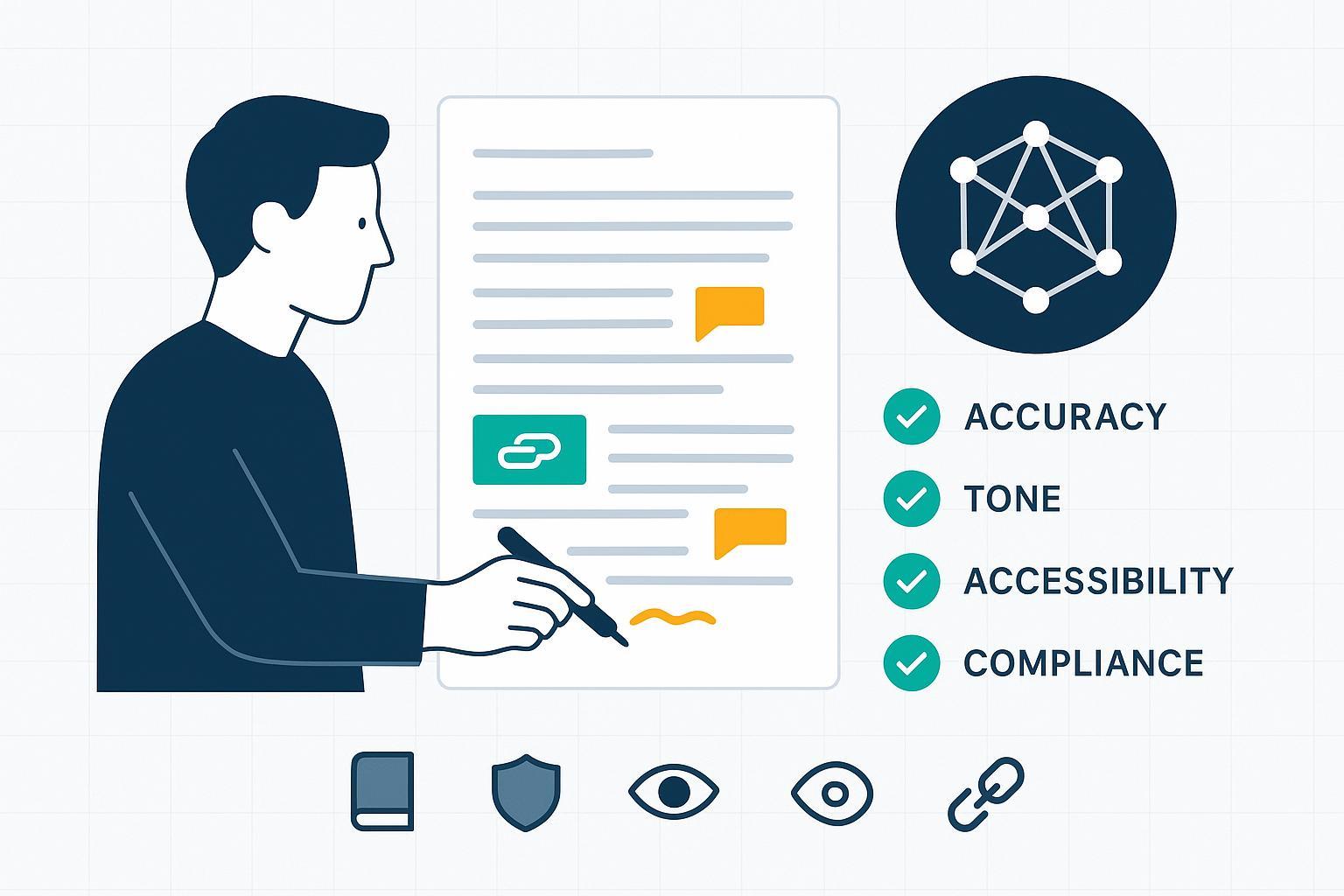
Want the speed of AI without sacrificing accuracy, brand voice, or reader trust? Here’s the deal: you can get the best of both worlds by designing a human‑in‑the‑loop editorial workflow where AI assists and humans remain accountable. Below is a pragmatic, tool‑agnostic guide I’ve used to ship content at scale—built around grounded drafting, rigorous human review, inclusive style, accessibility, and compliance.
Where AI fits (and where humans stay accountable)
Think of AI as a fast junior assistant: great at drafting, summarizing, pattern‑checking, and consistency. Humans set goals, own facts, and shape voice. Use the following split to avoid fuzzy responsibilities.
| Editorial Stage | AI’s Best Use | Human Accountability |
|---|---|---|
| Topic/Brief | Suggest angles based on vetted sources; surface risks/flags | Define audience, goals, scope, and compliance requirements |
| Research | Retrieve summaries via RAG; cluster sources | Select authoritative sources; decide inclusion/exclusion |
| Drafting | Produce first drafts grounded in citations; propose structure | Approve outline; ensure originality and intent |
| Fact‑checking | Cross‑reference claims; flag uncertainty | Verify against primary sources; remove unverifiable content |
| Copyediting | Fix grammar, consistency, and clarity | Final voice shaping; tone and nuance decisions |
| Inclusivity & Style | Audit for bias‑free language; check headings/terms | Enforce house style; approve sensitive phrasing |
| Compliance & Privacy | Scan for PII; apply policy rules | Confirm lawful basis, disclosures, and risk controls |
| Accessibility | Suggest alt text, semantic headings | Validate WCAG conformance; approve media alternatives |
| Metadata/Publishing | Recommend titles, descriptions, and tags | Own author bylines, accountability, and final sign‑off |
Build a safe end‑to‑end workflow
- Intake and editorial brief
- Capture audience, purpose, scope, risk level (YMYL?), and compliance notes (privacy, accessibility). List allowed sources for grounding.
- Define success metrics: accuracy targets, style conformance, accessibility level, and cycle time.
- Grounded AI drafting (RAG)
- Inject vetted sources into prompts with explicit requests for citations, reasoning steps, and uncertainty flags.
- Require abstention when sources are insufficient—better a gap than a confident error. For practical guidance on guardrails and grounding, see Azure AI Foundry best practices for mitigating hallucinations (2024).
- Human fact‑check pass
- Verify every claim against authoritative sources. If you can’t substantiate it, cut it.
- Prefer primary documents over summaries. A 2024 academic survey catalogs pipeline‑level mitigation methods—useful context for editors designing controls; see the arXiv survey of hallucination mitigation techniques.
- Style and inclusivity pass
- Encode brand voice in prompts (tone, sentence cadence, reading level) but keep human control for nuance.
- Apply inclusive terminology and accessible writing practices based on trusted guidance, such as Microsoft’s bias‑free communication guidelines.
- Compliance and privacy pass
- Confirm disclosures when readers would reasonably expect AI assistance. Google’s stance: helpful, people‑first content is permitted regardless of how it’s produced; see Google’s guidance on helpful, reliable, people‑first content (Search Central).
- Scrub prompts and outputs for personal data. Document lawful basis and risk controls for processing; reference the GDPR consolidated text on lawful bases and rights for EU contexts.
- Accessibility QA
- Validate headings hierarchy, alt text quality, captioning, and color contrast. Align with WCAG 2.2 AA for web content; see the WCAG 2.2 specification and WAI overview.
- Publish and measure
- Track accuracy rate (<1% minor errors post‑QA), style conformance, accessibility checks passed, and cycle time. Log issues to improve your prompt library and review gates.
Accuracy and hallucination controls
Hallucinations are predictable under ambiguity and weak grounding. Your defense is layered: better inputs, stricter prompts, observability, and human vetoes.
- Grounding and source control: Build a retrieval corpus of authoritative documents. Use semantic search and document chunking. Require citations with publication dates.
- Prompt discipline: Ask for uncertainty flags and “abstain” on missing sources. For complex topics, decompose tasks (outline → sections → claims → citations).
- Guardrails and detection: Apply content safety checks to flag unsupported statements. Instrument your pipeline with reviewable logs.
- Human review gates: Define escalation for high‑stakes content (finance, health). Senior editors must approve any section with risk markers.
Voice, style, and inclusive language
Readers can spot generic machine tone a mile away. Keep AI on rails and let editors do the final shaping.
- Voice encoding: Provide sample passages that represent your brand’s tone, rhythm, and point of view. Instruct AI to mirror cadence but avoid clichés.
- Inclusive terminology: Use allowlist/denylist for terms (e.g., whitelist → allowlist). Favor people‑first phrasing.
- Structure and clarity: Enforce short paragraphs, descriptive headings, and semantic markup. Ask AI to propose alt text; editors finalize.
Practical prompt starter
- “Using the attached sources only, draft a 1,200‑word article with citations in‑sentence. Flag any claim with low certainty. Mirror the voice sample’s rhythm and reading level. Propose alt text for images and a WCAG 2.2 AA checklist.”
Ethics, disclosure, and compliance
Who deserves credit, and what do readers need to know? Keep it simple and fair.
- Bylines and accountability: Use human authors and editors. Document their review passes.
- Disclosure: Add a short note where appropriate (e.g., “We used AI tools to assist with drafting and consistency; all facts and tone were reviewed by our editorial team.”). Does your audience expect this transparency?
- Privacy and data protection: Limit personal data in prompts. Maintain consent records and DPIAs where risk is higher. Handle data subject requests promptly.
- Spam and manipulation: Don’t publish content primarily to manipulate rankings. Evaluate drafts against “Who/How/Why” and reject thin or derivative pieces.
Measure and iterate
What gets measured gets improved.
- KPIs: accuracy error rates, accessibility conformance, style guide adherence, cycle time, revision count.
- Feedback loops: Keep a living prompt library with examples of “what worked” and “what failed.” Update allowed sources and risk flags regularly.
- Review cadence: Run a monthly QA audit across a sample set. Track trends and adjust gates.
Troubleshooting quick fixes
- Fabricated citations: Require URLs to canonical sources; cut anything unverifiable.
- Outdated facts: Add “as of” dates; refresh your corpus; prompt for publication years.
- Style drift: Re‑seed voice samples; add automated linting against your style guide.
- Bias or insensitive phrasing: Apply inclusive language audits; escalate sensitive topics to senior review.
- Accessibility gaps: Add alt text, captions, and proper headings; re‑test contrast and keyboard navigation.
- Privacy exposure: Scrub PII from prompts; restrict inputs; add a human gate before publish.
You don’t need magic—just a disciplined workflow where AI speeds the work and editors guard the truth. Ready to put a human‑in‑the‑loop system to work? Let’s dig in and ship something your readers will trust.