How to Build Topic Clusters for Agency Clients

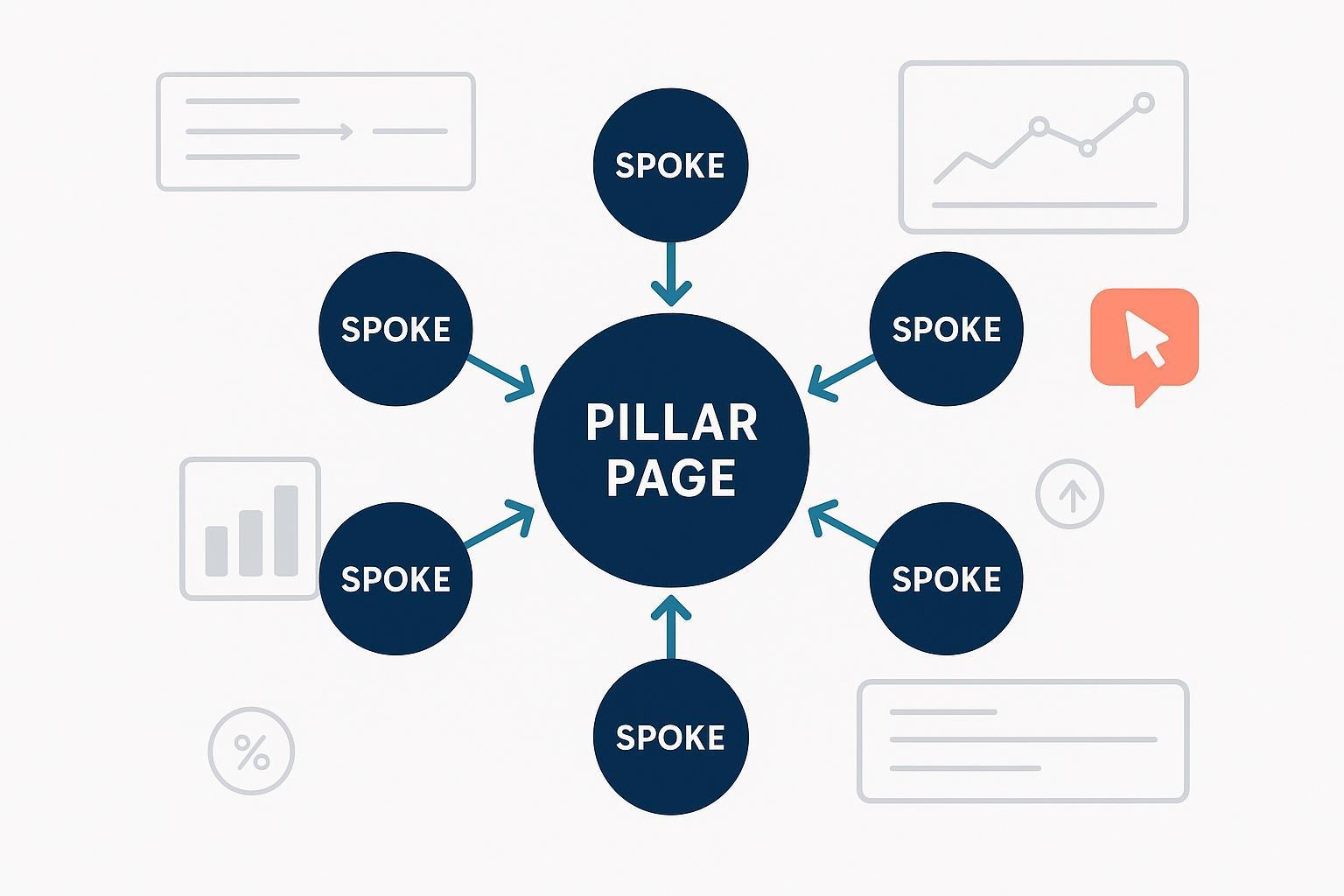
If you run SEO at an agency, topic clusters aren’t theory—they’re delivery. Clients want predictable growth, crawlable structures, and reporting they can trust. Clusters still work because they organize content by intent, reinforce relevance through internal links, and make it easier for search engines to discover and evaluate pages. That aligns with Google’s March 2024 shift toward people‑first content quality, where helpfulness and originality matter more than sheer volume. Google confirmed the Helpful Content system was folded into core ranking systems and rolled out new spam policies in March 2024; the takeaway is simple: build clusters that actually help users, not doorway‑like bundles of thin pages, as described in Google’s official summary of the March 2024 core update and spam policies.
1) Scope the engagement
Start by grounding the cluster strategy in business and audience truth. Clarify:
- Business goals and conversion events (lead type, sales path, demo requests).
- ICPs and jobs‑to‑be‑done; top problems the content must solve.
- Constraints (brand voice, compliance, CMS limits, localization, SME availability).
- Inputs you’ll need: analytics access, Search Console, a full site crawl, and any past content briefs.
Deliverables from this phase include a one‑page strategy brief, a measurement plan, and a list of candidate hub topics tied to the client’s offers.
2) Inventory and data gathering
Run a full crawl (Screaming Frog or Sitebulb) to inventory URLs, depth, canonicals, and internal links. Export inlinks/outlinks and check for orphans. Grab GSC query and page data for the last 12 months, plus GA4 landing pages from Organic Search. Enrich with third‑party data (Semrush/Ahrefs) to understand demand and SERP makeup.
Your goal is to map: what exists, what ranks, where intent overlaps, and which pages should be consolidated before you add new ones.
3) Cluster methodology: SERP similarity + intent
Choose a hub topic that matches real buyer demand (e.g., “enterprise SEO platform”). Then group queries by shared intent and SERP similarity. A practical rule: if top results heavily overlap and the searcher intent is the same, you likely want one page; if overlap is low or intent differs (how‑to vs comparative), split.
Name clusters consistently: hubs use broad, unifying terms; spokes target subtopics and long‑tail intents. Map each spoke to a journey stage (awareness, consideration, decision, post‑purchase) so the cluster can both rank and convert. For a current overview of why clusters still work and how to structure them, see Search Engine Land’s explainer on topic clusters and SEO.
4) Architecture that scales: URLs, breadcrumbs, canonicals, depth
Mirroring clusters in your site structure makes them easier to use and measure. Descriptive, human‑readable URLs are fine whether or not you nest paths, but keep click depth shallow (aim for ≤3 from the homepage). Add visible breadcrumbs and implement BreadcrumbList JSON‑LD that matches the on‑page trail; validate with Rich Results Test. Google’s guidance for markup and display is in Breadcrumb structured data.
Canonicalize consistently. Use self‑referencing canonicals for distinct pages, and point duplicates to a single preferred URL. Avoid canonical chains and conflicts (like canonicalizing to a URL that redirects). For paginated collections, make sure each page has a unique, crawlable URL; if you use infinite scroll, provide crawlable pagination links.
To keep team roles clear as you build, implement, and QA the cluster, use a simple ownership map.
| Phase | Primary owner | Key deliverables |
|---|---|---|
| Discovery & scope | Account Strategist + SEO Lead | Strategy brief, success metrics, candidate hubs |
| Inventory & audit | Technical SEO | Crawl exports, link depth/orphans report, consolidation list |
| Clustering & mapping | SEO Lead + Content Strategist | Cluster map, journey alignment, URL plan |
| Production | Content Strategist + Writer + SME | Briefs, drafts, schema, media assets |
| Implementation | Web/CMS + Technical SEO | URLs, internal links, breadcrumbs, canonicals |
| QA & launch | Technical SEO + Editor | Pre‑publish checks, corrections, publish schedule |
| Measurement & reporting | Analyst + SEO Lead | GA4/GSC setup, Looker Studio dashboards |
5) Internal linking patterns and anchors that move the needle
Internal links glue your cluster together—improving discovery, distributing PageRank, and clarifying topical relationships. Follow Google’s link best practices for crawlable, descriptive anchors, and avoid repetitive exact‑match patterns. For fundamentals, Moz’s primer on internal links is a solid reference.
Practical rules for hub‑and‑spoke clusters:
- Every spoke links back to the hub above the fold with a descriptive anchor (e.g., “enterprise SEO platform guide,” not “click here”). The hub links out to all core spokes in context.
- Add contextual spoke↔spoke links where the relationship is natural (e.g., “keyword research” spoke linking to “content brief template” spoke). Don’t force it.
- Keep depth shallow: hub and priority spokes should be ≤3 clicks from the homepage; use nav, breadcrumbs, and contextual links to reinforce paths.
Before publishing a new spoke, run a quick cannibalization check (site: search and GSC queries). If an older page targets the same intent, consolidate and redirect instead of competing.
6) Production workflow and E‑E‑A‑T
At agency scale, quality comes from process. Use standardized briefs that capture target intent, SERP patterns, user jobs, subtopics, internal links to insert, and schema to consider (HowTo/FAQ/Product/Article as appropriate). Attribute authors with credentials and involve SMEs; include citations for non‑trivial claims and add unique data, examples, or visuals. Post–March 2024 guidance emphasizes people‑first content and editorial oversight; see Google’s March 2024 update overview for the platform’s perspective on helpfulness and spam policies.
Run editorial QA: originality checks, fact‑check notes, brand/style review, accessibility, and layout. Technical QA before publish: verify canonical, indexability, structured data validity, internal link insertions, and page speed.
7) Measurement and reporting: make clusters measurable from day one
Give clusters a label in analytics and search data so you can report on them monthly without manual wrangling.
GA4 custom dimension for cluster attribution
- Create a custom definition (event‑scoped) named topic_cluster.
- Send a parameter with page_view events via GTM or gtag. GA’s help center explains custom definitions in GA4 custom dimensions.
Example gtag snippet for a static mapping (for illustration only):
<script>
  window.dataLayer = window.dataLayer || [];
  function gtag(){dataLayer.push(arguments);}
  gtag('js', new Date());
  gtag('config', 'G-XXXXXXX');

  // On route change or page load, send the cluster label
  gtag('event', 'page_view', {
    topic_cluster: 'enterprise-seo-platform'
  });
</script>
Pair this with Web Vitals to see engagement and experience together. The web.dev article on sending Core Web Vitals to GA4 shows how to record metrics alongside your cluster label.
GSC filters and regex for cluster views In Performance > Search results, filter by Page path (e.g., “/platform/seo/”) and optionally add a Query regex that matches your cluster intents. Track clicks, impressions, CTR, and average position over time. Google documents regex filters in Search Console’s Performance report.
Finally, build a Looker Studio report with a cluster scorecard (traffic, engagement, conversions), a query table, and diagnostics (Search Appearance, Core Web Vitals if relevant). Keep it client‑friendly: one page per cluster plus a rollup.
8) QA, maintenance, and expansion
Post‑launch, validate structure and fix gaps. Run a follow‑up crawl to confirm the hub and spokes are discoverable within three clicks from the homepage, that hub↔spoke and key spoke↔spoke links exist with natural, descriptive anchors, and that canonicals, breadcrumbs, and schema validate cleanly with expected Search Appearance in GSC. Treat this as a living system: for fast‑moving topics, review every 90–180 days; otherwise, review annually. Use GSC deltas (clicks/impressions) and GA4 engagement shifts to prioritize. Expand with new spokes only when they represent distinct intent; otherwise, update and deepen existing pages. When two pages substantially overlap, merge into the stronger URL, 301 redirect the weaker, and update internal links.
9) Common pitfalls and how to avoid them
- Over‑segmentation: Publishing many thin variations (“best tool,” “top tool,” “great tool”). Merge where intent/SERP overlap is high; make a better single page.
- Over‑optimized anchors and link schemes: Vary anchors naturally and link where it helps the reader. Follow crawlable‑link norms and avoid repetitive exact match.
- Hidden depth and infinite scroll: If you rely on infinite scroll, provide crawlable pagination links so deeper content can be discovered.
- Messy canonicalization: Don’t canonicalize to redirected URLs; avoid chains and contradictions between canonicals, redirects, and sitemaps.
Put it to work
You don’t need a complex tech stack to make clusters perform—you need a deliberate process, consistent internal links, and clean measurement. Start with one priority hub: audit, cluster, architect, link, publish, and label it in GA4 and GSC. Report monthly, iterate quarterly, and keep the focus on user intent. That’s how you build clusters clients can feel in their pipeline—and in their revenue.