How to Build a High-Output Content Team in 2025

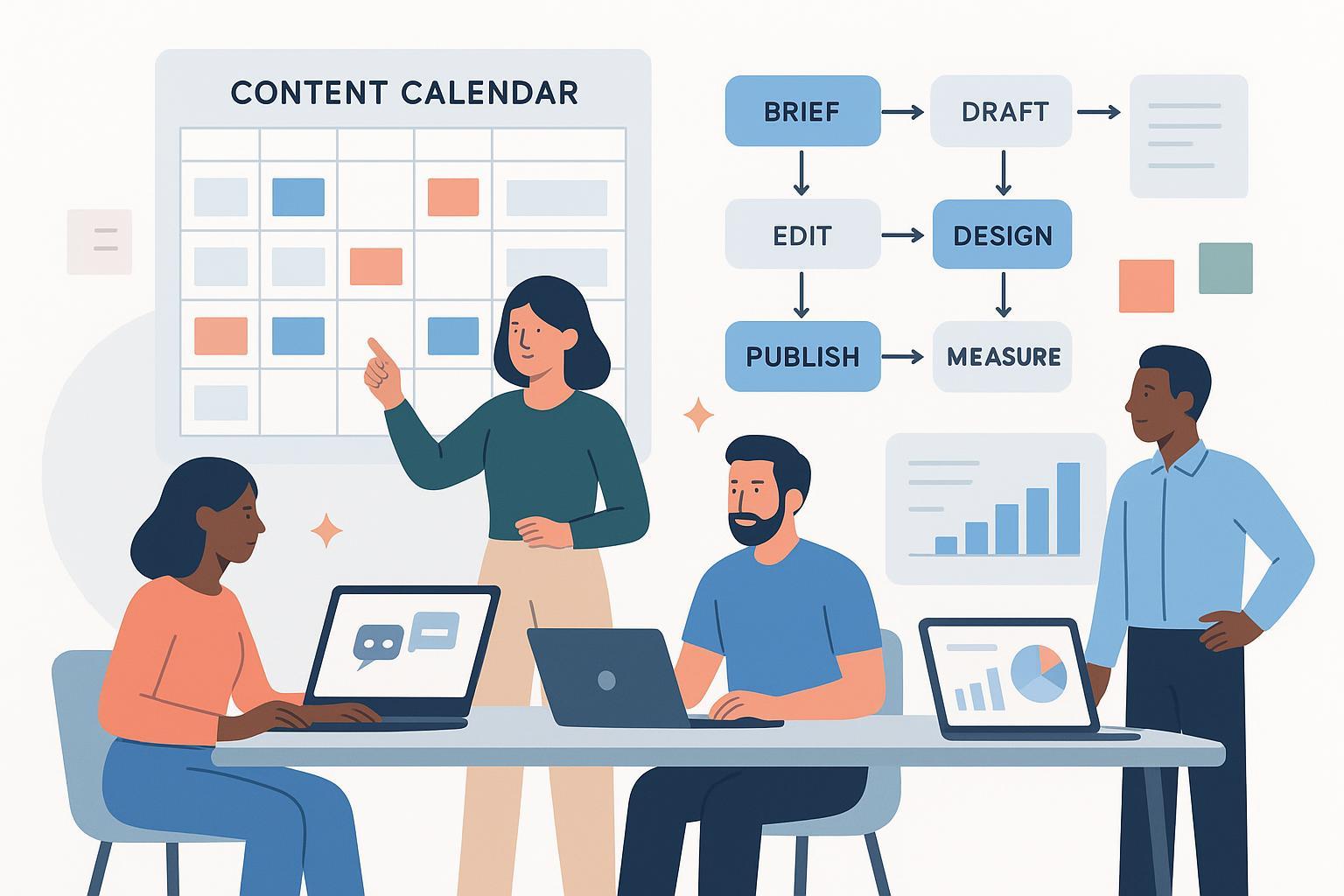
What does “high output” really mean in 2025? It’s consistent velocity without sacrificing quality, brand integrity, or business impact. The best teams don’t just publish more—they publish the right assets, faster, with tighter QA and clear attribution to outcomes. This guide lays out the operating models, roles, workflows, tech stack, and measurement practices I use when helping leaders scale content operations from scrappy to world-class.
1) Pick an operating model that matches your stage
A team’s throughput is capped by its underlying structure. Today’s top performers blend centralized standards with decentralized execution—think a Center of Excellence (COE) paired with cross-functional pods. Industry guidance in late 2024 emphasized composability and centralized governance for scale and reuse: Forrester’s recent CMS landscape urges aligning platform choices to business outcomes and modular, API-first thinking in content operations, not just features, in its content management systems trends landscape (2024). Complementing that, Contentful’s overview explains how a composable DXP model supports distributed teams without losing standards.
On the execution side, cross-functional pods—content, design, SEO, channel, and analytics working as a unit—are rising fast, with AI already embedded into briefs, drafts, and QA. AirOps’ 2025 report profiles teams using pods to drive velocity with centralized governance for prompts, analytics, and brand quality in The State of Content Teams (2025).
Below is a simple way to choose by stage.
| Company stage | Recommended operating model | Why it works in 2025 |
|---|---|---|
| Startup/Early | 1–2 cross-functional pods; light governance; sprint planning | Maximizes speed and customer proximity; adds just enough process to avoid chaos |
| Growth/Mid-market | Hub-and-spoke with a lean COE (standards, templates, taxonomy); regional/BU pods execute | Balances scale with autonomy; enables reuse and faster approvals |
| Enterprise/Global | Full COE + hub-and-spoke; regional pods for localization; composable CMS/DAM | Ensures brand and regulatory consistency while scaling volume across markets |
2) Make roles and responsibilities explicit
Title inflation kills throughput. Role clarity amplifies it. Define who is accountable vs. responsible at each stage of work, and codify it in a RACI for your core asset types—blog, video, product page, webinar kit, and more. You’ll likely combine a content lead who owns the roadmap, a managing editor who upholds standards, creators and editors across formats, SEO and channel owners, plus analytics and operations. As AI matures inside your workflow, consider dedicated enablement: an AI strategist to set policy and ROI guardrails, a prompt engineer or content technologist to maintain prompt libraries and evaluate outputs, and a localization lead to scale multilingual production without rework.
Don’t guess at approval paths. For regulated assets, set explicit approval gates (editorial, brand, and legal/compliance) and publish an approver matrix that’s easy to find. The Content Marketing Institute’s playbook highlights how shared standards and a formal content council reduce friction and rework—see How to unite roles and scale content operations (2024).
3) Build an end-to-end workflow that actually ships
High-output teams use one shared workflow from idea to optimization. You can rename stages, but skipping them backfires. A durable 2025 flow looks like this: ideation and prioritization → brief (with SEO, audience, and compliance fields) → draft → edit → design/production → legal/brand review (if required) → publish → distribute → measure → optimize.
Two things make this work at scale. First, governance assets that remove ambiguity: a style and voice guide; SEO and accessibility checklists; a taxonomy and tagging guide; and an approver matrix. Siteimprove’s collection on content quality shows how standards reduce error rates and speed up QA—see The Ultimate Guide to Content Quality Standards for a solid reference. Second, a weekly de-bottleneck routine keeps work moving: identify stalled assets older than your target cycle time and reassign or cut scope; triage approval queues over 48 hours old and escalate if needed; then compare planned vs. published and address the biggest systemic gap—brief quality, capacity, or approvals. Even that lightweight cadence can shave a full revision round.
A note on RACI cadence: owners for each stage must be visible in the brief. That alone reduces redundant pings and cuts a revision loop.
4) Equip the stack for speed and reuse
Your stack either compounds velocity or fragments it. In 2025, composable architectures are the safest bet because teams can upgrade parts without a painful replatform. Forrester’s late-2024 CMS perspective underscores choosing for business outcomes and modularity, while Contentful’s explainer breaks down how a composable DXP, modular content models, and API-first integrations let you reuse assets across channels without copy‑paste debt. If you’re deciding where to invest first, prioritize the handoffs that routinely slow you down: CMS ↔ DAM integration, approval automation, and analytics instrumentation.
AI belongs inside the flow of work, not as a sidecar. Define where genAI helps (ideation, outlines, first drafts of briefs, alt text, summaries, translations, repurposing) and where humans stay firmly in charge (facts, claims, originality, sensitive topics). Maintain a shared prompt library with examples of accepted outputs, and pair it with your style guide and QA checklist. McKinsey’s continuing research into enterprise AI adoption shows marketing teams among the most active users and the most likely to report revenue benefits—see The State of AI (2025) for usage patterns and impact ranges.
5) Measure what matters: throughput, quality, and impact
If you can’t see it, you can’t speed it up responsibly. High-output doesn’t mean more drafts; it means more accepted, on-time, high-performing assets. Establish a KPI schema with clear owners and definitions so dashboards aren’t debated every meeting.
Throughput and reliability include velocity (planned vs. published assets per sprint/month), on-time rate (percent shipped by the promised date), and cycle time (days from brief approval to publish). Quality and efficiency hinge on acceptance rate (drafts accepted without major rewrites), average revision cycles, and cost per asset alongside reuse across channels or regions. For impact, track engagement and conversion by asset type and channel, influenced pipeline or revenue with RevOps, and content health (updates completed and broken links per 100 URLs).
Run a monthly performance review to diagnose constraints and a quarterly content council to adjust standards and priorities. The Content Marketing Institute’s 2025 enterprise findings show marketers still optimizing around brand, demand, and revenue while increasing AI usage and budgets for formats like video—use those signals to weight your roadmap; see Enterprise Content Marketing Research Findings (2025).
When leadership asks, “What did content produce and what did it deliver?” your dashboard should answer both. Pair velocity and on‑time rate with acceptance rate and influenced revenue. If one line moves without the others, you’re likely trading quality for speed—or measuring the wrong thing.
6) Scale the culture: ceremonies, councils, and continuous improvement
Process without habits slips. Cement the culture with lightweight rituals that keep output high and standards intact. A weekly standup clears blockers on the in‑flight board and confirms owners for stalled items. A monthly performance review audits the KPI dashboard, agrees on two systemic fixes, and assigns owners. A quarterly content council updates style/voice, taxonomy, and AI policy; reviews governance issues; and reshuffles priorities based on results and market shifts.
Onboarding is another hidden lever. Give new contributors a starter kit—style guide, accepted brief examples, prompt library, approver matrix, and your measurement definitions. It’s amazing how many revision cycles vanish when everyone can see what “good” looks like.
Finally, don’t try to scale everything at once. Pick one constraint per quarter—brief quality, approvals, or distribution—and fix it visibly. Momentum is a moat.
7) A pragmatic 90-day plan to lift output
- Month 1: Clarity and standards — choose your operating model and publish a one-page RACI for top asset types; ship a refreshed style/voice guide, brief template, and approver matrix.
- Month 2: Workflow and stack — implement the unified workflow inside your CMS/PM tool and add QA checklists; integrate CMS ↔ DAM, instrument analytics, and set your dashboard schema.
- Month 3: Measurement and optimization — establish baseline KPIs (velocity, on-time, acceptance, revision cycles, reuse); run weekly de-bottleneck reviews and publish a wins-and-learnings note company-wide.
By day 90, you should see fewer stuck assets, lower revision churn, and cleaner attribution from content to revenue. If you don’t, your bottleneck is likely unclear prioritization or approvals—fix those before adding headcount.
8) Bring it together
If you’ve ever asked, “Why does our calendar look full but our pipeline looks thin?” you’re not alone. High-output teams in 2025 win by aligning structure (COE + pods), nailing role clarity and workflows, embedding AI with guardrails, and holding a tight measurement cadence. For strategic context on platforms and modular content, see Forrester’s CMS trends landscape (2024) and Contentful’s explainer on composable DXP; for team design and governance cues, see AirOps’ State of Content Teams (2025), CMI’s content operations guidance, and Siteimprove’s quality standards guide.
Here’s the deal: consistency beats heroics. Start small, instrument the work, and remove one bottleneck at a time. Your team—and your results—will accelerate faster than you think.