How to Build a Content Team Without Writers

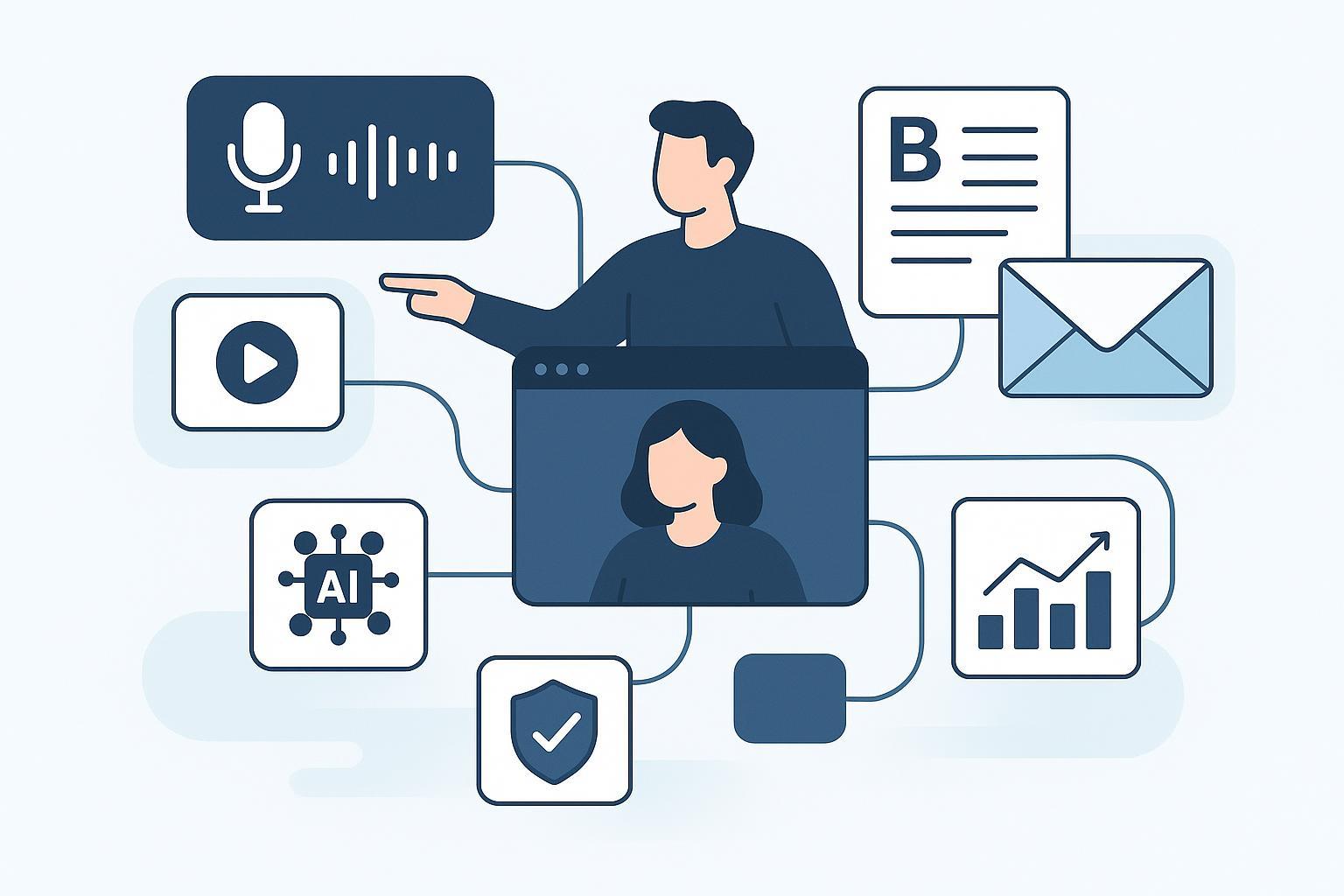
You don’t need staff writers to ship excellent content at scale. What you need is a tight operating model that captures expertise from your subject-matter experts (SMEs), a sharp editor/producer to orchestrate it, and a repurposing engine that multiplies every recording into many assets. This guide shows you exactly how to build that system—roles, workflow, tools, benchmarks, guardrails, and troubleshooting—so you can publish consistently without adding headcount.
The No-Writer Operating Model (What You’re Building)
The center of gravity is an SME-led, producer-orchestrated, multimedia-first program. Instead of asking a writer to start from a blank page, you capture real expertise (video/audio), transcribe it, and turn it into text, visuals, and clips with an editor guiding quality. A fractional team can move quickly and stay cost-efficient, which aligns with what nDash describes as a flexible, high-quality fractional content team approach (2025).
Here’s the idea in plain terms: record a 45–60 minute SME conversation, then transform it into a long-form page, a newsletter, multiple short videos, social posts, and a sales one-pager—without a full-time writer. AI can assist with first drafts, but human editorial judgment sets the bar.
Roles That Make It Work (Without Hiring Writers)
-
SMEs provide the raw insight. They’re the source of truth—product, customer stories, technical nuance, and objections from the field.
-
The Editor/Producer is your nucleus. This person plans the content calendar, writes concise briefs, runs interviews, oversees post-production, polishes copy, and ensures brand voice and accuracy.
-
A Strategist/SEO partner maps topics to demand, entities, and search opportunities, then validates that final assets line up with audience and channel intent.
-
A Multimedia Producer captures video/audio cleanly, pulls strong clips, and creates basic motion/graphics with templates.
-
Compliance/QA handles approvals, versions, and risk checks (claims, rights, accessibility). In regulated orgs, involve Legal.
-
Freelance Specialists jump in as needed—design, motion, localization, or a specialist writer for one-off critical assets (e.g., a regulated white paper).
A Repeatable Workflow From Capture to ROI
This is the loop I’d recommend for most B2B teams. It respects SME time, avoids blank pages, and supports quality.
- Intake and Brief: Define the goal, audience, angle, and must-include examples. Share a one-page brief and 6–10 questions with the SME.
- Capture: Run a 30–60 minute recorded interview (video + audio). Encourage stories, metrics, and customer scenarios.
- Transcribe and Outline: Generate a transcript and mark highlights. Draft a skeletal outline from the strongest segments.
- Draft (AI-Assisted): Use AI to produce a first-pass article, show notes, and social snippets from transcript chunks. Keep it factual and close to SME phrasing.
- Edit and Structure: The editor tightens structure, adds context and sources, aligns voice, and removes generic filler.
- SME Review: Ask for a timeboxed fact check and clarifications. CMSWire’s guidance on enabling SMEs—prepped questions, timeboxing, and clear agendas—boosts participation as outlined in “12 Ways to Get SMEs Involved” (CMSWire, 2024).
- Compliance/QA: Verify claims, rights, and accessibility basics (headings, alt text, captions/transcripts).
- Publish: Ship the flagship asset first (page or video) with clean metadata and internal linking.
- Repurpose: Cut 15–60 second clips, design quote graphics, spin out a newsletter edition and 5–10 social posts. Store everything in a DAM for reuse.
- Distribute and Measure: Schedule across channels, arm Sales with a one-pager, tag assets in your CRM, and watch engagement and assisted pipeline.
A quick note on AI: Google’s spam policies warn against “scaled content abuse”—mass low-value pages generated to manipulate rankings. Keep a human in the loop, add original insight, and avoid mass templating. See Google’s Search Essentials spam policies (official) for guardrails.
Tooling You Actually Need (Right-Sized Stack)
- Capture/transcription: Zoom or Riverside for recording; Descript or Castmagic for transcripts and quick edits.
- Editing/production: Descript plus a lightweight design tool (Canva/Figma) for thumbnails and quote cards.
- CMS/DAM: WordPress/Webflow/Contentful and a simple DAM (Cloudinary/Bynder) to index assets for reuse.
- SEO and QA: Ahrefs/Semrush for research; an optimization tool for entity coverage; editor checklists for quality.
- Project management: Asana/Notion/Trello with review SLAs, approval gates, and owner assignments.
- Rights management: A shared folder or system of record for creator permissions, releases, and licenses.
Use tools you can sustain. The best stack is the one your team actually uses weekly.
Benchmarks and SLAs You Can Run With
Treat these as directional, not promises. Calibrate by complexity and industry.
| Area | Practical benchmark |
|---|---|
| Outputs from one 60-min SME session | 1 long-form page, 1 newsletter, 3–5 short video clips, 5–10 social posts |
| SME time per “content pod” | 45–90 minutes (interview + review) |
| Turnaround (capture → publish) | 5–10 business days with a focused editor/producer |
| Editor/producer fractional cost | $2,500–$8,000/month part-time or $75–$175/hour |
| Design/motion ad hoc | $50–$150/hour or per-asset packages |
| Tooling (record/transcribe) | ~$30–$100/seat/month |
These ranges reflect common 2024–2025 market patterns observed across B2B teams.
Governance You Can Trust (UGC, AI, Accessibility)
-
UGC and creator content: Secure written permission to republish, credit the creator, and disclose any material connection clearly and conspicuously. The FTC’s guidance on endorsements and the 2024 rule banning fake reviews are must-reads; start with the FTC’s Endorsements resources.
-
Accessibility: Provide accurate captions for prerecorded video, transcripts for audio, keyboard-accessible players, semantic headings, and alt text. WCAG 2.2 is the canonical spec—see W3C’s WCAG 2.2 for criteria. Accessibility improves reach and reduces risk.
-
AI policy: Require human editorial review for every AI-assisted draft; cite primary sources; keep an audit trail of edits and approvals.
When to Scale Up (or Finally Hire a Writer)
There are moments when adding writing horsepower makes sense. For highly regulated content, large thought-leadership reports, or dense long-form technical guides, bring in a specialist writer on a project basis under your editor’s supervision. Multilingual expansion and heavy bylined executive content may also justify fractional writers. Keep the core model intact—SME-led capture, producer-led quality—and plug in specialist writing where the stakes demand it.
Troubleshooting: Quick Plays
- SME overload: Rotate experts, batch multiple topics in one session, and use async follow-ups. Protect them with a quarterly cadence and a 48-hour review SLA.
- Quality drift: Reinforce editorial standards, keep a brand voice doc, and run a pre-publish checklist. Centralize the final sign-off with the editor/producer.
- Search underperformance: Map each asset to a primary problem and query set; enrich with entities and examples; add internal links; refresh after 90 days if it’s not landing.
- Rights and disclosures: Store signed permissions and creator credits; use platform disclosure tools; avoid borrowed images without licenses.
Lightweight Templates to Steal
-
SME Interview Guide: 6–10 open prompts that ask for stories, numbers, and customer context. Share it 2–3 days before the recording and reiterate goals at the top of the call.
-
Editorial Brief: One page with goal, target audience, angle, example proof points, must-include definitions, and distribution notes. Add draft title and subheads to speed editing.
-
Review SLA: Day 0 editor sends draft; SME replies within 48 hours; editor revises by Day 3; compliance/legal signs off within 24 hours; publish by Day 5–10.
-
Repurposing Matrix: From one recording, spin a flagship page/video, newsletter, 3–5 clips, 5–10 social posts, a quote graphic pack, and a sales one-pager. Tag all assets in your DAM.
Final Word
Start small: schedule one SME recording next week. Run the workflow, publish the flagship asset, and cut three clips and five social posts. Measure, learn, and repeat. As consistency builds, the writer-less model stops feeling unusual—and starts feeling like an unfair advantage.
Resources mentioned: nDash on fractional teams (2025), CMSWire on SME enablement (2024), Google Search spam policies, FTC Endorsements guidance, and W3C’s WCAG 2.2. Links are embedded above where relevant.