How to Build Content SOPs

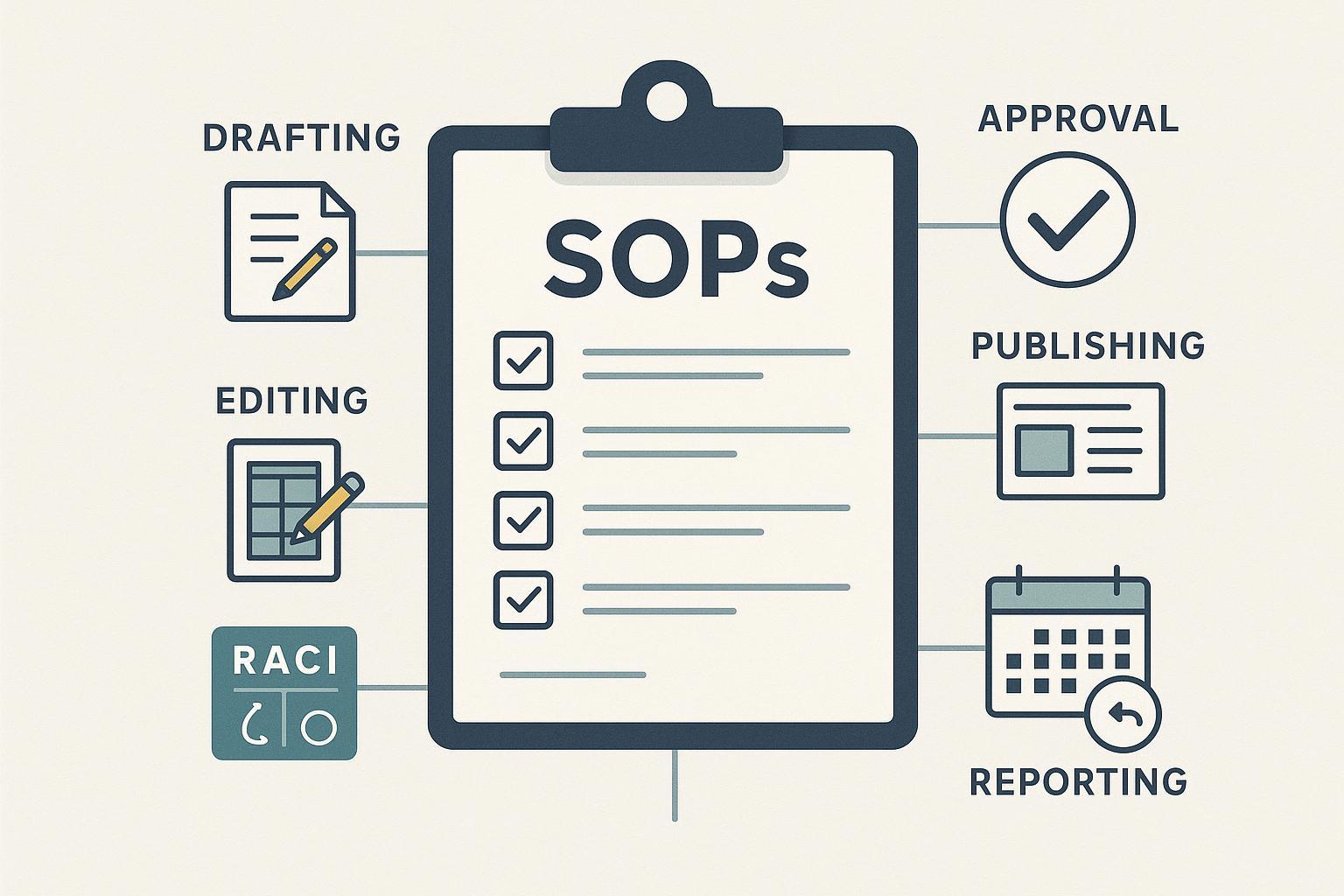
If your content feels slow, inconsistent, or risky, you don’t need more meetings—you need standard operating procedures (SOPs). Well-written SOPs turn tribal knowledge into repeatable workflows, reduce rework, and make approvals predictable. The good news: you can stand up a usable, minimal SOP library in 2–3 weeks and improve it as you go.
1) Decide scope and outcomes for each SOP
Start with intent. For every SOP, write a one-sentence purpose, define its scope (channels, content types, constraints), and specify what “done” looks like. Add entry criteria (what must be true before the process starts) and exit criteria (what must be delivered before handoff).
Use a simple front-matter header at the top of each document: Title, Purpose, Scope, Owner, Version, Effective date, Next review date, Stakeholders, and Related policies. For versioning, stick to a major.minor scheme (e.g., 1.2). Include a small change log at the bottom: “1.2—Updated legal review SLA; 1.1—Added accessibility checks; 1.0—Initial release.” That structure aligns with common SOP anatomy recommended in industry resources such as Document360’s practical overview in their guide to SOP examples and templates, which details headers, roles, and version blocks in usable formats (see Document360’s discussion in the resource titled “SOP Examples & Templates”). For a clear, step-focused document structure, you can also reference the style of Document360’s SOP examples and templates.
2) Audit your current workflow and surface bottlenecks
Map what actually happens today from idea to publish. Follow a piece of content through: request intake → prioritization → briefing → drafting → editing → SME review (if required) → legal/compliance (if required) → design/layout → final approval → publish → post‑publish monitoring. Note where work waits, who waits, and why. Capture average time per step for a few recent pieces to establish a baseline.
Pay special attention to approval-heavy gates (SME and legal). They often protect the brand but inject unpredictable delays. You’re not setting universal targets yet—you’re documenting reality so you can set credible service levels later.
3) Co-create with stakeholders to ensure adoption
SOPs fail when they’re written in isolation. Bring in the people who actually do the work: writers, editors, SEO, designers, PMs, SMEs, and compliance. Draft steps together, agree on handoffs, and define who approves what. The Content Marketing Institute emphasizes that documenting workflow roles, gates, and time expectations is foundational to governance; see CMI’s perspective on why content governance underpins successful strategy in “Content Governance Is a Must for a Successful Content Strategy”.
When you discuss SLAs, avoid hard promises based on someone else’s benchmarks. Start from your audit. For example: “Editorial review within 2 business days” and “Legal review within 5 business days” may be reasonable in some industries and unrealistic in others. Set initial targets, then adjust after a pilot.
4) Write SOPs people actually use
The best SOPs are scannable and unambiguous. Use numbered steps, role tags, and decision points. Keep sentences tight. Attach checklists where quality matters.
Mini example (excerpt from a Pre‑publish QA SOP):
- Writer: Confirm title tag (50–60 characters) and meta description (~150–160) are unique, include target keyword, and reflect search intent.
- Editor: Check headings follow H1 → H2 → H3 order; ensure internal links point to relevant pages; verify short, descriptive URL.
- Publisher: Validate images have descriptive alt text; run accessibility check; schedule publish date and add UTM tracking to promotional links.
For on-page SEO essentials, Backlinko’s comprehensive resource outlines practical items teams can adapt into checklists; use it to calibrate your pre‑publish checks via the Backlinko SEO checklist. For accessibility, align your checks with the W3C’s WCAG 2.2 quick reference (semantic headings, alt text, contrast, keyboard access, captions), which is summarized in the W3C WCAG 2.2 Quick Reference. For overall SOP anatomy (headers, roles, versioning), the Document360 SOP templates guide provides a helpful baseline.
5) Map roles, RACI, approvals, and escalation
Clarify who is Responsible, Accountable, Consulted, and Informed for each stage. For typical editorial flows:
- Ideation and prioritization: Responsible—Content Strategist; Accountable—Managing Editor; Consulted—Marketing/Sales/SMEs; Informed—PM.
- Writing: Responsible—Writer; Accountable—Editorial Director; Consulted—SEO/SME; Informed—Designer/PM.
- Editing: Responsible—Editor; Accountable—Editorial Director; Consulted—Writer; Informed—PM.
- SME/Legal (if required): Responsible—SME/Compliance; Accountable—Content or Compliance Manager; Consulted—Editor; Informed—PM.
- Final approval and publishing: Responsible—Managing Editor/Publisher; Accountable—Content Manager; Consulted—Legal (if applicable); Informed—Channel owners.
If you’re newer to RACI, TeamGantt’s primer provides simple, transferable definitions and examples you can adapt to content roles; see TeamGantt’s RACI guide with examples. Pair your RACI with an approval matrix that states: “For blog posts under 1,500 words, Editor approves; with claims about regulated topics, add Compliance approval; for thought leadership with executive quotes, add Leadership sign‑off.” Define an escalation path (e.g., if a gate misses its SLA by 24 hours, the PM pings the Approver and escalates to the Owner).
6) Your minimal viable content SOP library
Build the smallest set that covers the whole lifecycle, then expand. Assign a single owner and a review cadence for each.
| SOP | Primary owner | Review cadence |
|---|---|---|
| Content Request Intake & Triage | Content Operations Manager | Quarterly |
| Content Creation (Brief → Draft) | Managing Editor | Quarterly |
| Editorial Review & Approval | Editorial Director | Quarterly |
| Pre‑publish QA (SEO, Accessibility, Brand) | Editor | Quarterly |
| Publishing & Distribution (CMS + Channels) | Content Manager/Publisher | Quarterly |
| Content Refresh & Redirects | SEO Lead | Semi‑annual |
| Reporting & Analytics | Marketing Operations | Quarterly |
| Localization/Transcreation | Regional Content Lead | Quarterly |
7) Tooling to operationalize
You don’t need to buy new software to start. Begin with the tools you have and standardize how they’re used. Over time, map to categories and integrate.
- SOP/knowledge base to store approved procedures with version control and search.
- Project/workflow management to template tasks, route approvals, and set SLAs.
- CMS and DAM for role-based publishing, scheduling, and asset reuse; plus QA/SEO/accessibility checks integrated before publish.
- Analytics dashboards to standardize KPI definitions and automate reporting.
Think of the orchestration like a relay: intake request in the PM tool automatically generates tasks tagged with R, A, C, and I; the writer drafts in the CMS referencing SOP links; pre‑publish QA runs; gated approvals trigger notifications; publish and syndicate; then dashboards update with UTMs. Keep it simple first; add automation only after the manual path is stable.
8) Pilot, train, and embed into daily work
Pilot your SOPs with a single content type (e.g., blog posts) and a small squad. Measure cycle time and defect rate for two weeks. Capture friction: unclear steps, missing assets, tool gaps, or SLA misses. Update the documents, then roll out.
Training should be role-based. Give writers the Creation and QA SOPs; give approvers the Review SOP and approval matrix; give publishers the CMS/Distribution SOP. Keep sessions short, record them, and link recordings from the SOP itself. Store everything in a searchable, permissioned repository and add SOP links directly into PM templates and CMS publishing checklists so they’re impossible to miss.
9) Measure adherence and outcomes
If you can’t see it, you can’t improve it. Start with a small KPI set and track them every week. For flow metrics, Atlassian’s guidance on Kanban metrics provides clear definitions and collection methods for throughput and cycle/lead time; see Atlassian’s overview of Kanban metrics.
- Throughput: completed assets per week by type.
- Cycle time: brief approved → publish; track by asset type.
- Approval lead time: submission to gate approval for editor, SME, and legal.
- Defect/rework rate: percent of assets requiring substantive rework after a gate.
- Adherence rate: percent of audited items that followed the SOP steps and checklists.
- Outcome metrics: engagement, search visibility, and conversions where applicable.
Baseline for a month, then set targets like “reduce cycle time 20% over two quarters” or “increase adherence to 90%+.” Use weekly reviews to spot aging work, stuck approvals, or checklist items frequently missed.
10) Troubleshoot and scale (including localization)
Common failure modes include SOPs that don’t match reality, vague ownership, and documents that live outside daily tools. Fix them by co‑creating with end‑users, assigning an explicit Owner/Reviewer/Approver on each SOP, and embedding links into PM tasks and CMS checklists. Tie adherence to performance reviews for the people who own the process.
As you expand across regions or languages, keep a global “core” SOP for the shared steps and create regional appendices for local legal, language, and channel nuances. Assign a Regional Content Lead as the owner of each appendix, require local SME/compliance sign‑off, and set a synchronized review cadence so changes roll out consistently.
Action checklist to get started this week
- Pick one content type (e.g., blog posts) and draft three SOPs: Creation, Editorial Review, Pre‑publish QA.
- Map roles and create a one‑page approval matrix with SLAs grounded in last month’s actuals.
- Pilot with a small squad for two weeks; measure cycle time, defects, and adherence. Update SOPs and set quarterly review dates.
The payoff is tangible: faster cycles, fewer errors, and content you can scale without chaos. Ready to make “how we work” part of your competitive advantage? Start your first draft today and iterate from there.