How to Build an AI Writing SOP

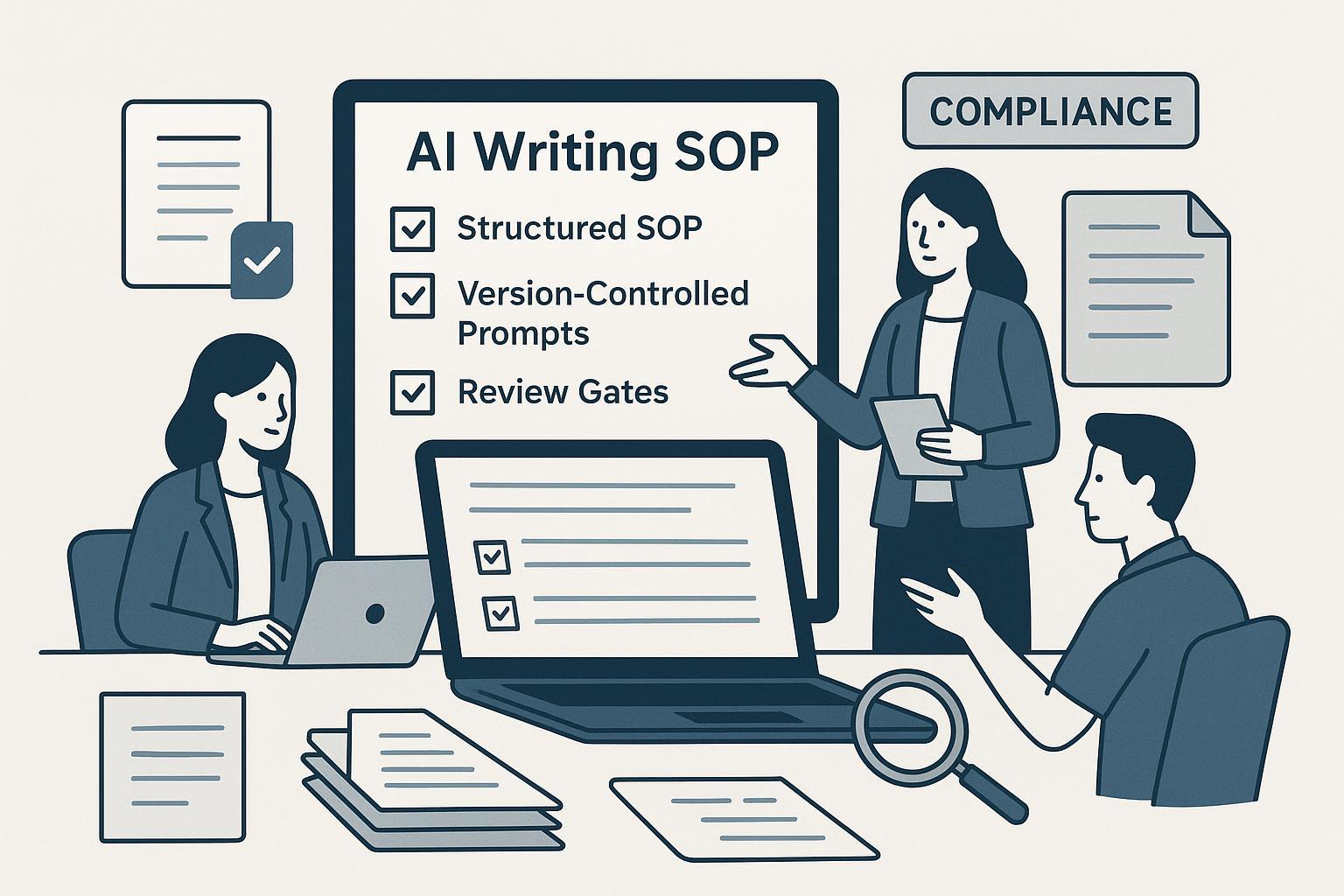
You’ve seen the upside of AI drafting. But can you trust it at scale, across teams, under scrutiny? An AI Writing SOP is your playbook for consistency, auditability, and risk control. It spells out who does what, how AI is used, what “good” looks like, and how you prove it—so you can move fast without cutting corners.
Governance anchors (so your SOP stands up to scrutiny)
Ground your SOP in recognized frameworks. Use NIST’s AI Risk Management Framework—especially its four functions: Govern, Map, Measure, Manage—to structure decisions and documentation. NIST’s companion guidance for generative systems highlights risks like confabulation and provenance. For authoritative context, see the NIST AI Risk Management Framework overview (nist.gov, 2023–2025) and analysis of the Generative AI Profile in Tech Policy Press’ unpacking of NIST guidance (2024).
If your organization is pursuing formal management-system discipline, align controls with ISO/IEC 42001 (AI management systems) covering scope, leadership, planning, operation, performance evaluation, and improvement. A concise overview of applicable requirements is available in the ANSI/ANAB explainer on ISO/IEC 42001 (2024).
Publishing to EU audiences? Incorporate transparency duties from the EU AI Act’s Article 50: inform users when they interact with AI and label synthetic content (text, images, audio, video) in ways that are clear and machine-detectable. For timing and scope, review the European Commission AI Act Article 50 page (2024) and enforcement timelines summarized by White & Case (2024).
Step-by-step: Build your AI Writing SOP
1) Define scope, roles, and approval authorities (NIST: Govern)
Start by naming the content types eligible for AI assistance—think blog posts, product summaries, internal FAQs—and explicitly exclude high-risk or specialist content like legal or medical advice and regulated disclosures. Assign owners for the prompt library, reviewers for factuality and bias, and approvers for publication. Clarify escalation to compliance/legal. Codify acceptable use, disclosure mandates, and artifact retention. Require mandatory human-in-the-loop review for all AI-assisted outputs.
2) Map use cases, audiences, and risks (NIST: Map)
Document intents, audiences, and channels for AI-assisted content. Build a risk register that tracks failure modes (hallucination, outdated info, bias, off-brand tone, privacy leakage) with likelihood/severity ratings and compensating controls. Record model/provider, version/date, grounding data sources, and retrieval settings. Why bother? Because when something goes wrong, you’ll want the trail.
3) Establish a prompt library and versioning protocol
Create standardized prompts bound to your style guide (voice, tone, formatting, citation policy) with examples and negative constraints. Assign version IDs, owners, timestamps, and rationale notes for changes. Support staging, A/B evaluation, rollback, and version pinning. Evaluate prompts on representative briefs and capture metrics like accuracy, relevance, style adherence, and safety flags. Think of your prompt library like source code: tested, versioned, and reversible.
4) Drafting workflow and human-in-the-loop editorial review
Produce initial drafts in a controlled environment; disable web-connected generation where proprietary content is in scope. Gate the draft through verification: fact-check against primary sources, confirm citation integrity, run originality scans, screen for bias/toxicity, and check brief alignment and readability. Record reviewer approvals and corrections, storing artifacts (prompt, draft, review notes) linked to content IDs.
5) QA metrics, thresholds, and verification gates (NIST: Measure)
Define pass/fail thresholds and remediation steps. Aim for ≥95% of factual claims verified against primary or authoritative sources; rework or correct below threshold. Keep plagiarism scores under 5%, revising and re-checking if exceeded. Ensure no severe toxicity; flagged sensitive topics must pass manual review. Enforce 100% adherence to internal policy and applicable regulations, with disclosures present where required. Track operational metrics like turnaround time, revision rate, and approval latency.
6) Compliance and disclosure for EU-facing content (EU AI Act Article 50)
Label synthetic content clearly at first exposure and embed machine-readable metadata/watermarks when technical standards are finalized. For interactive experiences, inform users when they’re engaging with AI unless it’s obvious. Retain label decisions, exemption rationales (e.g., artistic contexts), and timestamps in an audit trail.
7) Publishing, audit logging, and retention (NIST: Manage)
Publish only after approvals pass all gates. Archive prompts, outputs, review notes, risk register entries, disclosure labels, and approvals in a secure repository. Link artifacts to the published asset for traceability, and maintain access logs and retention schedules.
8) Post-publication monitoring, incidents, and SOP refresh
Track reader feedback, corrections, and compliance signals. Classify incidents (e.g., hallucination, bias, noncompliance), remediate by updating or withdrawing content, and record postmortems. Run quarterly SOP reviews, red-team sensitive content, retrain staff, and update prompts and policies. Continuous improvement isn’t a slogan—it’s how you keep drift in check.
SOP phases, artifacts, and checkpoints
| SOP phase | Core artifacts | Required checkpoints |
|---|---|---|
| Govern | Policy docs; role map; training plan | Owner assigned; signoff authorities defined |
| Map | Use-case inventory; risk register; model notes | Failure modes documented; controls listed |
| Measure | QA rubric; dashboards; thresholds | Accuracy/originality/bias gates enforced |
| Manage | Incident log; audit trail; retention plan | Postmortems; quarterly refresh completed |
Troubleshooting and escalation
When the output goes sideways, here’s how to steer it back.
- Hallucination or outdated facts: Ground with citations; constrain prompts; add retrieval; re-verify against primary sources.
- Off-brand tone: Bind prompts to the style guide; use examples and negative instructions; add reviewer style checks.
- Bias/toxicity: Run automated screens; mandate manual review for sensitive content; adjust prompts and training.
- Privacy risk: Redact identifiers; avoid entering confidential data into public tools; use approved environments.
- Noncompliance: Add disclosure labels; halt publication for severe issues; escalate to compliance/legal.
Implementation tips: adoption, training, and change management
Start with a pilot—two content types, clearly defined artifacts, and hard gates—then expand once metrics stabilize. Train for competence: prompt design, verification, disclosure practices, and incident logging. Integrate SOP artifacts with your project management and secure storage platforms using role-based access control. Keep dashboards visible: accuracy, originality, compliance, and turnaround time should be easy for editors and leadership to track. And keep it human: AI accelerates drafting, but editorial judgment guards quality. When in doubt, slow down and re-check.
References and further reading
- NIST’s core framework: see the AI Risk Management Framework overview (nist.gov).
- Generative AI guidance context: Tech Policy Press analysis of NIST’s Generative AI Profile (2024).
- ISO management-system view: ANSI/ANAB’s overview of ISO/IEC 42001 (2024).
- EU transparency duties and timing: European Commission Article 50 page (2024) and White & Case enforcement timeline explainer (2024).
A well-built AI Writing SOP doesn’t just keep you safe—it makes your team faster and more consistent because everyone understands the rules and the proof points. Ready to start? Choose a pilot scope, set the gates, and build the artifacts so your content can scale with confidence.