How to Audit Your GEO Visibility

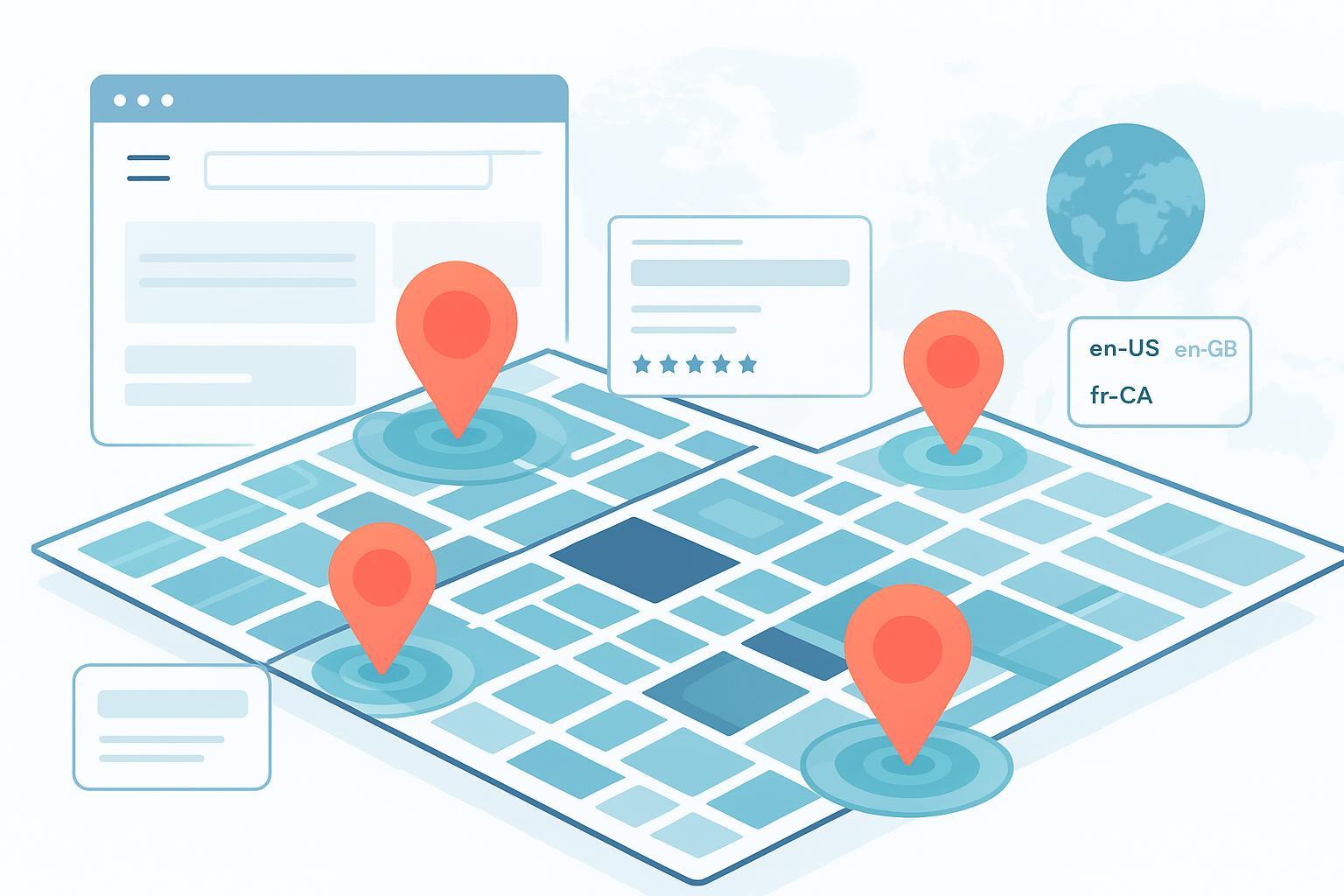
GEO means two things in 2025: your geographic search visibility (Local Pack/Google Maps, localized organic, and international) and your presence inside generative answers (AI Overviews, Bing Copilot, Perplexity). This guide prioritizes the geographic audit you can run quarter after quarter—and then adds a practical adjunct to check your generative visibility without guesswork.
Audit prep: scope, data, and a myth check
Before you start, define the locations and markets you’ll audit, the query buckets (discovery vs. branded), and the timeframe. Keep it repeatable so you can compare month over month.
- Locations/markets: a list of cities or ZIPs per location; international locales if applicable.
- Queries: group by intent (category/discovery vs. brand/near-me variations).
- Timeframe: last full 28–30 days, with annotations for major changes.
Myth check: you don’t need to stuff keywords into your business name or create hundreds of thin location pages. Follow policy and build real local signals. Google’s rules on names, categories, addresses, reviews, and more are explicit in Google’s Business Profile policies (Google, 2024), and review conduct is governed by Google’s review policy (Google, 2024).
Local Pack/Maps audit (GBP, geo-grids, citations, trust)
You win the Local Pack by aligning Business Profile quality with proximity and prominence, then proving it over time with reviews, local content, and consistent data.
1) Google Business Profile: field-by-field quick pass
Open your GBP (or use the in-search “Edit profile” surfaces) and confirm:
- Eligibility and verification are intact; sensitive edits (name, address, primary category) can trigger re-verification. Keep documentation handy as enforcement has tightened.
- Business name matches real-world signage; no descriptors or keyword stuffing. Primary category is precise; secondary categories are relevant. Attributes reflect reality (accessibility, ownership, amenities).
- Hours, holiday hours, and service areas are current. Service-area businesses should hide the street address if customers don’t visit.
- Photos are original and recent; products/services are complete and accurate; Q&A is answered; messaging/booking (if enabled) meets your response SLAs.
- Reviews show healthy volume, recency, and owner responses. Encourage reviews within policy; never gate or incentivize.
Why this matters: policy alignment reduces suspension risk and improves relevance and conversion rate from the profile.
2) Measure visibility with geo-grids (and read them correctly)
Set up geo-grid tracking for your discovery and branded queries. In dense urban cores, start with ~250–500 m spacing; expand to 500 m–1 km in suburban areas and 1–2 km in rural regions. Track mobile and desktop separately. Record the zoom-level or tool default because the viewport can shift results.
Interpretation tips:
- Don’t fixate on one pin. Use mean or median rank across the grid and look at the heatmap spread. Where are you strong—and where do you fade?
- Create a share-of-voice proxy: the percentage of grid points where you appear in the top 3 for each query bucket.
- Triangulate. Personalization, pack rotations, and SAB edge cases mean no tool is perfect—spot-check on devices within the target area. For context on what matters in the Local Pack, see Search Engine Land’s Local Pack guidance (2025).
3) Citations and NAP consistency (plus UTMs)
Establish a master NAP record and enforce it across top platforms (Google, Apple Maps, Bing Places, Facebook, Yelp) and authoritative niche/geo directories. Audit and clean up inconsistencies and duplicates; suppress or merge when possible. Tools can help, but verify with manual checks for your most important listings.
Add UTMs to the Website field in GBP so you can segment traffic in GA4, for example: utm_source=google&utm_medium=organic&utm_campaign=GBP. Consistency and attribution together reveal which locations convert.
4) Local trust signals and structured data
Real-world trust lifts both visibility and conversion:
- Reviews: aim for a steady velocity with at least 30% of reviews in the last 90 days, a competitive average rating (often ≥4.5), and owner responses within 48 hours.
- Local links/PR: earn mentions from local news, chambers, sponsorships, and community sites.
- On-page proof: show neighborhoods served, directions/parking, staff photos, and recent projects.
Implement schema where it fits your content. The safest starting point is LocalBusiness (or a subtype), plus Breadcrumb; add Review/AggregateRating and FAQPage only when they reflect visible content and current eligibility. See Google’s Search Gallery for structured data (Google, 2025) and confirm current eligibility changes on Google’s Search updates page (Google, 2025).
Core metrics and advisory targets
| Metric | What it tells you | Advisory target (adjust for market difficulty) |
|---|---|---|
| Geo-grid mean rank (discovery) | Average Local Pack strength across your service area | Top 3 mean for priority terms in core areas |
| Share-of-voice (top‑3 % of pins) | Coverage of the map where you appear in the Pack | >30% early; >50% mature campaigns |
| Reviews: volume/recency/rating | Trust and conversion signals | 50+ reviews/location; ≥30% within 90 days; ≥4.5 avg; responses <48h |
| Citation accuracy | Consistency of NAP across major sites | ≥90–95% match; duplicates trending to zero |
| GBP activity cadence | Freshness and engagement | New photos or Posts every 30–60 days |
Localized organic audit (your site’s location coverage)
Location pages should feel like real local storefronts online, not boilerplate.
- On-page: Use natural city/region modifiers in the title and H1. Provide distinct content per location (ideally 300–500+ words) with services, staff, photos, local testimonials, neighborhoods served, directions/parking, and local FAQs. Link from service pages to the relevant location pages and back. Embed a map to the exact location.
- Technical: Confirm indexability (no stray noindex), inclusion in sitemaps, and self-referencing canonicals. Monitor Core Web Vitals and mobile UX. Use LocalBusiness schema (and appropriate subtypes), Breadcrumb, and add Review/FAQPage schema only when aligned with content and eligibility.
- Validation stack: Use Search Console coverage, Enhancements, and URL Inspection; PageSpeed Insights or Lighthouse for CWV; Rich Results Test for schema.
SERP features to watch: Review snippets (when eligible), FAQ snippets (eligibility has been restricted and can change), People Also Ask, and image packs. Keep an eye on the latest policies in the documentation for Review snippets (Google, 2025) and FAQPage markup (Google, 2025).
International SEO audit (hreflang, architecture, localization)
If you operate across countries or languages, a clean hreflang and a sane site structure prevent cannibalization and wrong-page rankings.
- Hreflang validation: Use valid ISO codes (en-US, en-GB, fr-CA), ensure each page references itself and all alternates (reciprocity), and align canonicals with each variant (no cross-canonicals to a generic page). Include x-default when you have a global selector. Validate with URL Inspection, crawling, and third-party validators.
- Architecture choices: ccTLDs (strongest country signal, highest overhead), subdomains (separation with some authority split), or subfolders (scalable, consolidated authority). Reinforce intent with hreflang and, when appropriate, Search Console geo-targeting for subdomains/subfolders.
- Localization depth: go beyond translation. Use local currency, units, shipping/returns, legal pages, and market-specific content and offers.
For specifications and examples, reference Google’s guidance on localized versions and hreflang (Google, 2025).
Generative surfaces (adjunct GEO): quick presence audit and uplift
You can’t “optimize for AI” the same way you do for traditional SERPs, but you can check whether your brand gets cited and make your content easier to quote. Here’s a lightweight workflow you can repeat.
- Build a prompt set: 30–50 branded, category, and problem-solution prompts that mirror real customer intent in your markets.
- Test surfaces: Google for AI Overviews-eligible queries, Bing Copilot, and Perplexity. Capture screenshots and the cited URLs/text where available.
- Log consistently: date, prompt, platform, whether cited, which URL, and any inaccuracies. Repeat quarterly; do monthly spot checks during content or PR pushes.
How to earn more citations—without speculation:
- Write answer-first. Open pages with a concise definition or steps, then offer depth. Use clear subheads, short paragraphs, and occasional lists or tables.
- Strengthen machine-readable signals: Organization/LocalBusiness, Person (authors), HowTo/FAQPage/QAPage, Product/Service where relevant—always valid, always matching visible content.
- Build topical hubs with interlinked subpages and include first‑hand elements (photos, process evidence, original data). If you’re thinking “will this be quotable by an engine?” you’re on the right track.
Turn the audit into a roadmap (cadence and prioritization)
A one-off audit is useful. A recurring one is transformative because it shows trend lines and cause-effect. What should you do first?
- Quick wins: fix GBP policy violations, repair mismatched NAP on top platforms, add UTMs, update hours/holiday hours, refresh photos, and respond to recent reviews.
- Medium lifts: improve weak geo-grid zones with local content/PR, strengthen location pages with unique proof and FAQs, implement/repair schema, and remove duplicates in directories.
- Structural fixes: resolve hreflang and canonical conflicts, re-evaluate international architecture, and standardize review generation and response workflows across locations.
Recommended cadences by business type:
- SMB single location: monthly reporting; quarterly full audits; weekly spot checks during tests or peak season.
- Multi-location/franchise: monthly rollups with location-level drilldowns; bimonthly citation checks; monthly geo-grid tracking for priority locations.
- International programs: quarterly hreflang and indexation reviews; post-launch verifications after migrations or localization waves.
References for current standards and eligibility
Policies and specs change. When in doubt, go to the source and verify against the most recent documentation.
- Policies: Google’s Business Profile policies (Google, 2024) and Google’s review policy (Google, 2024).
- Local Pack context: Search Engine Land’s Local Pack guidance (2025).
- Structured data: Search Gallery and eligibility updates (Google, 2025) and Search updates (Google, 2025).
- International: Localized versions and hreflang guidance (Google, 2025).
One last question before you get started: if you ran this audit today, which two fixes would move the needle fastest in your core neighborhoods? Pick them, schedule them, and measure the next 30 days on your geo-grids and in your GBP engagement. Then repeat.