How AI Determines Brand Authority

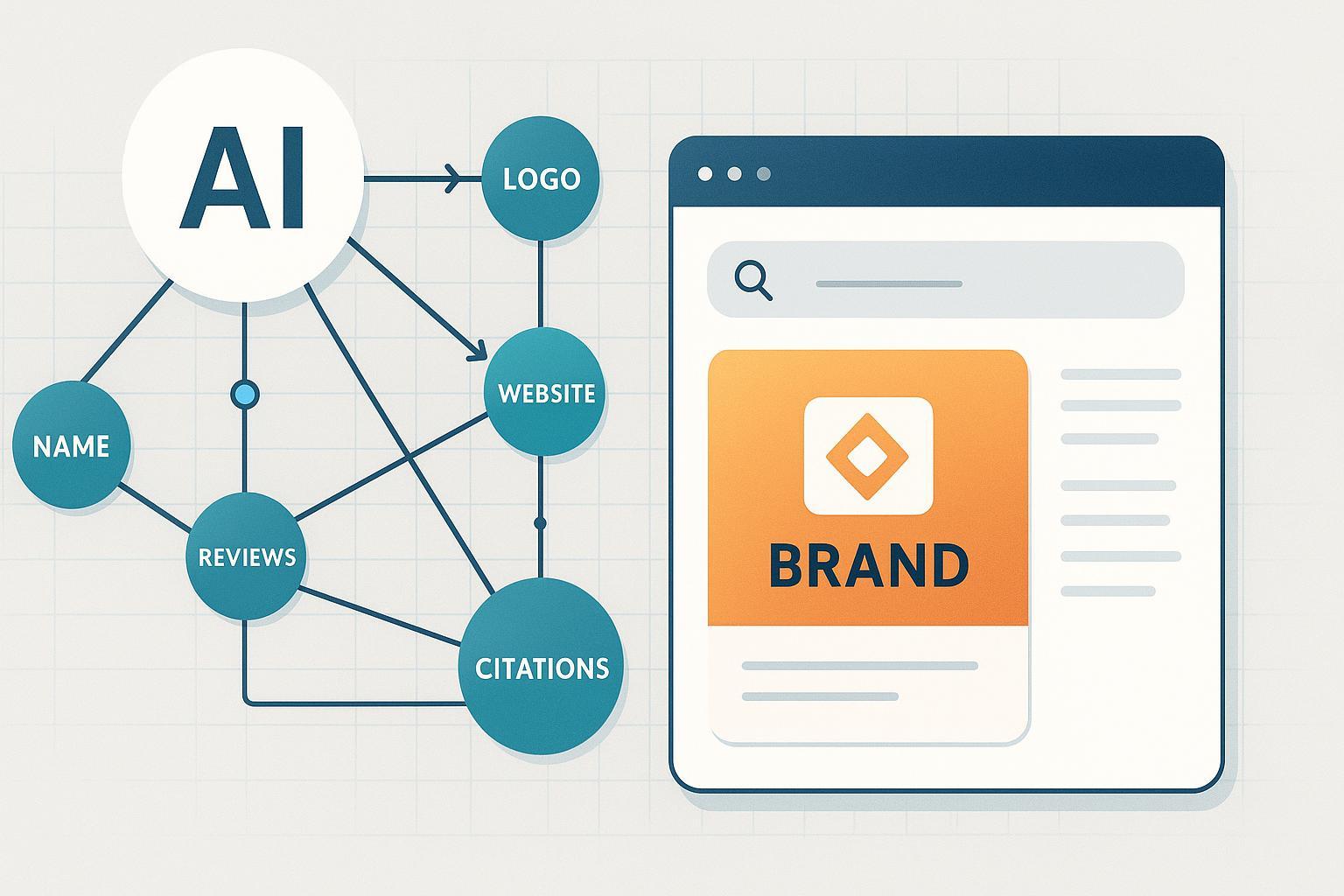
Why do AI answers and search results keep citing the same handful of brands? It isn’t luck. Modern ranking and generative systems infer which brands they can trust—then surface, summarize, or cite them more often.
In this context, brand authority means: the degree to which automated systems recognize your brand as a reliable, notable entity worth retrieving and citing. It’s not a single “ranking factor.” Instead, it’s a pattern of evidence across your site, the broader web, and your entity identity. Google frames the quality side of this as E‑E‑A‑T—Experience, Expertise, Authoritativeness, and Trustworthiness—emphasizing that it’s a guiding framework rather than a discrete signal. See Google’s public stance in the Google Search guidance about AI‑generated content and E‑E‑A‑T (2023).
How AI systems “see” brands: entities and identity
Search engines model brands as entities—objects with attributes (name, logo, site, profiles) and relationships (founders, products, locations). When your identity is unambiguous and consistent, systems can represent you more confidently and connect your content to your entity.
Practically, that means getting the machine‑readable basics right. Implement Organization structured data (JSON‑LD) with canonical name, url, logo, and sameAs links to official profiles, and make sure your public profiles match what your site says. Google documents this under establishing business details and representation; see Establish business details / Organization markup (documentation). Consistency across your site, Business Profile, and authoritative directories reduces ambiguity and increases eligibility for richer representations (e.g., logo usage, brand cards), when warranted by overall corroboration.
Signals that reinforce authority in practice
Brand authority is inferred from converging evidence. Think of it this way: systems look for alignment between what you claim and what the rest of the web corroborates.
-
Helpful, reliable content and authorship. People‑first content that demonstrates first‑hand experience, cites authoritative sources accurately, and features clear bylines tends to perform better over time. E‑E‑A‑T isn’t a toggle; it’s a quality lens that your content should consistently pass.
-
Technical hygiene and page experience. Strong page experience won’t turn irrelevant content into a winner, but it supports visibility and credibility: indexability, clean information architecture, HTTPS, mobile performance, and Core Web Vitals (LCP/INP/CLS). Google summarizes these expectations in the Page experience overview (documentation).
-
Off‑site corroboration and reputation. Editorial links and mentions from credible publications, plus authentic reviews where relevant (especially in local contexts), tell systems that others recognize your value. Attempts to “borrow” authority by hosting third‑party content at scale are explicitly discouraged under Google’s site reputation abuse policy (2024).
-
Eligibility for AI features and retrieval. Generative experiences still begin with discovery and retrieval. Ensure your content is indexable, eligible for snippets, and marked up accurately (aligned with what users can see). Google’s guidance on AI experiences clarifies how to show up more reliably; see Succeeding in AI Search (May 2025).
-
Directional brand interest. Growth in branded queries and direct visits often correlates with stronger brand recognition. Treat this as a directional signal rather than a guaranteed ranking lever.
How LLMs decide which brands to cite
Production assistants typically combine a pretrained model with retrieval from search indices or curated corpora. Training teaches patterns of language and typical source pairings; retrieval injects fresh, verifiable documents. Research shows models can evaluate quality cues to a degree, but they’re sensitive to framing and can hallucinate without grounding. For a synthesis, see the academic survey “A Survey on Factuality in Large Language Models” (Wang et al., 2023).
What’s the practical takeaway? Strengthen machine‑verifiable signals: a crisp entity identity, consistent profiles, accurate authorship, structured data aligned to visible content, and citations from reputable outlets. These make your brand easier to retrieve and safer to cite.
Topical authority vs. brand authority
These concepts overlap but aren’t the same. Topical authority is depth on a subject; brand authority is market‑level recognition as a trustworthy entity.
| Topical authority | Brand authority | |
|---|---|---|
| Scope | Specific subject areas or niches | Cross‑topic reputation and recognition |
| Primary evidence | Comprehensive, high‑quality coverage; niche‑relevant editorial citations | Broad corroboration: credible press, consistent entity identity, authentic reviews, strong authorship |
| System analogs | Google’s modeling of consistent coverage (e.g., topic authority for news) | Knowledge Graph/entity confidence; eligibility for rich brand representation |
| Typical outcomes | Ranks well for subject clusters; referenced within the niche | Cited in summaries across varied queries; earns knowledge cards/panels when warranted |
| How to build | Publish depth and breadth; earn expert citations within the niche | Solidify entity identity; earn high‑quality mentions across trusted outlets; maintain quality and reputation at scale |
Google’s explanation of topic authority is specific to news surfacing, but it illustrates the idea of consistent, authoritative coverage; see Understanding topic authority for news (2023). Don’t overgeneralize it; use it as a conceptual reference.
Measuring brand authority responsibly
Treat authority as a composite outcome, not a single metric.
-
First‑party indicators: Segment branded vs. non‑branded performance in Search Console; annotate PR launches; track the share and quality of editorial mentions; monitor Organization markup validity, logo usage, and any knowledge panel changes; keep an eye on review velocity/ratings where relevant.
-
Technical health: Track Core Web Vitals pass rates, crawl/index coverage, HTTPS, and mobile performance. Reliability is part of trust.
-
Vendor metrics (secondary only): Scores like “Brand Authority” or “Authority Score” are vendor models, not Google signals. Use them to benchmark relative position, not as KPIs of record.
Above all, beware of false precision. Improvements often travel together—better content, higher quality PR, and stronger UX—but attribution is multi‑factor.
A practical playbook to strengthen AI‑recognizable brand authority
- Solidify your entity identity. Implement Organization JSON‑LD with canonical name, url, logo, and sameAs to official profiles; align Business Profile categories; keep NAP consistent across authoritative directories.
- Clarify authorship. Add visible bylines, expert bios with credentials, and connect articles to Person/Organization authors in structured data that matches what users see.
- Publish people‑first content with real experience. Show first‑hand use, data, and methods; cite primary sources accurately; avoid thin summaries. Here’s the deal: quality beats volume.
- Earn editorial corroboration. Run ethical digital PR in and adjacent to your niche; aim for coverage that quotes or analyzes your original work. Avoid pay‑to‑play link schemes.
- Maintain technical excellence. Ensure clean crawl paths, sitemaps, canonicalization, and strong CWV; fix template‑level issues that drag down INP or LCP.
- Prepare for AI experiences. Keep pages eligible for snippets; use structured data aligned with visible content; provide clear summaries, FAQs, and multimedia that improve retrieval and summarization.
- Standardize brand assets. Use a consistent name, boilerplate, logo, and descriptions across your site and profiles to reduce entity ambiguity.
Guardrails: what not to do
Don’t lean on shortcuts that violate policies or mislead users. Avoid scaled low‑quality or auto‑generated pages with no original value, schemes that “rent” authority via third‑party subdomains, review gating or manipulation, and schema spam (like marking up content users can’t see or mislabeling authorship). Google’s site reputation abuse policy outlines one such prohibited tactic; broader spam policies apply across the board.
Wrapping up
AI and search systems don’t grant authority; they infer it from evidence they can verify. If you make your identity unmistakable, create helpful content with clear authorship, earn credible citations, and run a reliable site, you’ll increase the odds that both rankings and AI answers pick you. Ready to start? Choose one workflow above—entity identity or authorship clarity—and make it airtight this week.