How Agencies Can Write Technical Content With AI (2025 Playbook)

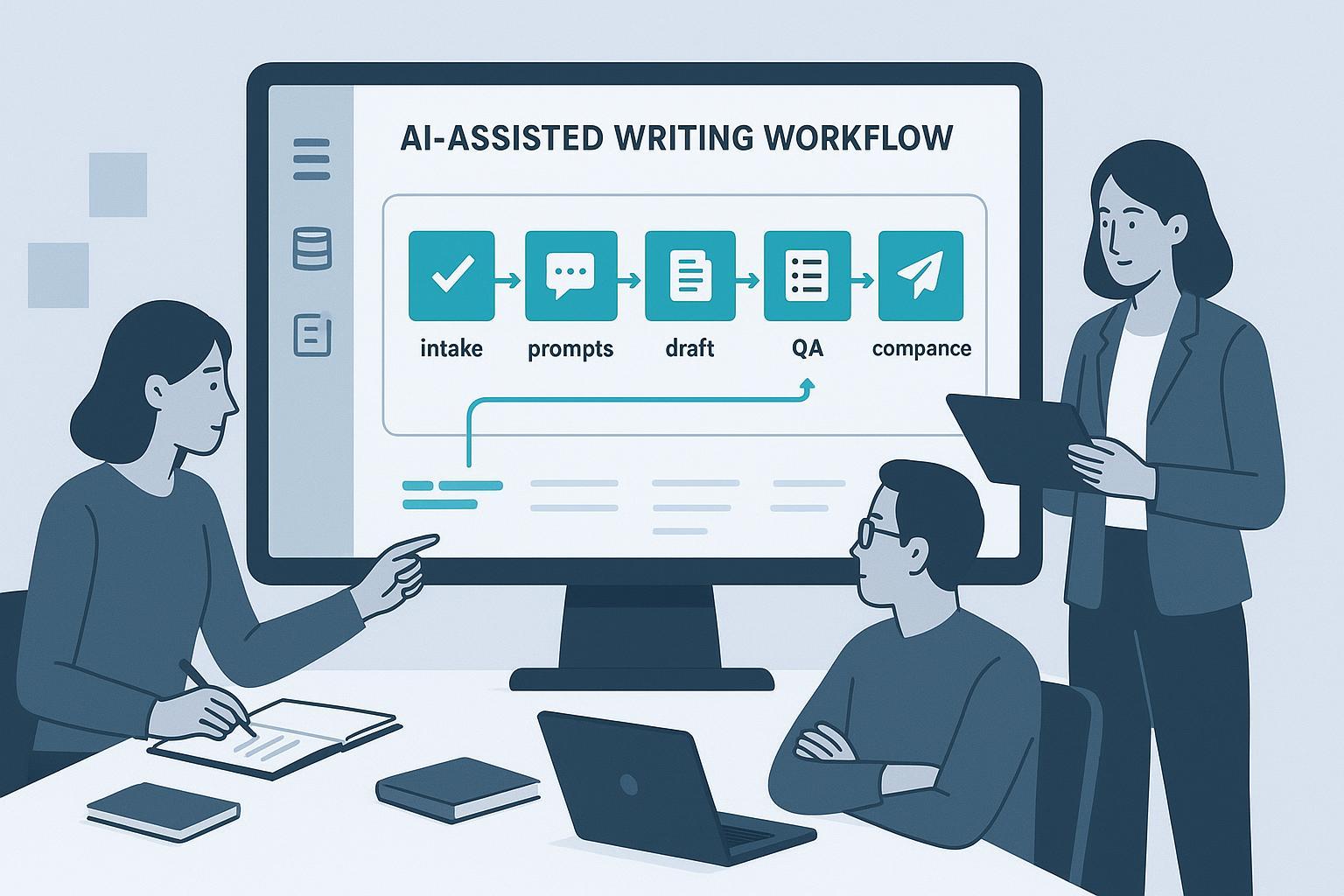
If your clients expect faster documentation, deeper technical accuracy, and clear governance—without ballooning budgets—you’re not alone. In 2025, organizations report measurable top‑line impact from AI; McKinsey notes revenue uplift attributed to genAI programs in its workplace analysis, the Superagency report, focused on marketing, sales, and engineering contexts. See the 2025 findings in McKinsey’s report, Superagency in the workplace, for the distribution of outcomes. That macro signal is promising—but what does an agency actually do differently on Monday morning?
Let’s dig in with a defensible, end‑to‑end workflow your team can run, measure, and explain to clients.
1) The agency workflow that scales
Technical content at agencies lives in handoffs. You’re juggling brief quality, source fidelity, subject‑matter reviews, multiple brand voices, and compliance. The right hybrid workflow makes those handoffs visible and auditable.
- Intake and source packet: Turn the client brief into a “source‑of‑truth” packet—approved docs, code snippets, architecture diagrams, release notes, and citation rules.
- Grounded drafting: Generate a first draft only from the source packet; capture citations inline and log model/settings.
- SME fact check: Route to a named expert; request explicit pass/fail on claims and unresolved questions.
- Editorial QA: Apply style, structure, and accessibility checks; track defect types.
- Compliance and disclosure: Label AI‑assisted sections if required; record data provenance and reviewer approvals.
- Client delivery and change log: Share a clean draft plus an audit trail—what changed, why, and which sources support it.
Two things matter most: grounding the draft in trusted sources and preserving an audit trail that proves the work.
| Role | Responsibilities across the workflow |
|---|---|
| Account/PM | Scope, SLAs, timeline, risk log; ensure client approvals on sources and disclosure approach |
| Technical Writer | Construct source packet; design prompts; generate grounded drafts; track citations and assumptions |
| SME/Engineer | Validate claims, code, and diagrams; flag knowledge gaps; approve or request revisions |
| Editor | Enforce style and structure; reduce ambiguity; verify citations; measure defect density |
| Compliance/Legal | Review disclosures, copyright notes, privacy constraints; sign off on sensitive claims |
| QA/Ops | Maintain prompt library, evaluation sets, and regression tests; monitor groundedness metrics |
2) Prompting that proves its work
The best prompt is a contract: it tells the model what to use, what to ignore, how to format, and when to say “I don’t know.” Source‑bounded prompts reduce drift and make reviews predictable. Think of the prompt as your house style for reasoning.
A compact, reusable pattern:
System: You are a technical writer. Answer only from the provided sources. If the answer isn’t in sources, say “I don’t know.” Cite sources inline as [Source ID].

User:
- Task: Draft a {doc_type} for {product/version} aimed at {audience}.
- Style: Follow Microsoft and Google developer style conventions.
- Structure: H2 sections with short paragraphs; include one code sample if present in sources.
- Sources: [S1: API_Reference_v2.pdf] [S2: ReleaseNotes_2025_10.md] [S3: Architecture_Overview.png]
- Constraints: No speculation; no external knowledge; flag unclear or conflicting passages.
- Output: Include a final “Assumptions & Open Questions” section listing any gaps.
Guardrails that help in production reviews:
- Mandate inline citations and a final “Assumptions & Open Questions” section.
- Force “answer only from sources” and permission to decline.
- Require structured sections and explicit audience/scenario.
Why so strict? Because search engines reward people‑first, original value and penalize scaled, low‑value AI output, as Google reiterates in its 2025 guidance, Succeeding in AI Search, which warns against mass‑produced pages that don’t add unique value for readers.
3) Hallucination control that survives production
No single trick eliminates hallucinations; layered controls do. Retrieval‑Augmented Generation (RAG) consistently reduces unsupported claims when sources are curated and prompts are strict. An industry study presented at NAACL 2024 showed improved factuality and structured output adherence in production‑like settings compared with baseline LLMs. For methodology and results, see the NAACL 2024 industry paper on RAG’s impact on hallucinations.
In higher‑stakes domains, multi‑evidence retrieval and discrepancy‑aware refinement drove meaningful error reductions; a 2025 peer‑reviewed study reported over 40% lower hallucination rates versus baselines in biomedical QA tasks. See the 2025 Frontiers MEGA‑RAG paper for specifics.
What’s practical for agencies?
- Curate a vetted document store per client; label freshness and authority; expire stale sources.
- Use source‑bounded prompts with “I don’t know.”
- Add a chain‑of‑verification pass that re‑reads the draft against sources and lists any unsupported sentences for SME review.
- Monitor groundedness/factuality with a small evaluation set—10–30 questions per client corpus—and run regression checks on each model update.
4) Governance and compliance you can defend
Clients expect control, not magic. Map your operating model to recognizable standards and regulations, then show the receipts.
- Risk and governance frameworks: NIST’s AI Risk Management Framework—and its Generative AI Profile—lays out risk identification, documentation, transparency, and human oversight practices agencies can adopt for content pipelines. Read the official overview in NIST’s AI RMF Generative AI Profile.
- Management systems: ISO/IEC 42001:2023 defines an auditable AI management system—useful for roles, responsibilities, and continuous improvement across multi‑client programs. See ISO’s official listing for 42001 for scope and requirements.
- Transparency and labeling: The EU AI Act’s Article 50 requires informing users when they interact with AI and labeling certain AI‑generated or manipulated content. Agencies working with EU clients should align disclosure practices accordingly. Review the consolidated text of Article 50 for the exact obligations.
- Truth‑in‑advertising: The U.S. Federal Trade Commission emphasizes that AI claims must be truthful and substantiated; enforcement actions in 2024–2025 targeted deceptive AI marketing and misrepresentations. See the FTC’s September 2024 enforcement communication on deceptive AI claims for context.
- Authorship and copyright: The U.S. Copyright Office’s 2025 report clarifies that purely machine‑generated content isn’t protected; AI‑assisted works can be protected to the extent of human authorship, and applicants must disclaim AI‑generated portions. See the 2025 Copyright Office Part 2 report for the policy details.
Operationalize this by keeping: a model and data inventory, prompt libraries with versioning, reviewer sign‑offs per deliverable, and a disclosure register that notes when/where AI assisted the work.
5) Editorial QA: from style to measurement
Style is your first line of defense against confusion. The Microsoft Writing Style Guide and the Google Developer Documentation Style Guide are practical baselines for clarity, inclusive language, and consistent terminology. Standardize them in your editorial checks.
Beyond style, measure quality like a product team:
- Track defect density: factual errors, terminology mismatches, broken references, formatting issues—per 1,000 words.
- Evaluate groundedness and completeness on a small, fixed eval set per client. Microsoft’s engineering guidance outlines dimensions such as Relevance, Truth, Completeness, Fluency, Coherence, Equivalence, and Groundedness and describes practical evaluation workflows for AI apps.
- Run usability checks for core tasks: can a target reader complete the task faster with fewer errors? The Nielsen Norman Group’s benchmarking guidance provides a solid approach to task‑success measurement you can adapt to docs.
Set baselines for each client. Then aim for deltas, not absolutes: for example, +15% task success, −20% time‑on‑task, and a 50% reduction in factual defects over two release cycles.
6) Proving value: KPIs and ROI clients recognize
Executives don’t buy “AI vibes”; they buy outcomes that ship faster and reduce risk. A compact scorecard keeps everyone honest.
- Time‑to‑first‑draft (TTFD): from brief approval to grounded draft.
- Time‑to‑publish (TTP): from brief to live doc; highlight SME and legal bottlenecks.
- SME review cycles per doc: target fewer cycles without sacrificing accuracy.
- Factual error rate per 1,000 words: track by severity; analyze root causes.
- Reuse and modularity: percent of content blocks reused; number of canonical snippets.
- Search and support impact: internal search satisfaction, task success, support ticket deflection for docs.
Treat vendor ROI studies as directional, not gospel. They can help frame potential, but your model should be validated against your own baselines and costs.
7) Teams, training, and client communications
Here’s the deal: processes only work if people know how to run them and clients understand what to expect.
- Upskill by role: writers on prompt design and source curation; editors on groundedness review; SMEs on structured sign‑off; PMs on risk logs and disclosure registers.
- Maintain a living playbook: prompt patterns, style and QA checklists, disclosure rules, and escalation paths.
- Set expectations early: explain where AI assists and how you ensure factual accuracy; include the audit trail in every client delivery so they can see the chain of custody for facts.
Want a quick gut‑check? Ask: could we defend this draft to a skeptical engineer and a regulator, using only our sources and logs?
Build your 90‑day pilot like a product sprint: pick one client, one content type, and one KPI. Stand up a source packet, prompt patterns, a tiny eval set, and a review cadence. Cite your sources, label where required, and keep an audit trail. Then measure, learn, and expand.
Cited sources
- McKinsey, 2025: Superagency in the workplace (business impact and adoption): Superagency in the workplace
- Google Search Central, 2025: people‑first content and scaled content abuse: Succeeding in AI Search
- NIST AI governance: AI RMF Generative AI Profile
- EU AI Act transparency: Article 50 (transparency and labeling)
- FTC enforcement context: FTC crackdown on deceptive AI claims (Sept 2024)
- U.S. Copyright Office, 2025: Copyright and AI Part 2 report
- Hallucination mitigation: NAACL 2024 RAG industry paper and Frontiers 2025 MEGA‑RAG study