How Agencies Can Acquire More Content Clients in 2025: A Pragmatic, Omnichannel Playbook

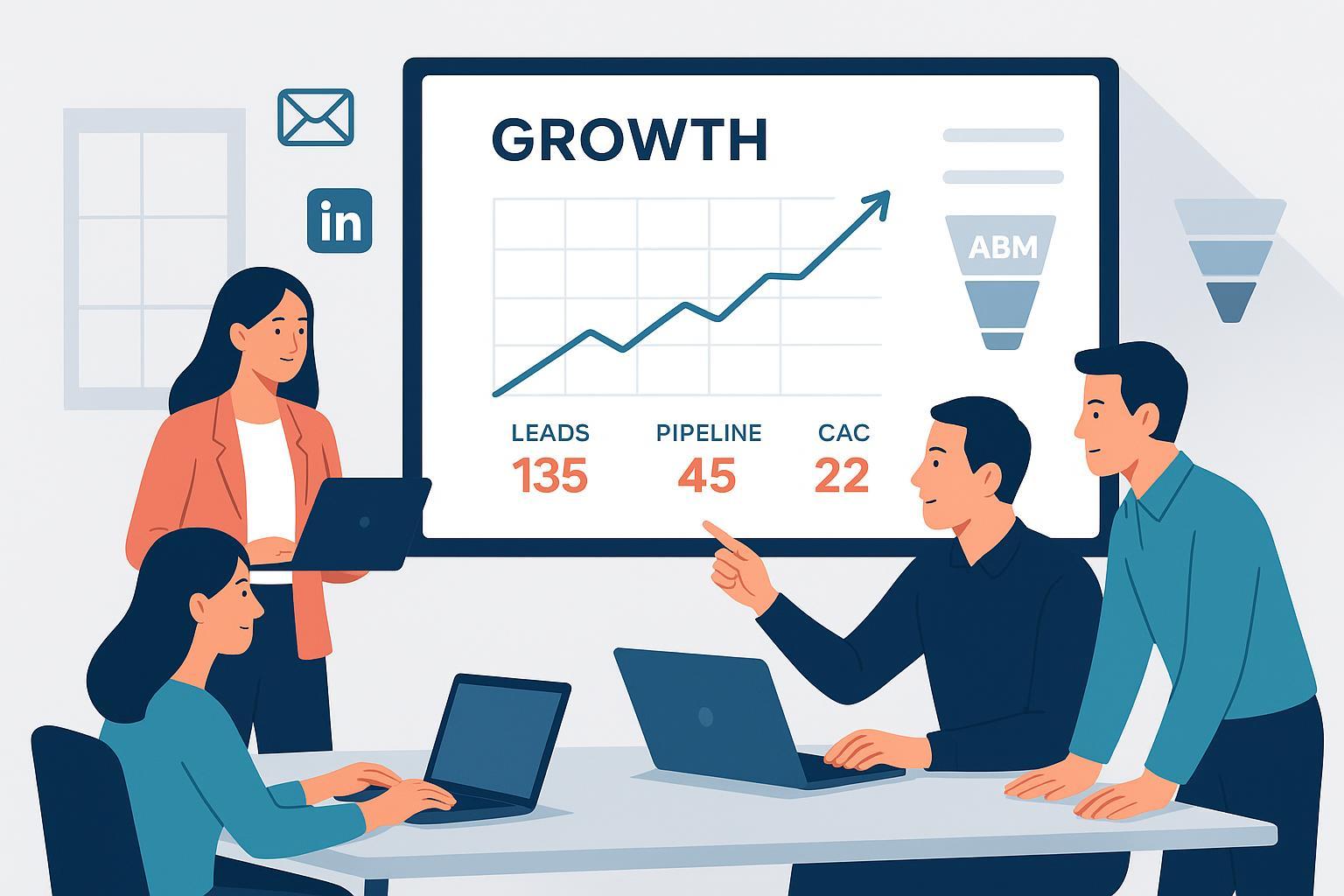
If your pipeline swings from feast to famine, the issue isn’t effort—it’s a system that can’t be measured, repeated, or improved. This guide lays out a practical, testable acquisition motion agencies can run to win more content clients in 2025, blending inbound, outbound, and ABM—with clear benchmarks, simple templates, and privacy‑aware measurement.
1) The mandate in 2025: consistent pipeline, not sporadic spikes
Attribution is messy, AI content is everywhere, and privacy changes keep shifting goalposts. Yet decision‑makers still pay for the same things: clarity of offer, credible proof, and steady communication.
Recent data shows budgets are holding and shifting toward plays that reward expertise and distribution. The Content Marketing Institute’s 2024 benchmark study reports widespread use of content with rising AI influence—and persistent challenges proving ROI, a gap you can turn into advantage by instrumenting outcomes beyond vanity metrics, per the MarketingProfs/CMI 2024 B2B Content Marketing Benchmarks. Looking ahead, B2B marketers plan to invest more in video, thought leadership, paid amplification, and events, according to The MX Group’s B2B25 insights (2024).
The promise of this playbook is simple: define your ICP and offer, lay compounding inbound foundations, run focused outbound cadences, deploy ABM for high‑value accounts, and measure with first‑party data so you can prove pipeline impact.
2) Nail your ICP, offer, and proof before you scale
If your positioning feels fuzzy, every channel underperforms. Tighten three things first:
- ICP: Specify verticals, company sizes, buying committee roles, triggers (e.g., new funding, new VP Marketing, migration), and pain language. Capture “jobs to be done” and common objections.
- Offer: Package outcomes, not activities. For example: “90‑day thought leadership ramp” or “SEO topic authority in 2 clusters this quarter,” each with clear deliverables and milestones.
- Proof: Publish 2–3 case formats: a quantified story, a teardown with before/after, and a quick “wins reel.” Even short, transparent case notes beat generic claims.
If you need a full‑funnel blueprint, see the Client Acquisition Process: The Ultimate Guide for 2025 for a step‑by‑step system you can adapt.
3) Inbound foundations that compound
Inbound works when you make two commitments: topic authority and distribution. Build a cadence that blends deep how‑tos, POV pieces, and short video. Anchor around a monthly webinar or live Q&A to convert attention into conversations.
Topic authority starts by picking two or three clusters tied to your offers (for example, “product‑led content for PLG SaaS” and “executive POV distribution”). Map pillar pages and supporting articles, reference credible industry sources in your content, and include screenshots of your process for trust. For distribution, ship a weekly or biweekly newsletter, post founder POVs on LinkedIn, and syndicate highlights to partner communities or relevant publications. LinkedIn remains fertile ground; the 2025 benchmark shows engagement by impressions around 5.2%, per Socialinsider’s LinkedIn benchmarks (2025)—but results vary widely by niche and quality. Finally, make conversion obvious: calendar links, “audit” forms, or “office hours.” If you run events, repurpose clips into shorts and carousels; if you publish long‑form, create a companion email mini‑series.
For channel‑specific outbound/inbound blends, explore How to Find B2B Clients in 2025 and adapt the mix to your ICP.
4) Outbound that earns responses (AI‑assisted, human‑led)
Good outbound is respectful, concise, and relevant—and it starts with clean data. Use enrichment tools to confirm role, company context, and live initiatives (from job posts, press releases, or funding notes). Keep list ops consent‑first and maintain a preference center. Also recognize that opens are unreliable signals due to Apple Mail Privacy Protection; avoid over‑weighting them in scoring, as Apple explains in Mail Privacy Protection.
Directional benchmarks help set expectations. Industry aggregations in 2025 suggest cold email open rates around 27% with strong lists, reply rates in the 3–10% range, and positive replies around 2–5%—with disciplined follow‑ups pushing results higher, per Snov’s 2025 cold email statistics. Treat these as ranges to calibrate your own baselines.
A simple, respectful multi‑touch over two weeks:
| Day | Channel | Prompt |
|---|---|---|
| 1 | 75–100 words referencing a specific initiative; one question | |
| 2 | Follow + like recent post; optional comment | |
| 3 | Short value add (relevant teardown link or 90‑sec loom) | |
| 5 | LinkedIn DM | Soft ask: “Worth a 15‑min fit check?” |
| 7 | Case snippet: 2–3 metrics + “would this help?” | |
| 10 | Objection handling: pricing, resourcing, or timeline | |
| 14 | Breakup note: permission‑based close |
Tip: Personalize around the buyer’s priorities, not your features. One crisp line that proves you did homework beats a wall of text.
5) When and how to run ABM plays
ABM is ideal when deal sizes justify orchestration and your ICP is well understood. Start by mapping the buying committee (economic, technical, and user champions), then run coordinated touches across email, LinkedIn, retargeting, founder outreach, and event invites.
Directional results are promising. Benchmarks summarized from TOPO/SiriusDecisions point to mature ABM programs achieving roughly 3:1 ROI on average and up to ~7:1 at the top end, as noted in RevNew’s ABM ROI overview (2025). Analysts also report higher win rates and pipeline conversion lifts with ABM motions, as compiled in TheCMO.com’s ABM statistics roundup (2025). Context matters: your niche, offer, and list quality drive variance.
Practical setup:
- Tier accounts (A/B/C) by revenue potential and fit. Give A‑tier 1:1 personalization; B‑tier gets modular personalization; C‑tier follows your standard outbound.
- Create offer variants by tier: executive brief for A‑tier, mini audit for B‑tier, resource bundle for C‑tier.
- Track influence at the account level: meetings booked, stakeholders engaged, opportunities created, and pipeline velocity—not just email metrics.
6) Measurement in a privacy‑first, post‑cookie reality
Third‑party cookies continue to fade and timelines shift, so instrument your own data. Google’s Privacy Sandbox outlines the path forward on Chrome’s side, but attribution will remain modeled and less granular. Keep your measurement centered on first‑party behavior and pipeline impact; see Privacy Sandbox from Google for current status.
- First‑party capture: Gated assets with clear value, event sign‑ups, and “office hours” are straightforward ways to build consented lists.
- Preference center and opt‑outs: Show respect and reduce spam complaints; smarter suppression lists improve deliverability.
- Outcomes that matter: replies, meetings, opportunities, pipeline, revenue, and payback windows. Replace “open rate” as a primary KPI thanks to Apple’s MPP; weight clicks, replies, and booked meetings.
When discussing budgets and ROI with stakeholders, align on CAC and payback methodology. If you need a refresher, bookmark Client Acquisition Cost: How to Measure and Manage It.
7) Workflow example: from proposal to onboarding to the first 30 days
Disclosure: AgencyHandy is our product.
Here’s a lightweight workflow you can mirror in your stack:
- Proposal: Use a templated scope with options (good/better/best) tied to outcomes. Include a 90‑day plan, explicit assumptions, decision criteria, and a simple next‑step (calendar link + procurement checklist).
- Kickoff and onboarding: Share a working doc with goals, ICP notes, brand voice, approval rules, and a content calendar skeleton. Confirm access: analytics, CMS, CRM, email, and social. Establish review SLAs and escalation paths.
- First 30 days: Ship one pillar and two support pieces, plus a founder POV post. Launch the outbound cadence to 50–75 accounts matching the offer. Start retargeting to site visitors and event attendees.
- Communication rhythm: Weekly check‑ins; monthly executive summary; quarterly business review (QBR) with metrics that roll up to pipeline and revenue.
If you don’t have a formal communication plan, adapt this outline from Client Communication Strategy and trim it to your service tier. Tools like AgencyHandy help standardize proposals, onboarding checklists, and reporting cadences without adding admin overhead.
8) Expansion and retention as acquisition force multipliers
Happy clients are your best acquisition channel. Systematize how you turn delivery into proof and proof into demand.
- QBRs and stories: Use QBRs to agree on next bets, capture quotes, and earmark case studies. Keep legal templates ready so approvals don’t stall.
- Community presence: Host niche roundtables or invite‑only peer sessions. The halo effect feeds inbound and gives you qualitative insight.
- Referrals and partners: Reward referrals with a clear program; share case snippets partners can use in their own channels.
Quick gut check: if a prospect visits your site today, would your latest three pieces make them think, “These folks get my world”? If not, that’s your first sprint.
9) Next steps: a 30‑day action sprint
Use this to get momentum without boiling the ocean.
- Week 1: Finalize ICP notes, refresh your two core offers, and draft one short case.
- Week 2: Publish a POV article and a 90‑second video; set up the 14‑day outbound cadence; prepare your preference center.
- Week 3: Host a live office hour; launch retargeting; send your first newsletter issue.
- Week 4: Run five QBR‑style check‑ins with current clients to uncover stories and referrals.
If you want a full acquisition blueprint and templates, start with the Client Acquisition Process: The Ultimate Guide for 2025. When you’re ready to formalize proposals and onboarding flows, try AgencyHandy to speed up the busywork so you can focus on strategy.
References and benchmarks used in this guide include: the MarketingProfs/CMI 2024 B2B Content Marketing Benchmarks, The MX Group’s B2B25 insights (2024), Socialinsider’s LinkedIn benchmarks (2025), Snov’s 2025 cold email statistics, RevNew’s ABM ROI overview (2025), Apple’s Mail Privacy Protection, and Google’s Privacy Sandbox. Treat all external ranges as directional and calibrate to your own CRM/ESP baselines.