Green Claims Compliance Best Practices (2025): A Practitioner’s Playbook for Marketers and SaaS Teams

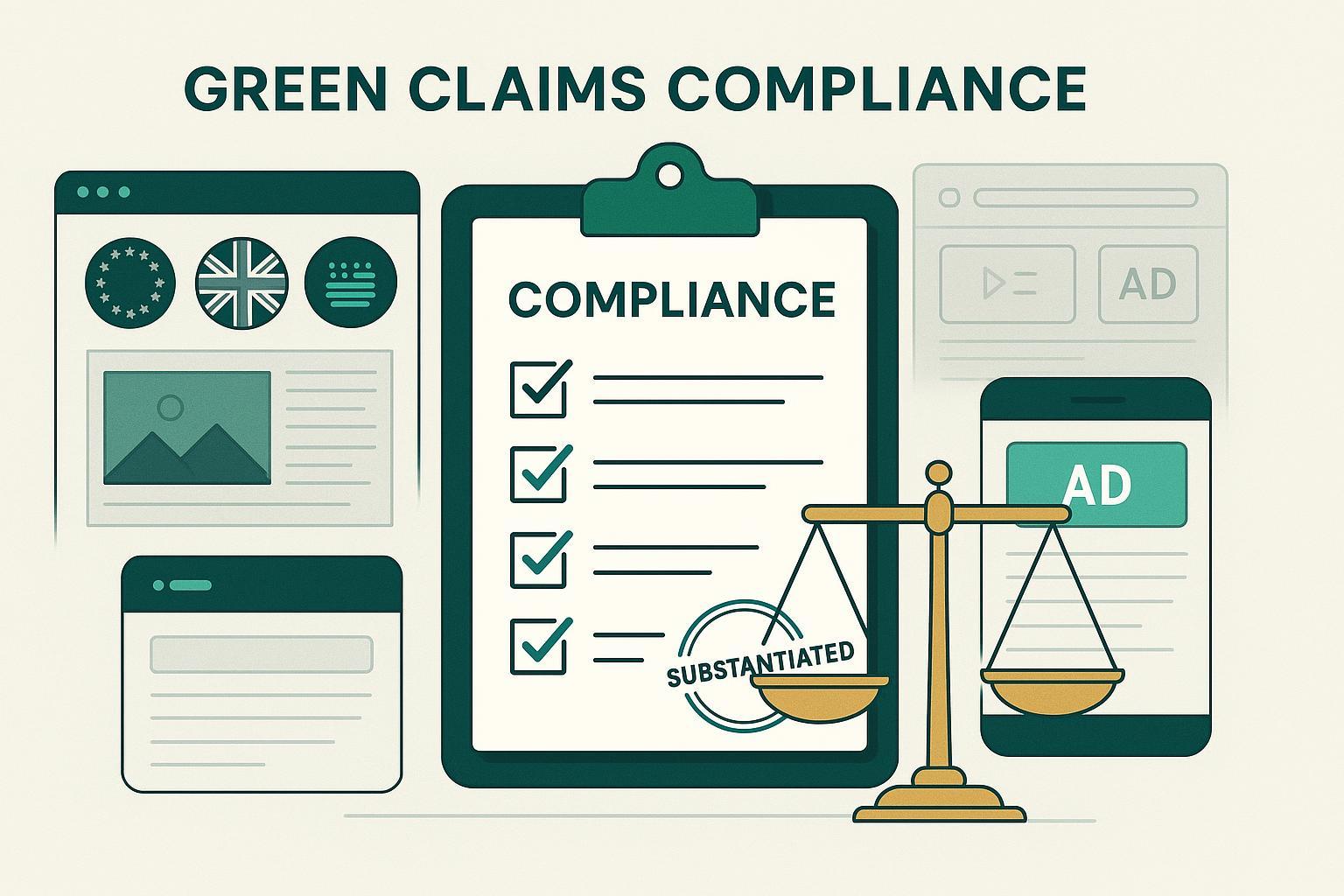
If you put environmental claims in ads, product pages, or in‑app messaging in 2025, regulators assume you can prove them. The bar is rising across jurisdictions: the EU’s Empowering Consumers for the Green Transition Directive bans generic claims and restricts offset-based neutrality at product level starting September 2026, transposed by March 2026 (EU Parliament/Directive (EU) 2024/825, 2024; EC news 2024). In the UK, the CMA gains civil penalty powers up to 10% of global turnover under the DMCCA from 2025, while ASA rulings have reset expectations for specificity in ads (UK CMA annual report 2024–25; ASA rulings on Lufthansa, 2023). In North America, the FTC continues enforcing environmental marketing under Section 5 while its Green Guides await updates, and California’s AB 1305 mandates detailed public disclosures for offset-based claims (FTC environment portal; California OAG opinion on AB 1305, 2024).
This playbook distills field-tested practices we’ve used with brands and SaaS teams to make claims credible, clear, and defensible—without turning every headline into a legal memo.
First Principles That Keep You Out of Trouble
Based on recent enforcement and guidance, the following principles are non‑negotiable:
-
Be specific, not generic.
- Avoid empty terms like “eco‑friendly,” “green,” or “sustainable” without context; the EU ECGT directly targets these (EP explainer 2024).
-
Substantiate with current, like‑for‑like evidence.
- Use recognized methods (e.g., ISO 14067 for product carbon footprints; ISO 14064‑1 for organizational GHG inventories). Ensure baselines, boundaries, and timeframes are explicit (ISO standards overview).
-
Clarify scope up front.
- Say what the claim covers (e.g., manufacturing phase vs. full life cycle; Scope 1–2 vs. 1–3). ASA rulings emphasize immediate clarity and not burying qualifiers (ASA travel claims guidance).
-
Don’t imply absolutes unless you can prove them.
- Claims like “carbon neutral product” or “zero emissions” require rigorous evidence and, in the EU, offset‑only product claims will be heavily restricted from late 2026 (Directive (EU) 2024/825).
-
Be transparent about offsets.
- Separate gross emissions reductions from residuals and disclose credit details (project, vintage, permanence). California AB 1305 sets a practical template for U.S. disclosures (AB 1305 overview documents, 2024).
-
Keep evidence fresh and accessible.
- Regulators expect current data and easy access for consumers; the Netherlands ACM stresses claims must be up‑to‑date, concrete, and verifiable (ACM guidelines).
The 8‑Step Implementation Playbook
1) Inventory and Classify Every Claim
Map all environmental claims across channels (ads, landing pages, packaging, PR, in‑product UI, app stores, influencer scripts). Classify by claim type (recyclability, recycled content, energy efficiency, emissions reductions, neutrality/net‑zero, certifications) and by jurisdictional exposure.
Create a central Claims Register capturing:
- Claim text and scope (product, service, corporate activity)
- Audience/channel and geography
- Evidence owner and sources
- Date of last verification and next review due date
If you operate globally, tag each claim with regional risk notes (EU ECGT exposure, UK ASA high‑risk categories like aviation, U.S. offset disclosure needs, Canada’s “adequate and proper testing” standard as of June 2024 per the Competition Act amendments: see Blakes 2024 analysis).
2) Build Substantiation Packets That Match the Claim
For each claim, assemble a packet with:
- Methodology and boundaries (e.g., ISO 14067 product CF with cradle‑to‑grave vs. gate‑to‑gate)
- Data sources, baselines, and calculations (with version control)
- Independent verification/assurance statements when used (ISO 14065/17029‑accredited bodies)
- Supplier attestations and certificates (cross‑checked)
- If using offsets: project registry links, additionality/permanence notes, and annual disclosure page (AB 1305‑style)
Align neutrality claims with ISO 14068‑1:2023 and SBTi net‑zero guidance—show deep reductions first, then neutralization of residuals (BSI ISO 14068‑1 transition, 2024–25; SBTi net‑zero standard).
3) Design Compliant Wording and Visuals
Rewrite vague or absolute claims into precise, scoped statements.
-
Weak: “Eco‑friendly packaging.”
-
Stronger: “Carton uses 85% post‑consumer recycled fiber, verified to ISO 14021 definitions; excludes plastic liner.”
-
Weak: “Carbon neutral product.”
-
Stronger (EU‑aware): “Manufacturing emissions reduced 38% vs. 2019 baseline; residual 0.9 kg CO2e per unit neutralized with forestry removals (Verra VCS, 2019–2022 vintages).” Note: avoid product‑level neutrality claims in EU markets post‑Sept 2026 without meeting ECGT restrictions (EP press 2024).
Ensure labels/certifications used are legitimate and not look‑alikes; ASA and ACM have acted against misleading visuals (ACM principles).
4) Handle Offsets and “Neutral” Claims With Extra Care
- Separate reductions vs. neutralization in all narratives; do not suggest offsets equal ongoing emissions cuts (aligned with SBTi’s stance that credits don’t count toward SBTs: SBTi FAQs, 2024).
- Maintain a public disclosure page listing project types, quantities, retirement IDs, and permanence/monitoring details—mirroring California AB 1305’s spirit for U.S. audiences (California OAG opinion, 2024).
- In France, neutrality messaging in ads triggers specific disclosures and a long‑term reduction trajectory per Decree 2022‑539 (Legifrance decree).
5) Govern With an Approval Workflow and SLAs
Establish a RACI with Marketing, Legal/Compliance, Sustainability, and Data owners. Require:
- Evidence freshness SLAs (e.g., product CF updates every 12–24 months or after material changes)
- Pre‑flight legal checks for high‑risk channels (OOH, TV, performance ads)
- Version control and an audit trail for edits and takedowns
UK advertisers should assume ASA scrutiny on high‑profile sectors; ASA has used proactive monitoring, including AI, for sustainability claims (ASA monitoring with AI, 2024).
6) Align Suppliers, Partners, and Influencers
Bake claim accuracy into contracts and briefs:
- Supplier contracts require data sharing and audit rights
- Co‑marketing agreements bind both parties to substantiated claims
- Influencer briefs include exact wording and mandatory disclosures; CAP/ASA rules apply to social content too (ASA advice for travel/environmental claims).
7) Train Teams on the Rules They Actually Use
Run role‑specific sessions:
- Copywriters: ECGT bans on generic claims; scope language; offset transparency
- Performance marketers: ad platform copy limits and placement of qualifiers; landing page evidence linking
- Product managers: in‑app claims, dashboards, and offset widgets—avoid implying product use is “carbon neutral” without proof (EU ECGT relevance by 2026; EP explainer, 2024)
8) Monitor, Audit, and Course‑Correct
- Quarterly audits of top‑traffic pages and ads; spot‑check affiliates
- Track regulator updates: EU ECGT implementation, UK DMCCA commencement orders, FTC Green Guides docket (FTC-2022-0053)
- Maintain a rapid takedown/clarification protocol for complaints
Fast Jurisdiction Notes (2025)
-
European Union: The proposed Green Claims Directive is on hold as of mid‑2025; prioritize compliance with the ECGT, transposition by Mar 2026, application from Sep 2026 (EP legislative train/status 2025; ECGT OJ text).
-
United Kingdom: CMA’s Green Claims Code enforced via DMCCA civil penalties up to 10% global turnover from 2025; ASA rulings demand clear, specific evidence at the point of claim (UK CMA annual report 2024–25; ASA Lufthansa rulings 2023).
-
United States: FTC Green Guides review ongoing; rely on current guides and Section 5. For offset marketing, mirror California AB 1305 transparency expectations (FTC portal; AB 1305 opinion 2024).
-
Canada: 2024 Competition Act amendments require “adequate and proper testing” for product environmental claims and recognized methodologies for broader claims; private right of action begins June 20, 2025 (Blakes 2024 overview).
-
Australia: ACCC prioritized greenwashing and secured an AUD 8.25m penalty against Clorox over “ocean plastic” claims (2024) (ACCC release 2024).
-
Netherlands: ACM’s five rules of thumb set a high bar for specificity, substantiation, and credible labels (ACM guidelines).
Mini Case Vignette: Rewriting a Risky SaaS Claim
Situation: A SaaS platform plans to launch a “carbon neutral analytics” feature, showing users’ footprint and auto‑offsetting emissions monthly.
What the audit found:
- “Carbon neutral” implied absolute product‑level neutrality; offsets were the sole basis.
- No public disclosure of project details; dashboards implied ongoing use is impact‑free.
Fix implemented:
- Renamed to “Lower‑impact analytics: 38% lower data‑center emissions per user session vs. 2022 baseline (Scope 2).”
- Added measurement appendix detailing methodology and boundaries (ISO 14064‑1; data‑center PUE, grid mix, allocation approach).
- Offsets framed separately: “We neutralize residual Scope 2 emissions annually with nature‑based removal credits (list registry IDs, vintages, permanence).”
- Geo‑conditioning: EU pages avoided product‑level neutrality claims ahead of ECGT application in 2026; all markets added a public disclosure page and updated customer FAQs.
Result: Reduced legal risk, higher clarity for users, and stronger internal discipline around data updates.
Toolbox for Documentation and Transparency (neutral selection)
- Greenly — Carbon management platform for data collection and footprinting across Scopes 1–3; helps organize evidence for claims at scale: greenly.earth.
- Plan A — ESG and decarbonization management with supplier engagement and reporting capabilities: plana.earth.
- QuickCreator — AI‑powered content workspace to structure claims registers, attach evidence links, and maintain consistent, clear wording across languages. Disclosure: we may have an affiliation with QuickCreator.
Use enterprise carbon accounting platforms (e.g., Persefoni) when you need investor‑grade inventories; use documentation/authoring workspaces to keep marketing claims and evidence synchronized. Tool choice depends on scale, resources, and assurance needs (Persefoni overview).
Practical Checklists You Can Use Today
Claim Substantiation Mini‑Checklist
- Define claim scope, boundary, and timeframe in plain language
- Identify methodology (ISO 14067/14064‑1) and baseline year
- Assemble raw data sources and calculations; record assumptions
- Obtain independent verification where appropriate (ISO 14065/17029)
- If offsets are cited: disclose project type, standard, vintage, quantity, and retirement IDs; publish an annual disclosure page
- Set a review cadence and owner; log in the Claims Register
Wording Red Flags to Eliminate
- “Eco‑friendly,” “green,” “sustainable” without specifics
- “Zero emissions,” “carbon neutral,” “net‑zero” without clear basis and disclosures
- Future ambitions framed as achieved outcomes (“on track to be net‑zero by 2030” used as proof of current benefit)
- Comparative claims without like‑for‑like bases (“50% greener than Brand X” without boundary/method parity)
Approval Workflow Essentials
- RACI defined; legal sign‑off required for high‑risk claims
- Evidence freshness SLA (12–24 months; sooner after material change)
- Versioned copy and asset repository; takedown protocol
- Partner/influencer scripts pre‑approved; affiliate monitoring in place
Common Pitfalls and How to Avoid Them
- Treating certifications as a substitute for evidence. Many seals don’t validate your specific claim; check the scheme’s scope and recognition.
- Leaning on offsets to justify bold headlines. Regulators increasingly expect reductions first; disclosures alone won’t cure an overclaim.
- Mixing organizational and product scopes. Don’t use corporate targets to imply product‑level benefits.
- Ignoring national quirks. France’s neutrality decree, Canada’s testing standard, and the UK’s ASA approach can each trip up global campaigns.
- Letting evidence age out. Data staleness undermines claims and increases risk during investigations.
Final Word
Compliance isn’t a slogan—it’s an operational habit. If you build a claims register, require evidence packets, train teams, and rehearse audits now, you’ll ship credible messages faster and avoid expensive rework or penalties. For deeper alignment, anchor to ISO 14068‑1 for neutrality, ISO 14067/14064‑1 for measurement, and keep an eye on ECGT timelines and UK DMCCA enforcement as 2025 progresses.
Note: This article provides general best practices and does not constitute legal advice. Always consult qualified counsel for specific campaigns and jurisdictions.