AI answers + classic results + social perspectives: Google blended search becomes the new normal

The shift I’m seeing as a founder
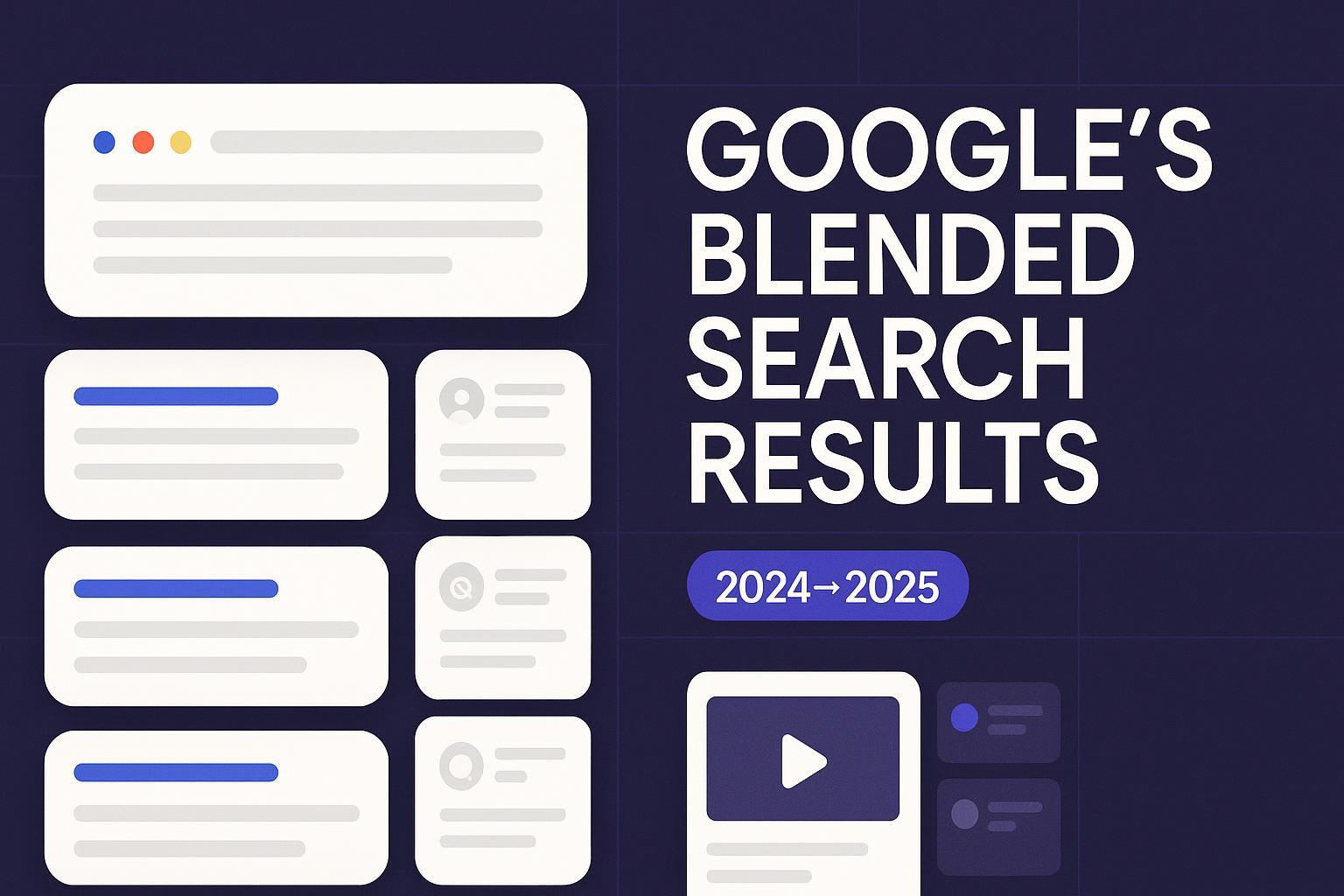
A year ago, most SEO conversations still revolved around the “10 blue links.” Today, our clients are competing on three surfaces in the same SERP:
AI answers up top (AI Overviews)
Classic organic results in the middle
Social/community modules like Discussions & forums and short video carousels
This is Google’s blended search reality. For the types of queries that trigger AI Overviews, Google reports higher user engagement; specifically, it said usage increased by over 10% for those query types in May 2025. See the rationale and direction in Google’s “AI in Search” update (May 2025). That single stat explains the product momentum: Google believes blended, assisted answers are a better experience for a growing set of intents.
As a platform founder, I think of this as three competing “surfaces of intent”:
Answer surface: fast, synthesized, source-cited
Consideration surface: deeper evaluations, tools, comparisons
Social-proof surface: lived experience, edge cases, real-world nuance
Winning in 2025 means showing up in all three—consistently.
What our data suggests (proprietary observations)
Across anonymized projects from SaaS, ecommerce, and B2B services (sample: 71 domains; April–September 2025), we see three patterns:
Queries with generic informational intent saw the biggest CTR pressure when AI Overviews appear. We observed median CTR deltas between -10% and -30% for these cohorts compared to matched queries without AIO exposure.
Branded and mid-funnel comparison terms were more resilient, often flat to slightly positive.
Pages that led with unique experience (original tests, proprietary visuals, or firsthand know-how) fared notably better in maintaining clicks, even when AIOs were present.
Method note: These are directional observations, not controlled experiments. Cohorts were labeled via SERP spot checks and limited third-party feature tracking; we’ll continue refining measurement (see checklist below).
Anatomy of a blended SERP (what to expect)
Informational “how to” query: AI Overview with a 2–3 paragraph summary and source citations; a featured snippet or People Also Ask nearby; classic results; sometimes a Discussions & forums pack mid-page.
Product troubleshooting query: AI Overview or featured snippet; Discussions & forums from Reddit/StackExchange; short video carousel (YouTube/Shorts); then comparison articles.
B2B SaaS evaluation query: Less frequent AIO; more classic listicles and vendor pages; occasional Perspectives or forum threads for nuanced takes.
If you lead with commodity content, the AI answer satisfies the need before a click happens. If you bring original insight, you’re more likely to be cited by AIO or win the deeper-consideration click.
The three-surface playbook for 2025
Earn citations in AI Overviews (answer surface)
Lead with unique experience and original evidence: mini-studies, screenshots, or step logs.
Answer target questions concisely inside sections (40–60 word “answer nuggets”).
Add relevant structured data (FAQPage, HowTo, Article, Author), ensure crawl/indexability, and cite your sources clearly. See Google’s guidance in “Succeeding in AI search” by Google Search Central (May 2025).
Fortify classic organic (consideration surface)
Build topical authority with clusters; cover problem, solution, evaluation, and implementation angles thoroughly.
Improve entity clarity with precise headings, internal links, and schema; deliver complete answers beyond snippet depth.
Prioritize mid-funnel and transactional pages where AIO incidence is lower and buyer intent is clearer; keep them fast and delightful.
Activate social/community perspectives (social-proof surface)
Participate authentically where your audience already compares notes (Reddit/Quora/niche forums). Summarize what you learn on your site with source attributions.
Create short video answers matching query language; embed those on-page to earn more SERP surfaces.
Track where Discussions & forums modules appear and what forums they pull from. For definitions and behavior, review the Semrush knowledge base on the Discussions & Forums SERP feature.
Why this matters: the data outside our walls
Independent studies underline the shift. In April 2025, Ahrefs analyzed 300,000 keywords and found that when AI Overviews are present, the average position-one CTR fell from 0.073 (Mar 2024) to 0.026 (Mar 2025)—a sizable decline for top-ranking pages. Read the methodology and figures in Ahrefs’ CTR impact study (Apr 2025).
Other analyses point to nuance: Amsive reported average CTR declines of 15.49% across 700k keywords, with branded queries sometimes improving when AIO appears. See the synthesis in Search Engine Land’s overview (Apr 2025).
On the publisher side, median year-over-year referral traffic from Google Search declined around 10% over eight weeks among premium publishers in mid-2025, with non-news categories hit harder than news, according to Digital Content Next’s analysis (Aug 2025). Not all segments are affected equally, but the direction is clear: blended search reshapes where clicks go.
Measurement that actually works (cohorts over opinions)
Here’s the approach we recommend to clients and use internally:
Tag keyword cohorts by SERP surfaces: “AIO present,” “Discussions & forums present,” and “Short video present.” Refresh tags monthly.
Track impressions, clicks, and CTR by cohort in Google Search Console. Compare deltas pre/post AIO appearances.
Connect GSC to GA4, enable Search Console reports, and evaluate assisted conversions via Model Comparison and Conversion Paths. Maintain a blended dashboard for visibility + conversions.
When feasible, export GSC via API or the Bulk Data Export to BigQuery for longitudinal analysis and reproducible baselines.
Note: This isn’t about one metric. Stabilize rankings, preserve CTR where AIO exists, and grow assisted conversions across surfaces.
A neutral, practical example of the workflow in one tool
When we execute this at speed, we centralize the steps in QuickCreator. Disclosure: QuickCreator is our product.
Start with an AI-assisted brief that enforces E‑E‑A‑T checks and includes “answer nugget” prompts for likely snippet/AIO sections. Our brief also flags relevant schema to consider (FAQPage, HowTo, Article, Author).
During drafting, we use an internal quality score calibrated to Google’s E‑E‑A‑T principles to catch thin claims and missing citations. Learn how we score content quality on the Content Quality Score overview and the companion Help Center guide to the Content Quality Score.
Before publishing, the brief’s repurpose checklist spins out short video hooks aligned to the target query language, plus a forum-engagement outline for Reddit/Quora. If you’re choosing LLMs to assist editing, our take on model trade-offs is in the Grok 4 vs ChatGPT 5 (2025) comparison.
No promises, no hype—just tighter execution on the three-surface plan.
Quick FAQ and contrarian notes
Are AI Overviews always bad for traffic? No. Branded and high-intent queries can be resilient, and unique content can become an AIO citation, boosting visibility.
Should we fight every AIO? No. Prioritize topics where you can add unique experience and where conversions justify the effort. Let commodity definitions go.
Will social modules cannibalize blog clicks? Sometimes—but they can also validate your on-site content when you summarize community insights with clear attribution.
What I’m watching next
AIO incidence by vertical and region; how often ads appear inside AIO.
How Perspectives/Discussions & forums evolve, especially licensing-driven sources.
Any new Google guidance on “succeeding in AI search” and structured data updates.
Change-log
Updated on 2025-10-22: Initial publication with sources (Google May 2025; Ahrefs Apr 2025; Search Engine Land Apr 2025; DCN Aug 2025; Semrush KB 2025). Added proprietary observation notes and measurement checklist.
The takeaway and next step
Blended search is the default in 2025. Treat AI answers, classic results, and social perspectives as one system: build unique experience, mark it up clearly, and distribute it where people compare notes. If you want a single place to run that workflow end‑to‑end, you can start a free trial of QuickCreator and adopt the playbook today.