GEO Predictions for 2025 and Beyond

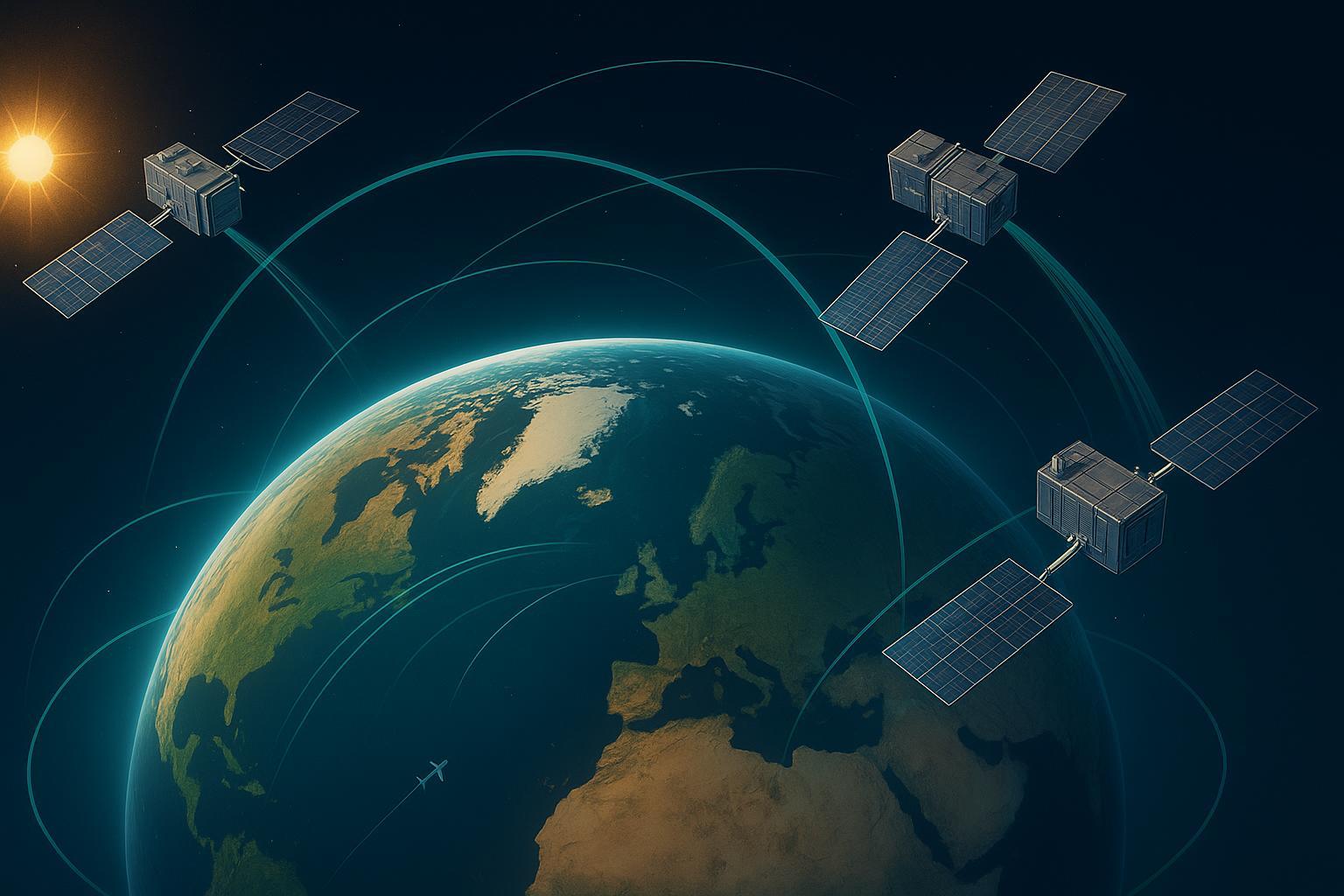
GEO isn’t fading—it’s getting choosier. 2025 opens with a different center of gravity: SES closed its acquisition of Intelsat, creating a multi‑orbit heavyweight; the Sun is near peak activity; and the WRC‑23 decisions are flowing into national rulemaking. Put simply: fewer GEO birds will be built, but they’ll be smarter, paired with LEO/MEO for resilience, and governed by tighter interference and debris discipline.
1) GEO’s 2025 market posture: specialization, software‑defined momentum, consolidation
Order volumes stayed modest through 2024–2025, but the mix shifted toward software‑defined payloads and, selectively, smaller GEO platforms. The headline signal is scale and strategy: SES completed its acquisition of Intelsat in July 2025, citing a combined backlog above €8B, pro forma revenue around €3.7B, and a plan for multi‑orbit growth with disciplined capex. See SES’s closing announcement, which outlines the integration thesis and financial guardrails, in the company’s July 17, 2025 release: the deal “creates global multi‑orbit connectivity” with targeted synergies and leverage reduction according to the official communication in the SES completes acquisition of Intelsat (2025).
Prediction: 2025–2027 sees “fewer but smarter” GEO orders. Expect a larger share of software‑defined satellites (Airbus OneSat/Thales Inspire class) to hedge demand shifts across mobility, government, and video. Small GEO will find its lane in targeted regional capacity and government programs, but risk tolerance will remain front‑of‑mind after a few high‑profile anomalies in the small‑sat cohort.
2) Multi‑orbit becomes the default SLA—and GEO keeps the anchor roles
Customers now buy availability, not orbits. LEO brings latency and on‑demand capacity; GEO brings scale, coverage stability, and well‑understood economics. The winning pattern in 2025 is multi‑orbit routing with GEO as the “always‑on” backbone for broadcast, backhaul, and sovereignty‑driven missions.
Think of it this way: when a storm knocks LEO links around or a gateway hiccups, GEO fills the gaps; when a mission needs sub‑100 ms paths, LEO steps in. The trick is choreography—policy‑driven steering across fleets and orbits.
| Use case (2025–2027) | GEO’s role | LEO/MEO’s role |
|---|---|---|
| Video distribution & broadcast | Primary: wide‑area beams, predictable costs | Supplemental IP return paths |
| Rural/remote backhaul | Primary where latency permits; scalable coverage | Burst capacity, latency‑sensitive sites |
| Government/sovereign networks | Primary anchor for coverage/control | Diversity paths, surge bandwidth |
| Aviation & maritime mobility | High‑availability overlay; regional/geopolitical fit | Primary for low‑latency cabin/crew data |
| Enterprise SD‑WAN | Stable core capacity | Low‑latency breakout, cloud edges |
Prediction: By 2027, “multi‑orbit by default” is in most RFPs. GEO’s edge strengthens in premium availability packages, while LEO soaks up latency‑sensitive consumer broadband. SLA language will explicitly reference multi‑path failover across orbits rather than single‑constellation commitments.
3) Regulation through 2027: WRC‑23 decisions meet national rulemaking
WRC‑23 locked in meaningful gains for satellite, including enabling ESIM communications in specified Ku/Ka segments and maintaining protective coexistence frameworks while tasking further study of NGSO‑to‑GSO interference (e.g., EPFD‑related items) heading into the next cycle. The authoritative record is the ITU’s Final Acts—see the WRC‑23 Final Acts (2024)—and the ITU’s regional preparation pages for the run‑up to WRC‑27.
In the U.S., the FCC has begun to translate pieces of this into domestic rules. A December 2024 Report & Order addresses NGSO FSS space‑to‑Earth operations in 17.3–17.8 GHz and aligns protection limits, indicating the direction of travel on coexistence and incumbent protection. See the Federal Register notice in NGSO FSS space‑to‑Earth operations in 17.3–17.8 GHz (FCC, 2024). Canada’s ISED is also aligning domestic frameworks with international outcomes and tightening debris expectations via licensing reviews and ISO alignment; the consultation sets out proposed changes in ISED’s 2025 debris mitigation consultation.
Prediction: Expect incremental liberalization for ESIM and flexible FSS use, paired with stricter interference discipline and measurement obligations. Practical step for 2025: engage early in WRC‑27 regional prep and align technical filings and simulations with EPFD study scopes to avoid last‑minute surprises.
4) Debris and safety: compliance as a competitive advantage
GEO disposal and passivation are not check‑the‑box items anymore—they’re bid differentiators. The widely used ITU‑R S.1003‑2 guidance sets the minimum graveyard altitude above GEO as: ΔH = 235 km + 1000 × CR × (A/m), where CR is the solar radiation pressure coefficient and A/m is the area‑to‑mass ratio. Most operators add margin beyond the computed minimum.
A simple example: suppose a spacecraft has A/m = 0.02 m²/kg and CR = 1.2. The formula yields ΔH = 235 + 1000 × 1.2 × 0.02 = 235 + 24 = 259 km. In practice, planners might target 300+ km to accommodate long‑term perturbations and conjunction risk.
Beyond re‑orbiting, ISO 24113 and IADC guidelines emphasize passivation—venting residual propellants, de‑energizing batteries, and eliminating stored energy—to reduce breakup risk. National licensing regimes increasingly expect clear, auditable plans. Canada’s current consultation exemplifies how regulators are weaving ISO conformance directly into license conditions; details are in ISED’s 2025 debris mitigation consultation.
Operator checklist for 2025 bids and missions:
- Include a worked graveyard altitude calculation (with margins) and a passivation plan aligned to ISO 24113/IADC.
- Provide disposal delta‑V budgets with contingency, plus verification telemetry plan.
- Document conjunction screening and long‑term stability analysis for the disposal orbit.
Prediction: Enforcement tightens in 2025–2027. Expect more rigorous license conditions, post‑mission reporting, and public transparency on disposal execution—turning meticulous compliance into a trust signal.
5) Solar Cycle 25 at peak: a GEO operations playbook for 2025
We’re operating near solar maximum through 2025. That means elevated geomagnetic storms, enhanced radiation belt dynamics, and higher surface‑charging risk for GEO platforms. Operations teams should tie playbooks to authoritative alerts and indices.
Useful trigger points include Kp ≥ 6 (G2–G3 storm levels) and sustained elevated particle flux. NOAA’s Space Weather Prediction Center provides daily forecasts, alerts, and summaries—bookmark the NOAA SWPC portal.
SOP triggers many teams adopt in peak periods:
- Move to conservative payload modes or lower amplifier drive during severe events; postpone sensitive switching or software updates.
- Increase telemetry/telecommand cadence and enable additional watchdogs; pre‑brief anomaly response bridges.
- Review station‑keeping timing and eclipse operations; verify safe‑hold paths and autonomy thresholds.
Prediction: 2025 will bring more “anomaly days” but fewer nasty surprises for organizations that practice their storm playbooks and coordinate with satellite manufacturers on configuration constraints.
6) Security and RPO: a sharper threat model for GEO
Remotely proximate operations (RPO) and non‑cooperative behavior in GEO are no longer theoretical. Open‑source assessments in 2024–2025 document inspector satellites, historical close approaches, and persistent jamming/cyber risks. For a public baseline, the Center for Strategic and International Studies compiles incidents and capabilities in its Space Threat Assessment 2025.
Prediction: Expect firmer norms around proximity operations and attribution standards by 2027, with increased allied cooperation on space domain awareness. Commercial operators should maintain clear RPO response frameworks: notification protocols, ephemeris sharing, and pre‑agreed escalation paths with customers and government stakeholders. Why wait until an unexpected visitor sidles up to your slot?
7) 2025–2027 scenarios and how to plan
Base case: GEO orders remain steady but smarter, with software‑defined payloads the default for new FSS platforms. Multi‑orbit becomes standard in SLAs; regulators incrementally expand ESIM/flexible use while tightening interference and debris accountability. Space‑weather disruptions are episodic but manageable with playbooks; RPO norms consolidate.
Upside: Faster‑than‑expected enterprise and government adoption of multi‑orbit SD‑WAN and sovereign networks lifts GEO utilization; EPFD studies yield practical coexistence rules that accelerate licensing; solar activity eases earlier than forecast.
Downside: Launch slips and small‑GEO reliability concerns slow capacity refresh; EPFD debates bog down filings; prolonged solar turbulence elevates anomaly rates; a notable RPO incident triggers reactive operating constraints.
What to do in 2025
- Update procurement specs to require software‑defined GEO payloads and multi‑orbit routing compatibility; build SLA language around explicit cross‑orbit failover.
- Assign regulatory owners to WRC‑27 prep and national dockets; simulate EPFD compliance early.
- Publish (and rehearse) space‑weather SOPs referencing SWPC alerts; integrate with NOC calendars and vendor constraints.
- Treat debris compliance as a customer‑facing quality metric: show your graveyard math, passivation steps, and verification plan.
Bottom line: GEO’s next act is about specialization and choreography. The winners in 2025–2027 will pair flexible GEO capacity with LEO/MEO diversity, prove out interference and debris discipline, and operate with the calm, practiced tempo that solar max and proximity risks demand. Ready to tune your playbook before the next storm?"}