GEO for Marketing Agencies: What It Means and How to Use It

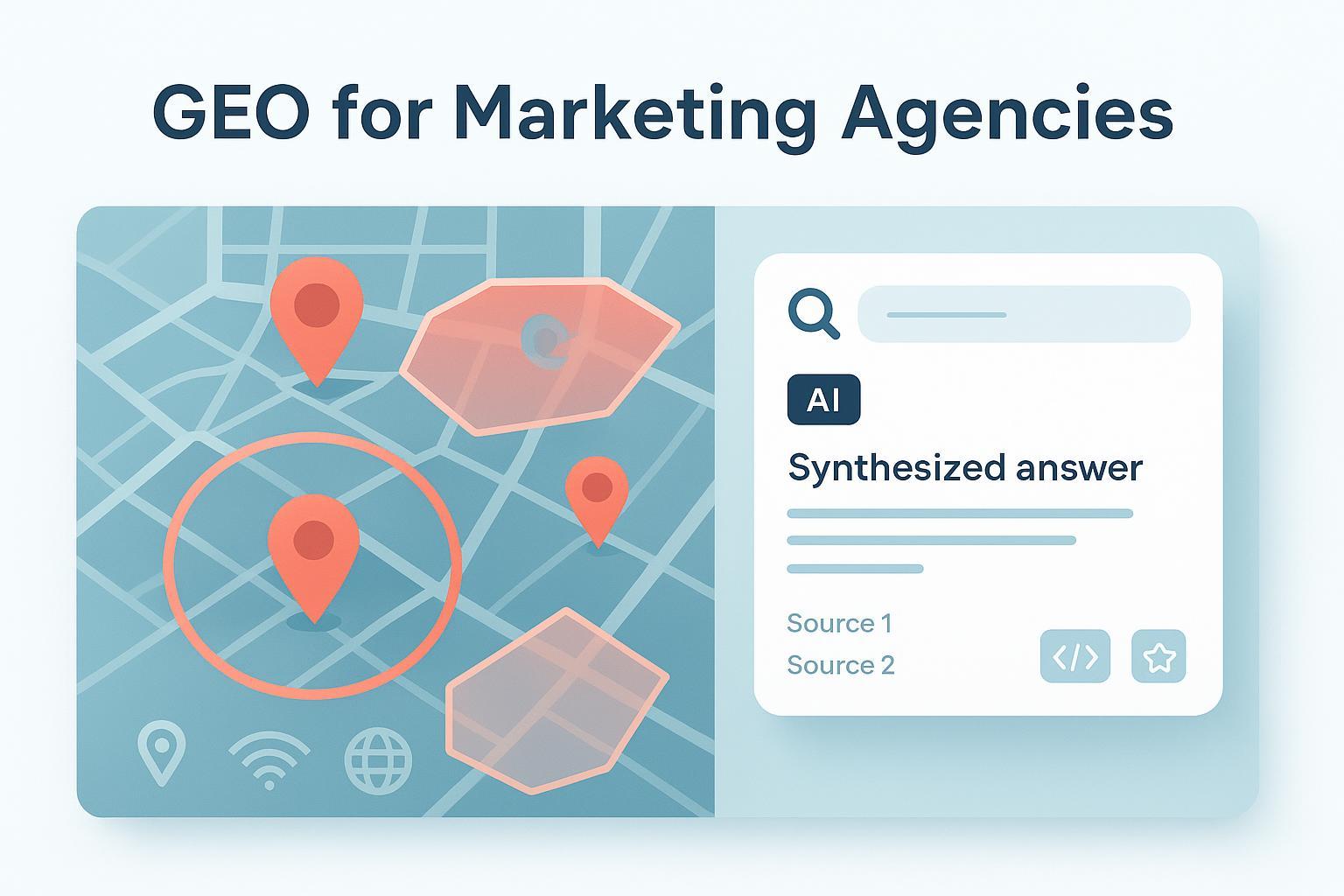
A client Slack lands: “Can you add GEO to this campaign?” Quick question—big ambiguity. Do they mean turning on location targeting and geofencing, or do they mean Generative Engine Optimization so their brand shows up (and gets cited) in AI answers? Here’s the deal: both meanings matter to modern agencies, but they solve different problems. This explainer clears up the term, shows when to use which, and gives you execution guardrails you can plug into briefs today.
Two meanings, one acronym
Let’s separate the twins and keep them labeled for the rest of this piece.
-
GEO (Geographic): The family of tactics that deliver ads or content based on a person’s location—geotargeting, geofencing, and geo‑segmentation. You might target a ZIP list, drop a one‑mile radius around a store, or define a polygon around an event venue. This is the world of presence, radius, and points of interest.
-
GEO (Generative Engine Optimization): Practices that increase your inclusion, accuracy, and attribution within AI‑generated answers (Google AI Overviews, Bing Copilot, Perplexity, assistants). Think concise, quotable answers, clear entities, E‑E‑A‑T signals, and structured data so engines can cite you. For a solid industry overview, see Search Engine Land’s 2024 primer on Generative Engine Optimization (GEO).
In agency life, both show up in briefs, pitch decks, and optimization plans. The trick is knowing which “GEO” belongs to the objective in front of you.
GEO vs. GEO at a glance
Below is a side‑by‑side to align teams fast.
| Aspect | GEO (Geographic) | GEO (Generative) |
|---|---|---|
| Objective | Deliver ads/content to people in or near defined places | Earn inclusion and accurate citations inside AI answers |
| Primary inputs | GPS/Wi‑Fi/cell/IP signals; platform geo settings (country/region/ZIP/radius/polygon) | Content quality; structured data; E‑E‑A‑T; entity clarity; freshness |
| Typical outputs | Impressions, clicks, and visits within chosen geos; store‑visit proxies | Presence in AI Overviews/Copilot answers; cited snippets; qualified referral traffic |
| Core KPIs | ROAS/CPA by region; geo‑lift; store‑visit lift; reach vs. waste | Share of AI answers mentioning your brand; citation count/quality; answer accuracy rate |
| Key risks | Coarse IP accuracy; GPS gaps; consent limits; sensitive POIs | Non‑deterministic inclusion; hallucination; misattribution; entity confusion |
When to use which
-
Use Geographic GEO when: you need hyper‑local reach (stores, events), regional budget allocation, regulated service areas, or in‑market footfall. It’s also right for exclusion problems (avoid border bleed) and for measuring incrementality via geo‑based tests.
-
Use Generative GEO when: you want your brand named—and quoted—inside AI answers; you need to fix wrong or incomplete AI summaries; or you’re building an entity‑first content model (FAQs, how‑tos, definitions) that assistants can trust and cite.
Geographic GEO: execution essentials
Geographic targeting is powerful, but the mechanics and settings matter more than the buzzwords.
Platform settings that change outcomes
On Google Ads, location eligibility hinges on matching behavior. The “Presence,” “Presence or Interest,” and “Search interest” options alter who can see your ads, even if your map pin looks the same. Read the official Google Ads advanced location options documentation to ensure your setting aligns with the brief (e.g., strictly physical presence for service‑area compliance versus presence‑or‑interest for tourism).
On Meta, you’ll work with countries, regions, cities, ZIP/postal codes, and pin‑drop radii, plus audience relations (e.g., lives in vs. recently in) depending on UI version. The help center clarifies constraints and minimum radii by placement and geography—start with Meta Business Help on location targeting.
Practical tip: exclusions override inclusions where they overlap, and “presence only” settings often curb volume more than planners expect. Validate expected reach in platform before you promise numbers in a deck.
Signals and accuracy (set expectations early)
Not all “location” is created equal. GPS can be very precise outdoors but struggles indoors or among tall buildings. Wi‑Fi and cell triangulation fill gaps but bring broader uncertainty. IP‑based location is the coarsest of the bunch and can drift across cities due to ISP routing or VPNs. For a vendor’s frank take, review MaxMind’s geolocation accuracy notes; they even provide an “accuracy radius” for uncertainty.
Geofencing itself is straightforward under the hood: define a region (often a circle via latitude/longitude/radius), then trigger events when a device enters, exits, or dwells. Android’s APIs document those transitions and the trade‑offs between precision and battery life—see Android Developers geofencing overview. The takeaway for planners: avoid tiny radii unless you’ve tested signal quality on‑site, and be conservative around dense urban canyons or multi‑story venues.
Measurement that respects reality
- Incrementality: Use geo‑lift designs (treated vs. control geographies) to estimate causal impact without user‑level tracking. Plan adequate pre‑periods and ensure controls match on baseline demand.
- Efficiency and allocation: Track ROAS/CPA and impression share by region; adjust budgets toward performing ZIPs or DMAs rather than squeezing frequency everywhere.
- Footfall and store visits: Treat visit metrics as modeled proxies with confidence intervals. Cross‑check with POS trends or cohort‑level outcomes where possible.
Privacy and policy guardrails
Precise location is sensitive in many jurisdictions. Build explicit consent into data collection, exclude sensitive points of interest (e.g., healthcare, places of worship), and keep retention tight. In agency contracts and briefs, spell out data sources and verification steps. If a partner promises perfect precision, slow down and ask for methodology and audits.
Generative Engine Optimization: execution essentials
You can’t force an AI engine to cite you, but you can make being cited the easiest and most defensible outcome.
What engines tend to reward
- Clear, direct answers that map to how users ask questions (FAQ and how‑to formats work well)
- Credible sourcing and visible authorship (who wrote it, what qualifies them)
- Structured data and crawlable layouts that clarify entities and relationships
Google’s quality bar still applies in this world. Their guidance on people‑first content and E‑E‑A‑T is a practical checklist for editors and SEOs—see Google’s guidance on helpful, people‑first content. Use it as the baseline for briefs and QA.
Build assets that win inclusion and correct errors
- Answerable content: Short, quotable definitions; stepwise how‑tos; and tightly scoped FAQs that a model can lift without mangling.
- Entity clarity: Consistent names for your brand, products, and people; Organization and Person schema; a clean “About” page that disambiguates similar entities.
- Evidence packs: Citations to primary sources, original data summaries, and diagrams that are easy to attribute.
- Technical hygiene: Robust structured data (FAQPage, HowTo, Article), internal linking that reinforces entities, and a freshness cadence on reference pages.
If you need a concise industry definition to get non‑SEOs aligned, point them to Search Engine Land’s 2024 primer on Generative Engine Optimization (GEO), then translate that into your editorial and schema requirements.
Measurement when analytics are foggy
Native reporting for AI answers is limited, so adopt proxy metrics and consistent spot checks.
- Share of answers: Track the percentage of monitored queries where your brand is named or cited inside AI Overviews/Copilot responses.
- Citation quality: Note whether links point to your canonical resource versus third‑party summaries.
- Accuracy rate: Maintain a log of correct vs. incorrect AI claims about your brand; file fixes by updating your pages and strengthening entity signals.
- Modeled impact: Annotate spikes in brand queries or assisted conversions when major answer inclusions appear; treat this as directional.
Agency workflows and brief templates
Make GEO explicit in your paperwork. In the campaign brief, label the workstream as “GEO (Geographic)” or “GEO (Generative)” right up top so media, SEO, and analytics read it the same way.
For Geographic GEO, your deliverables might include: a location matrix (countries/regions/ZIPs/radii/polygons with inclusions and exclusions), platform settings (Google Ads matching behavior; Meta audience relation), footfall/vendor notes, and a geo‑lift test design (treated/control cells, power assumptions, readout dates). Creative teams get a localization pack with place names, store hours, and venue‑specific CTAs.
For Generative GEO, deliverables often look editorial: an entity map (brand, products, people, categories, synonyms), a brief for answerable content (FAQs/how‑tos/definitions) with target queries and primary sources, structured data requirements per template, and an evidence/citation pack for writers and legal. Analytics adds a monitoring sheet with tracked questions and monthly QA.
Collaboration rhythm: media and SEO trade notes weekly. Media flags regional demand shifts; SEO flags new AI answer opportunities or inaccuracies. Analytics owns the test backlog (geo‑lift; answer share) and publishes readouts that drive the next sprint.
Pitfalls and guardrails
- Shrinking your audience to a pinhead: Over‑narrow radii or excessive exclusions spike CPMs and kill scale; start broader and ratchet down using data.
- Trusting IP like GPS: IP is great for country‑level decisions and shaky for city blocks; set expectations with stakeholders.
- Polygon art without QA: Fancy shapes don’t fix weak signals; walk the venue, test on‑device, adjust radii.
- Chasing AI citations without substance: If your page doesn’t answer the question cleanly and cite sources, no amount of schema saves it.
- Ignoring entity hygiene: Inconsistent brand and product names create confusion; standardize naming across site, feeds, and bylines.
- Treating either flavor as “set‑and‑forget”: Location patterns and AI answer behaviors both drift—review monthly and re‑test quarterly.
Bring it together
Think of GEO as two toolkits on the same shelf. One controls where your media shows up; the other increases how and when your expertise is quoted by machines. The best agency programs use both without tangling them. Start with the objective, name the “GEO” you mean in the brief, and wire in the right metrics from day one. If you’re unsure which lever to pull, ask a simple question: do we need to be in a place, or inside an answer? Then plan accordingly.
Further reading for your team:
- For settings nuance on paid search, see Google Ads advanced location options (Google Ads Help).
- For paid social geo controls, review Meta Business Help on location targeting.
- For signal mechanics and geofencing concepts, skim Android Developers geofencing overview.
- For IP geolocation caveats, consult MaxMind’s geolocation accuracy notes.
- For generative search fundamentals, align on Search Engine Land’s 2024 primer on Generative Engine Optimization (GEO) and Google’s guidance on helpful, people‑first content.