GEO for Local Businesses: Best Practices for 2025

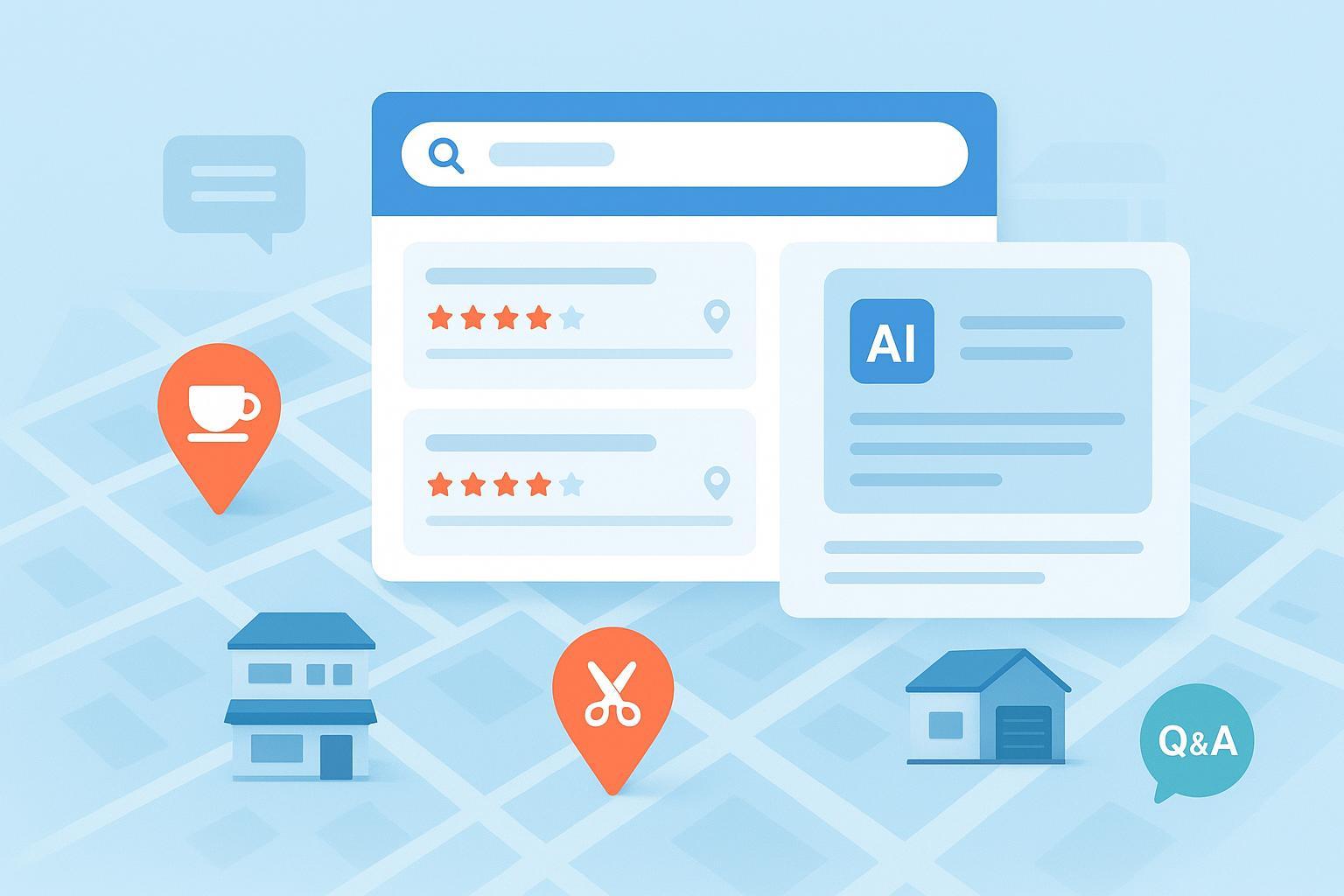
If you run a local business, your next customer might not click a blue link at all. They could discover you in a map pack, a review carousel, or an AI-generated answer that summarizes options and cites sources. That’s why 2025 is the year to fuse traditional local SEO with Generative Engine Optimization (GEO)—so you’re findable in both organic results and AI Overviews.
GEO in 2025: What’s new—and what hasn’t changed
GEO complements, not replaces, classic local SEO. You still need accurate NAP data, solid location pages, reviews, and a complete Google Business Profile (GBP). What’s new is how often AI-generated answers appear and what they tend to cite. Semrush’s March 2025 analysis found roughly 13% of queries triggered AI Overviews and most were informational, with strong citation overlap with pages that already rank organically—evidence that authoritative, structured content wins twice: in organic and in AI summaries. See the methodology and findings in the Semrush report: the Semrush AI Overviews study (2025).
Several industry analyses of BrightEdge data reported lower click-through rates when AI Overviews appear, even as impressions rise—but impact varies by vertical and over time as coverage shifts. The practical takeaway: optimize for inclusion in AI answers while measuring success on calls, direction requests, and bookings—not just clicks. For context, review the discussion in Search Engine Land’s coverage of BrightEdge’s findings: Google AI Overviews research on search and sales (2025). If AI reshapes the results page tomorrow, will your reporting still show wins?
| Focus area | Local SEO (core) | GEO (AI answer inclusion) |
|---|---|---|
| Primary goal | Be visible in Local Pack/organic | Be cited/summarized in AI Overviews |
| Content shape | Service + location pages, blog posts | Concise Q&A, fact boxes, step lists, pricing/availability notes |
| Data structure | LocalBusiness schema, FAQs, products/services | Same as left, plus scannable answers and clear sources |
| Proof signals | Reviews, photos, posts, local links | Author bios, dates, supporting references, community presence |
| KPIs | Rankings, organic clicks, calls, reviews | AIO citations/coverage, calls, direction requests, bookings |
Google Business Profile (GBP): 2025 essentials you can’t skip
GBP remains the heartbeat of local discovery. Two realities define 2025: authenticity and activity. Google has tightened verification (including more video verification) and removed some features. Notably, Business Profile chat and call history were sunset in July 2024, with final removal on July 31, 2024—details are documented in Google Help: Changes to Business Profile chat and call history (2024).
You can now add social profile links (like Instagram, Facebook, LinkedIn) to your Business Profile via the editor. When available in your region/category, this increases your brand’s proof surface and helps Google connect your identity across the web. Workflow and eligibility are described in Google’s guide: Add social media links to your Business Profile.
A steady cadence also matters: accurate hours (including holiday hours), fresh photos, Posts for offers and events, and active Q&A/review responses. Think of GBP as your live storefront window; stale profiles underperform both in the Map Pack and in AI surfaces that evaluate freshness and credibility.
- Quick GBP health check
- Name, address, phone (NAP) exactly match reality; no keyword stuffing in the business name.
- Primary and secondary categories reflect your services; attributes are complete.
- Hours (including holiday hours) are up to date; services/products are listed.
- Social links added (if eligible); high-quality photos uploaded monthly.
- Q&A monitored and answered; reviews responded to promptly and professionally.
Content that earns inclusion: hyperlocal pages, Q&A blocks, and schema
AI-generated summaries favor concise, supported facts. Your job is to make those facts easy to extract—and unmistakably local.
-
Build robust service + location pages. Each location page should feel like it could only belong to that neighborhood: nearest landmarks, parking tips, local testimonials, staff highlights, and service availability that actually varies by location. Include a short FAQ tailored to local questions (“Do you service condos near Elm Park?”) and add internal links to related services.
-
Use JSON-LD structured data. For most local businesses, implement applicable LocalBusiness subtypes, along with FAQPage, Product/Service, and Event where relevant. Keep data fresh, use quality images, and validate regularly. For coverage and best practices, see Google Search Central’s overview: Intro to structured data (developers).
-
Write for scannability. Clear headings, a short summary box, and direct answers to common questions make inclusion more likely. If your industry allows transparent pricing or ranges, state them plainly. If inventory or availability changes, note how customers can confirm in real time.
-
GEO content playbook for local pages and posts
- Lead with a 2–3 sentence answer that stands on its own (what you offer, for whom, where, and when).
- Follow with the “how”: steps, requirements, or preparation tips; keep paragraphs short.
- Add a compact FAQ (3–5 questions) that mirrors real customer queries.
- Cite supporting references sparingly when you state facts beyond your business (e.g., permits, safety standards); include dates or “last updated.”
- Mark up with the right schema and add author/byline details on substantial pages.
For a sense of how AI Overviews pick sources and what they reward, review the 2025 Semrush analysis referenced above: the Semrush AI Overviews study.
Reviews and trust signals that move the needle
Social proof is a ranking signal and a conversion engine. BrightLocal’s ongoing Local Consumer Review Survey shows consumers care about star rating, recency, and whether the business responds—many expect a response within days, not weeks. See the latest edition for expectations and behavior trends: BrightLocal Local Consumer Review Survey (2025).
Operationalize reviews like a core process: request ethically after service, rotate request channels (email, SMS, in-person QR), and coach staff on timing. Reply to every review, especially negatives, within 2–3 business days. Recency matters for AI surfaces too—fresh interactions signal an active, trusted business.
Measure what matters (beyond clicks)
When AI Overviews appear, clicks may drop even as impressions grow. That’s why your KPIs must include phone calls, direction requests, bookings, and store visits—metrics that reflect intent and revenue. Google’s Business Profile provides in-product Performance metrics and an API for scalable reporting: explore the Business Profile Performance API (developers).
Pair GBP metrics with GA4 events (e.g., click-to-call, appointment form submissions) and per-location UTM parameters on GBP links (source=google, medium=organic, campaign=gbp-location-name). Maintain a change log for each location—when you add schema, post new photos, or update categories—so you can correlate edits with lifts in calls or directions. Curious whether AI Overviews are eating clicks for a query cluster? Annotate those dates and compare call/direction trends week over week.
Multi-location and franchise playbook
Scaling GEO and local SEO across dozens or hundreds of locations takes governance:
-
Standardize categories and attributes. Define an approved set per service type and enforce it during on-boarding. Centralize ownership with location-level permissions for managers.
-
Template your location pages—but make them unique. Use a shared framework (hero + quick answers + services + local proof) and require at least 150–250 words of unique local context, 2–3 local photos, and a localized FAQ per page.
-
Normalize tracking. Mandate UTM standards on all GBP website links, unify GA4 event names, and—if you use call tracking—implement dynamic number insertion on the website while keeping your canonical NAP consistent.
-
Run a monthly GEO/SEO operating rhythm. Review Performance metrics, audit a sample of profiles and pages, refresh photos, and rotate one new FAQ per priority location. Over time, you’ll build a flywheel of fresh, verifiable facts.
According to expert consensus compiled by Whitespark, the biggest levers for Local Pack and local organic remain GBP signals, reviews, strong on-site content, and user engagement, with hyperlocal relevance rising in importance. See the current edition: Whitespark Local Search Ranking Factors (published Nov 2025).
Your 90‑day GEO action plan
-
Weeks 1–4: Baseline and fixes
- Verify or re-verify GBP as needed; align real-world name; complete categories/attributes.
- Clean NAP inconsistencies; set holiday hours; add social links (if eligible);
- Tag GBP URLs with UTMs; configure GA4 events; document a per-location change log.
-
Weeks 5–8: Build for inclusion
- Launch or overhaul top location pages with local FAQs, images, and LocalBusiness/FAQ schema.
- Add 1–2 concise Q&A posts/pages for each major service with summary boxes and bylines.
- Start a disciplined review request and response program; publish one new Post per location.
-
Weeks 9–12: Measure and scale
- Pull GBP Performance metrics and GA4; compare calls/directions pre/post changes.
- Expand the model to second-tier locations/services; add one community event or guide with Event schema where relevant.
- Iterate based on what moves calls and bookings; retire tactics that don’t.
Why this works
GEO is just disciplined local marketing expressed in machine-readable ways. You’re supplying concise, verifiable answers in places both humans and AI look. You’re proving trust with reviews and visible activity. And you’re measuring what actually leads to revenue. Simple idea, rigorous execution.
Got a neighborhood or service line that’s underperforming? Start with one location, one page, one FAQ block, and one review workflow. Then scale what works.
References cited
- Google Help: Changes to Business Profile chat and call history (July 2024)
- Google Help: Add social media links to your Business Profile
- Semrush: Semrush AI Overviews study (2025)
- Search Engine Land (covering BrightEdge data): Google AI Overviews research on search and sales (2025)
- Whitespark: Local Search Ranking Factors (published Nov 2025)
- BrightLocal: Local Consumer Review Survey (2025)
- Google Developers: Business Profile Performance API
- Google Developers: Intro to structured data
About the author
I’m a local SEO and GEO consultant who’s helped SMBs and multi-location brands standardize GBP operations, implement schema at scale, and build reporting that ties search to revenue. My work focuses on practical, testable playbooks that marketers can run without enterprise budgets.