What Is Generative AI? Definition, Infographic, and Its Content Marketing Impact

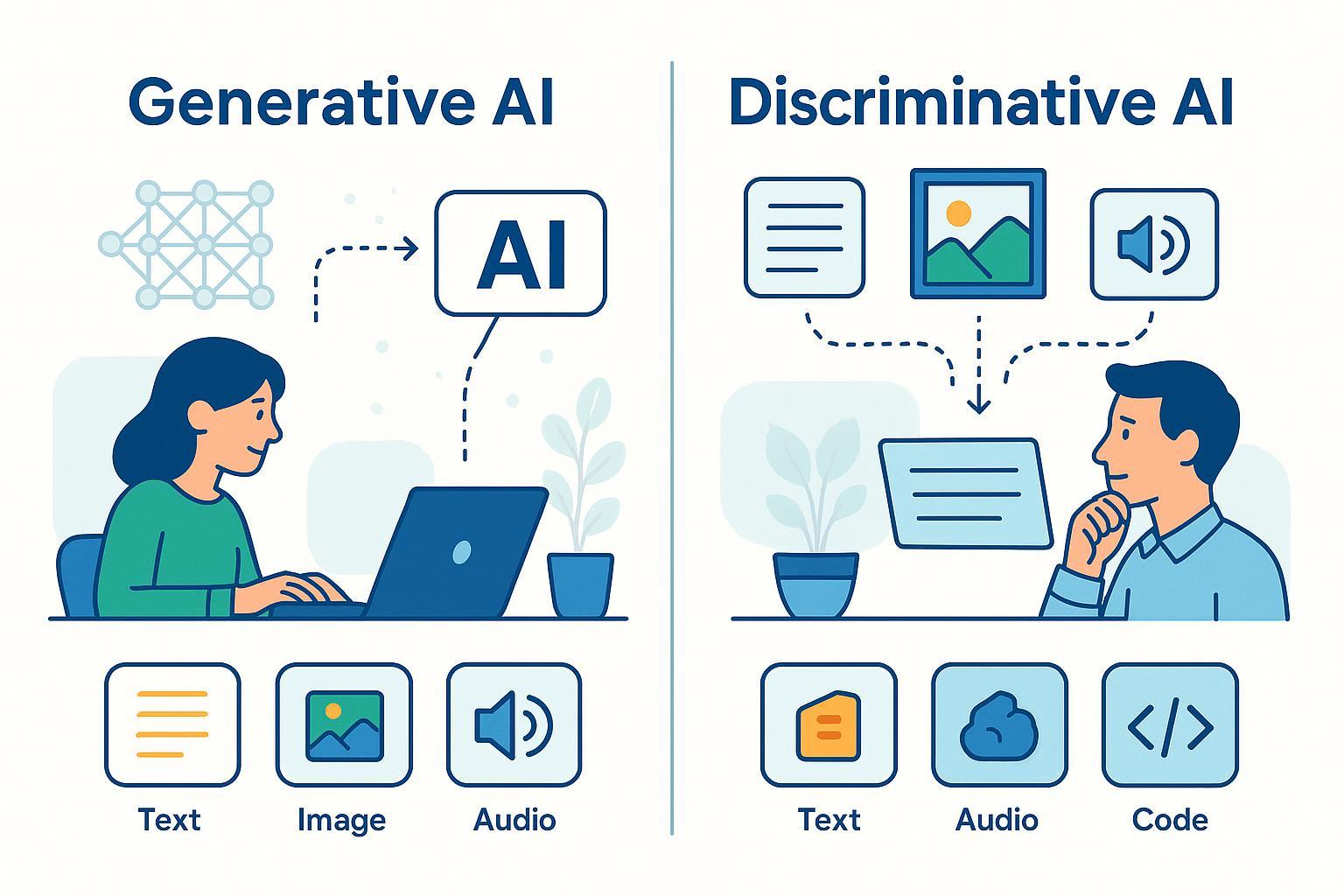
Generative AI: Authoritative Definition
Generative AI refers to artificial intelligence systems that create new content—such as text, images, audio, code, or video—by learning patterns from vast datasets and generating results in response to prompts. Unlike analytical or discriminative AI, generative models are built to produce outputs that are new and contextually relevant, not just replicate or classify existing data. According to IBM, generative AI leverages models like large language models (LLMs) and generative adversarial networks (GANs) to enable creative and scalable content generation. OpenAI and Wikipedia also highlight these models’ ability to synthesize original material based on learned structure.
Generative vs. Discriminative AI: A Quick Visual Contrast
| Generative AI | Discriminative AI | |
|---|---|---|
| Main Role | Creates new content (text, images, code, etc.) | Classifies or analyzes existing data |
| How It Works | Learns data patterns to produce novel outputs | Identifies boundaries between data categories |
| Business Use | Blog writing, campaign design, synthetic media creation | Spam detection, recommendation engines |
Generative AI is about building; discriminative AI is about sorting.
How Does Generative AI Work?
Most generative AI systems are built on deep neural networks, often using architectures like transformers (as in LLMs), GANs, or diffusion models. They’re trained on enormous datasets to recognize patterns and then generate “new” samples that mimic or innovate beyond what’s found in their training data. When you input a prompt (a description or instruction), the system encodes it, runs it through the neural network, and outputs a fresh result—be it a blog post, branded image, or chatbot script.
Key Features:
- Multi-modality (handles text, images, audio, code)
- Context-aware synthesis
- Prompt-dependent creativity
- Human-in-the-loop refinement (you often edit outputs)
Step-by-Step: Generative AI in Content Marketing/SaaS Workflows
Business Workflow Example:
- Input prompt: Marketer specifies desired content, e.g., “Monthly campaign blog post on AI trends.”
- Choose modality/model: Select whether text, image, or code is needed (LLMs for text, GANs for images, etc.)
- AI generates draft: System creates the first version based on prompts and data patterns.
- Human review: Marketer/editor reviews, refines, and ensures brand alignment.
- Publish and analyze: Final content is launched; analytics tools track engagement for feedback and future improvements.
Major Modalities: Examples in Action
- Text: Automated blog/content generation (Forbes)
- Images: Campaign visuals and social graphics via DALL-E or GANs (MIT News)
- Audio: Podcast scripts, synthetic voiceovers
- Code: Automated website templates or email tools
Related Concepts Glossary
- Large Language Model (LLM): An advanced neural model (like GPT-4) trained to produce human-like text—key driver of generative AI. Learn more
- Natural Language Processing (NLP): The field focused on enabling machines to understand, generate, and respond to language.
- Prompt Engineering: The craft of designing effective instructions for generative models to elicit targeted outputs.
- AI-Generated Content: Material (text, visuals, media) produced autonomously by AI systems.
- Discriminative AI: Models that sort or classify data rather than create new content.
Benefits, Challenges & Trends
Benefits:
- Creative acceleration, cost and time savings
- Personalization at scale for campaigns and products
- Versatility across business and media types
Challenges:
- Outputs need input quality and human review
- Ethical risks (bias, misinformation)
- Requires technical oversight and ongoing retraining
Recent Industry Trends:
- Rise of multimodal systems (text + image + audio)
- Ethical guardrails and human-in-the-loop standardization
- Growth in prompt engineering as a strategic skill
For further reading, see IBM’s Generative AI resources, OpenAI Research, and GrowthLoop’s marketing AI guides.
SEO Keywords: What is Generative AI? Generative AI definition, Generative AI in content marketing, Generative vs. Discriminative AI, AI-generated content, LLMs.
All definitions and explanations in this article are grounded in authoritative, industry-leading sources (IBM, OpenAI, Wikipedia, Forbes, MIT News).