How to Write E-E-A-T-Compliant AI Blog Posts (2025)

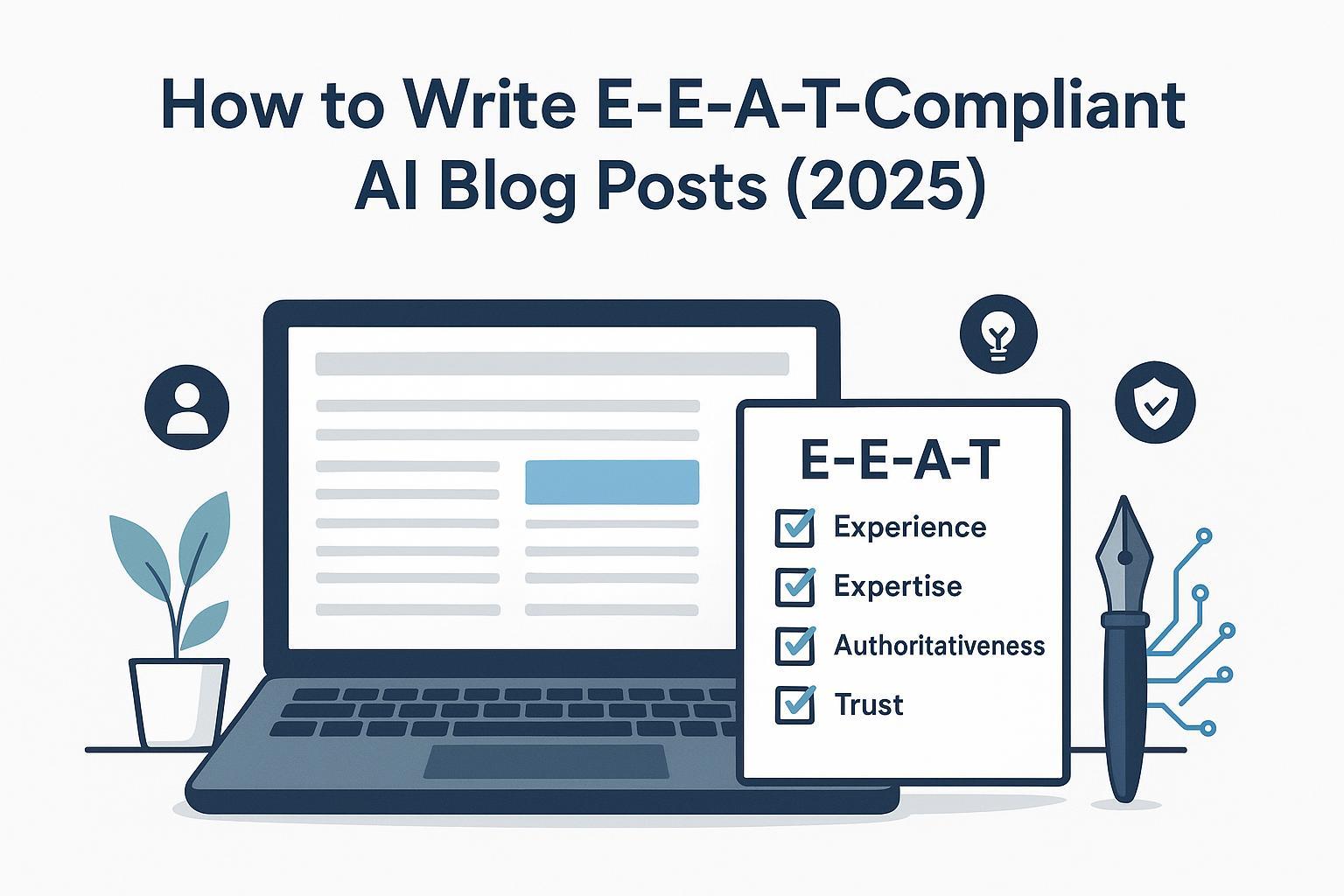
Quality AI content doesn’t win because it’s AI—it wins because it’s useful, original, and trustworthy. If you’re publishing AI-assisted posts in 2025, your playbook must align with Google’s people-first guidance and demonstrate Experience, Expertise, Authoritativeness, and Trustworthiness (E‑E‑A‑T) without slipping into scaled, generic text. Here’s a practical, evidence-backed guide to do exactly that.
1) E‑E‑A‑T in 2025: What it is—and what it’s not
E‑E‑A‑T isn’t a single ranking factor you can “turn on.” It’s a framework Google references across guidance and evaluations to encourage content that satisfies people with unique, non‑commodity value. Google’s 2025 reminder on AI search success stresses publishing helpful, original content that users actually find satisfying, not whether it was produced by a human or a tool. See Google’s perspective in “Succeeding in AI Search” (May 2025) and Search Essentials.
What does that mean for AI‑assisted writing?
- Focus on purpose and usefulness. A page must answer the query thoroughly and uniquely; avoid commodity paraphrases.
- Disclosure of AI use is not a ranking requirement. It’s a user‑trust decision. Prioritize clarity, accuracy, and intent per Search Essentials.
- Avoid spam risks: scaled content abuse, site reputation abuse, and thin AI text. Google clarified enforcement in 2024–2025; read Spam Policies and the March 2024 update.
2) A human‑in‑the‑loop editorial workflow that passes muster
Here’s the deal: you need a repeatable SOP that keeps humans in control of quality. Use AI where it accelerates, but gatekeep every step with expert judgment.
- Plan: Define search intent, audience, and a unique angle. Collect primary sources and constraints.
- Draft: Use AI to outline or generate a first pass; instruct it to cite and flag unknowns for human review.
- Expert review: A subject‑matter expert annotates, adds firsthand experience, and corrects facts.
- Fact‑check & link audit: Verify claims against primary sources; limit external links and ensure descriptive anchors.
- Edit for clarity and originality: De‑genericize; add original visuals/data; reduce passive voice.
- Publish with authorship signals: Visible byline, robust bio, datePublished/dateModified, and accurate structured data.
- Monitor & update: Track performance, reader feedback, and freshness requirements.
Roles and responsibilities
| Step | Human owner | AI assistance |
|---|---|---|
| Plan | Strategist/SEO | Keyword clustering, gap analysis hints |
| Draft | Writer/Editor | Outline, draft sections, style normalization |
| Review | Subject expert | Summaries, checklist reminders |
| Fact‑check | Editor/Researcher | Suggest source candidates |
| Edit | Managing editor | Grammar/style cleanup |
| Publish | Dev/SEO | Validate structured data |
| Monitor | Analyst/SEO | Anomaly detection, summaries |
Quick checklist
- Clear intent and unique angle?
- Firsthand experience integrated?
- Claims verified against primary sources?
- Descriptive anchors and limited link density?
- Visible byline, robust bio, and correct structured data?
- Updates scheduled based on topic freshness?
3) Proving experience and expertise on‑page
You can’t fake experience. Show it.
- Robust bylines and bios: Include credentials, years in practice, notable results, and links to authoritative profiles (e.g., LinkedIn, conference talks). Keep bios on dedicated author pages and link them from each post.
- Firsthand commentary: Add “what we did,” “what worked,” and “pitfalls we saw.” Screenshots, original diagrams, or brief case snapshots turn an AI draft into lived expertise.
- Primary sources: Ground claims in original documentation. When defining search guidance or policies, link to Google’s canonical docs once per concept—then build upon them with your own insight.
- Corrections and updates: Maintain a visible corrections policy and update notes. These are trust signals, especially for fast‑moving topics.
4) Technical signals that help systems understand your content
Structured data doesn’t “add E‑E‑A‑T” directly, but it clarifies entities, authorship, and eligibility for rich results. Implement markup aligned with on‑page truth.
- Article/BlogPosting: Provide headline, author (Person), publisher (Organization), datePublished, dateModified, image, and sameAs links on author pages. See Article structured data guidelines.
- Visible authorship: Keep the byline and bio on the page—not only in JSON‑LD. Consistency matters across pages.
- Internal linking and topical clusters: Use hub‑and‑spoke models to demonstrate depth and coherence. While Google doesn’t publish a blueprint for non‑news sites, editorial clusters are a proven pattern for building topical authority; use descriptive anchors and avoid orphaned pages.
- Validation: Test pages with the Rich Results Test and fix errors before publishing.
5) Transparent AI‑use disclosure and provenance
Google doesn’t require AI disclosure for ranking, but your audience may. Transparent, specific notes can strengthen trust and future‑proof your policy.
- Ethics guidance: Communication pros recommend specificity about tools and human oversight. See PRSA’s AI ethics guideline (2024) and Trusting News’ research on AI disclosure specificity (2024).
- Content provenance: Consider adopting C2PA Content Credentials to attach verifiable creation and edit histories to media. Explore the C2PA specification 2.2.
Template language “We used [tool] to [task—e.g., draft an outline, check grammar, synthesize sources]. A subject‑matter expert reviewed, fact‑checked, and edited this article before publication.”
6) Competing in AI Overviews—and rethinking success metrics
AI Overviews change click behavior. Don’t chase blue links alone; aim to be cited, visible, and trusted.
- Quality and uniqueness: Google’s 2025 guidance emphasizes “unique, non‑commodity content.” That’s your ticket to inclusion and citation in AI experiences.
- CTR realities: Multiple 2025 studies report CTR declines when AI Overviews appear. For example, Ahrefs found position‑one CTR for “AI Overview” keywords fell from ~7.3% (Mar 2024) to ~2.6% (Mar 2025) in their dataset; treat this as directional, not universal. See Ahrefs’ 2025 analysis.
- Measurement shifts: Track AI Overview citations, brand/entity mentions, assisted conversions, newsletter growth, and community referrals. Optimize for entity clarity and original assets that summaries can reference.
7) Copy‑ready templates
Use, adapt, and standardize across your team.
Author bio block
- Name, role, years of experience.
- Credentials and notable results (with links to authoritative profiles).
- Disclosure of specialties and conflicts where relevant.
AI‑use disclosure snippet
- “This article was drafted with assistance from [tool] for [tasks]. A human expert reviewed, fact‑checked, and edited all content prior to publication.”
Citation format pattern
- “According to Publisher’s title (Year), ‘key finding or guidance.’” Place the year and publisher in the sentence and limit re‑linking.
Final notes: put this into practice now
If you publish AI‑assisted content, your advantage is process and proof. Build a human‑in‑the‑loop workflow, show lived experience, use accurate structured data, disclose AI use when it helps reader trust, and measure success beyond traditional CTR. Questions to ask your team this week: Where is our unique angle? Which expert signs off every AI draft? Are our bios and structured data airtight?
Ready to raise your editorial bar? Let’s make quality the differentiator.