E-E-A-T for Health & Finance Websites: The 2025, Compliance-Ready Playbook

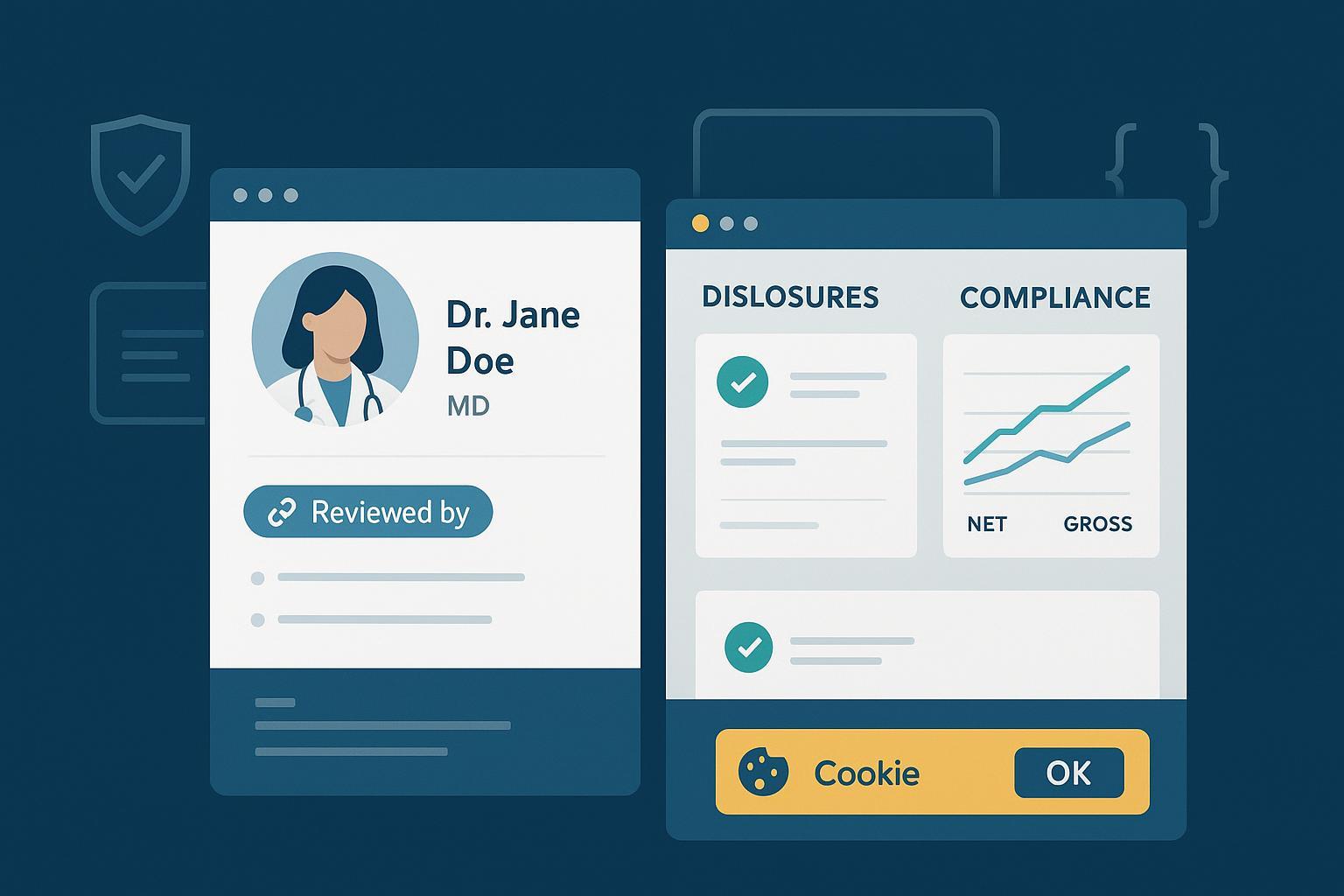
If your site can affect someone’s health or money, trust isn’t a brand story—it’s an operational system. Here’s the deal: E-E-A-T (Experience, Expertise, Authoritativeness, Trust) only moves the needle when you hardwire it into authorship, review workflows, structured data, accessibility, privacy, and sector-specific compliance. Anything less is cosmetic.
1) Make expertise visible where it matters
E-E-A-T for YMYL topics starts with visible, verifiable expertise. Don’t bury qualifications in a corporate About page. Put the author’s credentials, affiliations, and a concise reason they’re qualified right on the page, along with a “reviewed by” line for sensitive clinical or financial guidance. Google’s quality paradigm prioritizes helpful, reliable content, and its rater documentation and system guidance consistently emphasize clear authorship, transparent sourcing, and appropriate dates for YMYL pages. See the official update to the Search Quality Rater Guidelines and people-first content guidance summarized in Google’s own communications in late 2023 and 2024, e.g., the QRG update notice in November 2023: Google’s Search Quality Rater Guidelines update (Nov 16, 2023).
On the page, include a properly formatted publication date and, when you substantially update the article, a modified date. For machine-readability, pair the visible dates with Article structured data (author, datePublished, dateModified). This isn’t a “ranking hack”—it’s basic transparency that aligns with how Google renders dates and evaluates reliability via structured cues.
Practical pattern: add a compact author box with degree/certification (e.g., MD, DO, PharmD, CFP, CFA, CPA), a link to a full bio, and, when appropriate, a license/NPI reference on that bio page. Make reviewer names prominent on medical advice and regulated financial guidance. Cite primary sources and consensus positions rather than tertiary summaries.
2) Build the editorial + compliance workflow
Health and finance teams need similar bones but different muscles. In healthcare, content must be created or reviewed by licensed professionals with clear scope-of-practice boundaries. In finance, pre-approval and disclosures are non-negotiable. Either way, document the lifecycle—ideation, drafting, expert review, legal/compliance review (as required), publication, monitoring, and scheduled review.
Healthcare workflow: appoint a reviewer panel of credentialed clinicians for topic areas. Define review SLAs by page type (e.g., medication and condition pages reviewed every 6–12 months, policy-driven pages on change). Maintain an update log with what changed and why. Keep a standing policy for what you won’t publish (e.g., individualized diagnosis, emergency guidance) and when to escalate to care pathways.
Finance workflow: route all public communications—web pages, PDFs, calculators, and social snippets—through compliance before publication. Standardize on-page disclosure modules and maintain archives that satisfy retention requirements. For content touching performance, ensure templates enforce parity between net and gross and include appropriate time periods and risk caveats.
One question to ask at every stage: “Would a reasonable user understand who wrote this, why they’re qualified, what sources support it, and when it was last substantively reviewed?” If any answer is “no,” the page isn’t ready.
3) The structured data and on-page trust stack
Structured data doesn’t create expertise—but it helps search engines and assistive technologies understand your expertise and identity. Use Article and Person schema to declare author identity, publication and modification dates, and affiliations. At the site level, implement Organization (and LocalBusiness for clinics/advisers with locations) to establish canonical name, logo, contact options, and trusted profiles. For medical topics, you can pair your core Article markup with relevant schema.org medical entities as the page’s main subject when appropriate, and surface a visible “reviewed by” annotation for sensitive topics.
Follow Google’s official patterns for Article/Person/Organization and keep dates ISO-8601 compliant. For background on structured data support and how it appears in Search, refer to Google’s documentation: Article structured data (Google Search Central).
Operational tips: ensure author names match across the visible page, schema, and bio pages; use sameAs to unify identity; avoid updating dates for minor formatting changes; and don’t mark up authors or reviewers who aren’t visible to users.
4) Accessibility, privacy, and tracking
Accessibility is not optional. In the U.S., the DOJ’s 2024 Title II rule requires state and local governments to conform to WCAG 2.1 Level AA for web and mobile, with compliance dates into 2026–2027. Even if you’re private-sector, WCAG 2.1 AA remains the de facto benchmark in settlements, and adopting key 2.2 improvements (like focus appearance and target sizes) will future-proof your UX. See the official rule and summary: DOJ ADA Title II web accessibility final rule (2024).
From a privacy and security standpoint, healthcare sites must evaluate trackers carefully. HHS/OCR explains when identifiers combined with health-related interactions can constitute PHI, which can trigger HIPAA obligations such as BAAs or authorizations. A 2024 court decision narrowed the application on some unauthenticated pages, but OCR still expects Security Rule risk analysis and appropriate safeguards. Start by inventorying all trackers, removing or isolating them from authenticated contexts, preferring first-party or HIPAA-aligned analytics, and updating your privacy notices and consent logic accordingly. Primary guidance: HHS/OCR’s online tracking technologies guidance.
Finance and health organizations alike should respect universal opt-out signals where required and adopt clear, non-deceptive consent and preference UIs. Recognize Global Privacy Control, avoid dark patterns, document data maps and retention schedules, and maintain user request workflows.
5) Financial marketing content you can safely publish
If you’re an investment adviser, your website is advertising. The SEC’s Investment Adviser Marketing Rule governs testimonials, endorsements, and performance content. You may use testimonials and endorsements—but only with prominent disclosures and appropriate oversight of compensated promoters. If you present performance, show net alongside gross with equal prominence, include standardized time horizons, and avoid cherry-picking. Hypothetical performance has audience gating and disclosure requirements. Keep substantiation and retain ads and related records. Primary source: SEC Investment Adviser Marketing Rule – Adopting Release IA‑5653 (2020).
Broker-dealers face additional obligations under FINRA’s advertising rules, including fair and balanced presentations, supervision, and recordkeeping that extend to websites and social media. FINRA’s topic pages and annual oversight reports provide practical expectations for digital communications. Overview: FINRA Advertising Regulation – Key Topics.
In practice, stand up a compliance design system: standardized disclosure blocks, a library of approved claims with citations, audience gates for hypothetical or complex materials, and a WORM-ready archive for regulated pages and posts.
6) Endorsements, reviews, and AI content
Endorsements, testimonials, and reviews are powerful trust signals—if they’re real and properly disclosed. The FTC’s Endorsement Guides require conspicuous disclosure of material connections, prohibit misleading formats, and expect advertisers to substantiate objective claims. In 2024, the FTC finalized a rule banning fake reviews and testimonials, including purchased or AI-generated reviews, undisclosed insider reviews, and fake social metrics, with civil penalties attached. See: FTC final rule banning fake reviews and testimonials (2024).
On AI content, Google’s stance is straightforward: quality and people-first usefulness matter, not the tool. That said, scaled, unhelpful content and site reputation abuse are explicitly targeted, and YMYL pages should involve qualified experts in drafting or review, with fact-check logs and disclosures where readers would reasonably expect them. Background: Google’s March 2024 Search update on helpfulness and abuse.
Operationalize this with a documented AI policy: define when AI may be used, require expert review for YMYL drafts, log sources, and disclose AI assistance when material to user expectations. Train teams to avoid over-claiming and to flag conflicts of interest.
7) Measure what matters and keep it enforceable
E-E-A-T is a system you can measure. Track quality, compliance, and performance with clear ownership and review cadences. Use the table below to seed your governance dashboard.
| KPI/Control | Target | Owner | Cadence |
|---|---|---|---|
| YMYL pages with visible author + credentials | ≥ 95% | Managing Editor | Monthly audit |
| Pages with “reviewed by” on clinical/regulated guidance | 100% of applicable pages | Medical/Compliance Lead | Monthly audit |
| Pages with primary-source citations | ≥ 90% | Section Editors | Monthly audit |
| Median content age (priority topics) | ≤ 12 months | Editorial PM | Quarterly |
| Article/Person/Org schema validation pass rate | 100% | Technical SEO | Release cycle |
| WCAG 2.1 AA defects outstanding | 0 P1/P2; P3 < 10 | Accessibility Lead | Biweekly |
| HIPAA/Privacy tracker risk analyses on file | 100% of tracked contexts | Privacy Officer | Quarterly |
| SEC/FINRA pre-approval pass rate | ≥ 98% | Compliance | Release cycle |
| Archive/retention coverage for regulated pages | 100% | Records Manager | Quarterly |
Remediation playbook: when an audit fails, fix the page within a defined SLA (e.g., 10 business days for content issues, 5 for compliance disclosures). If a claim lacks substantiation, remove or revise and document the correction. If accessibility bugs block users, prioritize them above feature work. Keep a public-facing “last reviewed” label for sensitive pages and an internal change log describing what changed and why.
Your first 90 days: a focused rollout
- Week 1–3: Inventory and triage. Identify all YMYL pages and classify by risk. Add visible bylines, bios, and dates. Implement Article/Person/Organization schema and validate. (List 1)
- Week 4–6: Stand up governance. Publish your editorial and compliance SOPs, reviewer rosters, and update cadences. Add disclosure modules and archive workflows for finance sites. (List 2)
- Week 7–9: Shore up compliance. Run a WCAG 2.1 AA audit; remediate P1/P2 issues. Complete HIPAA/privacy tracker risk analyses; adjust consent. Train teams on FTC endorsements and AI policy. (List 3)
By the end of this sprint, you’ll have visible expertise, enforceable workflows, and a measurable path to trust—exactly what E-E-A-T demands.
References (primary sources cited inline):
- Google rater documentation and people-first guidance context: Search Quality Rater Guidelines update notice, Nov 2023
- Structured data implementation: Article structured data (Google Search Central)
- Accessibility obligations: DOJ ADA Title II final rule (2024)
- HIPAA tracking guidance: HHS/OCR online tracking guidance
- Investment adviser advertising: SEC IA‑5653 (Marketing Rule)
- Broker-dealer advertising: FINRA Advertising Regulation – Key Topics
- Endorsements and reviews: FTC final rule banning fake reviews/testimonials (2024)