Differential Privacy in Advertising: A Plain‑English Guide

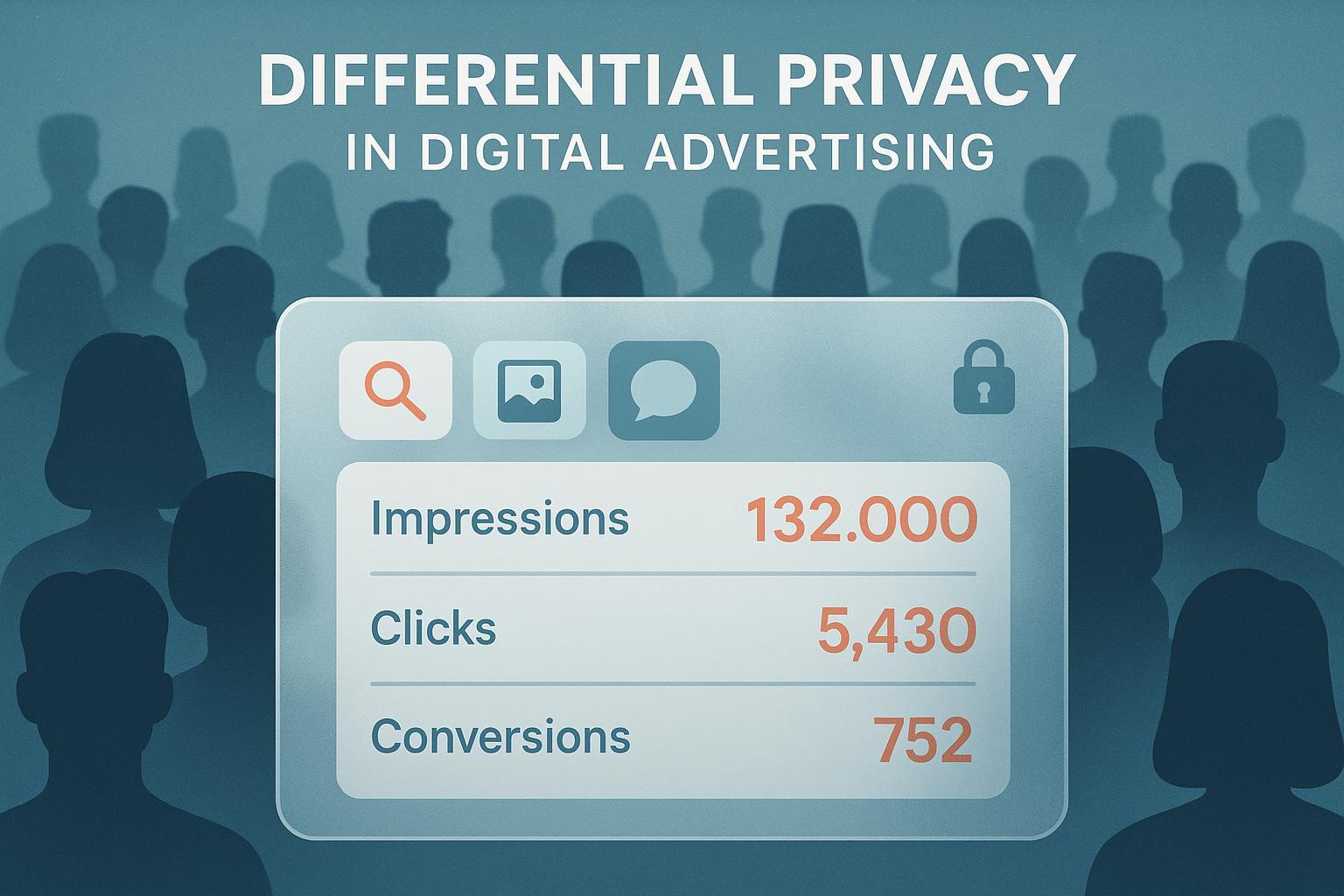
Differential privacy (DP) can sound intimidating, but the idea is simple: it lets you learn about groups without revealing anything meaningful about any one person. Think of looking at your campaign dashboard through frosted glass—you still see the big picture, but no single individual can be picked out.
Key Takeaways
- Differential privacy adds carefully calibrated “noise” so that one person’s data barely changes the result. It provides a formal guarantee, not just good intentions.
- It shines in aggregate advertising measurement (reach, conversions by channel, trendlines) and is ill‑suited for 1:1 targeting.
- Practical success depends on setting privacy parameters, bounding contributions, handling sparse segments, and budgeting for repeated releases.
- Major platforms apply DP‑style techniques: Apple for on‑device analytics, Chrome’s Attribution Reporting for noisy aggregates, and Google’s Ads Data Hub via noise and thresholding.
- Governance matters: align with organizational risk policies and standards such as NIST SP 800‑226 (finalized 2025).
What is differential privacy (in human terms)?
At its core, differential privacy is a formal, mathematical guarantee that the output of an analysis barely changes when any one person’s data is added or removed—so an attacker can’t confidently infer whether that person participated. Accessible primers from OpenDP explain this guarantee, including how privacy loss is quantified by epsilon (ε) and delta (δ) and how noise is calibrated to a query’s sensitivity in order to preserve privacy while maintaining utility—see this plain‑English overview in the OpenDP explainer.
- The foundational guarantee and its parameters ε/δ, sensitivity, composition, and post‑processing are laid out in the OpenDP overview and in NIST’s evaluative framing in NIST SP 800‑226 (finalized 2025).
Anchor links:
- OpenDP’s accessible introduction to the guarantee and mechanisms: the OpenDP “What is Differential Privacy?” explainer.
- NIST’s formal evaluation and governance lens: NIST SP 800‑226 (finalized 2025).
The dials that matter to advertisers
- Epsilon (ε): The privacy loss parameter. Smaller ε means stronger privacy (more noise) and typically wider confidence intervals on your KPIs.
- Delta (δ): A tiny failure probability used with ε in “approximate DP.” You’ll often see (ε, δ) reported together.
- Sensitivity: The most your query could change if a single person’s data changes. You can control sensitivity with contribution bounds (e.g., cap a user at one conversion per week per channel).
- Composition and privacy budget: Every DP release “spends” some privacy budget. Weekly reports compose over time, so you must track cumulative privacy loss and potentially tighten ε or reduce frequency.
For formal treatments and practical evaluation, see the definition and properties in the OpenDP explainer and the evaluation criteria and composition guidance in NIST SP 800‑226 (2025).
Where DP shows up in advertising workflows
- Local DP (on‑device): Users’ devices randomize data before sending it. Apple documents a large‑scale local differential privacy system for product telemetry, which provides aggregate insights while protecting individuals across billions of observations. See Apple’s Differential Privacy overview and research on learning with privacy at scale.
- Central DP (server‑side): Data are aggregated, then noise is added to the aggregate. In ads, central DP‑style approaches power privacy‑preserving reporting.
- Chrome’s Attribution Reporting for the Privacy Sandbox produces summary reports via an Aggregation Service and intentionally adds noise to protect user privacy. While the docs avoid labeling the API as “differentially private,” the design explicitly analyzes the effect of noise on accuracy and utility—see Chrome’s design decisions and its “understanding noise in summary reports.”
- Google’s Ads Data Hub (ADH) supports aggregate queries with privacy checks such as minimum thresholds and an optional noise injection mode to further protect individuals—see ADH privacy checks and the marketers’ guide to noise injection.
- Industry guidance: The IAB Tech Lab situates differential privacy as appropriate for aggregate measurement and cautions against user‑level activation—see its Differential Privacy guidance (2023).
Anchor links:
- Apple’s local DP system for telemetry and analytics.
- Chrome’s Attribution Reporting design decisions and noise behavior.
- Ads Data Hub privacy checks and noise injection for marketers.
- IAB Tech Lab’s Differential Privacy guidance (2023).
A concrete example: weekly conversions by channel
Imagine you report weekly conversions for Channels A, B, and C. To control sensitivity, you cap each user’s contribution at 1 conversion per channel per week. You then add calibrated noise to each channel’s count according to your chosen ε.
- Large buckets (e.g., thousands of conversions) incur small relative error—trends remain clear.
- Sparse buckets (e.g., tens of conversions) see higher relative error—directionality may still be useful, but confidence intervals widen.
- Thresholding: Suppress buckets below a minimum size to avoid unstable or privacy‑risky disclosures. This mirrors the thresholding and filtered‑row patterns in ADH privacy checks and the sparsity considerations in Chrome’s utility metrics for noisy aggregates.
Because you’ll publish this report every week, you need a privacy accountant to track composition (how privacy loss accumulates). NIST SP 800‑226 (2025) discusses budgeting and evaluation practices so you can set and defend your reporting cadence.
Anchor links:
- Chrome’s discussion of accuracy and sparsity in noisy summary reports.
- ADH privacy checks including thresholding and filtered‑row behavior.
- NIST SP 800‑226 (2025) on composition and evaluation.
Calibration checklist (practical, not prescriptive)
- Define decisions first: What choices will these KPIs inform (budget shifts, creative rotation)? Calibrate privacy to preserve those decisions, not every decimal place.
- Choose aggregation wisely: Favor aggregates where each person’s bounded contribution is small relative to totals (e.g., weekly by channel vs. minute‑by‑minute by micro‑segment).
- Set contribution bounds: Cap per‑user events per period and per dimension to tighten sensitivity.
- Pick ε/δ within policy: Document rationale, stakeholders, and expected error bands. Tie your choices to established evaluation guidance like NIST SP 800‑226 (2025).
- Budget for composition: Define how often you’ll release metrics and how you’ll account for cumulative privacy loss across the year.
- Handle sparsity: Apply minimum thresholds; merge or bucket long‑tail segments to keep relative error reasonable. See ADH’s thresholding practices.
- Monitor utility: Track relative error or confidence bounds over time using holdouts or back‑testing on synthetic releases.
- Preserve guarantees: Remember post‑processing invariance—don’t “de‑noise” outputs in ways that violate the DP model.
Anchor links:
- NIST SP 800‑226 (2025) for evaluation and budgeting.
- ADH privacy checks for thresholding practices.
When not to use DP (and common pitfalls)
- Don’t use DP for 1:1 targeting, retargeting, or per‑user lookups. The guarantee limits per‑person leakage by adding noise—exactly what undermines individual‑level precision. The IAB’s DP guidance calls this out explicitly.
- Avoid tiny segments: DP’s noise can overwhelm very small cohorts. Combine segments or increase aggregation windows.
- Watch privacy budget exhaustion: Frequent, granular releases consume budget quickly. Use a privacy accountant and revisit cadence.
- Beware of false certainty: DP protects individuals, not against all modeling errors. Communicate uncertainty with intervals.
Anchor link:
- IAB Tech Lab’s Differential Privacy guidance (2023) on suitable vs. unsuitable use cases.
How DP fits with other privacy‑enhancing technologies (PETs)
- Clean rooms and cryptography (MPC/PSI) and TEEs: These protect the process of joining and computing over data, often for measurement or modeling without sharing raw data. DP complements them by controlling what leaves the clean room as aggregates. See the IAB Tech Lab’s ADMaP (Attribution Data Matching Protocol) and the Data Clean Room Standards portfolio for context.
- Federated learning (FL): FL keeps raw data on devices or servers and aggregates model updates, but that alone doesn’t guarantee output privacy. Adding DP to the training process (e.g., DP‑SGD) helps protect against data leakage from trained models; see NIST’s discussion of privacy‑preserving FL.
Anchor links:
- IAB ADMaP overview and Data Clean Room Standards portfolio.
- NIST on protecting trained models in privacy‑preserving FL.
Regulatory and governance lens
Regulators increasingly encourage risk‑based adoption of PETs. The UK ICO’s anonymisation and PETs guidance outlines how techniques like DP can enable compliant analytics when coupled with governance and accountability. In the US, NIST SP 800‑226 (finalized 2025) offers evaluation criteria to assess DP claims, calibrate trade‑offs, and support procurement and oversight.
Anchor links:
- ICO’s anonymisation and PETs guidance.
- NIST SP 800‑226 (finalized 2025).
Common questions answered
- Does Chrome’s Attribution Reporting “use DP”? The documentation emphasizes noisy aggregation for privacy, analyzes accuracy, and aligns with DP‑style principles, but it does not brand the system as “differential privacy” end‑to‑end. See Chrome’s summary report design decisions.
- Is there a standard ε for ads? No authoritative, cross‑industry benchmark exists as of 2025. Organizations set ε based on risk tolerance, utility needs, and evaluation practices such as those in NIST SP 800‑226 (2025).
- Will DP break my KPIs? Expect wider intervals and some directional uncertainty, especially for small segments. For high‑volume aggregates, trend signals generally remain robust—Chrome’s utility metrics discussions illustrate this behavior for noisy aggregates.
Bottom line
Differential privacy won’t replace every analytics or activation tactic—but it’s a powerful tool for aggregate measurement in a privacy‑first ad ecosystem. Start with your decisions, pick sensible aggregations and bounds, adopt a budgeting discipline, and document parameters and governance. Combine DP with clean‑room protections for computation and with strong organizational controls. You’ll get decision‑worthy insights while ensuring any single customer’s participation hardly moves the needle.
References (selected anchors cited above)
- OpenDP – What is Differential Privacy? (definitions, ε/δ, sensitivity, mechanisms)
- NIST SP 800‑226 (finalized 2025) – evaluation, composition, governance
- Apple – Differential Privacy overview and research on learning with privacy at scale
- Chrome – Attribution Reporting summary reports: design decisions; understanding noise in summary reports
- Google Ads Data Hub – privacy checks; noise injection for marketers
- IAB Tech Lab – Differential Privacy guidance (2023)
- IAB Tech Lab – ADMaP and Data Clean Room Standards portfolio
- ICO – Anonymisation and PETs guidance
- NIST – Protecting trained models in privacy‑preserving federated learning