Creator Pay Transparency

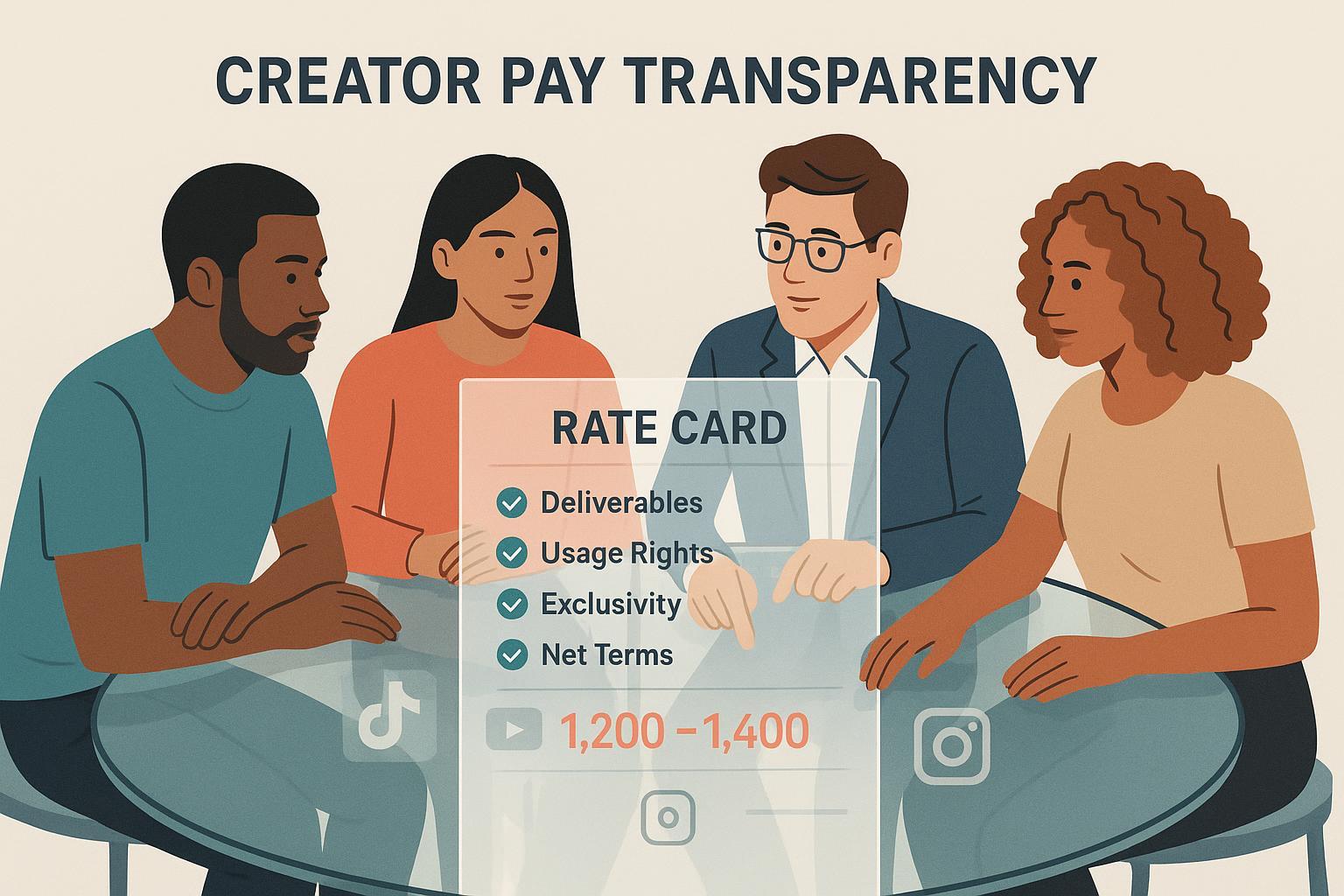
What “creator pay transparency” means (and why it matters)
Creator pay transparency is the practice of openly sharing how creators are compensated—for example, typical fee ranges, what’s included in the scope of work, how usage and exclusivity are priced, and when payments are due. The purpose is straightforward: help both creators and hiring teams benchmark, negotiate fairly, and reduce inequities while improving operational consistency.
It’s not just an ethical stance. For brands and agencies, having shared rate cards and clear workflows reduces friction and speeds up deal cycles. Industry practitioners have framed pay transparency as a strategic lever for scalable programs and better partner relationships, not merely a moral initiative; see how advocates argue that transparency strengthens creator programs in Traackr’s discussion of why pay transparency is a smart strategy for brands (2025).
Clear boundaries: what it is—and what it isn’t
-
What it includes
- Fee structures and ranges by platform and creator tier
- The assumptions behind a scope (number/formats of assets, revisions, turnaround/rush)
- Usage/licensing terms (duration, territory, media, whitelisting/paid amplification)
- Exclusivity constraints and compensating premiums
- Payment terms (invoicing steps, net days, late-fee policy)
-
What it does not include
- Audience-facing disclosures like “#ad”—those are governed separately. For example, the FTC updated its Endorsement Guides in 2023 to clarify “clear and conspicuous” disclosures and liability across advertisers, endorsers, and intermediaries; see the FTC’s press release (June 29, 2023) and the FTC’s endorsements FAQ (revised 2023). Pay transparency complements ethical practice, but it is a business-to-business norm rather than a consumer-disclosure rule.
The evidence: inequities persist without benchmarks
- Racial disparities. Ongoing influencer equity research by MSL has documented material racial pay gaps in the U.S. creator market and published best practices to address them; see MSL’s newsroom page consolidating findings (2023). Third-party coverage has cited headline disparities (for example, Campaign discussed a “27%” racial pay gap when reporting on MSL’s program in 2021–2023), underscoring the need for transparent benchmarks and policies.
- Gender disparities. The Collabstr 2025 Influencer Marketing Report—based on more than 15,000 collaborations—found that “male creators earn on average $83 (40%) more per collaboration” than female creators (2025), providing a current, directional metric on gender differences.
- Sector-specific barriers. In beauty and adjacent verticals, qualitative analyses highlight structural challenges faced by Black creators; see the National Partnership’s analysis of closing the pay gap for Black creators in beauty (2024). While not a source of precise percentages, it usefully frames barriers and solutions.
Treat single-source numbers as directional and triangulate with multiple inputs before setting policy.
How this relates to FTC endorsement rules (without confusing the two)
The FTC’s rules focus on what consumers must be told when an endorsement is paid or there’s a material connection. In 2023, the FTC updated 16 CFR Part 255 and issued clarifications in its endorsements FAQ about what counts as clear, conspicuous disclosure and who can be liable; see the FTC’s 16 CFR Part 255 landing (2023) and the FTC’s endorsements FAQ (2023). Law firm summaries offer practical implications for brands and agencies—for example, the Morgan Lewis overview (2023), DLA Piper’s summary of the changes (2023), and a “one year later” perspective from Hall Render (2024). None of these impose pay transparency mandates, but internal transparency helps prevent disputes and aligns with ethical practices.
A practical playbook: implementing creator pay transparency
Below is a step-by-step approach you can adapt for a brand, agency, or creator business.
1) Publish rate bands and scope assumptions
- Build internal rate bands by platform (TikTok, YouTube, Instagram), creator tier (nano, micro, mid-tier, macro), and common deliverables (e.g., 60–90s TikTok, 1x IG Reel + 3 story frames, YouTube integration). Price to value, not just follower counts (consider engagement quality, audience fit, content complexity, turnaround).
- Document assumptions explicitly: number of assets, format specs, rounds of revision, reshoot policies, rush fees.
- When feasible, share external-facing ranges (e.g., “For mid-tier creators, our typical range for a TikTok 60–90s video is $X–$Y before licensing”). This signals fairness and reduces back-and-forth.
2) Separate content creation from usage/licensing
- Always separate the fee for creating content from the license to use it. Define duration (e.g., 6 months, 1 year), territory (single country vs. global), and media (organic social, paid social, web, display, CTV). Paid amplification/whitelisting is an additional license.
- Use code-aligned principles from trade bodies. The ISBA & IMTB Influencer Marketing Code of Conduct (Version 4, 2024) emphasizes explicit permission and clarity on re-use/reposting; consult the ISBA 2024 Influencer Code of Conduct (PDF) and the ISBA contract templates landing for structure and clauses you can adapt.
3) Price and narrow exclusivity
- Define the competitive set, platforms, and duration precisely (e.g., “No paid work with named competitors in the skincare category on TikTok/IG for 3 months”).
- Compensate exclusivity separately because it limits the creator’s opportunity to earn. Narrowly tailor it to the actual conflict risk, consistent with the ISBA code’s emphasis on proportionality and authenticity.
4) Lock down payment terms and workflows
- Spell out invoicing requirements, approval checkpoints, and net terms (e.g., Net 30), and include a reasonable late-fee policy. There is no universal mandate on net terms—make your policy explicit so all parties can plan.
- Standardize a single workflow from brief to signature and payment to reduce cycle time and disputes. When teams share rate cards and templates internally, variance in pricing decisions drops and creators know what to expect.
5) Govern and align with consumer disclosure rules
- Keep the distinction clear: pay transparency is internal/external business practice; endorsement disclosures are consumer-facing. Still, ensure your contracts cover paid amplification/whitelisting and that content plans include the right disclosures under the FTC’s guidance; see the FTC’s endorsements FAQ (2023) for plain-language examples of adequate disclosure.
Tools and communities that support transparency (use as directional inputs)
- FYPM (For Your Pay): A crowdsourced database of creator-submitted brand deal reviews and pay insights that can help with negotiation prep; Business Insider profiled how FYPM submissions surfaced pay patterns among brands (2023). Start from FYPM’s searchable listings and cross-check with your own history.
- Clara for Creators: An app-based community often described as a “Glassdoor for creators,” enabling anonymous rate and brand reviews; see Clara’s About page and the App Store listing for functionality and access details.
Limitations: Both rely on self-reported data with uneven coverage by niche and geography. Treat insights as directional, not definitive, and triangulate with first-party history and reputable market reports (e.g., Traackr perspectives on strategy and annual market reports such as Collabstr 2025).
Templates and checklists you can adapt today
Sample rate card fields
- Platform and tier (e.g., Micro IG, 50–100k followers)
- Deliverable type(s) and quantity (e.g., 1 Reel + 3 Story frames)
- Base creation fee (excludes licensing)
- Usage license: duration, territory, media (organic, paid social, web, display/CTV)
- Whitelisting/paid amplification rights (yes/no; budget caps; timelines)
- Exclusivity: category scope, platforms, duration, fee
- Timeline: draft due, live date, revision rounds, rush fee if applicable
- Creator-owned raw assets provided? Terms and format
- Payment: invoicing steps, net terms, late fees, required tax/vendor forms
SOW/contract clarity checklist
- Scope of work enumerated, including asset specs and approval gates
- Content ownership vs. license clarified (who owns what, for how long)
- Usage and whitelisting rights clearly separated from creation fee
- Exclusivity precisely defined and time-bound with a separate fee
- Disclosure responsibilities documented (brand/agency/creator) for sponsored content
- Payment workflow and timelines specified; dispute resolution outlined
- Cancellation, reshoot, and force majeure clauses present
Negotiation prompts (for both sides)
- What are the exact deliverables and the audience outcome we’re optimizing for?
- What usage rights are actually needed (duration/territory/media) and what can be removed to reduce cost?
- If exclusivity is required, what is the narrowest category and shortest duration that still protects the brand?
- What timeline constraints (rush or extended) should be priced in or out?
- Which KPIs matter (reach, clicks, conversions) and how will success be measured and reported?
Measuring success: metrics that prove transparency is working
- Pay equity dispersion: Track variance in fees for comparable creators by tier/engagement and examine gaps across demographic groups where legally and ethically permissible.
- Operational consistency: Measure cycle time from brief to signature, dispute rate on SOW/usage, and on-time payment rate.
- Relationship health: Monitor creator satisfaction/NPS and repeat-collaboration rate.
- Representation: Track the share of spend and briefs going to underrepresented creators by tier and category.
Pitfalls to avoid
- Pricing by follower count alone. Prioritize audience fit, engagement quality, and content complexity.
- Bundling usage into the base fee without clarity on duration/media. Separate licenses prevent surprises and disputes.
- Overbroad exclusivity without a compensating fee. Keep it narrow and time-bound.
- Opaque net terms or multi-step approvals that cause late payments. State the process and deadlines clearly.
- Treating crowdsourced benchmarks as gospel. Use them to inform, then validate with your own data and reputable reports.
FAQs
- Is creator pay transparency legally required? No. There’s no general legal requirement to publish rate cards. However, transparency practices align with ethical marketing and reduce disputes. For consumer-facing disclosures, remember that the FTC’s Guides and FAQ were updated in 2023 to clarify what counts as a proper endorsement disclosure; see the FTC’s press release (2023) and the 16 CFR Part 255 landing (2023).
- Should brands post public rate ranges? Many start internally, then selectively share external ranges to reduce negotiation friction and signal fairness. Sharing ranges is optional but often beneficial.
- How do I price whitelisting/paid amplification? Treat it as a distinct license based on media plan value (duration, spend caps, platforms). Trade-body guidance emphasizes clarity of rights rather than universal multipliers; see the ISBA Influencer Marketing Code of Conduct (2024) and ISBA contract templates for structure.
- What data should I rely on for benchmarks? Triangulate: first-party historicals, crowdsourced platforms (FYPM, Clara), and current market reports such as Collabstr’s 2025 analysis (15,000+ collaborations) and practitioner perspectives like Traackr’s strategy article (2025).
References and further reading
- The FTC updated its Endorsement Guides in 2023 and explains adequate disclosures in its endorsements FAQ (2023).
- Law firm summaries: Morgan Lewis analysis of the FTC’s 2023 update; DLA Piper’s changes overview (2023); Hall Render’s 2024 “year later” reflection.
- Pay-gap and market data: MSL newsroom on influencer equity (2023); Campaign’s coverage of the “27%” racial pay gap headline when reporting on MSL’s research (2021–2023); Collabstr 2025 Influencer Marketing Report (15k+ collaborations, gender gap statistic); National Partnership’s piece on Black creators in beauty (2024).
- Transparency communities and tools: FYPM searchable listings and Business Insider’s 2023 profile of brand pay patterns via FYPM; Clara’s About page and App Store listing.
- Practitioner framing: Traackr’s “Why Creator Pay Transparency Is a Smart Strategy for Brands” (2025); NetInfluencer’s overview (2024); Digiday’s discussion of transparency and sponsorship rates (2024).