The Rise of Creator Economy Professionalization in 2025: From Ad‑Hoc to Episodic Content Partnerships

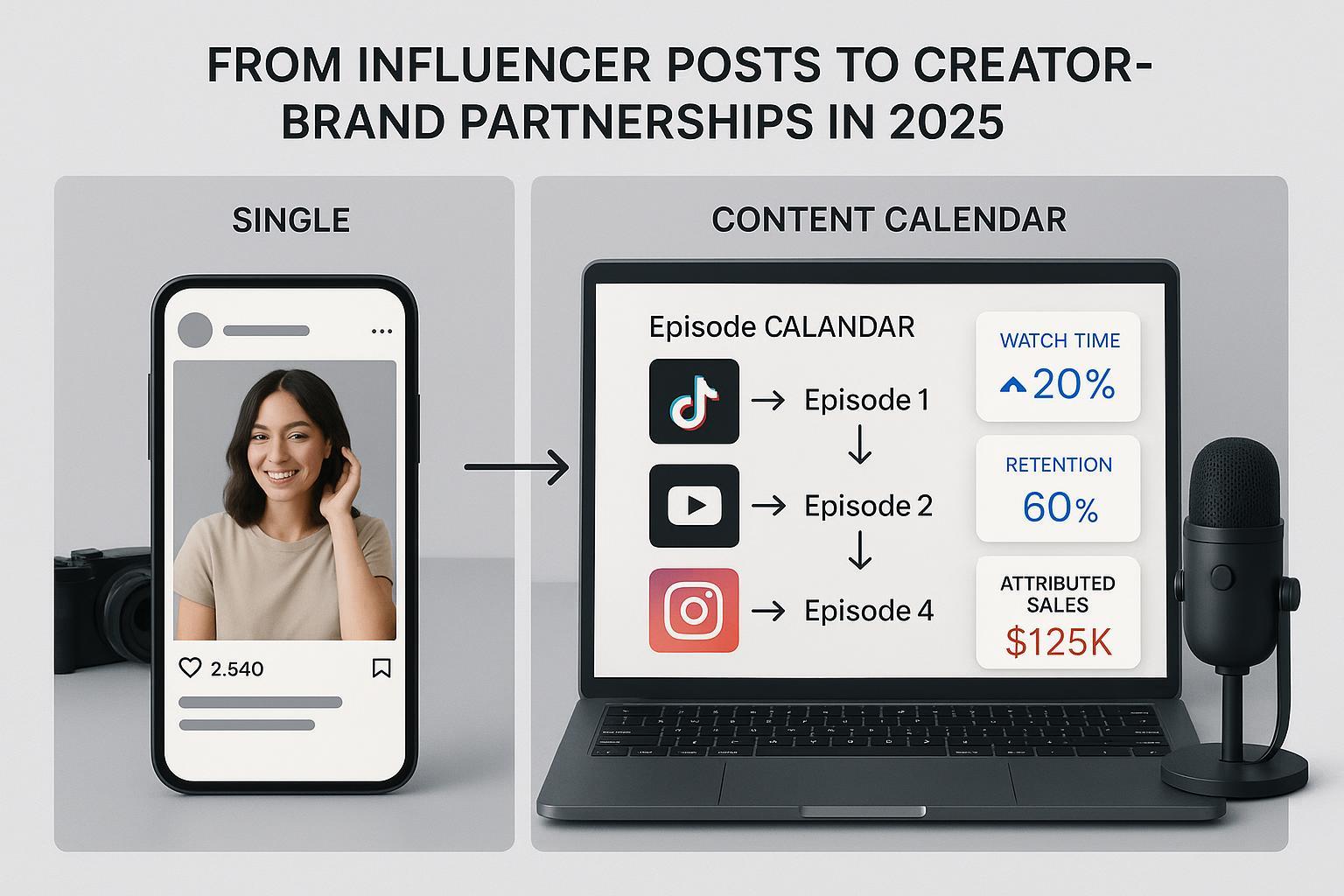
Professionalized creator-brand relationships are no longer a forecast—they’re the operating reality of late 2024–2025. Analysts framed 2025 as the year marketers hold creator programs to higher standards, moving beyond one-off posts toward serialized, multi-platform partnerships that behave like ongoing media programs rather than isolated ads, as noted by Insider Intelligence/eMarketer’s 2025 creator economy trends overview (12/16/2024). Budget conversations are following suit as the creator economy scales; context from Digiday cites Goldman Sachs’ estimate of roughly $250B in 2024 value and aggressive growth through 2027, underscoring why brands are building longer-term programs and governance around creators according to Digiday’s 2025 guide referencing Goldman Sachs (08/18/2025).
What “episodic partnerships” mean—and why they outperform one-offs
Episodic partnerships are multi-episode, multi-asset collaborations with creators that run over weeks or months, often spanning TikTok short-form, YouTube long-form/CTV extensions, Instagram Reels/Stories, and sometimes podcasts or live streams. They create a narrative arc—characters, rituals, running jokes, recurring utility—and build habit with audiences.
Compared to one-off posts, episodic partnerships typically:
- Accumulate attention through continuity (audiences come back for the next installment).
- Provide repeated learning cycles for creative and offer testing.
- Enable cross-platform retargeting (e.g., short-form discovery → long-form depth → shoppable/live moments).
- Support clearer measurement with consistent cadences (watch-time, retention, frequency, and sequential lift on commerce or leads).
If you’re new to structuring multi-format creator campaigns, this background on Hybrid influencer campaign models and strategies can help bridge from single-post tactics to program thinking.
Platform momentum is pushing serial, multi-platform collaborations
Updated on 2025-09-30
- TikTok has consolidated creator collaboration and media workflows in TikTok One, announced June 3, 2025. TikTok positions it as “your home for making high-impact TikTok content,” with planning insights and integrated boosting that make creator content a repeatable input to an ongoing program—see TikTok’s official TikTok One announcement (06/03/2025).
- YouTube leaned into serialized sponsorships and living-room reach at Brandcast 2025. New sponsorship constructs around cultural moments and AI-assisted “Peak Points,” plus shoppable CTV, make it easier for brands to underwrite recurring series that reach viewers on the biggest screen, as detailed in YouTube’s Brandcast 2025 recap (05/14/2025).
These product shifts aren’t just features; they’re infrastructure for episodic creator-led storytelling and always-on commerce.
Decision tree: When to pivot from ad-hoc posts to episodic partnerships
Ask these questions before you scale into a series:
- Strategic fit and objectives
- Do you need sustained attention, brand lift, or education (vs. a short-term pulse)?
- Will sequential storytelling or recurring formats unlock better understanding of your offer?
- Audience and channel dynamics
- Are you seeing repeat engagement patterns (comments anticipating “part 2,” playlist saves, recurring live viewers)?
- Do you have at least two viable surfaces to cross-pollinate (e.g., TikTok + YouTube; Instagram + podcast)?
- Creative and operational capacity
- Can you commit to a weekly or biweekly cadence for 6–8 weeks with timely review cycles?
- Do you have workflow clarity on scripts/outlines, approvals, and asset reuse?
- Measurement readiness
- Are your KPIs sensitive to serial formats (watch-time, 30-second retention, episode completion, frequency/sequence lift, attributed sales/leads)?
- Can you tag links, coupon codes, UTM parameters, or use platform-native shopping to capture impact?
If you answer “yes” to most of the above, graduate to an episodic pilot.
A 6–8 week pilot blueprint (and how to judge it)
Goal framing
- Awareness/attention: prioritize watch-time, retention, and frequency (per viewer) across episodes.
- Consideration/education: track episode completion, search lift for branded terms, and long-form views after short-form exposure.
- Commerce/leads: attribute clicks, sign-ups, add-to-cart, and conversion from episode-aligned links or native shopping.
Cadence and scope (example)
- Weeks 1–2: 2 short-form videos/week; 1 long-form/week; 1 live or Stories Q&A.
- Weeks 3–6: Maintain cadence; introduce a recurring ritual (weekly challenge, serialized plotline, product “build” in steps). Add a mid-series recap.
- Weeks 7–8: Finale and wrap-up; repurpose into a highlight reel and an email/social recap; plan renewal decision.
Creative workflow
- Episode outline template → rapid script beats → creator draft → brand review (24–48 hours) → publish → boost/select for paid.
- Reserve 10–20% of runtime for recurring hooks (series intro motif, CTA ritual) to build memory structures.
- Leading indicators: first 3–5 seconds hook hold, 30-second retention, average view duration/watch-time, returning viewers across episodes.
- Lagging indicators: search lift, direct traffic, subscriber growth, email capture, shoppable clicks and conversions where enabled.
- Decision gate: Predefine green/amber/red thresholds for renewal (e.g., retention + repeat viewers trending up by week 4; CAC vs. target within tolerance by week 6). Keep thresholds realistic and specific to your category.
Budget and resourcing
- Treat the pilot as a bundled package (not isolated posts): include creative fees, usage rights, potential exclusivity, production add-ons (live/podcast), and paid distribution for proven episodes. Pricing varies widely by tier/format and rights; avoid over-optimizing on CPP for single assets—optimize for series outcomes.
Contracting and compliance: Professionalize the foundation
Updated on 2025-09-30
Contract checklist (core clauses to align in episodic deals)
- IP and licensing: Preserve creator pre-existing IP; define ownership or license for new content; detail territory, duration, and redistribution (including CTV/podcasts).
- Usage rights and edits: Enumerate deliverables, usage in paid ads/CTV, allowed modifications, and review windows.
- Exclusivity: Specify category scope, geography, platform list, and cooling-off periods post-campaign.
- AI and likeness: Address synthetic voice/image use, localization, and compensation limits.
- Term/renewal: Include rolling renewal options; define cause and convenience termination.
For scoping and handoffs, clarify deliverables early. This primer on how to Define deliverables in creator agreements can reduce friction between brand, agency, and creator teams.
Policy watchpoints (2025)
- TikTok commercial content disclosure: As of September 1, 2025, TikTok tightened enforcement with in-app notifications and potential distribution limits for undisclosed branded content; see Bazaarvoice’s 2025 TikTok policy explainer (08/29/2025). Ensure creators use TikTok’s Commercial Content Disclosure tools as documented in platform help resources.
- YouTube advertiser-friendly and monetization policies: Creators and brands should align serialized content with YouTube’s current monetization/advertiser guidelines and AI disclosure updates outlined in YouTube Help’s monetization policy hub (accessed 2025).
- FTC Endorsement Guides: The U.S. FTC requires “clear and conspicuous” disclosures; platform tags alone may be insufficient. Review the FTC’s business guidance for influencers (2023 update, current in 2025) and incorporate it into creator briefs.
AI-enabled throughput: How teams keep a weekly cadence without sacrificing quality
Creators are increasingly using AI to accelerate editing, localization, and asset adaptation. In a 2025 release, Epidemic Sound reported that 91% of creators use AI in their production workflows, reflecting a mainstream shift that makes episodic schedules more feasible, as noted in Epidemic Sound’s 2025 creator economy report (06/17/2025). For a broader primer on generative tools in the production stack, see this explainer on AI’s role in scaling episodic content.
Tactically, consider:
- Script beat expansion and translation to test new locales without reshooting every scene.
- Automated highlight extraction for weekly recap reels and teaser cuts.
- Audio and music adaptation to fit platform norms and pacing.
A pragmatic workflow example (mid-series) that scales
Once your series is live, operational simplicity matters as much as creative spark. A practical weekly rhythm might look like this:
- Monday: Pull prior-week episode analytics; decide which cut to syndicate or boost.
- Tuesday: Draft beats for two shorts + one long-form; slot one live/podcast segment.
- Wednesday: Creator records; brand reviews within 24–48 hours.
- Thursday: Publish shorts and long-form; deploy paid on the proven hook version; schedule live.
- Friday: Compile learnings and prep next week; document deliverables and usage rights.
To keep planning, production notes, and channel publishing consolidated, teams often adopt a content system with simple editorial blocks and one-click publishing to owned channels. QuickCreator supports documenting episodic arcs, publishing blog recaps, and pushing approved copy to WordPress while teams comment asynchronously. Disclosure: QuickCreator is our product.
Risk and governance: Avoidable pitfalls as programs scale
- Measurement myopia: Overweighting vanity metrics (likes, raw views). For episodes, prioritize watch-time, retention, and returning viewers before optimizing spend.
- Rights creep: Neglecting to secure usage across paid, CTV, or podcast feeds, then paying twice to reuse winning episodes.
- Over-exclusivity: Overly broad category blocks that inflate costs and limit creator income; narrowly tailor to true conflicts.
- Compliance slippage: Missing disclosures or misaligned claims; institute pre-flight checks aligned to FTC and platform rules.
- Platform dependency: Spread formats across at least two surfaces (e.g., TikTok discovery + YouTube depth/CTV) to hedge algorithm and policy changes.
Why this shift matters for 2026 planning
The infrastructure for serialized creator storytelling is hardening. TikTok’s collaboration suite and YouTube’s sponsorship/CTV footprint lower the friction of sustaining weekly arcs; creators’ AI-enabled workflows add throughput; and brand teams are adopting program-level KPIs. The implication for CMOs and program leads: treat creators like editorial partners with clear rights, recurring formats, and renewal cadences.
If you need a single-page summary to align stakeholders, anchor your argument with two data-backed points and one platform thesis:
- Professionalization is the dominant 2025 narrative per Insider Intelligence/eMarketer’s creator trends (12/16/2024).
- The market’s scale and growth potential compel better program governance and measurement, per Digiday’s 2025 guide referencing Goldman Sachs (08/18/2025).
- Platform roadmaps (TikTok One; YouTube Brandcast 2025) favor serialized sponsorships over single shots—see TikTok One announcement (06/03/2025) and YouTube Brandcast 2025 (05/14/2025).
Next steps
- Run the 6–8 week pilot with pre-defined renewal gates; lock weekly review cycles and secure rights for multi-platform reuse.
- Build a contracting checklist and a disclosure SOP that references FTC guidance and current platform rules.
- Consolidate your episodic documentation, publishing, and analytics notes in a single system to speed decisions; tools like QuickCreator can be used to centralize briefs, publish blog recaps, and coordinate WordPress pushes without developer effort.
Sources and notes
- Professionalization trend framing: eMarketer (12/16/2024)
- Market scale context: Digiday citing Goldman Sachs (08/18/2025)
- Platform product shifts: TikTok One (06/03/2025); YouTube Brandcast (05/14/2025)
- Compliance updates: TikTok policy enforcement (08/29/2025); FTC influencer guidance (2023, current 2025)
- AI throughput adoption: Epidemic Sound (06/17/2025)