What Are Creator Affiliate SKUs? A Practical, No‑Nonsense Guide

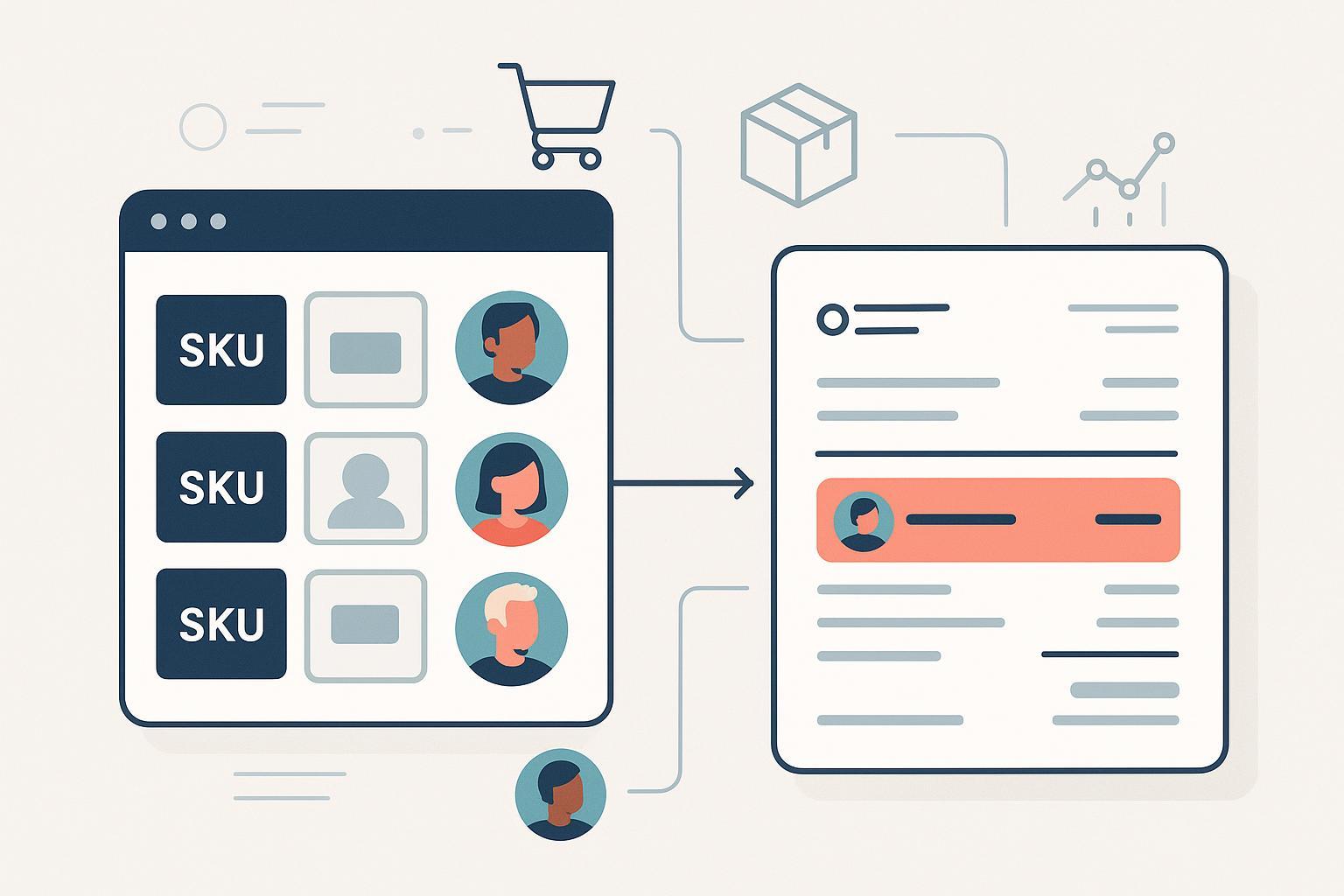
If you work with creators or affiliates, you’ve probably felt the pain: links get stripped, cookies expire, and credit goes missing. Creator Affiliate SKUs are a simple, durable way to embed attribution into your catalog and orders—so the order line item itself tells you who drove the sale.
The short definition
Creator Affiliate SKUs are creator- or affiliate-specific SKUs (or SKU variants/bundles) assigned by a brand so that any order containing that SKU is automatically attributed to the corresponding creator at the line‑item level in your ecommerce system.
In other words, instead of relying only on links or cookies, you use the product identifier already living in your first‑party systems to carry the attribution signal.
Why this matters now
- Third‑party cookies are being restricted across browsers. Google’s Privacy Sandbox updates in 2024 confirmed that phase‑out timing shifted, with deprecation expected to start in 2025 following regulatory review, which keeps pressure on cookie‑dependent tracking. See the official Privacy Sandbox update on the plan for phase‑out (2024).
- UTMs are great for analytics, but they don’t create transactional attribution or commissions by themselves. Google’s GA4 docs clarify that UTMs are for campaign data collection and reporting, not payout logic: Collect campaign data with custom URLs (GA4 Help).
- SKUs are first‑party, operational IDs that persist through orders and exports. They’re different from global identifiers like GTIN/UPC, which are standardized across the supply chain (see GS1 US: What is a GTIN). Leveraging SKUs for creator attribution keeps the signal close to inventory, fulfillment, and payouts.
How Creator Affiliate SKUs work (step by step)
- Create a creator‑specific SKU path
- Add a variant or bundle that’s functionally the same product but with a unique SKU tied to a specific creator. On Shopify, each variant has its own SKU and can be deep‑linked via a variant ID; see Shopify Liquid: variant object.
- Make it easy for shoppers to add the right SKU to cart
- Use prebuilt cart links so the creator’s variant ends up in the basket automatically. Shopify supports cart permalinks like /cart/VARIANT_ID:QTY; see Create cart permalinks (Shopify).
- Attribute on the order line item
- When the order is placed, the presence of that creator‑specific SKU anchors attribution. Your order export already includes the SKU, making reporting and payouts straightforward.
- Send product-level data to partner/affiliate platforms
- Many partner platforms support product/SKU‑level commissioning. Awin’s Product Level Tracking accepts line‑item fields such as productSku and commission group; see Awin Product Level Tracking (developer docs).
- Similarly, impact.com allows Category & SKU exception lists to define custom payouts by SKU families: Create Category & SKU Exception Lists (impact.com Help).
- Close the loop for analytics
- You can still pass events via server‑side or conversion APIs for ad platforms and analytics, but order‑line attribution remains intact even if cookies fail.
How it compares to other attribution methods
-
Referral links + cookies
- Strength: Easy to launch; trackable journeys when cookies persist.
- Weakness: Vulnerable to browser restrictions and consent issues (see the 2024 Privacy Sandbox update).
-
Coupon/discount codes
- Strength: Works without cookies; fans love a deal.
- Weakness: Requires manual entry; can be leaked or misused; conflicts with other signals.
-
UTMs
- Strength: Campaign analysis in tools like GA4.
- Weakness: Not transactional attribution by themselves (GA4 UTM guidance).
-
SKU‑level attribution
- Strength: First‑party, order‑line durable; inventory‑native; clean for payouts.
- Weakness: Catalog sprawl if unmanaged; requires operational discipline.
-
Best in class: Hybrid
- Use creator SKUs plus links/coupons for redundancy, and feed conversions server‑to‑server to your affiliate platform and ad platforms. That way, even if a cookie is missing, the SKU in the order still credits the creator, and S2S improves measurement resilience.
Implementation patterns (Shopify and WooCommerce)
-
Shopify
- Structure: Create a variant per creator (or limited creator bundles) with unique SKUs. Deep‑link the specific variant and share cart permalinks so the correct SKU is added automatically (variant object; cart permalinks).
- Mapping: Keep a creator–SKU mapping table (in a sheet, PIM, or metafields). Your payout job looks up SKUs to determine the creator.
-
WooCommerce
- Structure: Use Variable Products and assign SKUs at the variation level so each creator’s variant is identifiable in orders; see Variable products (WooCommerce Docs).
- Scaling: Use a consistent SKU naming convention; Woo’s official Bulk SKU Generator can help standardize patterns across a large catalog (Bulk SKU Generator).
-
Partner/affiliate platforms
- Awin: Submit line‑item product data via Product Level Tracking so you can commission by product/SKU (Awin PLT docs).
- impact.com: Configure SKU exceptions for higher or custom payouts on creator SKUs (impact.com exception lists).
Pros, cons, and common pitfalls
-
Pros
- First‑party, resilient to cookie loss and ad blocking compared to client‑side‑only methods.
- Clean reporting: SKU appears on the order line, so attribution and payout rules are auditable.
- Flexible commissioning: Product‑level rules in partner platforms let you reward specific SKUs.
-
Cons
- Catalog sprawl: One creator per variant/bundle can balloon your catalog if not managed.
- Operational overhead: Requires naming standards, lifecycle governance, and QA.
- Channel constraints: Marketplaces or ERPs may limit how granularly you can proliferate SKUs.
-
Pitfalls to avoid
- Leaking links that don’t add the creator SKU to cart (use variant deep links/cart permalinks).
- Conflicts when coupon, link, and SKU all appear—decide priority rules in advance.
- Self‑purchase or reselling schemes—monitor for anomalies.
Governance checklist (make it durable)
- SKU schema: Define a predictable pattern (e.g., BASE‑PRODUCT‑CR8R‑CODE) and document it.
- Mapping table: Maintain an authoritative creator↔SKU mapping and owners.
- Lifecycle: Retire/merge old SKUs, and redirect deep links when deprecating variants.
- QA: Test links, cart additions, and checkout flows for each new creator SKU.
- Conflict resolution: Set rules—if SKU + coupon + link are present, which one wins for commissions?
- Fraud checks: Flag unusual order clusters (self‑purchases, bulk buys, odd geos).
Compliance and disclosures
- In the United States, the Federal Trade Commission (FTC) requires clear and conspicuous disclosure of material connections in endorsements. Creators and brands should follow guidance such as the 2023 update to the FTC Endorsement Guides—What People Are Asking and the creator‑focused Disclosures 101 for Social Media Influencers. SKU‑based attribution doesn’t replace disclosure or consent requirements.
- For programs involving personal data, ensure appropriate legal bases and notices under regimes like GDPR and CCPA/CPRA; coordinate with legal counsel to align partner data flows and retention policies.
Real‑world scenarios
-
DTC apparel variant
- You launch a creator‑exclusive colorway as a variant with SKU “HOODIE‑BLK‑CR8R‑ALYX.” Creator links use a variant deep link and a cart permalink. Orders containing that SKU automatically credit ALYX, and your affiliate platform pays a higher commission for that SKU family via product‑level rules (e.g., Awin PLT).
-
Beauty bundle
- You assemble a skincare trio as a creator bundle with SKU “BEAUTY‑BNDL‑CR8R‑JAY.” Customers land on a prebuilt cart URL. Your payout job scans order lines for that SKU and triggers JAY’s commission using impact.com SKU exception lists.
-
Hybrid redundancy
- The creator uses a referral link; if cookies fail, the cart still contains the creator SKU. You also send confirmed conversions server‑to‑server to your partner platform and ad platforms, improving match rates without relying solely on browser storage.
Mini‑FAQ
-
Do I need to create a whole new product per creator?
- Not necessarily. Many brands prefer variants or bundles to minimize catalog duplication while preserving clear SKUs.
-
What if a shopper switches variants at checkout?
- That’s why cart permalinks and variant‑specific product pages help. Monitor for switching in QA and consider locking certain bundles or offering creator‑exclusive perks.
-
Can I use this on marketplaces?
- Support varies. Some channels restrict variant proliferation or custom SKUs per promoter. Keep creator SKUs primarily in your owned storefront when marketplace constraints exist.
-
How do I handle returns or exchanges?
- Treat like standard operations: reverse or adjust the commission when the attributed SKU is refunded; most partner platforms support adjustments tied to the original action ID.
Quick recap
Creator Affiliate SKUs embed the attribution signal into your catalog and orders. Assign creator‑specific SKUs (via variants or bundles), drive shoppers to add those SKUs to cart, and commission at the product level in your partner platform. In a world of changing browser policies and fragmented journeys, SKU‑level attribution gives you a first‑party, auditable path to credit the right creator—while still playing nicely with links, coupons, and server‑side integrations.