Content Production Workflow for Agencies: The 2025 Playbook for Speed, Quality, and Control

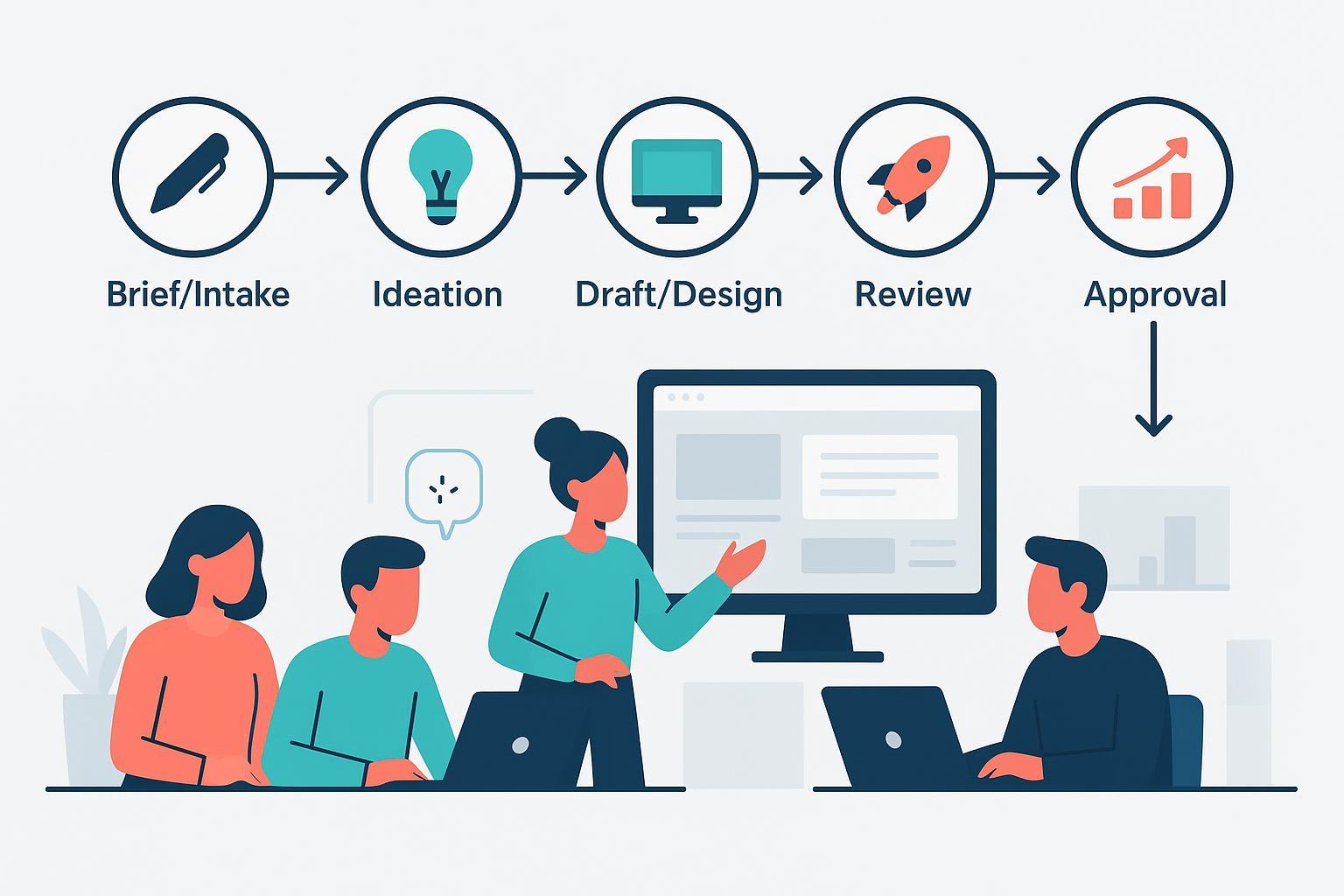
You’re not short on ideas—you’re short on flow. If your best concepts stall in review limbo, it isn’t a talent issue; it’s an operating-system issue. The solution is a standardized, AI-ready workflow that moves every asset from brief to publish with clear gates, owners, and outcomes.
The Agency-Grade Workflow Map (2025)
A reliable workflow is a sequence of gates with entry/exit criteria, not a loose checklist. Think of it like air traffic control: every stage has a controller, and nothing advances without a clean handoff.
| Stage | Goal | Entry Criteria | Exit Criteria | Primary Owner(s) |
|---|---|---|---|---|
| Intake/Brief | Align on objectives, audience, scope, and constraints | Approved brief, budget, deadline, KPIs, brand/voice guides | Handoff packet with RACI, SLA tier, and asset-specific path | Account/Project Lead |
| Ideation/Plan | Select angle, format, channels, and success measures | Final brief + research inputs | Approved concept + outline/storyboard + production plan | Strategist, Creative Lead |
| Create/Design | Produce draft(s), visuals, or edit(s) per plan | Approved concept + assets, SEO/keyword set | Version V1 ready for internal QA | Writer, Designer, Editor, Video Producer |
| Internal QA | Catch issues early: facts, style, brand, accessibility, SEO | V1 + checklists + sources | V1-QA passed, issues logged/resolved | Editor, QA Lead |
| Stakeholder Review(s) | Gather directional feedback with time-boxed windows | QA-passed asset + review brief | Consolidated feedback, ≤2 rounds | Project Lead, Stakeholders |
| Approval (Client/Legal) | Formal sign-off; audit trail captured | Final draft + review log | Approved/locked asset with metadata | Client Approver, Legal/Compliance |
| Publish/Distribute | Release across channels per plan | Approved asset + channel specs | Published, tagged, scheduled; links captured | Channel Owners |
| Analyze/Optimize | Learn, repurpose, and improve | Performance window elapsed | Report + backlog of improvements/derivatives | Analytics Lead, Strategist |
For a deeper stage-by-stage breakdown with visuals, see Planable’s 2025 content workflow guide and Wrike’s practical content creation workflow overview.
Asset-specific nuances matter. Long-form pieces need heavier fact-checks, SEO QA, and structured metadata; video requires parallel tracks for script, storyboard, and edit with frame-accurate review; social works best in batched sprints with pre-approved copy/visual variants.
Roles, RACI, and SLAs that Prevent Rework
Role clarity beats heroics. Define who does the work, who owns the decision, who must be consulted, and who needs to be informed—then publish that RACI per asset type. Pair it with SLA tiers that set realistic windows and cap review rounds so scope doesn’t creep by stealth. Handoffs should include a short “review brief” that restates the asset’s objective, audience, and what feedback is useful right now, and your DAM should lock approved files with full metadata and an audit trail. For practical strategies to prevent bottlenecks, Screendragon’s overview of approval workflow best practices is a helpful reference.
Suggested SLA tiers (adjust to your reality):
- Brief to V1 draft: 2–5 business days for a 1,200–1,800-word article; 5–10 days to a video V1.
- Internal QA: half to one business day.
- Review windows: 2–3 business days per round; cap rounds at two (three if regulated).
- Publishing: within one business day post-approval for web; campaign assets by agreed window.
Where AI Belongs in the Flow—and Where It Doesn’t
AI pays off when it augments judgment, not when it tries to replace it. Use it to draft briefs from strategy and research notes, to propose outlines or first passes inside defined voice guardrails, and to automate checks for facts, style, accessibility, and basic compliance flags. It also excels at metadata generation, alt text, captions, and task routing or SLA nudges. But keep humans in the loop anywhere meaning and risk live: editors own final tone and accuracy, brand leads arbitrate voice, and compliance partners validate claims. Require source links to original references in comments, maintain logs of AI-assisted steps for auditability, and never let AI-produced copy skip human QA. For 2025 upgrade context, Optimizely outlines how teams are pairing workflows with AI in its content workflow and AI overview (2025), and Ekamoira maps common automated content creation workflows and tools.
The Tool Stack, Without the Guesswork
Choose tools by scenario, not hype. Prioritize integration depth with your CMS/DAM, robust approvals, and automation that matches your asset mix and client volume.
| Scenario | PM/Work OS | Review/Approval | CMS/DAM | Automation |
|---|---|---|---|---|
| Multi-client, mid-market agency | Asana, Wrike, ClickUp | Ziflow, Filestage | CMS (e.g., Contentful), DAM (e.g., Bynder) | Native automations, Zapier/Make |
| Enterprise, heavy governance | Adobe Workfront | Ziflow, Frame.io (video) | Contentful + Bynder | Workato/iPaaS + native |
| Lean studio, fast social/video | ClickUp, Trello | Frame.io, Filestage | Native social suites + lightweight DAM | Native + Zapier |
Two data points to ground expectations: review platforms can cut rework—Ziflow reports projects average two versions to completion with formal approval software versus four to six without, a vendor-verified metric from late 2024 (Ziflow overview). And for enterprise-scale coordination, Forrester’s TEI (commissioned) found Adobe Workfront delivered a 285% ROI over three years with payback under three months, driven by productivity gains and fewer status meetings; see Adobe’s summary of the Forrester TEI analysis. Treat both as directional.
Special Cases: Regulated, Localized, and Distributed
Regulated accounts need early and frequent legal involvement, strict version control, and locked approvals with audit trails. In U.S. pharma, the FDA’s Office of Prescription Drug Promotion (OPDP) typically provides voluntary review feedback for core launch materials after a five‑day administrative screen, aiming to comment within about 45 days; teams should plan roughly six to seven weeks end‑to‑end. See the FDA’s OPDP news and resources hub and context from Clarkston Consulting’s 2024 overview of enforcement and timing.
Localization programs work best when terminology and style are centralized via translation memories and termbases and when CMS/DAM integrate directly with localization platforms. Route from a master asset to market adaptations, enforce variant management, and set regional review windows. Public numeric benchmarks for speed and savings are thin; industry commentary suggests AI+TM can meaningfully reduce costs and turnaround for standard content, but teams should validate per vendor SLAs.
Distributed teams should lean on asynchronous reviews with deadline windows, follow‑the‑sun handoffs, and ownership by time block to prevent stalls. Standardized intake, naming conventions, and metadata ensure anyone can pick up the thread without context loss. A short review brief for each round keeps feedback focused and scope contained. Think of it this way: clarity travels faster than files.
Measure What Matters: Baselining and the KPI Dashboard
Because public benchmarks for cycle time and throughput are scarce, start by baselining your own shop. Track how long each stage takes by asset type, how often work clears on the first pass, how many rounds your process actually uses, and how often you hit your SLA windows. Add creator hours and rework hours to understand cost per asset and throughput per FTE by role.
Core production KPIs
- Cycle time: brief to publish by asset type.
- First-pass approval rate and rounds per asset.
- On-time delivery rate (by SLA tier) and creator hours per asset.
- Rework hours and cost per asset; throughput per FTE by role.
Then shape a dashboard that shows a cycle-time trendline by asset, aging WIP and breach rates, plus utilization and rework ratios. Where external numbers are missing, use directional signals to set targets. For example, if your assets average four to five rounds without a review platform, the “two versions to completion” result reported by Ziflow (2024) suggests what’s possible with the right tooling and discipline.
Implementation Roadmap: 30–60–90 Days
30 days: Map your end‑to‑end flow with entry/exit criteria. Publish RACI templates by asset type, define initial SLAs and review windows, and choose a minimal viable stack (Work OS + review tool + CMS/DAM connection). Train leads on handoff quality and version control.
60 days: Roll out feedback hygiene with a review brief at each stage, cap rounds, and enforce deadlines. Add AI assist for outlines, QA checks, metadata, and routing—but keep human review mandatory. Stand up a KPI dashboard and begin baselining cycle time and rounds per asset.
90 days: Automate routing, escalations, and status updates; templatize common asset types; expand localization variants; and refine compliance checklists. Close with a quarterly retro to prune bottlenecks, update SLAs, and publish a “what we changed” memo.
A standardized, AI‑ready workflow won’t stifle creativity; it protects it—by removing busywork, clarifying ownership, and giving your team space to do work you’re proud of. For further reading, Planable’s content workflow guide and Optimizely’s 2025 overview on content workflow and AI are solid next stops.