Content Marketing on a Small Budget: A 2025 Playbook That Actually Works

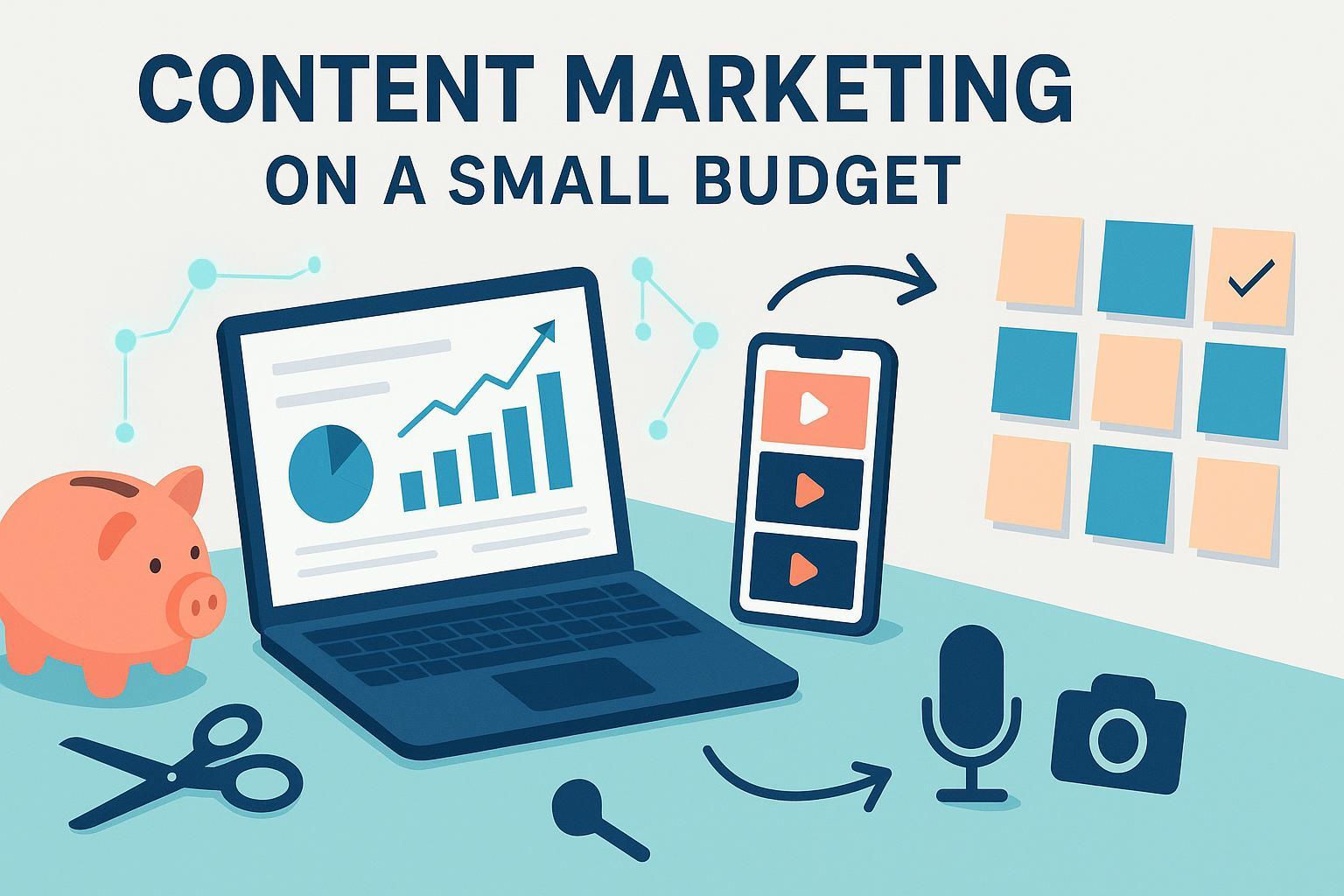
You don’t need a big checkbook to build a content engine. You need a simple system, a tight stack, and the discipline to measure what matters. This playbook distills what small teams and solopreneurs can deploy in 90 days to produce consistent content, distribute it smartly, and prove ROI—without burning hours or cash.
1) Set outcomes and budget guardrails
Before you create anything, decide what “good” looks like. Pick one business outcome (e.g., demo requests, online sales, booked appointments) and two channel KPIs that ladder up (e.g., qualified traffic and email opt-ins). Then time-box your effort: how many hours per week can you truly invest? Be honest; overcommitting kills consistency.
Use a simple rule of thumb: 70% of effort on evergreen content that compounds, 20% on timely or seasonal pieces, 10% on experiments. Teams everywhere are moving toward repeatable systems and selective AI support, while still wrestling with resource gaps and attribution—so your plan should be ruthlessly focused on repeatability, not one-offs.
2) Build a Minimum Viable Content Engine (MVCE)
Think of your MVCE as a weekly rhythm: one pillar, then break it down. One input, many outputs.
Pillar → batch → repurpose (weekly workflow)
- Choose a pillar format you can sustain (short webinar, live Q&A, audio-first mini-podcast, or an in-depth blog). Record it or draft it in one sitting.
- Pull 3–5 core insights. Turn them into short videos, image carousels, and quote graphics.
- Extract one email tip and a teaser for social. Link back to the pillar.
- Schedule distribution for the next 7–10 days. Reply to comments and log questions for future content.
Why video in the mix? Because it consistently drives understanding, awareness, and leads. In 2025, most marketers say video helps at every stage, from comprehension to sales, according to the long-running Wyzowl Video Marketing Statistics 2025 study.
Weekly production checklist (20–30 focused hours):
- 1 pillar (30–45 minutes recorded or 1,200–1,600 words written)
- 3–5 short videos (30–90 seconds, vertical)
- 1–2 image carousels or quote graphics
- 1 newsletter tip + 1 social teaser
Pro tip
A single 30-minute webinar can fuel 10+ assets: 3 shorts, 2 carousels, 1 newsletter, 1 blog recap, and 3 community posts answering real questions. Capture once; repurpose many times.
3) AI + automation on $0–$50/month
You don’t need a monster stack. You need a few tools that play nicely together. Use AI to draft outlines, condense transcripts, and brainstorm angles; use lightweight automation to keep publishing on schedule and your UTM tags clean.
The table below shows a sample low-cost stack and how each piece slots into the workflow (tools are examples—substitute equivalents you already have):
| Workflow stage | Example tool(s) | What it does for you |
|---|---|---|
| Ideation & outlining | ChatGPT or Copy.ai | Generate outlines, angles, and headline variations from prompts and FAQs |
| Recording & editing | Descript or CapCut | Record, transcribe, cut clips, and add captions fast |
| Design | Canva | Spin up carousels, thumbnails, and quote cards with brand presets |
| Planning | Notion or Trello | Keep a simple calendar, assets, and status in one place |
| Scheduling | Buffer or Metricool | Queue posts across channels; collect basic analytics |
| Light automation | Zapier or Make | Auto-create social drafts from new posts; enforce UTM tagging |
Keep it lean. Start with two automations: “When a blog/podcast publishes, create three social drafts with the right UTM” and “When a new review lands, alert Slack and paste a reply template.”
4) Social distribution, UGC, and micro-influencers
Organic reach still exists—if your content is native to the platform and anchored in real community. Invite customers to share how they use your product, then ask for permission to repost. Build a simple content rights process (written OK to reuse, where, and for how long). Favor micro- and nano-creators in your niche; they’re cost-efficient and usually deliver stronger engagement. Directionally, marketers report solid returns—around $5.20 back for every $1 spent on average—according to the Influencer Marketing Hub 2025 Benchmark Report.
Compliance note: If you provide any discount, gift, or payment, that’s a “material connection.” Disclose it clearly in the content itself (e.g., “#ad,” “Sponsored by …”), and don’t rely only on platform labels. Treat platform disclosure tools as additive.
5) SEO and local SEO wins that compound
Small teams win in search by aiming for achievable, intent-matched queries and building topic clusters. Internal links from supporting articles to your pillar page help search engines understand your depth. Why prioritize top-3 placement? Large-scale analysis shows the #1 organic result captures roughly 27% of clicks, and the top three together more than half, per Backlinko’s Google CTR study (updated 2024/2025). That’s worth chasing—on the right queries.
Watch SERP dynamics. Some queries now surface AI-generated answers that can dent click-through. SEER’s 2025 observations detail notable CTR declines on affected terms; segment your queries in Search Console and adapt with FAQs, structured data, and content that prompts branded searches. See SEER’s September 2025 AIO impact update.
Local? If you operate in a geographic market, your Google Business Profile (GBP) is non-negotiable. Complete every field, post weekly, upload fresh photos, and respond to all reviews. Consumers notice. In BrightLocal’s latest survey (2024), 75% regularly read local reviews and 81% use Google to evaluate businesses; 88% would use a business that responds to all reviews versus 47% that doesn’t respond. Details: BrightLocal’s Local Consumer Review Survey 2024.
6) Make email your growth engine
Email is the cheapest reliable distribution channel you control. Set a weekly cadence and keep it useful—one tip, one story, one link. ROI ranges by industry, but email remains a top performer; Litmus pegs average returns near $36 for every $1 spent, per the Litmus State of Email/ROI recap (2025). What’s the catch? You must keep your list clean and your content genuinely helpful.
One-week email setup
- Lead magnet aligned to your pillar (checklist, template, mini-guide)
- 3-part welcome series: promise, proof, and practical quick win
- Weekly digest that curates your latest pillar and best short-form clips
UTM-tag links in every email and segment by topic interest; this feeds your content calendar with real demand signals.
7) Prove it works: minimum viable measurement
A small stack can still be data-driven. Build a single-page dashboard with:
- Search: Google Search Console (queries, pages, top opportunities)
- Web: GA4 (traffic by channel and landing page; assisted conversions)
- Email: open/click rates and list growth (by source)
- Social: saves, shares, and comments (not just impressions)
- Reputation: review velocity and average rating
Adopt UTM discipline: channel, campaign, content. Every link—social, email, creator—should tell you what sparked the visit. Revisit the dashboard weekly and adjust next week’s content and distribution based on wins, not hunches.
8) A 90-day action plan (three sprints)
Sprint 1 (Weeks 1–4). Define the outcome and two KPIs, set your calendar, assemble the low-cost stack, publish Pillar #1, and repurpose it into five assets. Launch your lead magnet and 3-part welcome series. Complete your GBP profile and request your first 10 reviews.
Sprint 2 (Weeks 5–8). Publish Pillars #2–#3, refine your clip and carousel templates, and test two micro-creators with clear briefs and disclosure. Build your first topic cluster (3–5 supporting posts) around one pillar and add internal links. Ship the weekly digest without fail.
Sprint 3 (Weeks 9–12). Double down on winners: your top two channels and top two content formats. Expand review responses, add a community Q&A, and lock in three automations. Present a one-page ROI snapshot and decide which experiment graduates to always-on.
Final word
What if your small budget isn’t the limitation—but the forcing function? When you focus on one outcome, a repeatable MVCE, and a handful of well-chosen tools, momentum builds fast. Start this week, measure next week, and let compounding do the heavy lifting.