Content Marketing for Personal Brands: The Ultimate, Low-Burnout Playbook

If you’re building a personal brand, you don’t need more platforms—you need a system that compounds. The right system gives you a weekly rhythm, turns one strong idea into many assets, and steadily grows authority, audience, and opportunities without burning you out.
This guide is a practitioner’s playbook. You’ll get a simple operating cadence, channel decisioning, platform-specific moves, personal-entity SEO, conversion basics, and a 90-day plan. The goal is predictable progress, not perfection.
1) Nail your positioning first
Your content works only when it’s anchored to a clear promise. Three quick lenses will calibrate your message:
- Who exactly are you for? Name the job titles, seniority, and the situations they’re in. Executive coaches, indie SaaS founders, fractional CMOs—pick one primary persona.
- What outcomes do you help them achieve? Replace vague “value” with concrete results—e.g., “book more qualified sales calls,” “ship v1 of your course,” “publish a thought-leadership series that earns invites.”
- What topics will you talk about consistently? Choose 2–4 content pillars that map to those outcomes. For instance: “LinkedIn growth,” “YouTube for experts,” “personal-entity SEO,” “offer positioning.”
A quick prompt: Describe your target person in one sentence; list the three outcomes they want; write five episode/post ideas under each outcome. You now have a month of content that actually aligns with what your audience cares about, not what the algorithm wants.
If you prefer a credibility anchor while doing this, use a short “signature story” to explain why you teach these topics—client examples, failures, or first-hand experiments. Foundations like personal narrative and clarity of promise align with mainstream guidance on building authority, as emphasized by the University of Pennsylvania’s overview on building a personal brand online in its Digital strategies for success: building a personal brand online (2025).
2) Choose your channels with intent
Think in roles, not fads. Discovery channels find new people; depth channels convert attention into trust and action.
- Discovery: Short-form video (YouTube Shorts, TikTok) and LinkedIn carousels/documents spread your ideas fast and let you stress-test hooks.
- Depth and conversion: YouTube long-form, LinkedIn newsletters and posts, your email list, and your blog build binge paths, reputation, and pipeline.
Here’s a simple, 2024–2025-ready matrix to guide your first picks.
| Channel | Primary role | Strengths | Core tactics | When to prioritize |
|---|---|---|---|---|
| YouTube (Shorts + long-form) | Hybrid: discovery + depth | Evergreen search traffic plus recommendation system | Weekly 8–12 min video; 3–5 Shorts; strong hooks; playlists; end screens/cards to move viewers deeper | You teach complex topics and want lasting authority |
| TikTok | Discovery + hook testing | Rapid reach; trend-native; fast iteration | 15–30 second clips; hook in first 3–5 seconds; native captions and edits | Your audience skews social-first or you need fast feedback on messaging |
| LinkedIn (posts, carousels, newsletter) | Authority + distribution | Professional context; built-in newsletter delivery/notifications | Weekly or biweekly newsletter; carousels; engage comments same day | You sell B2B services or want speaking/partner opportunities |
| Email/newsletter (owned) | Nurture + conversion | Direct reach; compounding relationship | Weekly/biweekly send; clear CTAs; lead magnet; referral nudges | You want pipeline reliability and conversion you control |
| Blog/website | Search + entity | Durable hub; builds E-E-A-T and internal linking | Pillar pages; FAQs; author page; schema; fast mobile performance | You want long-term search capture and a credible home base |
Pick 2–3 channels for your first 90 days: one discovery (Shorts or TikTok), one depth (YouTube long-form or LinkedIn newsletter), and one owned (email + a simple blog hub). Keeping the stack small lifts quality and creates room to learn.
3) The weekly operating system (1 pillar → many assets)
The 80/20 system is straightforward: produce one pillar each week, then slice it.
- Pick your format: an 8–12 minute video or a 1,200–1,800-word article answering a high-intent question.
- Turn that into derivatives: 3–5 short clips or bite-size post ideas, one LinkedIn post or carousel, one newsletter summary with a strong CTA, and a blog update or companion post.
- Schedule with intention: Publish Shorts across the week; drop the long-form video or article midweek; send your newsletter within 24–48 hours to consolidate attention.
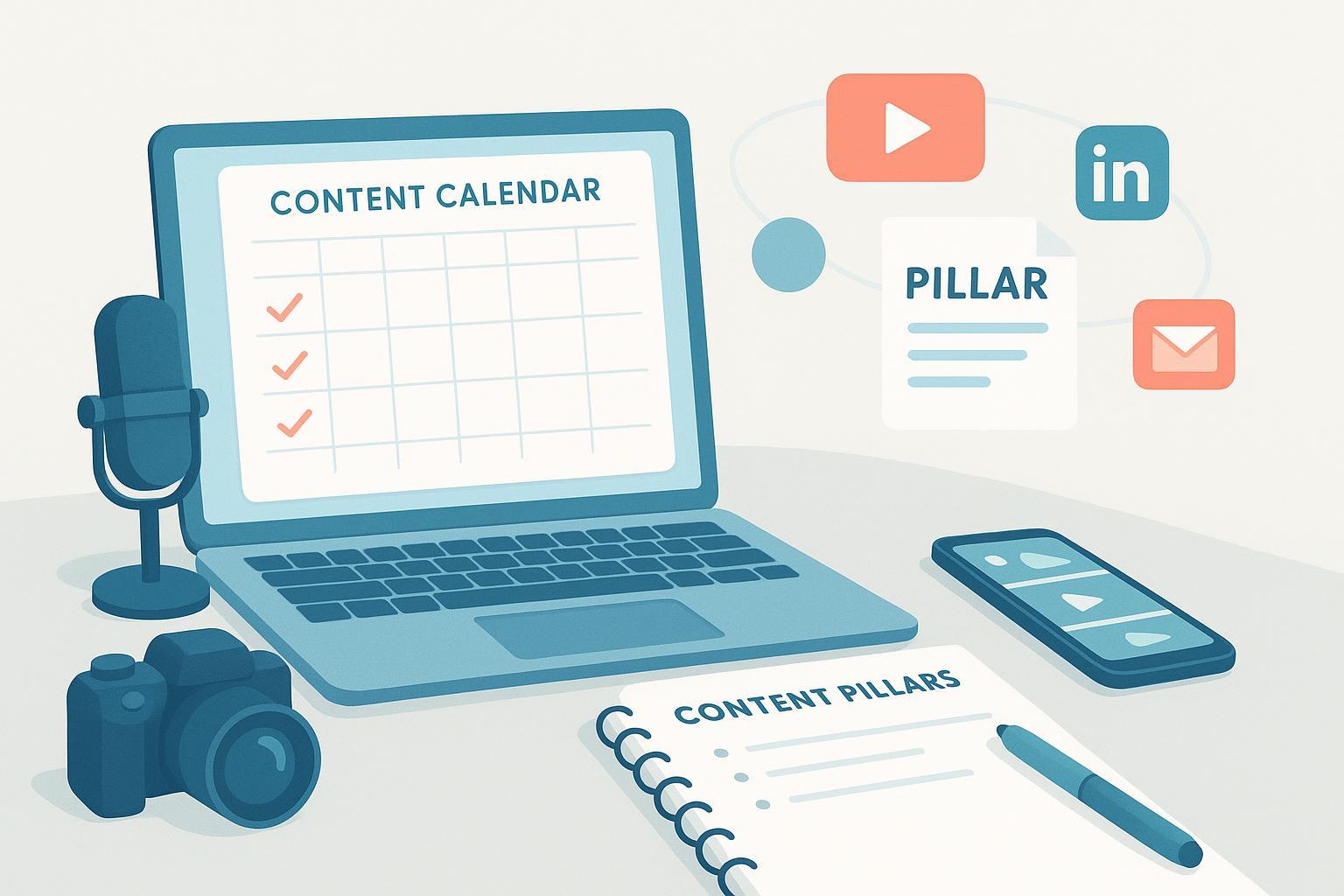
Repurposing map (think of it like spokes around a hub): Long-form video → cut clips with captions → post as Shorts/TikTok → expand into a LinkedIn carousel and one post → compile a newsletter with the core takeaway and next step → embed the long-form on your blog with a short FAQ and internal links.
AI can help—just keep your voice. Use it to draft titles, find clip timestamps, and outline newsletters. Always edit for accuracy and tone.
4) Platform playbooks (2024–2025 ready)
YouTube: Shorts for discovery; long-form for authority
Think of Shorts as door-openers and long videos as the house tour. Organize your content into playlists that mirror your pillars and use end screens/cards and descriptive links to move viewers to the next step. Official guidance focuses on mechanics like titles, descriptions, end screens, and cards—see YouTube Help and Creator resources for current how-tos on end screens, cards, and descriptions.
For added context on Shorts formats and best practices, Hootsuite’s 2025 overview of YouTube Shorts discusses hooks, captions, and cadence in YouTube Shorts: Everything marketers need to know (2025-07-29). In practice: aim for tight openings, pattern interrupts, and clear CTAs in the last seconds pointing to your long-form video or a playlist.
Practical weekly move: Record one 8–12 minute video that answers a precise query, slice 3–5 Shorts with captions, and use end screens, a pinned comment, and a simple verbal CTA (“Full walkthrough is linked”) to guide viewers deeper.
TikTok: Hook testing and rapid iteration
TikTok is excellent for testing hooks and finding language that resonates. Keep edits tight, use native captions, and track completion rates.
TikTok’s official business resources highlight fast hooks and concise edits—see Making TikTok videos for high engagement (2024) for core patterns. Use these insights to vet ideas before you invest in long-form content.
LinkedIn: Posts, carousels, and newsletters
For consultants and executives, LinkedIn is where authority shows up. Launch a weekly or biweekly newsletter and repurpose your blog posts to reach subscribers right inside LinkedIn. The platform’s help docs cover eligibility, setup, and management—start with LinkedIn’s Help Center overview for newsletters (updated 2024).
In early 2025, LinkedIn expanded newsletter analytics to include email-facing metrics like Email Sends and Open Rate; industry coverage summarized the rollout and what to watch—see Search Engine Journal’s report on LinkedIn newsletter email metrics (2025-02-24). Use the analytics to refine topics and CTAs, but remember: your real goal is moving readers toward owned email or booked calls.
For practitioner tips on titling, cadence, and distribution, Orbit Media’s guide LinkedIn newsletter best practices (2025) is a helpful companion.
Email/newsletter: Your owned channel
Email is your conversion and relationship engine. Expect variance in open rates due to privacy changes; prioritize clicks and replies over opens. Current, aggregate benchmarks suggest small, engaged lists often see roughly 30–45% opens and 2–5% click-through rates (your mileage may vary). Mailchimp maintains an up-to-date industry view—see Email Marketing Benchmarks (updated 2025) for ranges and context.
Keep cadence consistent (weekly or biweekly), use one clear CTA per send, and add a referral nudge occasionally. Cross-promote your newsletter in YouTube descriptions, LinkedIn newsletter bodies, and your website’s Featured or About sections.
Blog/owned site: Your authority hub
Your site proves you’re a real person with real expertise. Create an About/Author page, publish pillar pages that organize your topics, and add brief FAQs to capture long-tail questions. Google’s SEO Starter Guide (2025) explains the fundamentals (clear titles, internal links, mobile performance, alt text) in plain terms. Also review Google Search Central’s guidance on succeeding in AI-enhanced search to ensure your content stays people-first; see Top ways to ensure your content performs well in Google’s AI search (2025-05-21).
5) Personal-entity SEO (E-E-A-T for individuals)
Think of personal-entity SEO like setting up your “author passport.” You’re telling search engines who you are, what you publish, and where else you’re referenced.
- Build an Author page with a bio, credentials, first-hand experience examples, media mentions, and links to your professional profiles. Add Person schema with sameAs links to LinkedIn, YouTube, TikTok, GitHub/ORCID/Behance (as relevant). Keep your name and handle consistent across platforms.
- Organize content into 2–4 pillar clusters with internal links, descriptive URLs, and short FAQs. Include images with alt text and ensure fast, mobile-friendly performance.
- Weave in experience signals: anecdotes, screenshots, results, and lessons learned. Short Q&A blocks help win snippets and clarify quick answers.
This setup strengthens E-E-A-T signals and helps search engines connect your identity to your work, supporting durable visibility and trust.
6) Conversion the simple way
Conversion should feel like the natural next step, not a pressure tactic. Tie your CTAs to the specific transformation your audience wants.
- Offer one relevant lead magnet: a checklist, a one-page framework, a swipe file, or a lightweight calculator. Place it in YouTube descriptions, at the end of LinkedIn newsletters, and on your site.
- Make booking easy: link a calendar to your About and newsletter footer with a short qualifier on who should book.
- Showcase proof without boasting: a handful of case bullets, testimonials, or screenshots. Keep it specific: “From 2 to 8 booked calls/month in 8 weeks,” not vague praise.
Pair these with a weekly newsletter follow-up asking one question that invites replies. Conversation beats clicks when you’re selling expertise.
7) Measure what matters
Pick a north-star metric by stage, then instrument the handful of platform metrics that ladder up.
- Awareness: impressions/views, follower/subscriber growth, video retention, newsletter subscribers.
- Demand/lead: email signups, lead magnet downloads, reply rate, booked calls.
- Revenue: conversion rate from calls to clients, LTV from subscribers. If you run ads later, track CAC.
Treat public benchmarks as directional guidance, then build your own baselines. For example, if your YouTube long-form videos average a 35% view duration today, aim for 40% next month by tightening hooks and pacing. If your email CTR sits at 2%, test a single-CTA format and sharper subject lines to push toward 3–4%, using ranges like those maintained in Mailchimp’s Email Marketing Benchmarks (2025) as a reference, not a mandate.
8) Your 90-day plan
Here’s a realistic ramp that compounds effort without spreading you thin.
- Weeks 1–2: Clarify positioning and pillars; set up your site’s Author page and email service; outline your first four pillar topics. Draft two lead magnet options; pick one.
- Weeks 3–6: Publish one pillar per week (video or article). Derive 3–5 Shorts/TikToks, one LinkedIn carousel/post, one newsletter, and a blog update each week. Track simple KPIs in a sheet (views, retention, subscribers, email signups, replies, booked calls).
- Weeks 7–10: Tighten hooks based on what Shorts/TikTok completion rates reveal. Improve your long-form’s first 30–60 seconds and thumbnails/titles. Add a referral prompt to your newsletter. Start a lightweight case log of wins.
- Weeks 11–12: Review analytics holistically. Double down on the best-performing pillar theme and retire one weaker topic. Ship an updated lead magnet or mini course outline if interest is strong.
By Day 90, you should have a “minimum lovable system”: a weekly cadence, a small library of long-form pieces, a consistent short-form rhythm, a newsletter with replies, and a site that clearly represents who you are and what you deliver. From here, iteration beats reinvention.
A few final notes to keep momentum
- Keep scope sane. If a step takes more than an hour unexpectedly, simplify: fewer edits, clearer structure, tighter outcome.
- Stay audience-first. Your best topics come from client conversations, DMs, and questions you answer repeatedly.
- Think in seasons, not sprints. Run this playbook for 90 days, then recalibrate your pillars and channel mix.
If you want a mental model to carry with you, here’s the deal: one strong idea each week, expressed where your audience already spends time, and then brought home to an owned channel you control. That’s the system that compounds.