Content Marketing for Coaches and Consultants

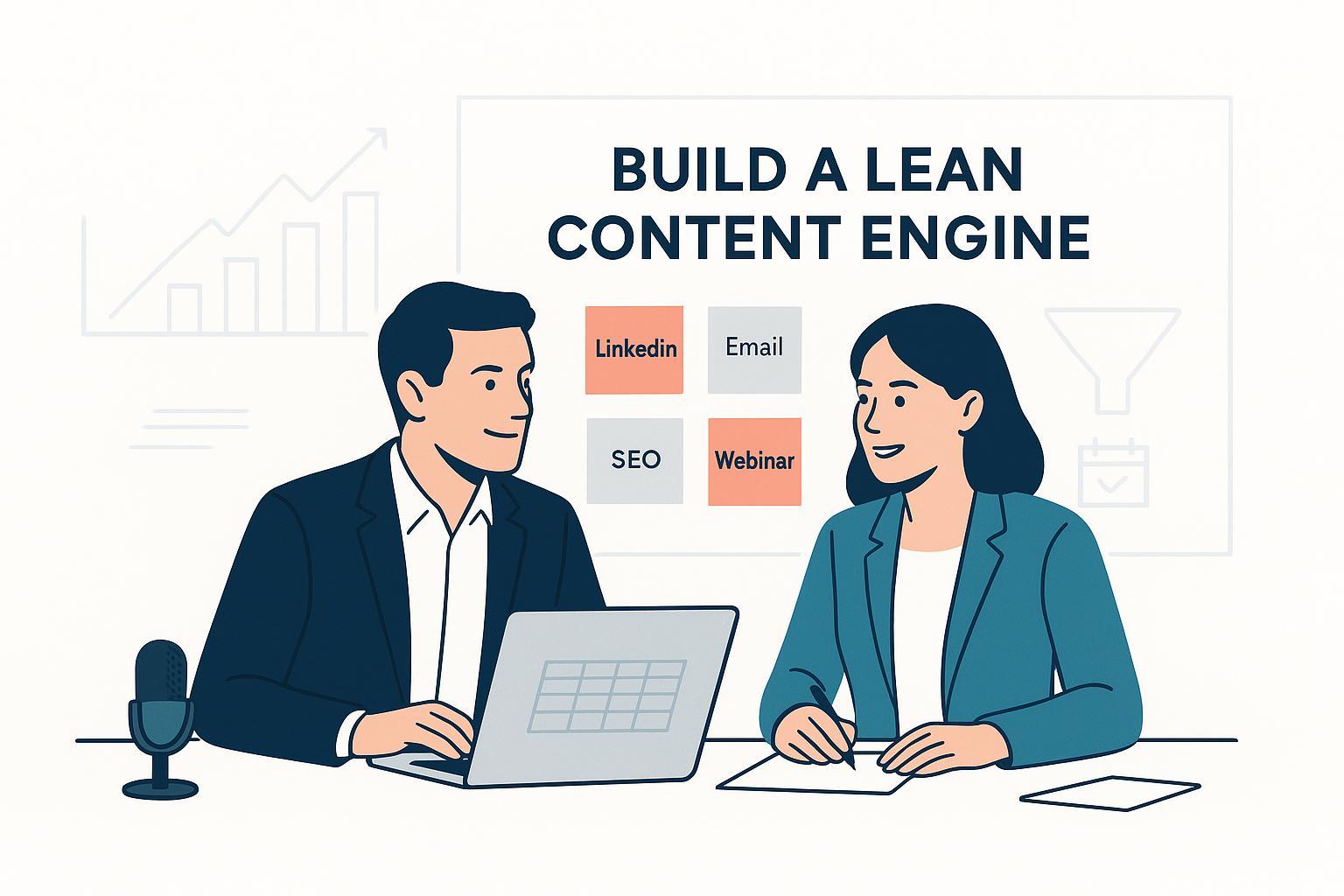
If you’re a coach or boutique consultant, you don’t need a sprawling content machine—you need a lean system that turns ideas into booked calls. This guide gives you that system: which channels to prioritize, what to publish, how to convert attention into pipeline, and how to measure it without drowning in dashboards.
Who this guide is for (and how your path differs)
A solo coach and a 10-person consultancy both sell expertise, but their constraints aren’t the same. Your content plan should reflect that reality.
| Audience | Primary goal | Constraints | Best-fit plays |
|---|---|---|---|
| Solo coach (life, career, executive, health/fitness) | Consistent discovery calls and authority | Limited time and budget; uneven publishing cadence | LinkedIn POV + weekly email + one lead magnet; one pillar article per month; quarterly webinar |
| Boutique consultancy (2–20 staff) | Pipeline quality and deal velocity; support ABM | Principal bandwidth; complex sales cycles; need case evidence | Thought leadership on LinkedIn; client stories and case pages; quarterly webinars; SEO pillars for demand capture; email nurture |
Think of your content engine like a train schedule: predictable departures, defined routes, and clear destinations. If people know when and where to catch you, more of the right riders show up.
Your 80/20 channel mix
Three channels do most of the heavy lifting for expert services: LinkedIn for visibility and conversations, email for nurturing and conversion, and SEO for compounding demand capture. Webinars and podcast guesting act as accelerants.
LinkedIn: daily visibility and point of view
LinkedIn remains the most reliable platform for expert-led B2B visibility and lead generation. For planning and benchmarking, see the guidance in Sprinklr’s 2025 overview of LinkedIn performance and metrics in the LinkedIn Benchmarks resource.
Recommended weekly cadence (minimum effective dose):
- Two original POV posts (one practical lesson, one opinion on an industry belief)
- One story or mini case (problem → approach → outcome)
- Ten thoughtful comments on ICP or partner posts (treat them as micro-posts)
Optimize your profile headline for “who you help + outcome,” keep your About section benefit-led, and use Creator Mode with one newsletter if you can sustain it. Every 6–8 weeks, promote a relevant lead magnet or your signature webinar.
Email: nurture and convert
Email is where curiosity turns into commitments. For practical guardrails on deliverability and benchmarks (opens, clicks, complaint thresholds), the 2024 industry overview from Mailgun is a solid reference: Email Industry Benchmarks. Build one lead magnet per ICP, route opt-ins to a welcome + six-email value sequence, then send a short weekly newsletter. Plain-text or simple HTML often feels more human for services.
SEO: capture demand others miss
SEO compounds. Target “problem + method” queries (e.g., “executive coaching intake checklist,” “pricing strategy consulting framework”). Publish one pillar page each month (1,200–2,000 words) and two supporting posts that link both ways. If you serve a region, add location pages and keep your business listings complete. For fundamentals, stick to Google’s SEO Starter Guide and prioritize helpful, original content.
Accelerants: webinars and podcast guesting
- Webinars concentrate attention and move prospects to next steps. For expectations and engagement levers, consult ON24’s 2025 guidance in their Digital Engagement/Webinar Benchmarks.
- Podcast guesting borrows credibility and reaches new audiences with a light lift. Edison Research’s 2025 edition of The Infinite Dial tracks sustained, broad U.S. podcast listenership; it’s a useful backdrop for deciding where to pitch: The Infinite Dial 2025.
Make an offer worth clicking (lead magnets and signature framework)
A lead magnet should feel like a preview of your paid engagement. Map offers to each ICP:
- Solo career coach: “The 7-Question Career Clarity Worksheet” + a short video walkthrough
- Executive coach: “Executive Onboarding Playbook: First 45 Days”
- Pricing consultant: “Pricing Strategy Diagnostic: 15 Signals You’re Undercharging”
Package your approach into a named, visual signature framework (e.g., ALIGN: Assess → Locate → Iterate → Gain → Normalize). A memorable framework makes your posts, webinars, and sales calls cohere. Use specific CTAs: “Download the 15-signal diagnostic” beats “Join my list.”
From visibility to booked calls (conversion infrastructure)
Your landing pages and follow-up create the bridge from attention to action. Unbounce’s practical field guides summarize the essentials of a high-performing page—benefit-led headline, tight subhead, single primary CTA, minimal form fields, proof that reduces risk, fast load times, and iterative A/B tests—as outlined in their landing page best practices.
A simple, effective flow:
- LinkedIn or SEO post → 2) Lead magnet page (single CTA) → 3) Thank-you page with calendar embed for a “fit call” → 4) Six-email sequence with value + soft invitations → 5) Quarterly webinar invite → 6) Case study follow-up for warm leads
Early CRO tests that pay off quickly: headline clarity and promise, proof placement (testimonial or mini-case above the fold), CTA copy specificity, and form friction (start with name + email; add one qualifying question only if you must).
Content ops you can actually sustain
When resources are tight, consistency beats intensity. A simple cadence keeps you shipping:
- 30 days: ship one pillar page, two supporting posts, four LinkedIn posts, and one lead magnet update (or a fresh checklist). Record one 30–40 minute webinar for this quarter.
- 60 days: repurpose the pillar into 10–15 micro-assets (quotes, carousels, short videos), add one case snippet, and run the webinar live once with Q&A.
- 90 days: review metrics, refresh the pillar (add a section based on questions you got), and plan the next signature webinar.
Repurposing workflow: start with the pillar or webinar deck → extract 5–7 key points → draft LinkedIn posts and newsletter blurbs → collect Q&A to update the pillar → cut 3–5 short clips for social and your lead magnet’s thank-you page.
Measurement that doesn’t eat your week
Track what matters and automate the rest. At minimum, measure visit → lead, lead → booked call, and booked call → client. Instrument your site with GA4, mark your lead form submissions and “booked call” button clicks as conversions, and use UTM parameters on campaign links. Google’s help article on conversions in GA4 is the canonical starting point: Mark events as conversions.
A lightweight weekly ritual: glance at traffic by source, leads by source, and booked calls by source; scan email replies from your sequence and newsletter; note LinkedIn posts that sparked DMs. Adjust next week’s topics accordingly.
Proof, privacy, and professionalism
Social proof moves services. Use testimonials ethically and accurately. The U.S. Federal Trade Commission’s guidance clarifies how to use endorsements, disclose material connections, and avoid implying atypical results are typical; see the FTC’s Endorsements, Influencers, & Reviews hub. For email, follow the CAN-SPAM compliance guide: accurate headers and subjects, a physical address, and easy, prompt opt-outs. If you handle data from EU residents or operate in California, review GDPR/CCPA obligations and consult counsel as needed.
Mini playbooks and examples
A few worked patterns to copy and adapt.
Six-email nurture (value-led, plain-text style)
E1 — Welcome + Quick Win
Subject: Here’s your [lead magnet] + a 2‑minute tip
Body: Deliver the asset. Add one small action they can do in 2 minutes. Soft PS: “If you want help applying this, here’s my calendar.”

E2 — Story + Lesson
Subject: A client who thought they had a traffic problem
Body: Short case: problem → approach → outcome. One actionable takeaway.

E3 — Objection Handling
Subject: “Our buyers don’t read long posts” (and what worked instead)
Body: Teach a counterexample. Invite a reply with their context.

E4 — Teach Your Framework
Subject: The 5 steps we use to [desired outcome]
Body: Outline your signature framework; link to a pillar or webinar replay.

E5 — Social Proof + Invitation
Subject: From [pain] to [result] in 6 weeks
Body: Mini case with numbers if available. CTA: “Book a 20‑minute fit call.”

E6 — Open Loop + Event
Subject: Want to see it live?
Body: Invite to the next webinar; offer to answer one question by reply.
A quarterly webinar outline (45–50 minutes)
- Hook (3 minutes): name the problem, promise the outcome, preview the agenda.
- Teach (20 minutes): 3–4 core ideas with one simple model or framework.
- Live example (10 minutes): walk through a mini case or teardown.
- Q&A (7–10 minutes): seed 1–2 common questions if the chat is quiet.
- Next step (3 minutes): offer the checklist/lead magnet and a 20-minute fit call; no hard sell.
Pro tip: Follow up within 24–48 hours with the replay, a timestamped outline, and a soft, time-bound invitation to book a call if the topic is relevant this quarter.
Your 30–60–90 plan (put it to work)
- Next 30 days: pick one ICP and one problem. Ship a named lead magnet and a matching landing page. Post on LinkedIn twice a week. Set up GA4 conversions and UTMs. Start your six-email sequence.
- Days 31–60: publish one pillar article and two supports. Run the webinar live once. Send your weekly newsletter. Collect 2–3 fresh testimonials (with permission and context).
- Days 61–90: refine based on the numbers. Update your pillar with Q&A insights. Pitch 5 podcasts with a tight angle tied to your framework. Plan the next webinar and refresh the lead magnet.
A final nudge: consistency compounds. If you keep this simple train schedule running—LinkedIn for visibility, email for trust, SEO for capture, and a quarterly webinar to accelerate—you’ll build a pipeline that’s calmer, higher quality, and far more predictable than posting “when you have time.”
References and further reading
- Sprinklr — LinkedIn Benchmarks (2025)
- Content Marketing Institute — B2B content marketing research hub
- Mailgun — 2024 Email Industry Benchmarks
- ON24 — Digital Engagement/Webinar Benchmarks (2025)
- Edison Research — The Infinite Dial 2025
- Unbounce — Landing page best practices
- Google — SEO Starter Guide
- Google Analytics Help — Mark events as conversions in GA4
- FTC — Endorsements, Influencers, & Reviews
- FTC — CAN-SPAM compliance guide