Best SEO Tools Similar to Clearscope (2025)

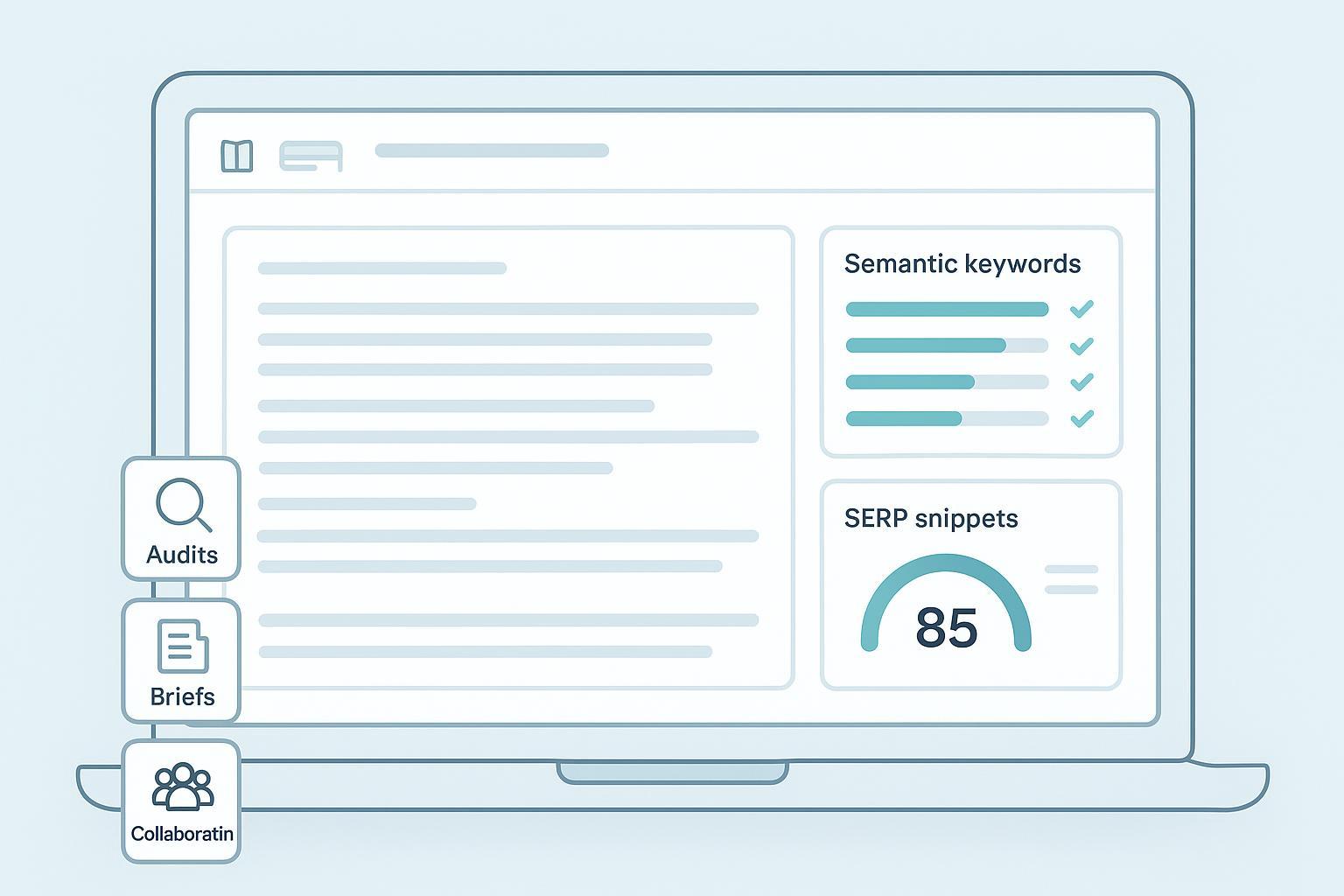
If your editorial team loves Clearscope’s clean editor and reliable content grades but still finds yourselves debating seats, costs, or broader workflow needs, you’re not alone. Many teams in 2025 want the same SERP‑informed briefs and semantic guidance, plus audits, monitoring, clustering, or AI drafting—often at different price points. Here’s the deal: we evaluated alternatives using weighted criteria—brief quality and NLP coverage (30%), on‑page depth and usability (25%), pricing and seat scalability (20%), workflow/integrations (15%), and monitoring/reporting (10%). Because SaaS pricing moves fast, treat any price posture as “as of December 2025” and verify on vendor pages before you buy.
When to stay with Clearscope vs when to switch
Think of it this way: if your writers trust Clearscope’s scores and your processes already revolve around its templates and Google Docs workflow, continuity may outweigh cost. Stay if your organization values its consistent guidance, you’ve templated briefs around it, and unlimited seats or current pricing fit your plan, which the company highlighted in its Essentials update “as of October 2025” on the official blog—see Clearscope’s Essentials announcement.
Switch if you need any combination of lower‑cost seats, deeper strategy modules (inventory, topic planning), built‑in audits or monitoring, or an all‑in‑one workflow with AI drafting and clustering. The tools below are ranked against the weights above and described with “best for” guidance plus fair “when not to choose” notes.
Quick comparison at a glance
| Tool | Core strengths | Pricing posture (as of Dec 2025) | Seat posture | Best for |
|---|---|---|---|---|
| Surfer SEO | Real‑time optimizer + Audit; competitor insights | Mid‑range; add‑ons | Multi‑user on tiers; credit‑based | Teams wanting optimization depth with audits |
| MarketMuse | Topic modeling, briefs, inventory/planning | Premium/enterprise | Team/enterprise plans | Enterprises building topical authority |
| Frase | Budget‑friendly AI briefs and outlines | Budget to mid | Lower‑tier seat caps | SMBs needing fast briefs with AI |
| Content Harmony | Robust briefs; intent analysis; unlimited seats | Mid, workflow‑based | Unlimited users | Editorial teams standardizing briefs |
| NeuronWriter | Value NLP editor; internal linking; audits | Budget tiers | Team perms at higher tiers | Budget‑conscious teams needing NLP |
| Outranking | SERP‑grounded AI briefs; clustering | Mid to premium | Seats scale by tier | Teams wanting factual AI briefs |
| Dashword | Lightweight optimizer + post‑publish monitoring | Budget to mid | Multi‑user tiers | Teams wanting monitoring baked in |
| Page Optimizer Pro | Precise on‑page recommendations | Budget | Scales to agency/Teams | Technical SEOs tuning pages |
| WriterZen | Keyword research + clustering + AI writing | Budget to mid | Seats scale by plan | Teams wanting bundled research + AI |
| Topic (Topic.com) | Shareable briefs and grading | Mid | Mix of flat rate and per‑seat | Teams standardizing outlines and grading |
The top Clearscope alternatives
Surfer SEO — best mid‑range optimizer with audits
Surfer SEO combines a real‑time Content Editor with competitor analysis through its Audit and SERP Analyzer, making it a favorite for teams that want actionable on‑page recommendations alongside brief and outline help. Its NLP term guidance is robust, and collaboration features fit multi‑writer teams. For current tiers and add‑ons, check the Surfer pricing page for details “as of December 2025.”
Best for: teams seeking deeper optimization and auditing inside a familiar editor.
When not to choose:
- You need unlimited seats and credits on a low budget.
- You expect a complete all‑in‑one suite with backlinks or advanced technical SEO.
- You dislike pay‑per‑feature add‑ons (e.g., AI article generation).
Content Harmony — best repeatable briefs with unlimited seats
Content Harmony focuses on robust, repeatable content briefs that reflect SERP intent, with collaboration features and a workflow‑based pricing model. Unlimited seats on all plans and credit rollover can be friendly to agencies and editorial teams. For current plan details, see Content Harmony’s pricing “as of December 2025.”
Best for: teams standardizing briefs across many writers and wanting predictable, reusable templates.
When not to choose:
- You require heavy real‑time optimization in the editor rather than brief‑centric workflows.
- You want comprehensive audits or monitoring within the same tool.
- You need highly automated AI drafting beyond outlines.
Dashword — best lightweight optimizer with monitoring
Dashword pairs automated briefs and real‑time content grading with post‑publish monitoring—alerts, weekly keyword reports, and rank tracking—which is handy for editors who want to see impact after hitting publish. Validate current features and limits on Dashword’s features page “as of December 2025.”
Best for: teams that value ongoing visibility into performance without stitching together separate monitoring tools.
When not to choose:
- You need deep topic modeling or enterprise governance.
- You require complex audits and competitor diffs.
- You want extensive marketplace integrations today.
Page Optimizer Pro (POP) — best for precise on‑page tuning
Page Optimizer Pro is favored by technical SEOs for highly specific on‑page recommendations and competitor analysis. It also offers POP AI Writer, schema aids, and an API at team‑level plans. Check plan comparisons and Teams/API on POP’s official compare page “as of December 2025.”
Best for: methodical on‑page optimization where controlled changes and measurement matter.
When not to choose:
- You expect an all‑in‑one suite with broad research, backlinks, or monitoring.
- You prefer a writer‑centric editor over detailed inputs.
- You need enterprise collaboration features baked in.
Topic (Topic.com) — best for standardized outlines and grading
Topic focuses on streamlined briefs, semantic term suggestions, and a shareable content grader that makes it easy to align freelancers and internal writers. Pricing blends flat‑rate and per‑seat models depending on tier. For specifics, review Topic’s pricing page “as of December 2025.”
Best for: teams standardizing outlines and grading across distributed writers.
When not to choose:
- You prefer unlimited‑seat models at scale without per‑user costs.
- You want deep audits or robust monitoring baked in.
- You need broader research or clustering features in the same tool.
MarketMuse — best for enterprise strategy and content inventory
MarketMuse stands out with topic modeling, content inventory, planning, and briefs that help large teams build topical authority and prioritize work. It’s oriented toward governance and strategic planning as much as optimization, which can be transformative for content operations at scale. Explore capabilities and team plans via the vendor site “as of December 2025.”
Best for: enterprises or mature content programs that need inventory analysis, prioritization, and strategic guidance, not just editor‑level scoring.
When not to choose:
- Budget is tight relative to seats.
- You don’t need inventory/planning modules and prefer a simple optimizer.
- You want lightweight, writer‑first tooling over strategy heavy features.
Frase — best budget‑friendly AI briefs
Frase offers SERP‑driven briefs, AI‑assisted outlines/drafts, and real‑time optimization with a friendly editor. Lower entry pricing and Google Search Console integration appeal to SMBs and solo creators. If you plan to lean hard on AI, note that unlimited AI writing is often an add‑on. Confirm tiers and seat caps on the vendor’s official pages “as of December 2025.”
Best for: small teams that want fast briefs and AI assist without premium pricing.
When not to choose:
- You dislike add‑on complexity to unlock unlimited AI writing.
- You need advanced audits or deep competitive diffs out of the box.
- You expect enterprise‑grade collaboration and governance.
NeuronWriter — best value NLP editor for teams
NeuronWriter delivers NLP term suggestions, a practical content editor, audits, internal linking ideas, and team collaboration, often at budget‑friendly tiers. It integrates with Google Search Console, WordPress, and Shopify, and offers APIs at higher levels. For tiers and team permissions, review the vendor’s pricing page “as of December 2025.”
Best for: budget‑conscious teams that still want strong semantic guidance and an editor they can grow into.
When not to choose:
- You need high‑volume credits without moving to upper tiers.
- You expect enterprise‑grade governance or advanced reporting.
- You require extensive native integrations beyond CMS basics.
Outranking — best for fact‑based AI briefs and clustering
Outranking emphasizes AI briefs grounded in live SERP data, intent mapping through clustering, and workflows that promote entity‑first optimization. Higher tiers add API access and white labeling for agencies. For current pricing posture and feature set, refer to the vendor site “as of December 2025.”
Best for: teams wanting AI to accelerate briefs with controls that keep outputs tied to factual, SERP‑aligned signals.
When not to choose:
- Price sensitivity is high compared to simpler brief tools.
- You don’t need clustering or entity‑first internal linking.
- You prefer minimal UI complexity and fewer configuration steps.
How to choose: a quick decision framework
- If cost per seat is the main constraint: start with Frase, NeuronWriter, POP, or Dashword. Content Harmony is attractive if unlimited seats matter.
- If you need audits or monitoring built‑in: Surfer (Audit) or Dashword (post‑publish monitoring) are strong picks; POP suits technical on‑page tuning.
- If you’re planning topical authority and inventory: MarketMuse leads for governance and planning; Outranking’s clustering can support entity‑first strategies.
- If you want unlimited seats: Content Harmony offers unlimited users across plans; Clearscope’s recent Essentials update highlights unlimited seats—verify fit and pricing on its official pages.
- If you want bundled research + AI drafting: WriterZen consolidates keyword research, clustering, and AI writing alongside optimization.
Migration tips if you switch from Clearscope
- Map templates and scoring expectations: translate your headings, questions, and term coverage standards into the new tool’s brief/editor framework.
- Pilot with 3–5 URLs: select representative articles, re‑optimize in the new tool, and compare term coverage, readability, and ranking deltas.
- Train writers on new scoring: create a short rubric so writers understand what the score reflects and where to focus (entities, headings, structure).
- Track impact post‑publish: use the new tool’s monitoring or pair it with your analytics/Rank Tracker to measure changes over 4–8 weeks.
Final thoughts and next steps
Every tool on this list can help teams produce intent‑aligned, semantically rich content. The right choice depends on whether you prioritize pricing and seats, strategic planning and inventory, audits/monitoring, or bundled research and AI. Because features and pricing change quickly, confirm details on vendor pages “as of December 2025,” and revisit your stack quarterly. If you already run smoothly on Clearscope, stay the course. If your needs have evolved, the alternatives above offer capable paths forward without derailing your editorial rhythm.