What Is Brand Voice? A Practical Guide for SMB Marketers

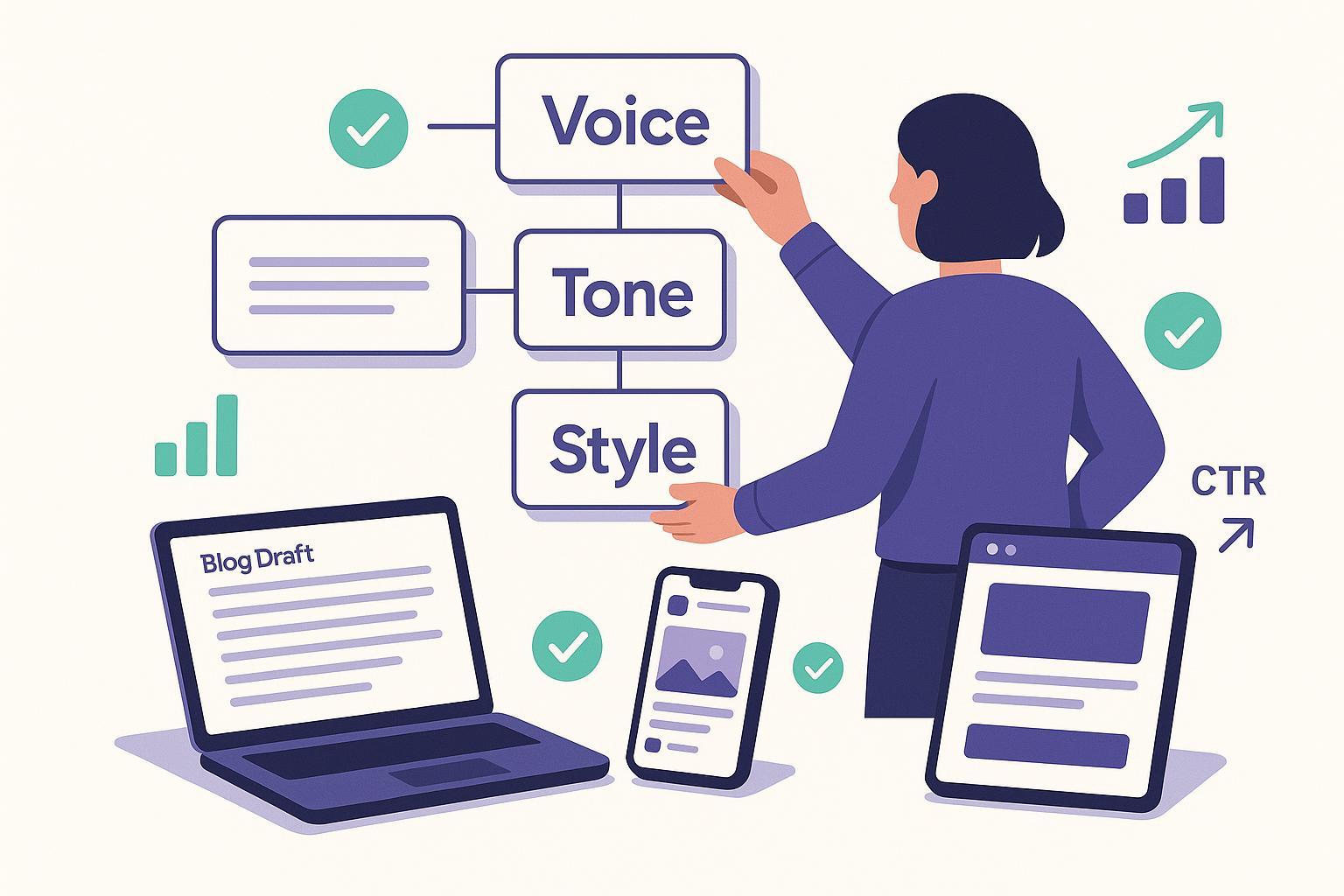
Brand voice is the consistent verbal expression of your brand’s personality and point of view across every channel. In other words: it’s how your brand “sounds,” no matter whether you’re writing a blog post, a landing page, an email, or a social caption.
Think of it like this:
Voice = your constant personality
Tone = your mood that adapts by situation
Style guide = the house rules (grammar, formatting, word choices) that keep everyone on track
Brand Voice vs. Tone vs. Style Guide (Clear Boundaries)
You might wonder where these concepts overlap. Here’s a practical way to separate them:
Brand voice: Stable personality traits and language patterns. It’s the big picture of how you speak. As framed in Sprout Social’s 2023 brand voice guide, voice is the distinct personality a business curates across mediums.
Tone: The emotional inflection applied to your voice depending on context (announcement vs. apology, sales vs. support). For deeper distinctions and examples, see our tone of voice guidance.
Style guide: The documented rules that operationalize your voice and tone with mechanics like punctuation, capitalization, naming conventions, and formatting. A useful primer is HubSpot’s content style guide template (2025).
What brand voice is not:
Just a list of adjectives (“friendly, bold”). Those are a start, but voice must be demonstrated through word choice, sentence rhythm, claims, and examples.
The same as tone. Tone flexes; voice stays steady.
A one-off document. It needs to be documented, trained, enforced, and updated.
Why Brand Voice Matters for Performance
Consistency isn’t just a brand nicety—it drives measurable outcomes.
Recognition and trust: When your message “sounds” familiar across touchpoints, audiences find you more credible. Research on brand trust emphasizes the role of consistent experiences over time, as discussed in Qualtrics’ brand trust overview (2025).
People-first SEO and E-E-A-T alignment: Google encourages helpful, reliable content authored with appropriate experience and expertise. Clear, consistent voice supports reader comprehension and transparent attribution—hallmarks of trustworthy content. This is underscored in Google’s guidance on AI and helpful content (2023) and complements our perspective in Building Content Authority for Google’s 2025 Update.
Conversion logic: A coherent voice reduces friction. When CTAs and explanations are consistently clear, readers hesitate less and progress more. While exact lifts vary by business, the linkage is straightforward: consistent messaging → clarity → reduced cognitive load → higher conversion propensity.
Production efficiency: Teams that share a single, well-documented voice spend fewer cycles on rewrites. Less “voice drift” means fewer edit rounds and faster time-to-publish.
Same Voice, Different Tones: Mini Examples
Imagine a brand voice that’s friendly, confident, and benefit-driven. Here’s how the same voice adapts its tone:
Announcement (excited): “We just launched a smarter editor that trims your time-to-publish—no web geeks needed.”
Support (empathetic): “We’ll walk you through getting that draft live. If something’s unclear, tell us and we’ll fix it fast.”
Compliance (formal): “Please review the updated content guidelines to meet security and accessibility requirements.”
Notice the personality stays constant, while the tone shifts to fit the moment.
A Step-by-Step Framework to Operationalize Voice (Voice Ops)
If you’re scaling blogs and landing pages, treat brand voice as a repeatable process.
Audit your current content
Collect 10–20 recent assets (blogs, LPs, emails, social). Identify patterns in personality traits, sentence rhythm, word choice, and promises.
Note which assets perform best. Look for correlation between clear, consistent voice and engagement metrics.
Define voice pillars (3–5)
Examples: Simple & Accessible; Confident & Authoritative; Benefit-Driven & Empowering.
For each pillar, add do/don’t phrasing examples. Do: “Explain benefits in plain language.” Don’t: “Overload with jargon or vague superlatives.”
Map tone variations by context
Specify tone per scenario: PR announcement, blog education, LP conversion, social engagement, support and compliance.
Include 1–2 example lines per scenario.
Create templates, prompts, and phrase banks
Build reusable prompts for blogs and LPs. Include approved phrases, banned words, and formatting conventions.
Add guidance for CTAs and headings, plus a pattern library for intros and conclusions.
Establish a pre-publish review checklist
Voice adherence: Are pillars reflected? Does tone match the scenario?
E-E-A-T elements: Clear authorship, credentials where relevant, transparent claims, primary source citations, and responsible internal/external linking. For governance workflows, see Best Practices for Content Workflows (Humans + AI, 2025).
Instrument metrics and iterate
Engagement rate: In GA4, an engaged session lasts 10+ seconds, has a conversion event, or 2+ page/screen views. See GA4’s engagement rate definition (2023).
Scroll depth: Use GA4’s enhanced measurement and add custom thresholds if needed.
CTA click-through: Track button clicks as events and define conversions appropriately.
Production metrics: Time to first publish, edit rounds per draft, revision hours.
Review pillars quarterly based on performance.
How to Apply Brand Voice at Scale in Your Workflow
Here’s a practical way SMB teams operationalize voice across blogs and landing pages.
Use platform presets/templates to encode your pillars, tone maps, CTAs, and formatting rules.
Generate draft variants that keep voice constant while adapting tone by channel.
Automate on-page SEO structure (H1–H3, meta description, internal links) without sacrificing clarity.
Maintain consistency with checklists and content quality gates before publish.
First mention and example using our own tool:
You can apply this workflow in QuickCreator. Disclosure: QuickCreator is our product.
Configure a brand voice preset, generate a blog draft and a landing page variant, and compare engagement metrics. For a deeper walkthrough, see our step-by-step product workflow.
Lightweight Brand Voice Checklist (Start Today)
Use this in your next sprint:
Gather 10–20 assets and note patterns in language and performance.
Select 3–5 voice pillars; write do/don’t examples for each.
Map tone by scenario (announcement, education, conversion, support, compliance).
Build a phrase bank and prompts; list banned words.
Add a pre-publish checklist: voice adherence, tone fit, E-E-A-T basics, CTA clarity.
Instrument: engagement rate, scroll depth, CTA CTR, time to publish, edit rounds.
Run monthly calibration: pick two assets, analyze where voice drifted, update templates.
Final Thoughts
Brand voice is not a one-time exercise; it’s an operational discipline that improves recognition, trust, conversion readiness, and production efficiency. Start by documenting your pillars and tone map, then bake voice into templates and checklists. When you’re ready, start a free blog draft with your voice preset and spin up a landing page variant to compare engagement—keeping the same personality while adapting tone to the context. Aligning your voice with helpful, people-first content and sound governance is one of the most reliable ways to support SEO and conversion outcomes over time.
External references used in this article:
GA4 Traffic acquisition: engagement rate (2023)