Why Comprehensive Coverage and Authority Building Are Crucial for GEO Visibility in 2025

2025 reality: Generative search changed the rules
Google integrated the Helpful Content system into its core ranking in March 2024 and reported by April 2024 that Search surfaces “about 45% less low‑quality content” compared to before the update, per the Google Search update announcement (2024 Google Blog). The implication for 2025 is straightforward: thin, fragmented pages lose visibility; cohesive topical depth and credible authority win—especially inside AI Overviews and AI Mode.
Large‑scale trackers show AI Overviews are no longer rare. In March 2025, Semrush (10M+ US keywords) found AI Overviews in 13.14% of queries, mostly informational, as detailed in the Semrush AI Overviews study (2025). Independent datasets report similar ranges and, critically, significant CTR shifts when AIOs appear—Ahrefs observed around a 34.5% drop in CTR for position #1 on AIO queries in 2024–2025, per the Ahrefs analysis (2025). In short: inclusion and citation in generative features matter; chasing blue‑link CTR alone is a losing strategy.
Why comprehensive topical coverage now drives GEO inclusion
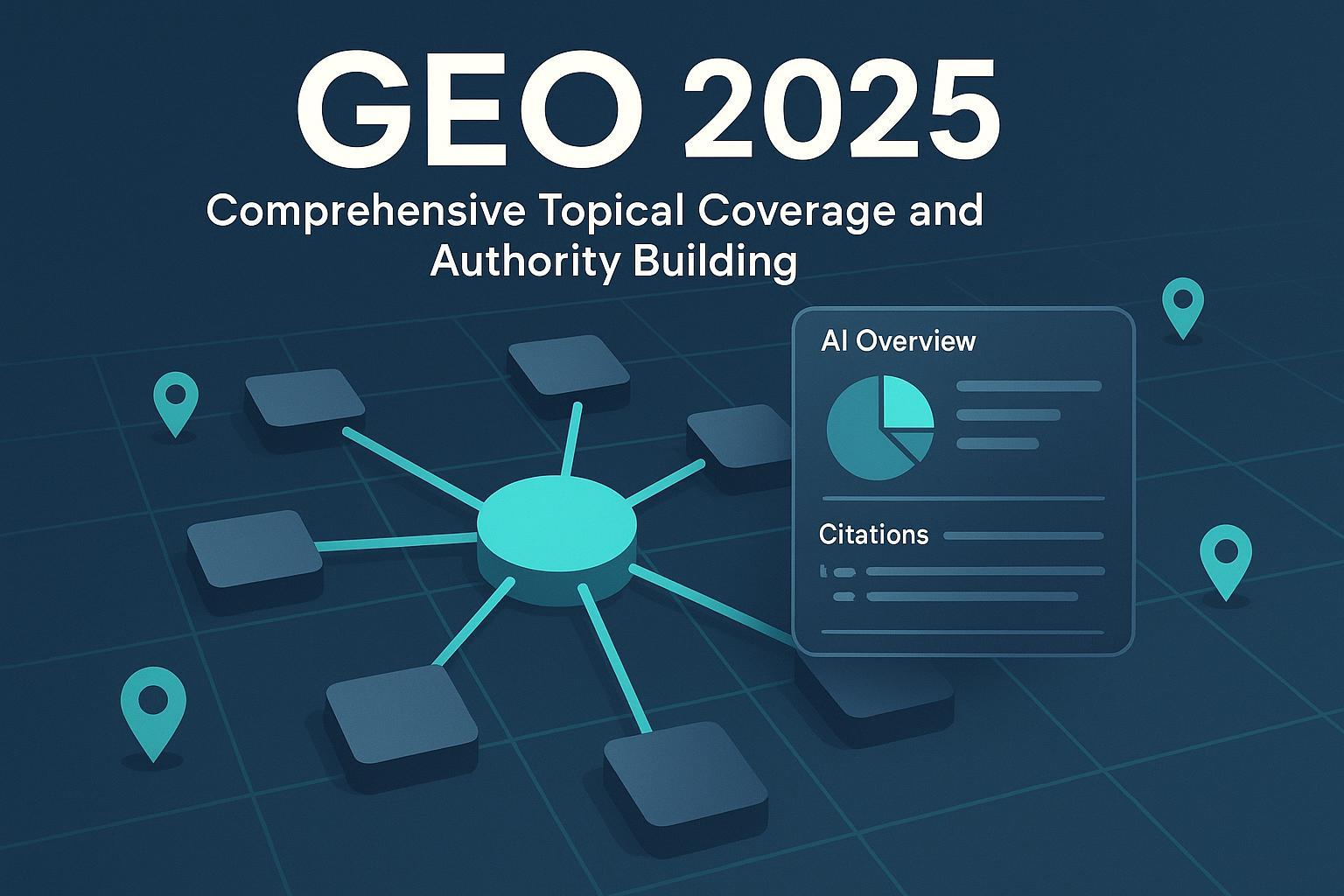
Generative engines need high‑confidence sources they can quote. In practice, sites that build complete, coherent topic clusters (pillar + spokes), wire them with descriptive internal links, and present answer‑first sections give AI systems clean, extractable passages. Google’s updated guidance emphasizes people‑first depth and expertise frameworks; see the March 2024 core update notes on Helpful Content integration (Google Search Central).
For local/GEO queries, consistent entity signals matter. Applying LocalBusiness structured data with accurate NAP details and aligning it to your Google Business Profile improves eligibility for local packs and enhances generative answers for “near me” searches, as outlined in Google’s LocalBusiness structured data documentation.
Trade‑offs you should expect:
- Not every query will show AI features, and inclusion varies by intent and vertical.
- CTR often declines on AIO‑heavy SERPs; instead, measure citation rate and assisted conversions.
- Over‑optimizing FAQs or stuffing anchors can trigger spam signals—follow Search Essentials.
Authority building (E‑E‑A‑T) that moves the needle
Google’s raters’ handbook operationalizes what quality looks like. The January 23, 2025 edition of the Search Quality Evaluator Guidelines (QRG PDF) reinforces the value of clear author identity, first‑hand experience, rigorous sourcing, and trust cues. While QRG isn’t a ranking algorithm, aligning to its standards correlates with better visibility.
Focus your authority program on four pillars:
-
Authorship and identity
- Publish detailed author bios with credentials and hands‑on experience statements.
- Add Person schema with sameAs links to recognized profiles (e.g., LinkedIn, professional associations).
- Include “last reviewed” timestamps and reviewer names on sensitive pages.
-
Citations and source rigor
- Cite primary sources inside the prose with descriptive anchors; prefer official docs, peer‑reviewed research, and recognized authorities.
- Maintain a citations log to refresh outdated data quarterly.
-
Reviews and reputation (local)
- Respond to reviews within 72 hours. BrightLocal’s U.S. consumer survey (2024) shows responsiveness strongly influences choice, as detailed in the BrightLocal Local Consumer Review Survey (2024).
- Monitor review velocity and rating distribution; publish testimonials with verification cues.
-
Topical link graph and mentions
- Earn links/mentions from topical authorities and local entities.
- Interlink cornerstone pages to consolidate topical authority and aid crawl.
Execution workflow: From architecture to schema to local alignment
A tested, stepwise approach works best. Below is a condensed SOP you can run cluster by cluster.
- Map topic clusters and intents (Week 1)
- Identify the pillar overview and 15–25 spokes across learn/evaluate/compare/implement/troubleshoot intents.
- Collect SERP features and AI Overviews behavior for target queries.
- Outline H2/H3 questions and a concise answer‑first block for each page.
- Draft and format content (Weeks 2–3)
- Pillar: 2,000–3,500 words; spokes: 800–1,500 words.
- Use answer‑first 40–70‑word summaries under each H2/H3; add checklists and bulleted steps.
- Integrate at least two primary sources per major section. For content structuring techniques that improve engagement, see this explainer: how to write a compelling blog style essay.
- Internal linking and structured data (Weeks 3–4)
- Wire pillar ↔ spokes bidirectionally; add lateral links between related spokes with descriptive anchors.
- Keep critical pages within 3 clicks of the homepage; follow Google’s link best practices in Search Essentials.
- Apply Article/HowTo/FAQPage schema where relevant; add Organization and Person markup with sameAs; for local intent, add LocalBusiness subtype with PostalAddress and openingHours.
- Local/GEO alignment (ongoing)
- Google Business Profile: Verify ownership; keep NAP, categories, and attributes accurate; post updates; answer Q&A.
- Location pages: One per location with unique local copy, NAP, embedded map, staff bios, local reviews, and matching LocalBusiness schema.
- Citations: Build/clean core citations; ensure NAP consistency across high‑trust directories.
- Monitoring and iteration (Quarterly cadence)
- Track AI Overviews/AI Mode presence and citation occurrences. Google’s “AI features and your website” documentation outlines how these features surface content; start with AI features guidance (Google Search).
- Refresh fast‑moving facts, expand missing intents, and test question phrasing.
- Shift KPIs from pure CTR to inclusion/citation rate and assisted conversions.
Example: Scalable topical coverage workflow with an AI‑assisted editor
If you manage multiple clusters across languages and teams, an AI‑enabled editor can standardize answer‑first blocks, schema prompts, and internal link scaffolding across pages. One option is QuickCreator, which supports block‑based drafting, multilingual generation, and WordPress publishing, helpful when rolling out pillar + spokes at scale. Disclosure: We may have an editorial relationship with QuickCreator; evaluate tools independently for fit.
LLM/GEO inclusion patterns: How to become quotable
- Be the best concise explainer: Short, direct answer blocks under each subheading.
- Lead with current numbers: Place recent stats and name original sources near the top of relevant sections.
- Keep semantic structure clean: Explicit H2/H3 questions, scannable lists, and FAQ sections.
- Mark up entities consistently: Organization and Person with sameAs; LocalBusiness where relevant.
- Update on a schedule: For fast‑moving topics, refresh quarterly; for stable evergreen, review twice a year.
For expert‑style structuring and signaling credibility in complex content, you can borrow techniques from legal writing’s clarity and sourcing discipline, as discussed in this guide on crafting a stellar legal memo.
Auditing and metrics that reflect 2025 realities
Shift your measurement to what generative systems reward.
-
Coverage depth
- % of planned spokes published per cluster
- Internal link coverage ratio and average clicks‑to‑reach
-
Entity integrity
- % of pages with Organization/Person schema; sameAs completeness
- Brand description consistency across major profiles
-
- Google Business Profile completeness score, review velocity, response SLA
- NAP consistency error count; LocalBusiness schema validation
-
- % of target queries that trigger AI Overviews/AI Mode
- Brand citation rate inside AI features; CTR deltas with/without AIO
- Assisted conversions attributed to GEO‑aligned pages
Common pitfalls and boundaries
- Thin coverage and orphan pages: Undermine cluster integrity and crawlability.
- FAQ spam and anchor stuffing: Can trigger spam policies; keep answers useful and concise.
- Review manipulation: Violates platform policies and erodes trust; focus on genuine requests and timely responses.
- YMYL topics: Require expert creation/review, robust sourcing, and clear disclaimers.
Action checklist
- Choose one high‑value cluster and define 15–25 spokes this week.
- Draft pillar and 6–10 spokes with answer‑first blocks; add two primary sources per section.
- Implement bidirectional internal links and appropriate schema.
- Align GBP and location pages; start a review response SLA.
- Instrument AI features tracking and refresh fast‑moving facts quarterly.
Sources and further reading
- Google’s announcement on reducing low‑quality content after the March 2024 core update: Google Blog – Search update (2024)
- Integration of Helpful Content into core ranking systems: Google Search Central – March 2024 core update
- Prevalence of AI Overviews across 10M keywords: Semrush – AI Overviews study (2025)
- CTR impact when AI Overviews appear: Ahrefs – analysis (2025)
- Guidance on how AI features surface website content: Google Search – AI features and your website
- Structured data for local businesses: Google Search – LocalBusiness schema