Best Content Playbooks for Agencies

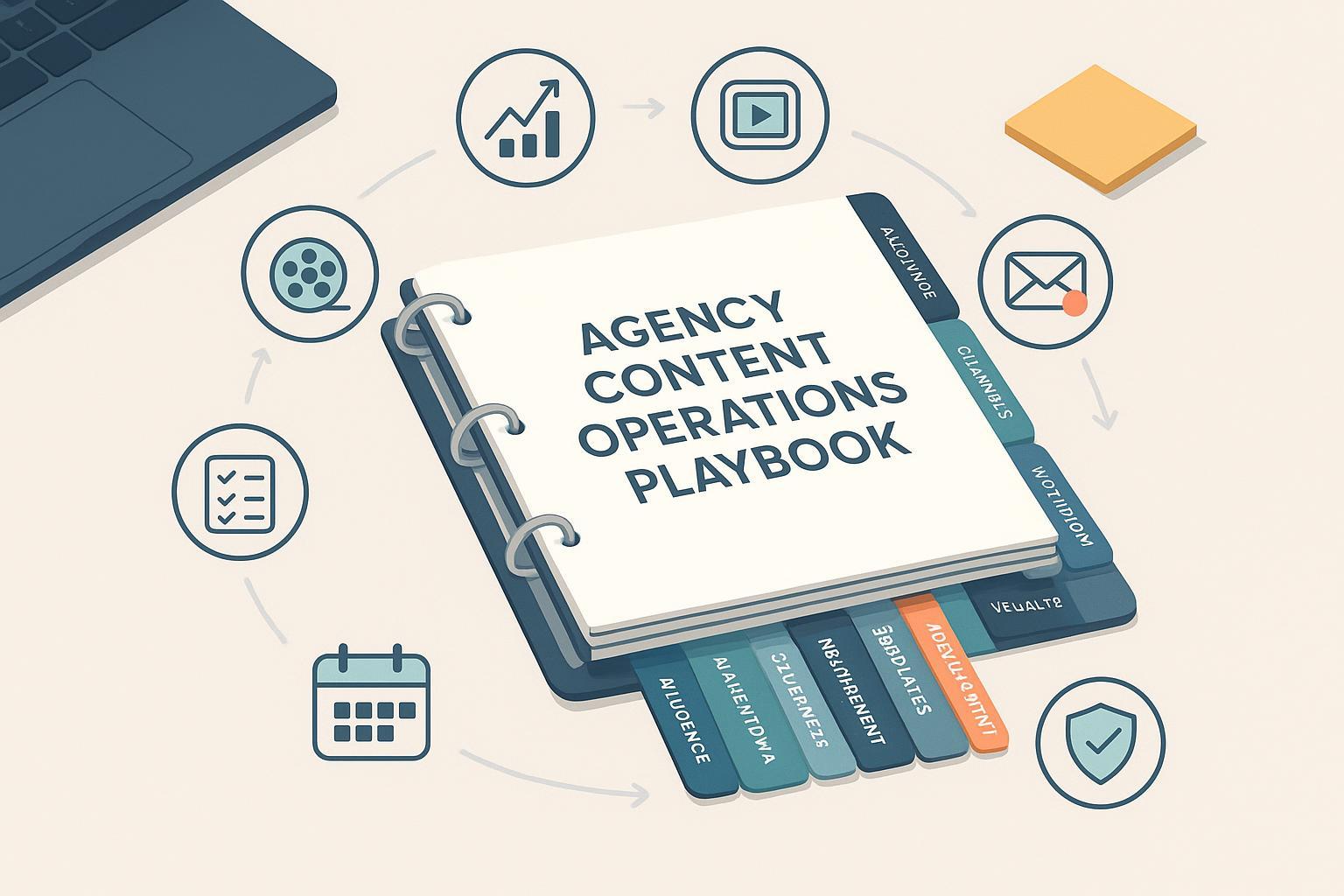
If your team is juggling five clients, three calendars, and a dozen formats, you don’t need more ideas—you need repeatable systems. That’s what content playbooks deliver: documented, reusable ways to plan, produce, distribute, and measure content so results are consistent no matter who’s assigned.
What a content playbook really is (and isn’t)
A content playbook is a living, audience-first operating system for content. It defines the narrative, the channels, the workflows, the QA, the approvals, and the metrics—so anyone on the team can execute with confidence.
It’s not a one-off strategy deck or a collection of ad hoc tips. Done right, it’s a single source of truth that shortens ramp time, reduces rework, and tightens the feedback loop between performance and planning. Think of it like a franchise manual for content: the same core recipe adapted to local tastes.
Outcomes you should expect:
- Faster time-to-publish because tasks, roles, and checkpoints are already mapped.
- Higher quality and consistency through standard briefs, voice guides, and QA.
- Clear attribution and improvement cycles thanks to shared KPIs and dashboards.
For structure and workflow inspiration, the Content Marketing Institute outlines a practical five-step content operations approach—mapping tasks by format, assigning roles, and inserting governance checkpoints—that pairs well with agency environments; see the detailed guidance in the CMI article on a content operation workflow that helps everybody (2024) for an execution model: CMI’s five-step content operations workflow.
The core components every agency playbook should include
Every client’s playbook will look a little different, but seven components show up in nearly all effective versions.
Audience and narrative Clarify who you’re serving, their jobs-to-be-done, and the messaging hierarchy that sets your client apart. You’re not just filling a calendar; you’re advancing a point of view.
Channel and distribution plan Document where content lives, how it moves, and how it’s syndicated. Distribution isn’t an afterthought—it’s a built-in habit.
Workflows and RACI Map per-format tasks, owners, and SLAs. Define how drafts move to approvals, what “done” means, and who can unblock issues.
Templates and QA Standardize creative briefs, SEO checklists, accessibility checks, and brand voice examples. Reduce variance at the source.
Measurement and attribution Select a North Star metric per playbook and pair it with leading and lagging indicators. Make it easy to know what to ship more—or less—of.
Governance and AI guardrails Spell out how AI can be used (and disclosed), what sources are allowed, rights and licensing rules, and legal review criteria.
Iteration cadence Schedule regular retros, content audits, and backlog grooming so the playbook keeps pace with performance and platform shifts.
| Component | Practical artifact to include |
|---|---|
| Audience & POV | One-page narrative stack, top FAQs, “things we won’t say” list |
| Channel plan | Channel-by-channel posting rules and handoff matrix |
| Workflow & RACI | Per-format task map with owners and SLAs |
| Templates & QA | Brief template, style/voice guide, pre-publish checklist |
| Measurement | KPI tree with dashboard mock and data sources |
| Governance/AI | Disclosure policy, rights checklist, review routing |
| Iteration | Quarterly audit questions and sunset criteria |
Five proven playbooks you can ship this quarter
Below are agency-tested playbooks you can document and deploy quickly. Each includes purpose, core cadence, and what “good” looks like.
1) SEO-led authority playbook
Purpose Build topical authority around a defined entity cluster to drive qualified non-brand search and assisted pipeline.
How it runs Start with a pillar topic and map 8–12 supporting pieces. Maintain internal link depth and entity coverage. Treat every long-form piece as a repurposing engine for social and email.
Cadence and roles Publish one long-form asset every two weeks and 2–3 supporting posts weekly for the first 60–90 days. Assign a strategist (topics and briefs), writer/editor (draft and polish), and SEO specialist (schema, interlinking, and technical checks).
What good looks like Improving coverage across target entities, steady growth in non-brand organic sessions, and first conversions from intent pages. Use Curata’s classic pyramid as your mental model for repurposing from cornerstone to micro assets: Curata’s content marketing pyramid.
2) Short-form social video playbook
Purpose Earn reach efficiently with hooks, native editing, and rapid iteration.
How it runs Source hooks from audience FAQs and search gaps. Build a reusable hook library, shoot in batches, and edit natively for each platform. Optimize intros for retention and add captions.
Cadence and roles Aim for 3–5 posts per week per core channel during the first 8 weeks to find format–message fit. Creator or producer shoots; editor adapts; strategist reviews hooks and keeps the library fresh.
What good looks like Healthy completion curves and save/share ratios. For directional targets, Hootsuite’s 2025 benchmark explains how engagement rate is calculated and typical ranges across platforms; use it to set realistic expectations by industry: Hootsuite’s average engagement rate primer (2025).
3) Email lifecycle playbook
Purpose Turn attention into action with segmented, behavior-based sequences.
How it runs Anchor around one or two core sequences (welcome/onboarding for B2B; post-purchase and win-back for ecommerce). Use dynamic content by segment and suppress fatigue with frequency caps.
Cadence and roles Quarterly refresh of copy and offers. Coordinator monitors list health; marketing ops ensures deliverability and naming conventions; copywriter iterates subject lines and body variants.
What good looks like Focus on CTOR, reply rate, and conversion rather than opens. Litmus outlines why open rates are noisy and recommends attention to CTOR, conversions, and unsubscribe/complaints; align your dashboards accordingly: Litmus on the email metrics that matter.
4) Event-to-evergreen playbook
Purpose Extend event ROI by turning one live moment into a quarter’s worth of content.
How it runs Treat every event as a capture sprint: record key sessions, secure speaker permissions, and storyboard derivative assets ahead of time. Within 10 business days, ship edited replays, 10–20 clips, a recap article, and a gated or ungated guide.
Cadence and roles Producer leads capture; editor and writer deliver post-production; channel managers schedule distribution waves.
What good looks like A steady cadence of derivative assets with retention above 50% on how-to clips and 40–45% on 3–5 minute recaps, which aligns with directional patterns in Wistia’s 2025 State of Video; use play rate and engagement to decide which topics deserve deeper follow-ups: Wistia’s State of Video 2025.
5) Thought leadership and research playbook
Purpose Publish a defensible point of view backed by original insights.
How it runs Pick one theme per quarter and field lightweight research (polls, scraped public data, or anonymized product usage). Package a flagship report and atomize into blogs, social threads, webinar, and sales enablement one-pagers.
Cadence and roles Analyst or strategist designs methodology; writer/editor ensures clarity; designer creates visuals; comms distributes via partner placements.
What good looks like Citations from industry voices, backlinks to the flagship asset, and sourced opportunities tied to the theme.
The simple way to build any playbook (and keep it alive)
If you’re starting from scratch, use this seven-step loop. It’s intentionally lightweight so you can ship in weeks, not months.
- Define the North Star and guardrails. One sentence on the outcome (e.g., “increase qualified organic pipeline”), plus scope and constraints.
- Inventory assets and map gaps. What exists, what performs, and what’s missing across the journey.
- Document the workflow. Who does what, in what order, with what SLAs. Keep it on one page.
- Create your starter templates. Brief, checklist, calendar fields, and a simple dashboard mock.
- Pilot for 30–60 days. Limit variables and publish at a sustainable cadence.
- Review performance with the team. Keep what works, cut what doesn’t, and capture learnings.
- Formalize and templatize. Move from experiment to shared agency template, then repeat for the next playbook.
Isn’t it easier to improve a working system than to brainstorm from zero every week?
Ready-to-use templates you can copy
Brief essentials
- Objective and audience: business goal, primary segment, and the action we want.
- Key message and proof: the single idea plus evidence, examples, or quotes.
- Format specifics: length, platform, and any SEO/entity or accessibility requirements.
- Distribution and measurement: where it ships and how we’ll know it worked.
Editorial calendar fields Use a structured calendar with fields for pillar/theme, asset type, owner, due dates, channel variants, and target KPI. Include status and blockers so account leads can intervene early.
QA checklist (pre-publish) Accuracy and sources checked; voice/style and legal/claims reviewed; accessibility (contrast, alt text, captions) confirmed; links tested; tracking parameters applied where appropriate.
Approvals and SLAs Set realistic but firm SLAs—e.g., 48 hours for editorial review, 24 hours for compliance/legal on non-claims content, and a defined escalation path for urgent releases.
Measurement that clients trust
Tie each playbook to a North Star, then layer supporting metrics that the team can influence week to week.
SEO-led North Star: assisted pipeline or qualified demo/trial from organic. Leading indicators: topical coverage, internal link depth, and content efficiency (wins per asset). Lagging indicators: non-brand sessions, rankings, and conversions.
Short-form video North Star: attributable reach × engagement quality. Leading indicators: 3-second and 50% completions, saves/shares, profile view growth. Lagging: site visits, micro-conversions, sourced opportunities. For directional engagement expectations by platform and industry, align with 2025 data explained in Hootsuite’s engagement benchmarks.
Email lifecycle North Star: revenue or qualified actions per sequence. Leading indicators: CTOR by segment and reply rates. Lagging: conversion, revenue per send, unsubscribe/complaint rate. The recommended emphasis on CTOR and conversion aligns with Litmus’s 2025 email reporting guidance.
Event-to-evergreen North Star: pipeline contribution per flagship event asset. Leading indicators: registration quality, post-event production SLA adherence, and clip retention. Lagging: influenced opportunities and content-assisted revenue. Use directional engagement norms from Wistia’s State of Video 2025 to sanity-check your targets.
Thought leadership North Star: sourced or influenced opportunities tied to the theme. Leading indicators: citations, partner placements, and newsletter list growth. Lagging: backlinks, PR mentions, and content-assisted revenue.
Governance and AI policies that protect your agency
You don’t need a 40-page policy, but you do need clear rules that keep clients safe.
Disclosure and provenance If AI assists with ideation or drafting, decide when and how to disclose. The Interactive Advertising Bureau’s 2024 Generative AI whitepaper explains transparency, IP, and data provenance considerations agencies should account for; use it to inform your policy language and vendor vetting: IAB Generative AI Whitepaper (2024, PDF).
Legal guardrails The U.S. Federal Trade Commission’s 2025 compendium reiterates that existing rules still apply to AI-enabled content—privacy, deception, endorsements, and substantiation among them. Build compliance checks into your approval path and document claims sources: FTC compendium of policy statements and rules (2025, PDF).
Rights and licensing Centralize licenses, model releases, and usage rights. Maintain a rights log per asset and include it in your QA.
Center of Excellence (optional, but powerful) If your agency is ready for scale, formalize a content Center of Excellence: a cross-functional group that sets standards, templates, and tooling, with a remit for continuous improvement. For a public blueprint, see Contentstack’s overview of establishing a CoE to drive operational efficiency and content excellence: Content Center of Excellence guide.
Pitfalls to avoid when scaling playbooks across clients
Process without narrative A flawless workflow can still ship generic content. Bake a clear point of view into briefs and reviews so the output sounds like your client, not the category.
Publishing without distribution If distribution is a scramble after publishing, you’ll miss the compounding effects. Treat distribution as part of “done,” with channel variants created upstream.
Too many KPIs, no owners Dashboards become wallpaper when no one owns the leading indicators. Assign metric owners and decide in advance what thresholds trigger a change.
Policy written once, then ignored Governance must live inside the workflow (checklists, approvals), not outside it in a static PDF. Keep policy examples close to where people work.
Overfitting to one platform Playbooks should survive platform changes. Keep the principles stable and the tactics flexible.
Your next move
Pick one playbook that maps to your client’s biggest opportunity, run a 60-day pilot, and document as you go. The goal isn’t perfection—it’s a durable system that your team can improve week after week. When the first playbook hums, templatize it for the next account and build your agency’s library of winning plays.