Best Anyword Alternatives (2025)

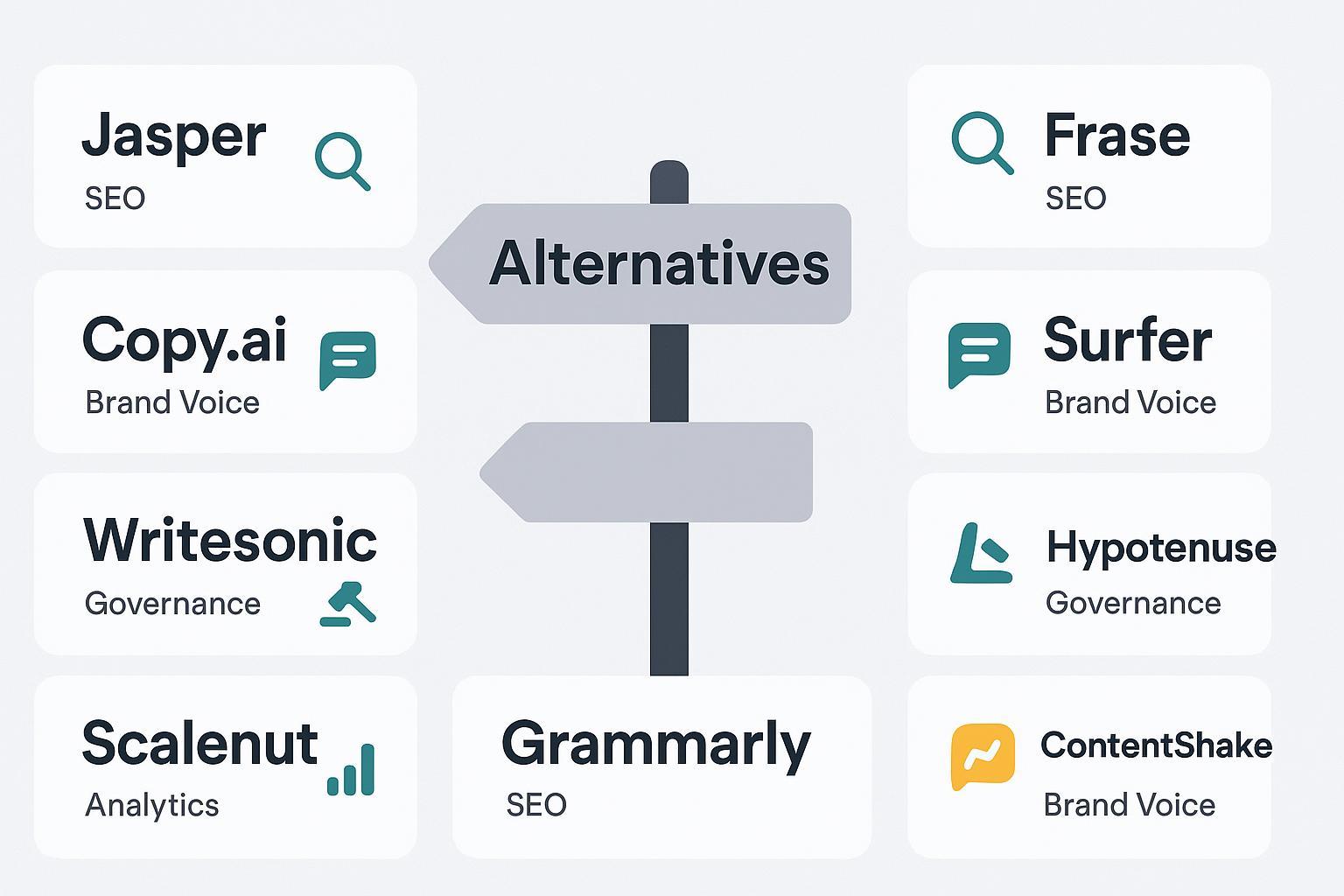
Looking at Anyword because of its Predictive Performance Score, but wondering if there’s a better fit for your team’s SEO depth, governance, or budget? This roundup focuses on real buyer criteria—brand voice fidelity, collaboration controls, analytics transparency, and total cost of ownership—so you can pick the right path without hype.
Should you stay with Anyword or switch?
Anyword’s signature value is performance-guided copy. If you’ve embedded its predictive scoring into ad ops and you can point to consistent uplifts in CTR or CPA, staying put may be sensible. The company lists Starter at $49/month and Data‑Driven at $99/month, with Business/Enterprise custom tiers—pricing on the official page as of 2025 ( Anyword Pricing & Plans). Some directories show lower figures (e.g., G2 lists $39/$79), which likely reflect promotions or lagging updates as of 2025 (G2’s Anyword pricing snapshot).
Switching tends to make sense when you need deeper SEO research and briefs, stronger team governance (roles, SSO, audit logs), more transparent analytics than black‑box predictions, or a lower total cost for multi‑seat teams.
Jasper — Long‑form quality and team governance
Jasper suits teams that care about brand voice and collaboration across longer content. Creator starts at around $49/month and Pro at about $69/month (or $39/$59 on annual billing), with Business custom—references compiled for 2025 from credible summaries and help docs. See the vendor’s SSO and API confirmations in the help center: Okta SSO for Jasper (Business) and Jasper Slack App and API access.
- Best for: Teams that need strong long‑form output, brand voice controls, and enterprise‑leaning governance.
- Pros: Quality long‑form, Surfer integration for SEO, brand voice modeling; documented SSO/API at Business.
- Cons: Seat‑based pricing can add up; SSO/API are gated to higher tiers.
- When not to choose: If you need predictive scoring transparency or deep analytics in lower tiers.
Copy.ai — Fast ideation and workflow agents
Copy.ai’s appeal is speed: chat, agents, and workflow credits that make quick experiments simple. As of 2025, official pricing lists Chat at $29/month (5 seats, unlimited chat words) and Agents at $249/month (10 seats, 10k workflow credits), with higher tiers offering more seats, credits, and API: Copy.ai pricing.
- Best for: GTM teams that want rapid ideation and lightweight automation.
- Pros: Generous allowances at the lower tier; easy onboarding; workflow agents.
- Cons: Governance depth (roles/approvals/SSO) is lighter until enterprise; API and automation scale live in higher tiers.
- When not to choose: If you need deep SEO briefs or strict governance without upgrading.
Writesonic — Versatile writer with native SEO tools
Writesonic mixes short‑ and long‑form content, native SEO checking, and bulk workflows. Official pricing varies by plan and article caps—Lite commonly around $39 annual ($49 monthly), with higher tiers adding more articles and API access: Writesonic pricing.
- Best for: Teams wanting a cost‑effective blend of writing plus basic SEO tools.
- Pros: Competitive mid‑tier pricing; SEO checker/audits; bulk operations; API from professional tiers.
- Cons: Credits and caps can be complex; governance features are less explicit publicly.
- When not to choose: If you need strict enterprise governance (SSO, audit trails) or Surfer‑level on‑page depth.
Scalenut — Research‑to‑optimizer SEO workflow
Scalenut is built around SERP analysis, briefs, and on‑page optimization. Pricing often presents Essential at $49/month, Growth at $79, and Pro at $149/month with multi‑seat support—as seen across 2025 reviews and vendor pages; verify current terms. Helpful overview: Scalenut on G2 (pricing overview, 2025).
- Best for: SEO‑first teams that want topic clustering, guided briefs, and optimization in one place.
- Pros: Strong research, clustering, and optimizer; practical integrations.
- Cons: Governance (roles/approvals/SSO) isn’t deeply documented; API details are limited publicly.
- When not to choose: If enterprise governance is mandatory or you need broad non‑SEO content ops.
Hypotenuse AI — eCommerce bulk content at scale
Hypotenuse focuses on product descriptions, bulk generation (CSV), and Shopify‑friendly workflows. Pricing snapshots as of 2025 frequently show Individual at ~$29/month and Teams at ~$59/month, with eCommerce tiers higher—see Hypotenuse AI pricing on G2 (2025).
- Best for: Retail and marketplace teams that need scalable, SEO‑tuned product content.
- Pros: Bulk ops; tone controls; Shopify/CMS integrations; API in upper tiers.
- Cons: Less suited to nuanced editorial long‑form; specialized for catalogs.
- When not to choose: If your priority is thought‑leadership content or deep briefs outside product pages.
Rytr — Budget short‑form
Rytr is the “good enough” option for simple short‑form tasks. Official pricing shows Free, Unlimited (~$9/month), and Premium (~$29/month) tiers as of 2025: Rytr pricing.
- Best for: Solo marketers and small teams tackling social captions, quick emails, or ad drafts.
- Pros: Very low cost; fast drafts; many templates and tones.
- Cons: Limited governance; less capable in complex long‑form.
- When not to choose: If you need multi‑seat governance, SSO, or advanced SEO features.
Frase — SERP‑driven briefs and optimization
Frase pairs SERP extraction with data‑driven briefs and a real‑time content optimizer. Its pages outline features, pricing, and add‑ons; a common setup in 2025 includes Starter from ~$45/month and a Pro Add‑On for expanded AI usage. See features: Frase SEO content optimization and Frase integrations.
- Best for: Teams that want research‑anchored briefs and on‑page optimization in an integrated workflow.
- Pros: Strong briefs and optimization scoring; GSC insights; practical integrations.
- Cons: Add‑on pricing for full AI usage; brand voice rules are more prescriptive than trained.
- When not to choose: If you need end‑to‑end content ops governance beyond SEO.
Surfer — Deep on‑page optimization and internal linking
Surfer shines for on‑page SEO. Essential and Scale tiers are well known, with pricing commonly reported around $99 and $219/month respectively as of 2025—confirm live rates. Capability updates and feature confirmations live on the official site: Surfer updates and features.
- Best for: SEO teams prioritizing detailed on‑page guidance, audits, and internal linking.
- Pros: Mature content editor and audits; internal linking automation; brand voice application in AI outputs.
- Cons: Higher price for robust usage; API and SSO sit at enterprise/add‑on levels.
- When not to choose: If you mainly need general‑purpose copywriting across channels.
Semrush ContentShake AI — Creation with Semrush data baked in
ContentShake AI brings Semrush’s data into content creation: briefs, scoring, and WordPress publishing. As of 2025, pricing is often shown at about $60/month after a trial, with bundles for extra SEO‑boosted articles: Semrush ContentShake AI overview.
- Best for: Marketers already using Semrush who want integrated briefs and scoring.
- Pros: Strong data backbone; practical briefs; easy publishing.
- Cons: API automation isn’t clearly documented; monthly SEO‑article bundles can constrain scale.
- When not to choose: If you need multi‑seat governance or heavy automation via API.
Grammarly — Governance and clarity companion
Grammarly isn’t a full marketing generator, but it’s unmatched for correctness, clarity, tone, and team style governance. Business/Enterprise tiers include brand style guides, SSO, audit logs, admin controls, and analytics. See support docs for Pro/Business/Enterprise details as of 2025: About Grammarly Pro.
- Best for: Teams that need quality assurance, style enforcement, and governance to complement generators.
- Pros: Best‑in‑class correctness and tone; strong governance at Business/Enterprise.
- Cons: Not built for multi‑channel content generation; no public API.
- When not to choose: If you need a primary generator with SEO briefs and workflows.
Feature snapshot (as of 2025)
| Tool | Predictive/Analytics | SEO Depth | Brand Voice | Collaboration/Governance | API/SSO | Typical Entry Price |
|---|---|---|---|---|---|---|
| Jasper | Basic analytics; reporting at Business | SEO Mode + Surfer | Trained voices by tier | Roles; SSO/API at Business | API/SSO (Business) | ~$49 Creator |
| Copy.ai | Workflow/agent credits | Limited native SEO | Brand settings; agents | Team seats; light governance | API (upper tiers) | $29 Chat |
| Writesonic | Traffic/SEO checks | Native checker/audits | Tone/voice by tier | Teams; governance minimal | API (Pro+) | ~$39 Lite (annual) |
| Scalenut | Traffic insights | SERP briefs + optimizer | Tone/templates | Up to 5 seats (Pro) | API (limited docs) | $49 Essential |
| Hypotenuse | E‑comm performance focus | SEO‑tuned for product | Tone controls | Multi‑seat teams | API (higher tiers) | ~$29 Individual |
| Rytr | Minimal | Basic suggestions | MyVoice tone | Premium adds collaboration | API (Premium) | ~$9 Unlimited |
| Frase | Content scoring; GSC insights | Strong briefs + optimizer | Style guides | Team/Enterprise suite | API add‑on | ~$45 Starter |
| Surfer | AI Tracker; audits | Deep on‑page + linking | Brand voice in AI | Teams; version history | API add‑ons; SSO enterprise | ~$99 Essential |
| ContentShake | Content scores | Briefs + optimization | Brand voice | WP integration; team mgmt via Semrush | API unclear | ~$60 |
| Grammarly | Writing analytics | N/A | Style guides | SSO; audit logs | No public API | Free; $30 Pro |
Note: Prices and features should be verified on vendor pages before purchase; the table reflects typical patterns as of 2025.
How to pilot and avoid lock‑in
- Define success metrics upfront. Pick 2–3 KPIs (e.g., organic traffic lift for SEO content; CTR/CVR for ads) and set a 4–6‑week test window.
- Map governance needs. If SSO and audit logs are non‑negotiable, shortlist Jasper Business, Grammarly Business/Enterprise, and Surfer Enterprise.
- Test SEO depth with real briefs. Run the same topic through Surfer, Frase, and Scalenut; compare SERP coverage, internal link suggestions, and optimizer scores.
- Validate brand voice. Train brand voice in Jasper and Copy.ai, generate sample content, and review with your editorial style guide.
- Check data portability. Ensure you can export drafts/briefs easily; verify API availability and rate limits if you plan automation.
- Watch usage caps and credits. Tools like Copy.ai (workflow credits), ContentShake (SEO‑article bundles), and Writesonic (article caps) can affect TCO.
- Run an A/B path alongside Anyword. If predictive scoring is core, compare outputs by live testing instead of relying on black‑box estimates.
Final thoughts
There isn’t a one‑size‑fits‑all replacement for Anyword. If predictive scoring is the backbone of your ad workflow, keep it and complement with Grammarly for governance. If SEO depth is the priority, Surfer, Frase, and Scalenut are your best bets. For multi‑channel content with sensible pricing, Jasper, Copy.ai, and Writesonic are pragmatic options; Hypotenuse shines for eCommerce catalogs, and Rytr is a budget‑friendly short‑form helper.
Think of your evaluation like a sprint: define KPIs, pilot two contenders, and decide based on actual outputs—not promises. Then, document your governance and migration steps so the switch sticks.