Best AI SEO Tools 2025: New Features Transforming Digital Marketing

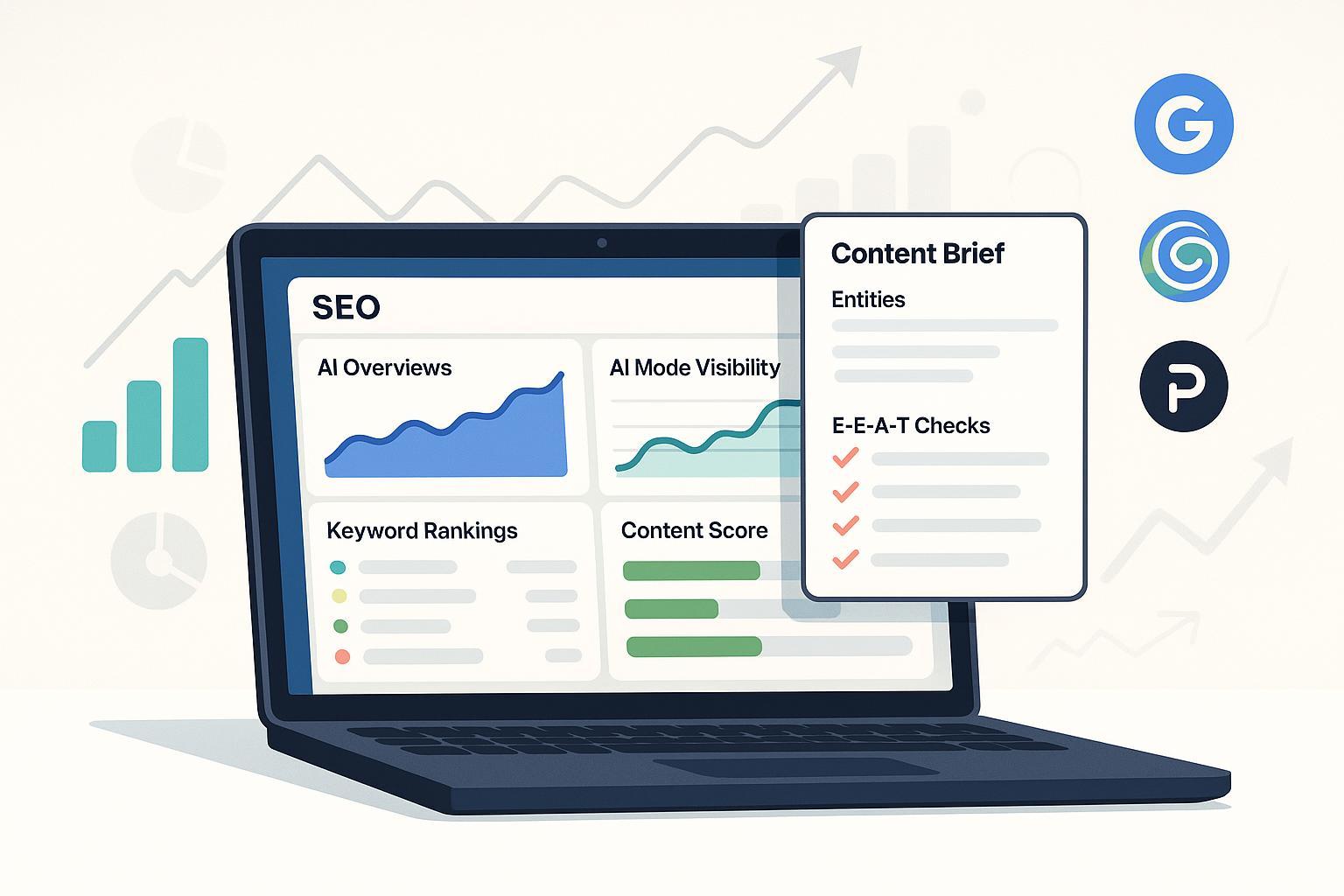
AI search changed the rules in 2025. Between Google’s AI Overviews/AI Mode and rapid updates across LLM-powered assistants, SEO now includes tracking your brand’s presence inside AI answers, not just the classic blue links. One data point that hints at the shift: a July 2025 study found that about 13.14% of U.S. desktop queries triggered AI Overviews in March (up from 6.49% in January), with most being informational queries. See the methodology details in the Semrush/Datos write-up: AIO prevalence and growth in 2025.
Below is a practitioner-curated list of AI SEO tools we’ve vetted for AI visibility, content optimization, and workflow impact. We segment picks by “Best for” use cases and call out notable 2025 updates that matter in real-world ops.
How we chose (methodology)
Evaluation criteria (weights shown as guidance):
- Capability match for AI search visibility and SEO breadth (25%)
- Evidence quality and recency of 2025 updates (20%)
- Workflow impact (speed, collaboration, automation) (15%)
- Learning curve and UX (10%)
- Ecosystem and integrations (10%)
- Value/pricing transparency (10%)
- Support, reliability, and documentation quality (10%)
Evidence priority: official product pages/release notes first, then reputable trade publications and established agency reviews. Pricing changes quickly—treat any ranges as “subject to change; confirm on the vendor site.” We prefer tools that make AI search visibility measurable and that integrate with existing content and technical SEO workflows.
Tip: Regardless of tooling, reinforcing E-E-A-T signals and content quality remains foundational. If you’re evaluating scoring aids, you can explore practical criteria in this overview of a Content Quality Score and E-E-A-T Checker.
The best AI SEO tools in 2025 (by use case)
1) Semrush — Best for unified AI search visibility plus classic SEO depth
What stands out in 2025
- AI SEO Toolkit: Tracks brand presence inside AI answers across Google AI Overviews/AI Mode and several LLM surfaces, including prompt-level visibility and share-of-voice metrics. Details: Semrush AI SEO Toolkit (KB).
- Across-suite AI guidance through Copilot and content workflows that blend keyword, topical, and on-page recommendations.
Best for
- Teams that need an all-in-one suite with credible AI visibility tracking alongside keyword research, auditing, and competitor intelligence.
Not for
- Very tight budgets that only need a niche point solution.
Pros
- Clear paths to measure AI answer citations alongside traditional rankings.
- Mature ecosystem (backlinks, site audit, content, competitive intel).
Cons
- Add-ons can increase total cost and complexity.
Pricing
- See official site for current plans and add-on pricing; subject to change.
2) Ahrefs — Best for competitive intel with growing AI brand-visibility tracking
What stands out in 2025
- Brand Radar monitors mentions across AI platforms (e.g., Google AIO/AI Mode, ChatGPT, Perplexity) and ties insights back into the Ahrefs ecosystem. Learn workflows in Ahrefs’ Brand Radar use cases.
- Rank Tracker and always-on audits received 2025 improvements, enhancing monitoring and site health.
Best for
- Competitive research and link intelligence-first programs adding AI visibility monitoring.
Not for
- Teams needing deep content brief generation or on-page writing assistance out of the box.
Pros
- Excellent competitor data and link graph context.
- Early but meaningful AI-mention tracking within a proven platform.
Cons
- AI visibility features are newer; expect iteration and potential add-on costs.
Pricing
- See official site for current plans; subject to change.
3) Surfer — Best for content optimization at scale with AI visibility tracking
What stands out in 2025
- AI Tracker monitors brand mentions across AI models and prompts with daily updates and alerting; see Surfer AI Tracker.
- Surfer AI emphasizes faster drafting (2025 updates) and brand voice/templates for consistent production.
Best for
- Content teams standardizing briefs, on-page scoring, and AI-assisted drafting while gaining visibility into AI answers.
Not for
- Organizations that avoid AI-assisted drafting or require highly customized editorial pipelines.
Pros
- Strong corpus-driven on-page guidance; expanding domain-level insights.
- Practical production accelerators (templates, voice, version history).
Cons
- AI drafting credits and add-ons can complicate budgeting.
Pricing
- See official pricing page for current tiers and credit structures; subject to change.
4) SE Ranking — Best for AI Overviews/AI Mode tracking on a balanced all-in-one platform
What stands out in 2025
- AI Visibility/AI Results Tracker measures your citations and positions in Google AI Overviews/AI Mode with volatility and benchmarking views. Product details: SE Ranking AI Visibility Tracker.
- Ongoing research posts on AI Mode trends inform practical monitoring setups.
Best for
- Teams wanting dedicated AI Overviews tracking alongside rank tracking, auditing, and reporting in one interface.
Not for
- Enterprises that require deep integrations or custom data pipelines beyond standard exports/APIs.
Pros
- Clear visuals for AI answer presence and movement.
- Competitive pricing relative to breadth (confirm on site).
Cons
- Some advanced AEO features are still evolving; results may vary by vertical.
Pricing
- See official site for current plans; subject to change.
5) Clearscope — Best for intent-led content scoring and topic exploration
What stands out in 2025
- Topic Explorations clusters queries into subtopics and tracks topical share of voice/impressions to build durable authority; see the announcement: Clearscope Topic Explorations.
- Clear guidance for aligning content with searcher intent and semantic coverage—useful for both classic results and AI-generated answers.
Best for
- Editorial teams who want premium-grade semantic coverage, intent alignment, and consistent on-page quality.
Not for
- Teams seeking an all-in-one suite with technical audits and link features.
Pros
- High-quality content scoring with intuitive editor experience.
- Topic discovery that supports authority-building content roadmaps.
Cons
- Premium pricing; limited technical SEO or backlink capabilities.
Pricing
- See official site for current plans; subject to change.
6) Frase — Best for brief-centric workflows and emerging GEO (generative engine optimization)
What stands out in 2025
- GEO Optimization/Score (BETA) combines SEO and generative-engine considerations inside the editor; more in Frase’s GEO optimizer explainer.
- Streamlined project start flow with clearer paths for generating content, starting projects, or importing assets.
Best for
- Content marketers who start with SERP-informed briefs and want an editor that nudges toward AI-era readability, structure, and authority.
Not for
- Heavy technical SEO or backlink analysis needs.
Pros
- Strong Brief Generator and SERP analysis for fast planning.
- Practical editor suggestions; GSC integration features in many workflows.
Cons
- GEO features are in BETA; expect changes and uneven coverage.
Pricing
- See official site for current plans; subject to change.
7) Alli AI — Best for programmatic on-page/technical fixes at scale
What stands out in 2025
- Bulk regeneration of titles, descriptions, and schema with automation improvements highlighted in Alli AI’s product update on schema and metadata.
- Crawler-driven internal linking suggestions and CMS-agnostic deployment for rapid site-wide implementation.
Best for
- Agencies and large sites needing automated on-page and technical adjustments without heavy engineering cycles.
Not for
- Teams that need deep content briefs or editorial scoring inside the same tool.
Pros
- Implementation-first approach with automation on core on-page elements.
- Helpful for sites with thousands of pages needing consistent updates.
Cons
- Requires governance to avoid over-automation risks.
Pricing
- See official site for current plans; subject to change.
8) Indexly — Best for indexing acceleration and LLM discoverability controls
What stands out in 2025
- LLM indexing toolkit supports llms.txt management, AI crawler detection, and submission to relevant indexes; overview here: Indexly LLM indexing features.
- Bulk indexing and on-page checks help ensure both classic and AI surfaces can discover and represent your content correctly.
Best for
- Teams prioritizing fast indexation plus control over how AI systems access and represent their content.
Not for
- Those seeking full-suite SEO; this is a focused toolkit.
Pros
- Practical controls for the AI era of discovery.
- Complements your main SEO stack.
Cons
- Narrow scope; pair with an all-in-one or content optimizer for full coverage.
Pricing
- See official site for current plans; subject to change.
Also great: Tools to consider
-
QuickCreator: AI-powered blogging and content SEO platform with an ultra-simple editor, integrated AI writing, automatic SEO optimization, and WordPress integration for one-click publishing. Good fit for teams that want to draft, optimize, and publish quickly without heavy setup. Disclosure: QuickCreator is our product.
-
NeuronWriter: Budget-friendly semantic optimizer with NLP term guidance and AI-assisted drafting. Best for solo creators and SMBs aiming for value; pair with separate rank tracking/technical tools as needed. Check the vendor site for current details and pricing.
Quick comparison table
| Tool | Best for | Standout 2025 capability | Pricing note |
|---|---|---|---|
| Semrush | Unified AI visibility + full-suite SEO | AI SEO Toolkit for AI answer share-of-voice | See site; subject to change |
| Ahrefs | Competitive intel + AI brand visibility | Brand Radar for AI mentions tracking | See site; subject to change |
| Surfer | Content optimization at scale | AI Tracker + faster branded AI drafting | See site; subject to change |
| SE Ranking | AI Overviews/AI Mode tracking in suite | AI Visibility/Results Tracker | See site; subject to change |
| Clearscope | Intent-led content scoring | Topic Explorations (clusters + SOV) | See site; subject to change |
| Frase | Brief-centric content ops | GEO Optimization/Score (BETA) | See site; subject to change |
| Alli AI | Programmatic on-page/technical | Bulk schema/meta regeneration, automation | See site; subject to change |
| Indexly | Indexing + LLM discoverability | LLM indexing toolkit, llms.txt controls | See site; subject to change |
| QuickCreator (also great) | Fast drafting-to-publish workflows | AI writing + auto-SEO + WP publishing | See site; subject to change |
| NeuronWriter (also great) | Value pick for SMBs | NLP terms + AI drafting | See site; subject to change |
Practical selection advice for 2025
- Map tools to jobs-to-be-done. If your KPI is growing citations in AI answers, prioritize platforms with AI visibility tracking (Semrush, Surfer, SE Ranking, Ahrefs) rather than classic-only suites.
- Combine complementary strengths. A common stack pairs an AI visibility monitor with a content optimizer (e.g., Surfer or Clearscope) and a technical implementer (e.g., Alli AI or your CMS/engineering).
- Guardrails for AI drafting. Maintain style guides and editorial workflows. E-E-A-T checks and factual validation are non-negotiable—consider augmenting your process with a structured rubric like the aforementioned Content Quality Score.
- Measure what matters. Track AI answer presence, classic rankings, click behavior, and conversion influence. Expect variability by topic and region as AI surfaces evolve.
FAQs
-
Will using AI SEO tools get my site penalized in 2025? Tools don’t cause penalties by themselves. Issues arise from unhelpful, low-quality content or manipulative practices. Focus on helpfulness, page experience, structured data parity, and clear sourcing. Always review AI-assisted drafts before publishing.
-
Do AI Overviews/AI Mode reduce clicks to websites? It depends on the query and the presentation. Some studies indicate reduced click propensity when AI summaries appear, but impact varies by niche and intent. Monitor your own data and AI visibility to understand the net effect for your topics.
-
What’s the minimum viable stack for a small team? Start with: one AI visibility tracker, one content optimizer with briefs/scoring, and either a lightweight technical tool or a CMS setup that handles core on-page/technical basics. Add rank tracking and reporting as you scale.
Next steps
- Shortlist 2–3 tools aligned to your immediate KPI (e.g., AI answer citations vs. content production speed). Run structured trials (2–4 weeks), define success metrics, and document workflows that stick.
- If you want a streamlined path from draft to publish with built-in SEO guidance, explore this overview of blog SEO workflows and capabilities to see how an integrated approach fits your team.
Source hygiene notes
We anchored key claims to original product pages or primary research and limited external links for readability. For the AI Overviews prevalence snapshot (U.S., March 2025), see the Semrush/Datos study linked in the introduction. Tool capabilities evolve quickly—recheck vendors’ release notes and pricing before committing.