How B2B Companies Can Use Topic Clusters (2025 Best Practices)

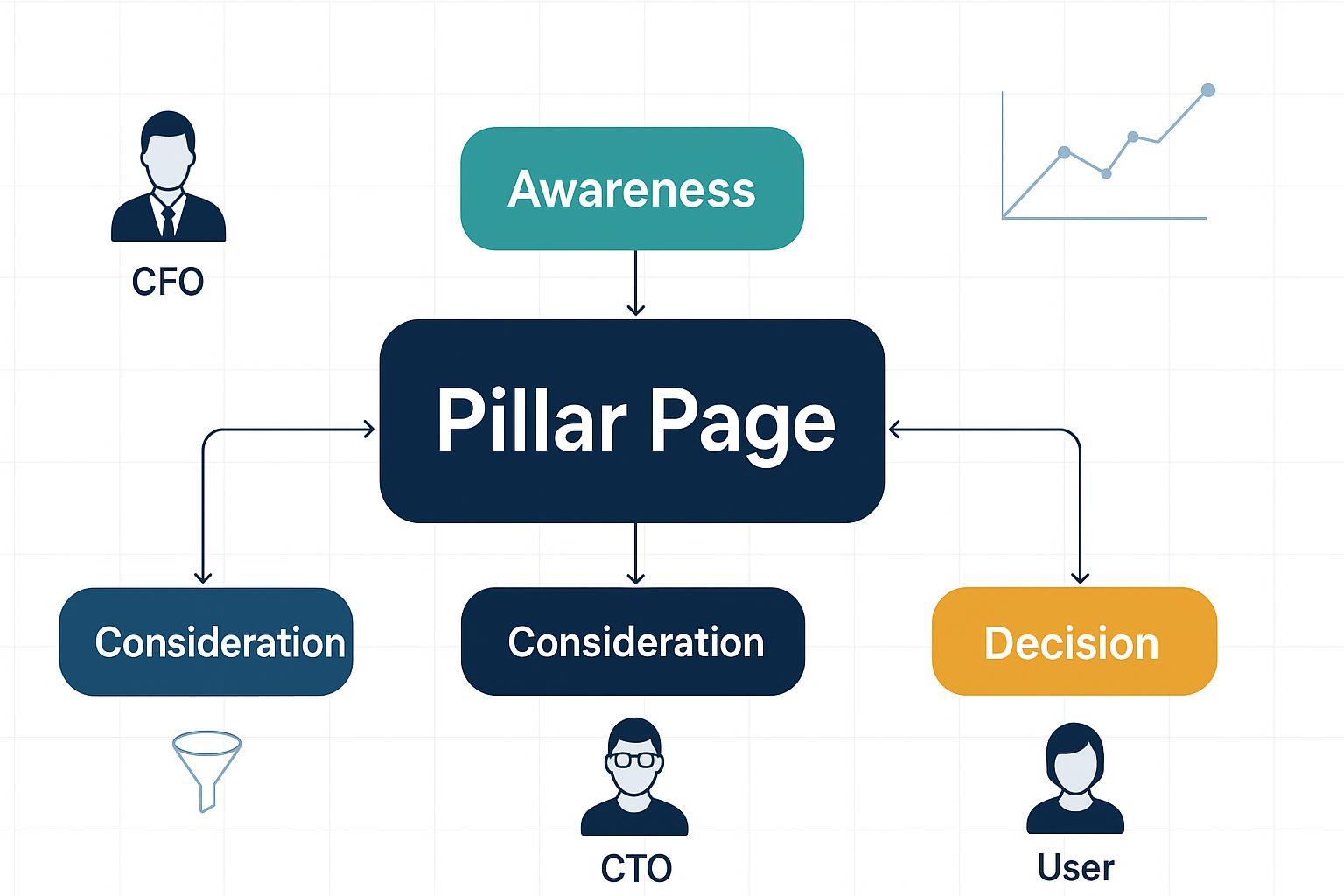
If your organic strategy feels scattered, topic clusters give you a durable structure that wins rankings, educates buying committees, and moves pipeline. Think of a cluster like a major airport hub: one central terminal (your pillar page) efficiently routes people to specialized gates (your subtopics) and back again. The result is clearer site architecture, stronger topical authority, and a smoother path from search to sales.
What a Topic Cluster Is—In B2B Terms
A topic cluster is a group of interlinked pages that cover a single business-critical theme from multiple angles. It starts with a comprehensive pillar page and extends to subtopic pages that address distinct intents (awareness, consideration, decision) and personas (economic buyer, technical evaluator, daily user). This isn’t just an SEO trick; it’s how you turn search demand into a teachable curriculum that aligns with your sales process.
For the canonical definition and model, see Semrush’s explanation of pillar-and-cluster structures in the topic clusters for SEO (updated 2025). On internal links—the connective tissue of clusters—Google emphasizes crawlable links and descriptive anchor text in its Links best practices (2025).
The 5‑Phase B2B Cluster Blueprint
1) Research and Audit
Start with what you have and what your market needs.
- Inventory current content by topic, intent, and persona. Note URLs, performance, duplicates, and gaps.
- Interview sales, solutions engineers, and CSMs for real buyer questions and objections. Your best “keywords” often live in Gong calls and CRM notes.
- Validate demand and intent using keyword/topic tools. Use the industry model as a reference point, then tailor it to your funnel; for background, Google’s refreshed SEO Starter Guide reiterates people-first content and findable structure.
Output: a shortlist of 3–5 pillar candidates that could each support 15–30 subtopics across the buyer journey.
2) Design and Mapping
Translate research into an architecture you can execute.
- Pick one pillar to start. Criteria: high business value, strong search breadth, clear differentiation, and internal SMEs available.
- Draw the cluster map: label subtopics by intent (Awareness/Consideration/Decision) and by stakeholder (CFO, CTO, User). Define internal link targets and the anchor text you’ll use between pages (keep anchors descriptive, not generic “click here”).
- Decide URL patterns and on-page elements (H1/H2, FAQs, schema where relevant). Plan the first wave: the pillar plus 3–5 high-impact subtopics that answer the most common questions and comparison needs.
A simple buyer‑journey overlay might look like this:
| Stage | CFO (Economic) | CTO/Architect (Technical) | User/Manager (Operational) |
|---|---|---|---|
| Awareness | Business case, risk of status quo | Integration approach, security lens | Pain points, workflow gaps |
| Consideration | ROI model, payback assumptions | Architecture fit, APIs, performance | How‑to guides, evaluation criteria |
| Decision | TCO, vendor viability | Implementation plan, SLAs | Rollout checklist, training |
3) Produce and Optimize
Ship deliberately and build momentum.
- Relaunch or publish the pillar first. It should define the topic, provide navigation to all subtopics, and answer executive-level questions with clarity.
- Publish the first 3–5 cluster articles in quick succession. Each should fully satisfy a distinct intent and link back to the pillar and to sibling pages when relevant.
- Optimize with semantic coverage tools and on-page best practices. Use clear headings, concise summaries, and internal links in body copy and “Further reading” areas. Add FAQs and appropriate structured data when it supports richer SERP features.
4) Launch and Promote
Align publication with campaigns and sales motions.
- Pair each new subtopic with enablement: talk tracks, email snippets, and a short Loom walkthrough for reps. That ensures your cluster content gets used, not just crawled.
- Pitch linkable assets (original research, calculators, or implementation templates) to relevant industry publications. Quality backlinks to the pillar lift the entire cluster.
- If you run webinars or events, map topics to cluster pages and vice versa so every campaign reinforces the hub.
5) Measure and Iterate
Treat the cluster as a system, not a pile of posts.
- In GA4, create a custom dimension (e.g., content_group or cluster_id) and pass it with page_view events to analyze performance by cluster. See Google’s custom dimensions documentation for GA4 for setup.
- In Search Console, review internal linking health and identify underlinked or orphaned assets using the Links report; Google’s Internal links help page explains how to evaluate this.
- Track KPIs at the cluster level: impressions and average position across the cluster’s keyword set; pages per session within the cluster; CTA clicks and form fills from cluster pages; influenced pipeline sourced from those CTAs.
- Refresh quarterly: expand FAQs, add new subtopics uncovered by sales, and update the pillar with concise summaries and links to the newest articles.
Two Mini Case Studies (With Transparency)
-
GenerateMore (B2B SaaS) restructured its site around pillars and clusters and reported a 22× increase in organic traffic over 12 months. The firm attributes a substantial revenue impact to this shift. See the team’s write‑up: B2B SaaS SEO case study (2024). Caveat: vendor-published; pipeline metrics aren’t fully broken out, and other SEO improvements likely contributed.
-
ContentVisit’s cybersecurity client built a pillar page plus tightly interlinked subtopics and grew from 77 to 808 ranking keywords in roughly a year; the pillar ranked for 148 keywords. Details here: B2B cybersecurity SEO case study (2023). Caveat: client is anonymized; traffic and lead data are summarized rather than fully detailed.
What should you take from these? Clusters correlate with better coverage, higher visibility, and compounding gains when combined with technical and link improvements. But be honest about attribution and measure clusters as systems.
ABM Overlays and International Scale
Buying groups aren’t monolithic. Layer ABM into your cluster plan so content lands with each stakeholder and top accounts.
- Personas and buying groups: tailor intros, examples, and CTAs by persona and industry. Decision‑stage content like implementation plans and ROI models should feel bespoke for your tier‑1 accounts, while programmatic assets can scale with modular sections.
- Sales alignment: codify common objections and evaluation criteria in briefs for BOFU assets (comparisons, integration guides, rollout checklists). That shortens cycles and improves enablement.
- International: when expanding, localize—not just translate—your pillar and the most important subtopics. Implement hreflang and keep your internal links clear between regional variants per Google’s guidance on localized versions and hreflang. Build region‑specific examples and compliance notes into each relevant page.
Common Pitfalls (and How to Avoid Them)
- Launching too many pillars at once. Result: thin coverage and weak internal signals. Fix: focus on one pillar until it has 10–15 solid subtopics and meaningful interlinking.
- Generic anchors like “read more.” Result: bots (and humans) miss the context. Fix: use descriptive anchors that match the subtopic’s promise, aligned with Google’s link guidance.
- Pillars that read like bloated glossaries. Result: high pogo‑sticking. Fix: write for executives, link out for depth, and keep summaries crisp.
- No analytics grouping. Result: you can’t prove ROI. Fix: tag every page with a cluster_id and build GA4 and GSC views around it.
A 90‑Day Starter Plan
Weeks 1–4: Research and selection Interview sales/CS, mine CRM notes, and review call transcripts for buyer questions. Audit your content and shortlist 2–3 pillar candidates. Choose one based on business value and search breadth. Draft the pillar outline and map 15–20 subtopics by intent and persona.
Weeks 5–8: Build and launch the foundation Publish or relaunch the pillar with clear navigation and executive‑level summaries. Ship the first 3–5 subtopics that answer the most common questions or comparisons. Add contextual internal links with descriptive anchors. Enable reps with short summaries, talk tracks, and email snippets for each new page.
Weeks 9–12: Promote, measure, and iterate Secure at least two quality backlinks to the pillar via PR or partner content. Configure GA4 with your cluster custom dimension and set up a Search Console view filtered to the cluster. Review early KPIs (impressions across the keyword set, pages per session within the cluster, CTA clicks) and prioritize the next 3–5 subtopics based on gaps and sales input.
Helpful References and Deep Dives
- Semrush’s definition and framework: Topic clusters for SEO (2025)
- Google’s guidance on internal links: Links best practices (2025)
- GA4 setup for content grouping: Custom dimensions in GA4
- Evaluating internal links in Search Console: Internal links report
Ready to bring order to your content and prove business impact? Start with one pillar, build a tight first wave of subtopics, wire up measurement, and let the internal links do quiet, compounding work. Then ask yourself: which buying group question deserves the next gate at your hub?